Discover Riding Stables & Horse Farms around Kassel
Discover Riding Stables & Horse Farms around Kassel
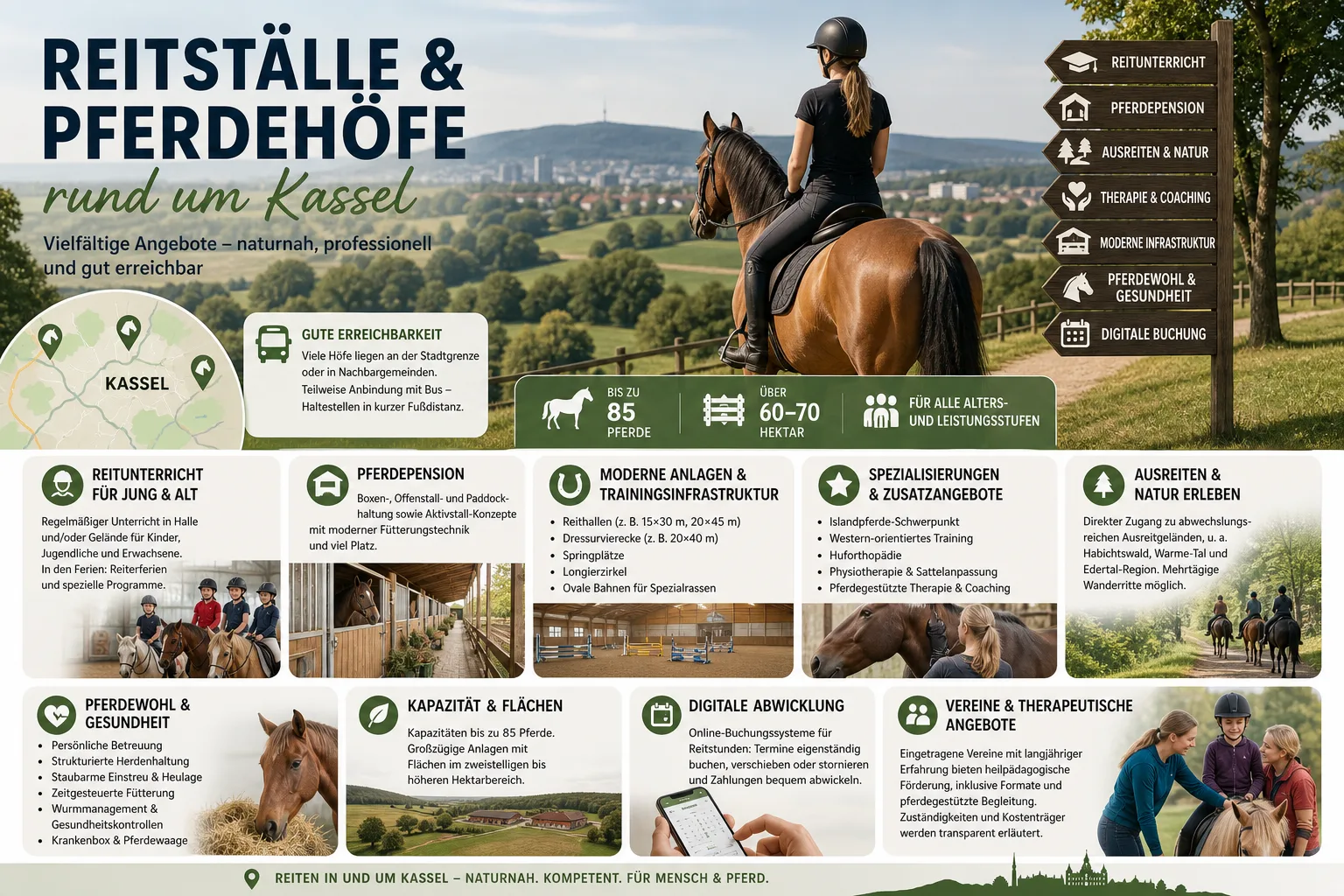
This guide shows what offers you can expect around Kassel in the future: riding lessons (children to adults), horse boarding (box, open stable, active stable), training infrastructure, riding areas such as Habichtswald and Warme Valley, as well as equine-assisted and inclusive formats. The goal is a safe, well-informed decision – for humans and horses.
Riding Lessons in Kassel: From First Grooming to Gallop
Around Kassel, riding schools will continue to offer a wide range in the coming seasons: first pony encounters for children, systematic lessons for teenagers, as well as riding lessons for adults with or without prior experience. Depending on the facility, sessions can take place in the riding hall, on the outdoor arena, and – if suitable – in the countryside.
If you are starting out, lunge lessons (with the horse on the lunge line) will often be a safe entry: seat, balance, and influence can develop steadily before you switch to group lessons. Advanced riders will usually find formats for dressage, jumping, pole work, or groundwork.
- For families: Riding holidays, vacation courses, or project days are typically booked out early; making an early inquiry will give you planning security.
- For returnees: Many facilities will offer assessment lessons so that horse-human pairings and skill levels can be realistically evaluated.
- For ambitious goals: If you have competition or badge plans, you will want to ask about trainer qualifications, lesson structure, and arena times.
Horse Boarding around Kassel: Box, Open Stable or Active Stable
If you want to board your own horse in the Kassel area in the future, you will generally be able to choose between several housing and service concepts: classic box keeping, open stable/paddock keeping, as well as structured herd concepts (e.g. active stable). In technically equipped systems, individual feeding via chip- or transponder-based solutions may be possible – depending on the stable concept and management.
What you can pay attention to when choosing
- Roughage & Feeding: What roughage quality is offered, how are feeding breaks avoided, and how are special needs (e.g. metabolism, respiratory tract) organized?
- Exercise & Social Contact: How many hours of turnout are realistic, what is the herd composition, and how is turnout/rotation managed?
- Hygiene & Dust Management: Bedding, ventilation, manure management, and storage influence stable climate and respiratory health.
- Health and Emergency Procedures: How are injuries noticed, what vet/farrier processes are established, and how are medications or special services documented?
- Transparency: Are services, additional costs, and communication channels clearly described (e.g. stable rules, service lists, digital updates)?
For professional assessment of housing and horse welfare, you can refer to recognized guidelines (see sources at the end). This way, you can conduct conversations with facilities in a targeted manner – without tying unrealistic expectations to a single concept.
Riding Facilities, Riding Halls and Training Grounds: Infrastructure with Many Faces
Many riding stables around Kassel will in future provide infrastructure that supports both leisure and sport-oriented riders. Common are riding halls, outdoor arenas, as well as areas for lunge work and groundwork. Depending on the focus, additional special training opportunities (e.g. jumping courses, cross-country obstacles, trail elements, or breed-specific tracks) may be available.
When comparing offers, these questions will help you:
- Weather and Seasonal Suitability: What times are realistic in the hall, and how are surfaces maintained?
- Safety: Are there clear rules for arena/field use, helmet and safety standards, as well as separate areas for lessons and free riding?
- Quality Network: Are (as needed) saddlers, physiotherapists, hoof care, or training support transparently referred, without pressure to use them?
To ensure the well-being of horse and rider in the long term, a trial appointment with a view to ground conditions, stable climate, tone of interaction, and clear procedures is often more revealing than pure online information.
Riding Out near Kassel: Habichtswald, Warme Valley & More
If you want to ride out around Kassel in the future, you will find a variety of landscapes in the region. Especially the Habichtswald will remain attractive for many riders, as forest paths, ridges, and open sections can offer varied routes. The Warme Valley will also be interesting for quiet trail rides, depending on route choice, weather, and right of way.
This is how you will start out (more) safely in the countryside
- Requirements: For guided rides, providers will usually expect a secure basic seat at walk and trot; gallop portions will often depend on weather, group, and route profile.
- Planning: Ask about route length, traffic contact, group size, rules for oncoming traffic, and emergency plan.
- Equipment: A helmet will be standard in reputable offers; depending on the ride, a safety vest, weatherproof clothing, and reflective elements may be useful.
If you want to ride out without your own horse, riding schools will occasionally offer suitable formats with school horses. Trail training (e.g. "Safe in the Countryside", "Calmness", "Spook Training") can help you realistically manage risks.
Equine-Assisted, Therapeutic and Inclusive Offers
Around Kassel, you will likely continue to find equine-assisted formats that go beyond classic riding lessons: educational support, inclusive group offers, or therapeutically oriented measures. Such offers are usually managed by appropriately qualified professionals and can use different methods depending on the target group.
Quality & Safety: Questions You Can Ask
- Qualification: What professional training (educational/therapeutic) and what equine-related qualification is present?
- Goal & Procedure: What goals are realistic, how is documentation handled, and how is data protection managed?
- Suitability: How are horses selected, how is workload managed, and how is safety (aids, accessibility, assistance) organized?
Note: Equine-assisted offers cannot automatically replace medical or psychotherapeutic treatment. If you are pursuing health goals, coordination with treating professionals before starting will be advisable.
Location, Accessibility and Digital Organization of Riding Stables
Some riding stables will be located a short distance from the city of Kassel, others in the surrounding area. For your planning, it will be worthwhile in the future not only to look at distance, but also at realistic travel times during peak hours, parking options, and – if relevant – connection to public transport.
At the same time, some facilities will further digitize their organization: online booking, digital waiting lists, automated payment processes, or information channels for arena occupancy and course schedules can make getting started easier. If reliability is important to you, clear cancellation and make-up rules as well as transparent communication about substitutes will be crucial.
Outlook: How the Riding Scene around Kassel May Develop Further
In the coming years, it can be expected that offers around Kassel will continue to combine two goals: plannable services (lessons, boarding, training) and measurably more focus on horse welfare, safety, and transparency. Technology-supported stable processes, structured housing models, and digitally organized course schedules can help – provided they are consistently oriented towards the well-being of horse and human.
If you are looking for a suitable facility soon, a structured on-site visit will remain crucial: Observe the tone of interaction, safety culture, condition of the facilities, feeding and turnout reality, as well as the quality of answers to your questions. This way, you can make a decision that will last in the long term.
Sources (Selection)
- German Equestrian Federation (FN) / FNverlag — Specialist information on riding theory, horse keeping and training (accessed 2026-09-30)
- Federal Ministry of Food and Agriculture (BMEL) — Information and framework conditions on animal husbandry and animal welfare in Germany (accessed 2026-09-30)
- Laws Online: Animal Welfare Act (TierSchG) — Legal basis for the protection of animals (accessed 2026-09-30)
- DIN — Standards and norms (including for safety and quality processes, depending on the application) (accessed 2026-09-30)