Events on Democracy & Contemporary History in Kassel
Events on Democracy & Contemporary History in Kassel (Preview for 2026)
How does the perspective on a city change when you get to know it not only through its streets, but through its debates, places of remembrance, and educational opportunities? In Kassel, there will again be a wide range of opportunities in the coming weeks and months to combine democracy education and contemporary history: in lecture halls, archives, urban spaces, and during civil society action days.
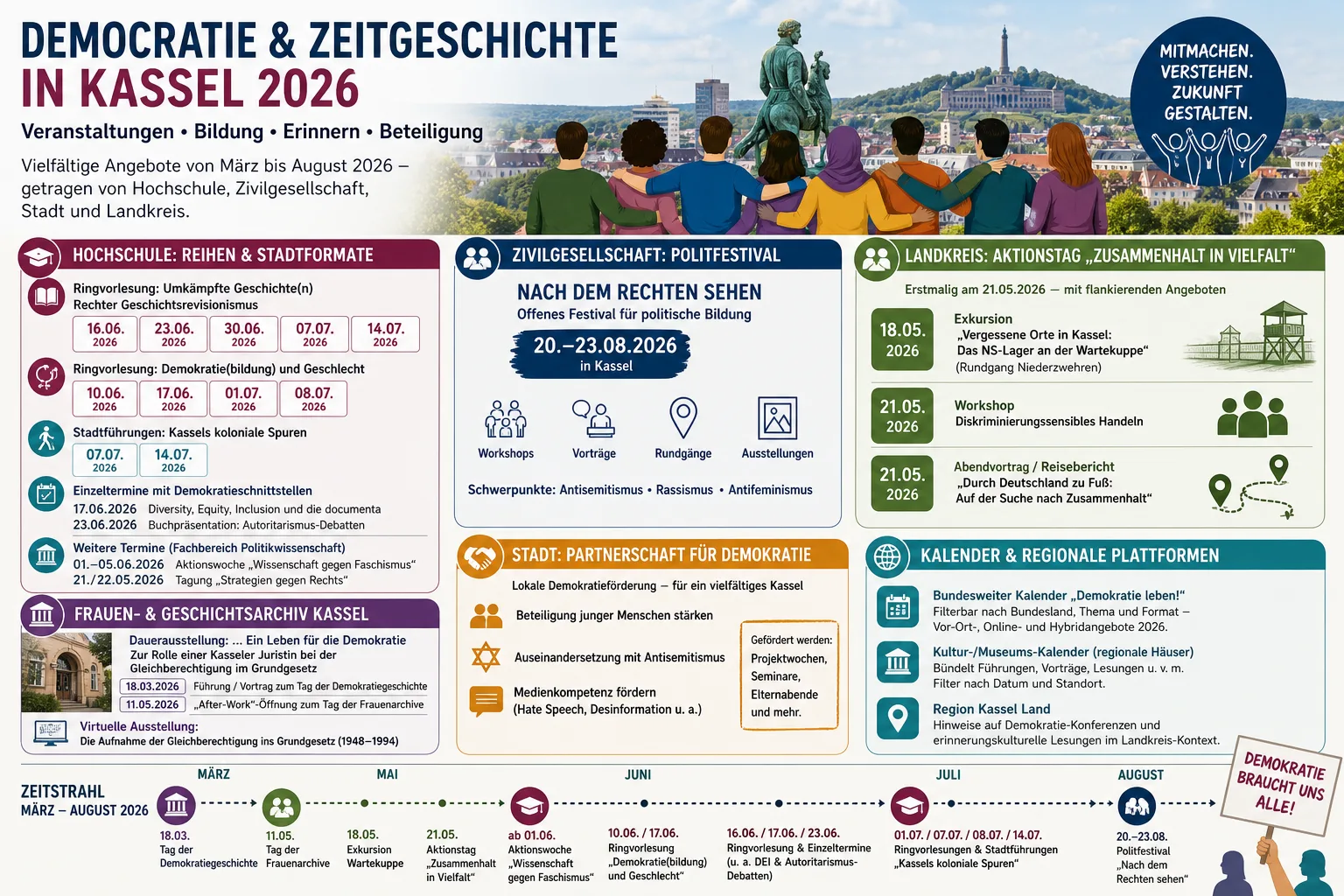
University Series: Democracy & Contemporary History in the Lecture Hall
If you want to get started with current debates at a low threshold, public lecture series at the university are a reliable starting point: Many dates are free of charge, are explicitly aimed at non-students as well, and offer space for questions afterwards. For the summer and winter semester 2026, formats are typically announced in Kassel that deal with the following topics:
- Dealing with Historical Revisionism and Disinformation (e.g. strategies of far-right actors, attacks on remembrance culture, counter-strategies)
- Democracy Education & Gender Justice (e.g. participation, exclusions, gender-based violence, political education in schools and youth work)
- Antisemitism, Racism, and Group-Focused Enmity (analysis, prevention, courses of action)
- Authoritarianism & Democratic Resilience (institutions, civil society, media literacy)
Practical tip for 2026: In announcements, pay attention to whether the events are designated as lecture series, public lecture, or specialist day. Often, registration is only required for workshops, while lectures can be attended without registration.
City Tours & Critical City Walks
If you prefer to understand contemporary history "on site," thematic walks are a strong complement to lectures. For 2026, many cities (and typically also Kassel) offer formats that tie democracy issues to specific places: street names, monuments, administrative buildings, former industrial or camp sites, places of Jewish life, and sites of political confrontation.
Common thematic focuses you can look for in Kassel in 2026
- Colonial Traces & Postcolonial Perspectives: Walks that bring together global power relations and local remembrance policy.
- Nazi Era & Aftermath: City history, persecution, resistance, continuities after 1945, and forms of commemoration.
- Democracy in Everyday Life: Places of civil society, freedom of the press and assembly, local political participation.
Good walks are dialogical: They not only provide information, but open up questions (e.g. how remembrance is made visible in public space, how city societies deal with problematic names, or how affected perspectives are included). For visitors, a walk can often be sensibly combined with a subsequent lecture, reading, or exhibition visit.
Political Festivals & Action Days
In addition to universities, civil society initiatives shape the program in Kassel (as in many cities): Multi-day political festivals, theme weeks, and action days bundle workshops, discussion rounds, and creative formats. For 2026, particularly common focuses are:
- Strategies Against Right-Wing Extremism (education, prevention, counseling services, local networks)
- Dealing with Hate Speech & Conspiracy Narratives (action strategies, reporting structures, self-protection)
- Solidarity & Cohesion in Diversity (empowerment, allyship, local conflict resolution)
Many of these formats are explicitly designed for beginners: You don't need prior knowledge, but above all the willingness to listen, ask questions, and tolerate different perspectives. If you come with a group (school class, club, youth group), early registration is worthwhile: Workshops are often booked out faster than lectures.
Archives & Exhibitions: Local Perspectives on the History of Democracy
Those who want to explore the history of democracy concretely and source-based will find particularly dense learning spaces in archives, collections, and exhibitions (on site and digitally). For 2026, the following event formats are typically to be expected in such institutions:
- Public Tours (through permanent or special exhibitions with a contemporary history reference)
- Readings & Discussion Evenings (biographies, local research, remembrance work)
- Workshops (e.g. working with sources, family and local history, methods of political education)
A look at local biographies is particularly rewarding: They make visible how nationwide developments (e.g. equality, fundamental rights, democratic institutions) were shaped by people on site. If an institution offers virtual exhibitions, you can also prepare specifically before a visit and deepen topics afterwards.
Partnership for Democracy & Local Educational Projects
For democracy education not to consist only of individual events, structures are needed that enable projects in the long term. Municipal funding and coordination offices (such as a "Partnership for Democracy") usually support local initiatives, network actors, and make new formats visible. For 2026, frequently funded and supported project types are:
- Projects with Young People (media literacy, participation, democracy workshops)
- Further Training for multipliers (schools, youth work, clubs)
- Dialogue Formats in Districts (coexistence, conflict resolution, participation spaces)
If you have your own idea (e.g. workshop series, exhibition, theater project, discussion format), it is worth looking at funding information and deadlines: Many programs work with fixed application windows, and early advice increases the chances of success.
Calendar & Planning: How to Find Suitable Offers for 2026
Because specific dates, locations, and registration deadlines can change, a simple routine is the most reliable for planning 2026: Check calendars, use filters, read details before participating (location, time, language, accessibility, registration).
Proven Points of Contact
- "Living Democracy!" Program: use the official event calendar and filters (region, topic, format).
- University/university-related event pages: here, lecture series, public lectures, conferences, and workshops are bundled.
- Municipal event and culture calendars: helpful for tours, readings, museums, and discussions in the city.
- Newsletters & social media channels of the participating institutions: often the fastest hints for additional dates or room changes.
Practical Search Terms
For Kassel and the region, keywords such as: democracy, remembrance, contemporary history, antisemitism, racism, hate speech, colonial, right-wing extremism, media literacy, workshop, walk often work in 2026.
Why Kassel's Democracy Offers Are More Than Just Dates
These events are not "additional culture," but lived democratic infrastructure: They create spaces where people can check information, practice changing perspectives, and negotiate conflicts without immediately forming fronts. Especially in times of disinformation and polarization, political education becomes effective in everyday life: in schools, clubs, cultural institutions, neighborhoods, and at the workplace.
If you want to participate in 2026, you don't have to be perfectly prepared. A good start is often a public lecture or a thematic walk – and then a conversation, a follow-up question, or subscribing to a newsletter to stay involved.