Discover Regional Cuisine & Slow Food in Kassel
Regional Cuisine & Slow Food in Kassel (2026/2027): How to Consciously Plan Future Culinary Experiences
In Kassel, you can plan your next restaurant visits, market strolls, and excursions so that they align with Slow Food values: good, clean, fair. This guide helps you recognize upcoming opportunities, ask targeted questions, and interpret the right signals for artisanal quality.
What Slow Food Practically Means for Your Next Kassel Visits
Slow Food is not just an idea for enjoyment, but a concrete framework for your upcoming decisions: Where does the ingredient come from? How was it produced? And who benefits along the chain?
- Good: Taste, maturity, craftsmanship (e.g., real fermentation/maturation instead of "quickly flavored").
- Clean: Production that conserves resources as much as possible, seasonal thinking, less waste.
- Fair: Transparent prices, respectful treatment of labor, animal husbandry, and businesses.
For the coming months, this means: You don't have to shop or eat out "perfectly." But you can consistently look for transparency—and favor businesses that provide it voluntarily.
How to Plan Upcoming Restaurant Visits in Kassel (Without Marketing Traps)
If you want to eat regionally in Kassel in the future, the menu is just the beginning. When choosing (online or on-site), look for clues that can be verified.
Checklist for Your Next Reservation
- Seasonal Logic: Does the menu seem to change throughout the year (asparagus/mushroom/pumpkin seasons, etc.)?
- Supplier Mention: Are farms, butcheries, bakeries, or cheese dairies named (at least category/region, ideally name)?
- Craftsmanship Signals: Homemade stocks/sauces, in-house bread, fermentation/pickling, maturation.
- Less is More: A smaller menu can be a sign of fresh processes (not proof, but a good indication).
- Allergens & Additives: Transparent labeling often indicates clean processes.
Short Questions That Will Give You Immediate Clarity (in the Future)
- "Which farm does the meat/cheese/vegetables currently come from?"
- "Is this a seasonal product from the region or available year-round?"
- "Are convenience components used here, or are the sauce/broth made in-house?"
A business that lives Slow Food values usually answers such questions calmly and concretely—without evasion.
Recognizing Regional Classics: Signals for Origin, Craftsmanship, and Maturation
Northern Hessian cuisine is often associated with hearty classics. If you want to specifically try regional specialties in the coming months, you can look for quality features—without having to rely on buzzwords.
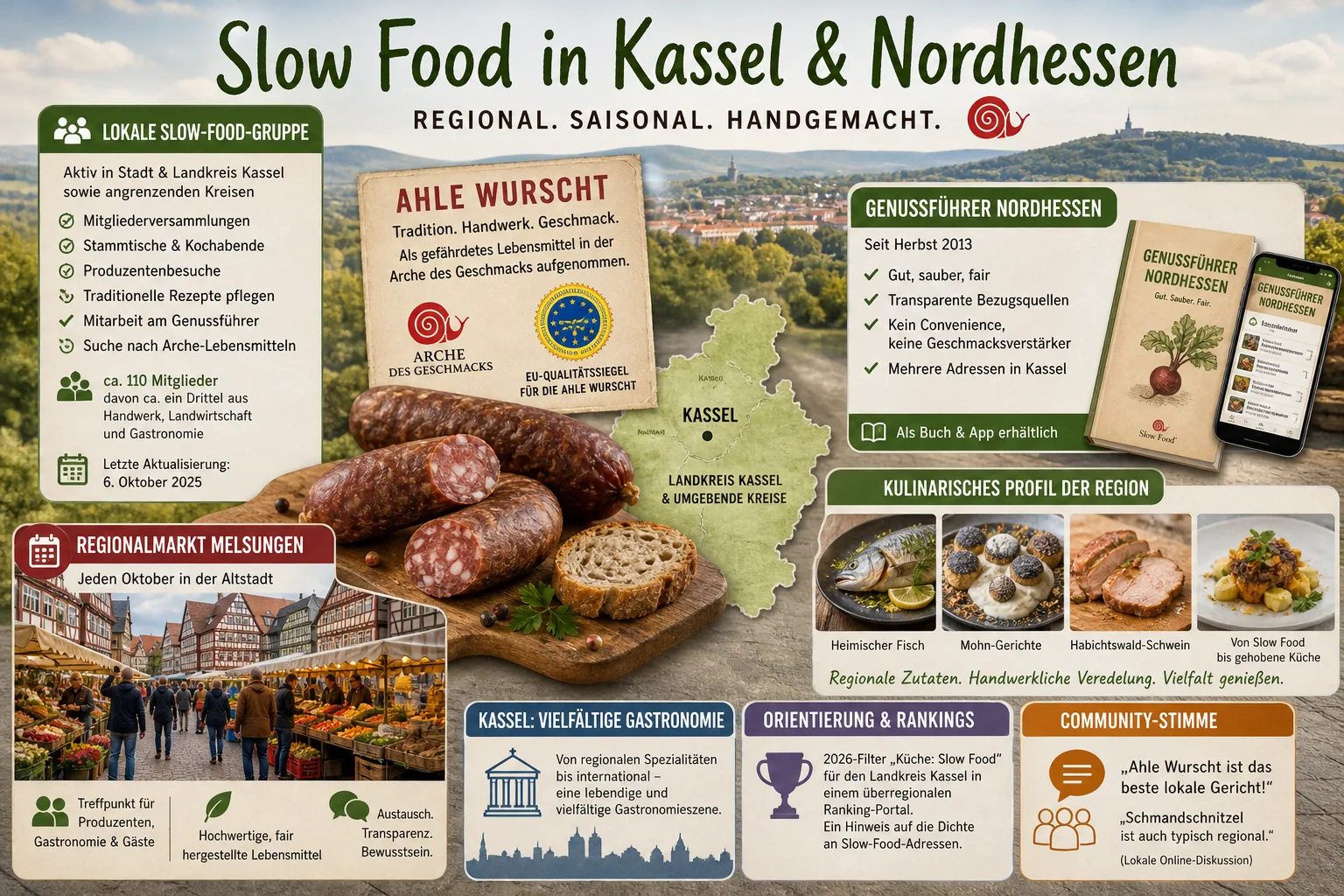
Example: Raw Sausage & Long Maturation (e.g., "Ahle Wurscht" as a search term)
For traditionally matured raw sausages, these points are relevant for your next purchase/restaurant visit:
- Maturation Time & Drying: Slow maturation typically results in a firmer texture and more complex aroma.
- Artisanal Processing: Clear information about recipe/production (e.g., smoking, storage) is a good sign.
- Origin: The more precisely region and business are named, the better you can compare.
If you are looking for products considered as protected culinary heritage: Slow Food operates the “Ark of Taste”, a publicly accessible collection. For your future planning, you can check there which products are documented and how they are described.
Reading EU Quality Seals Correctly (for Your Next Purchase)
If you shop in Kassel or Northern Hesse in the future, EU quality seals can provide orientation—if you interpret them correctly:
- PGI (g.g.A.): At least one stage of production is tied to a region.
- PDO (g.U.): Production, processing, and preparation are tied to the region.
- TSG (g.t.S.): Traditional composition/production, not necessarily regionally bound.
Important in practice: A seal does not replace a conversation—but it can give you a reliable, standardized basis for your next decisions.
Markets & Excursions Around Kassel: What to Look Out for at Future Events
For the coming months, it is worthwhile to include places in the surrounding area in addition to Kassel—especially when markets, producer days, or culinary action days are announced there. To ensure such events are truly "Slow Food" for you, these criteria help:
- Direct Contact: Are producers personally present (instead of just resellers)?
- Transparency at the Stand: Origin, ingredient lists, and production methods are clearly communicated.
- Tasting with Explanation: Good vendors explain maturation, varieties, feeding, or cultivation—not just "tastes good."
- Seasonal Offer: The assortment reflects the season.
If you are planning a trip to Melsungen or other Northern Hessian towns: In the future, check the official city/event calendars and the announcements of local initiatives shortly before your trip. This way, you avoid disappointment due to schedule changes and can specifically choose the days when producers are really present.
Enjoyment Guides & Lists: How to Use Them Sensibly in the Future
Enjoyment guides, apps, and curated lists can greatly simplify your next stays in Kassel—if you use them as a starting point, not as a final judgment.
This Is How You Proceed Strategically in the Coming Weeks
- Preselection: Mark 5–10 suitable addresses by location, cuisine, and price range.
- Double-check: See if the businesses name their supply chains/partners or at least cook regionally and seasonally plausibly.
- Contact: Briefly ask which regional products are currently in focus (quality of response is a signal).
- Verify on Site: Look for clear statements in the service and for seasonal changes.
This way, a list becomes a tool that reliably helps you achieve better quality in the future.
Eating Fairly: Questions You Can Really Ask in the Coming Months
"Fair" remains abstract until you apply it in everyday life. These questions work particularly well for your next purchase or restaurant visit in Kassel because they are concrete and do not trigger fundamental debates:
- Payment & Value: "Why does this dish/product cost this much—what goes into its production?"
- Animal Welfare/Production: "What type of husbandry is this currently, and is it documented?"
- Transport & Season: "Is there a regional alternative if the product is not seasonal?"
- Food Waste: "How do you handle trimmings/leftovers—are there daily specials or preservation/fermentation kitchens?"
This supports businesses that can reliably explain what they do—and you can more quickly recognize where regionality is just a label.
"Good, clean, and fair food is not recognized by superlatives, but by understandable decisions—and by the willingness to make them transparent."
Sources
- Slow Food International – Basic Idea & Values — Background on "good, clean and fair" (accessed 2026-08-12)
- Slow Food Germany — Information on projects and regional engagement (accessed 2026-08-12)
- Slow Food – Ark of Taste — Public directory of protected foods as a verification tool (accessed 2026-08-12)
- European Commission – EU Quality Systems Explained — PDO, PGI, TSG (accessed 2026-08-12)