Urban Transformation in Kassel: New Neighborhoods & Projects
Urban Transformation in Kassel: New Neighborhoods & Projects Set to Shape the Coming Years
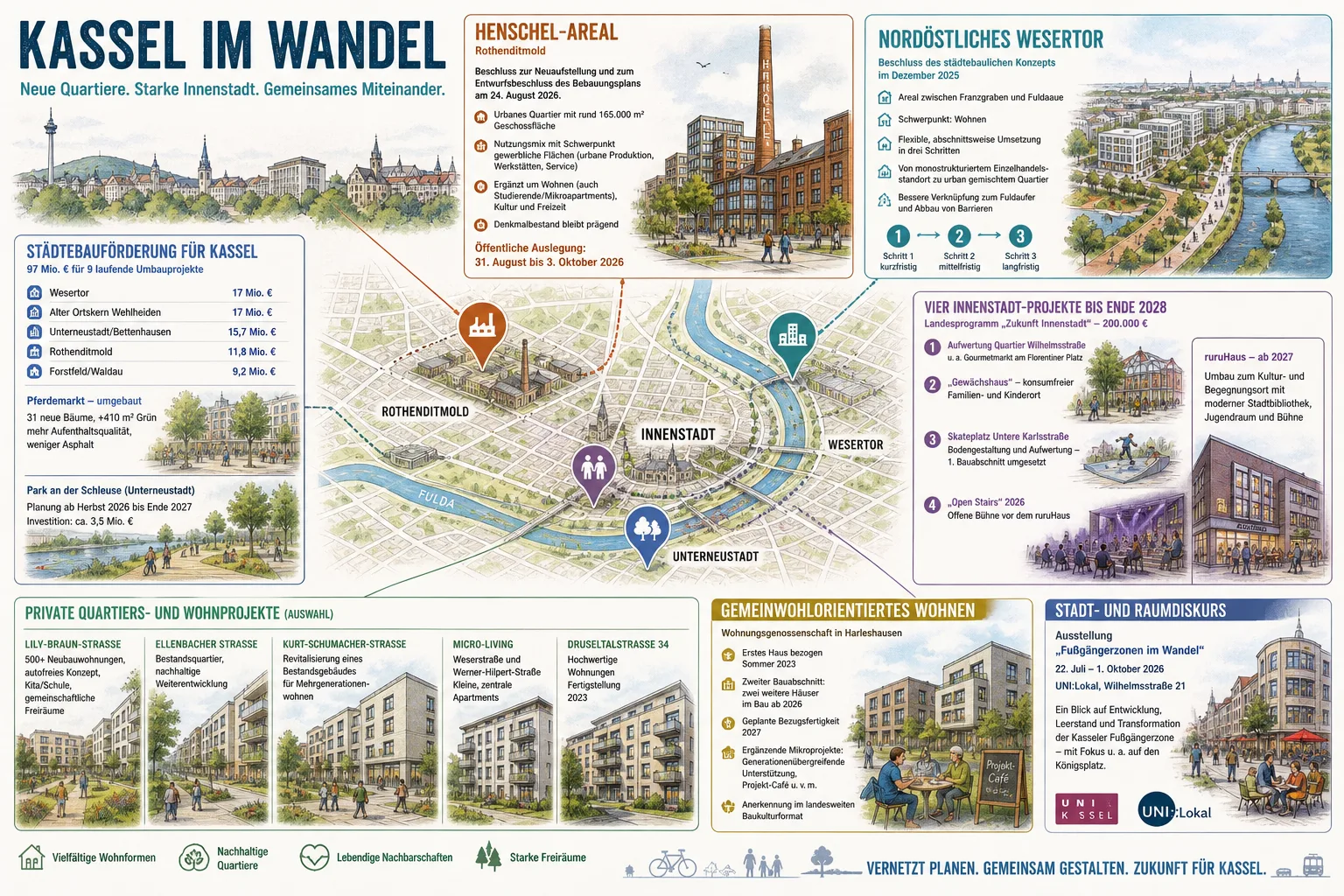
Several major urban development projects are underway in Kassel, aiming to transform industrial and transport areas into mixed-use neighborhoods while opening up new avenues for living, working, culture, and open spaces. This overview summarizes the most important initiatives that are likely to be particularly influential in the coming years—with a focus on the Henschel site, northeastern Wesertor, urban development funding areas, downtown impulses, and new forms of housing.
Henschel Site: From Factory Gate to Urban Neighborhood (in Planning)
Along Wolfhager Straße (Rothenditmold district), one of Kassel's largest neighborhood projects is planned for the Henschel site. The basis for this will be an updated development plan that enables the transformation from an industrially dominated location to a mixed-use urban building block.
A scale of around 165,000 square meters of gross floor area is planned for the development. The mix of uses is deliberately intended to be diverse: a focus on commercial (including urban production, workshops, services, and service areas), supplemented by residential construction (affordable multi-story housing), micro-apartments, and student housing. Cultural and leisure offerings are intended to activate the area outside of traditional working hours as well.
A central goal of the planning is to keep the industrial heritage visible: listed or identity-defining existing buildings are to be integrated where planned, so that the history of the site remains legible in the new neighborhood.
In terms of urban design, the area is intended to function as an open, interconnected neighborhood. Short distances, lively ground floor zones, and good connections to the Rothenditmold district and towards the city center are planned. The project is thus intended to support both new workplaces and additional housing in a well-connected location.
Northeastern Wesertor: Rethinking Living by the Water (Phased Development)
Between the city center, Franzgraben, and Fuldaaue, the northeastern Wesertor is to be gradually developed from large-scale retail and parking structures into an urban mixed, predominantly residential neighborhood. Implementation is to take place in phases so that development can respond to needs, market conditions, and insights from the initial construction phases.
The focus is on creating new apartments of various sizes—suitable for singles, families, and older people. In addition, ground floor spaces are to provide room for small-scale businesses, services, social offerings, or neighborhood-related infrastructure.
A key issue is the better opening to the Fulda riverbank. New pathways, squares, and green corridors are intended to improve the transition to the Fuldaaue, remove barriers, and thus enable new quality spaces by the water. In this way, an urban building block could emerge that connects the city center and landscape more closely.
Urban Development Funding: Investments Set to Shape Kassel's Districts for Years to Come
In addition to large conversion and new construction areas, funds from urban development funding are to further develop several Kassel districts. Public communications mention a total of around 97 million euros for nine funding areas. The objectives include climate-adapted street spaces, new or upgraded open spaces, stronger centers in the districts, and social infrastructure.
The following priority budgets are mentioned: Wesertor and Wehlheiden (old town center) with around 17 million euros each, Unterneustadt and Bettenhausen together with around 15.7 million euros, Rothenditmold with around 11.8 million euros, and Forstfeld and Waldau together with around 9.2 million euros (according to published program and city information).
Concrete redesigns are primarily aimed at more greenery, better quality of stay, and more usable public spaces. Examples that typically play a role in planning and program documents include the redesign of squares and street spaces (including more tree plantings and unsealed surfaces) as well as the upgrading of parks and riverbank areas along the Fulda.
Downtown in Transition: Culture, New Uses, and Enhanced Quality of Stay (by the End of the Decade)
Several projects are intended to strengthen Kassel's city center as a meeting place, cultural venue, and everyday living space. Planning often mentions implementation by the end of the decade.
Wilhelmsstraße & Florentiner Platz: Culinary Delights and Urban Space
Around Wilhelmsstraße, measures to improve quality of stay and new formats are intended to strengthen the connection between retail, gastronomy, and public space—for example, through markets or culinary offerings on central squares.
“Greenhouse”: Consumption-Free Place for Families and Children
A consumption-free place to stay (“Greenhouse”) is intended to give families, children, and neighborhoods space to meet and spend time in the city center without being tied to consumption. Such offerings are considered an important building block for making city centers more resilient and social.
Skate Facilities & Youth Spaces: Downtown as Everyday Space
The further upgrading of movement and youth areas (for example, skate facilities) is intended to help ensure that the city center is not just a shopping destination, but also remains attractive for younger target groups.
“Open Stairs” & ruruHaus Surroundings: Stage for Urban Life
“Open Stairs” on Treppenstraße are intended to serve as an open stage and, together with a cultural and meeting place (with elements such as a city library, youth offerings, and event spaces), make city life more visible and diverse.
In addition, exhibitions and discussion formats—from the university environment, for example—are intended to accompany and publicly negotiate the structural transformation of pedestrian zones, new usage ideas, and the handling of vacancies.
New Living in Kassel: Car-Free Neighborhoods, Micro-Living, and Further Development of Existing Stock (Planned Developments)
In addition to the large urban spaces, numerous housing projects are intended to reflect different housing needs—from largely car-free neighborhoods to the development of existing stock and compact downtown apartments.
Car-Free or Low-Car Neighborhood (Lily-Braun-Straße)
For the residential neighborhood on Lily-Braun-Straße, project descriptions mention the development of more than 500 new apartments with a largely low-car concept. Parking spaces are to be bundled, while pedestrian and bicycle paths, play areas, and green spaces are given more room. Integrated social infrastructure (such as childcare and community spaces) is intended to enable short everyday distances.
Existing Neighborhood Ellenbacher Straße: Renovate, Supplement, Qualify
The further development of a mature neighborhood on Ellenbacher Straße is intended to show how renovation, open space enhancement, and new uses can work together without losing the identity of the existing stock. Such projects are considered central to combining climate goals, housing quality, and affordability.
Micro-Living in a Central Location (Weser- and Werner-Hilpert-Straße)
Micro-living projects in the city center—including on Weser- and Werner-Hilpert-Straße—are intended to offer small, well-connected apartments for students, young professionals, or people with temporary stays. Combined with ground floor uses, this can create a dense, everyday-oriented urban structure.
Multi-Generational Living & New Housing Qualities
Conversion and revitalization projects (for example, on larger inner-city axes) are to better enable multi-generational offerings and communal uses in the future. At the same time, individual projects in greener locations are to create additional housing qualities—from quiet living to urban life with short distances.
Community-Oriented Living: Cooperative Neighborhoods as a Building Block for the Future (Further Expansion Planned)
In Kassel, cooperative and community-oriented forms of living are to become increasingly important. Especially in districts such as Harleshausen, further construction and expansion steps are expected, which can facilitate intergenerational living, self-organization, and everyday mutual support.
Supplementary neighborhood offerings—such as a project café or organized support services—are not to be an “add-on,” but an integral part of the neighborhood idea: Living is understood as social infrastructure that promotes exchange, participation, and co-creation in the district.
What the Planned Transformation Could Mean for Kassel
If the described projects are implemented as planned, Kassel could in the coming years:
- gain new workplaces in mixed-use neighborhoods (especially through commercial focuses such as at the Henschel site),
- create additional housing in various segments (from more affordable multi-story housing to micro-living),
- enable more access to the Fulda and better connected open spaces (including in the Wesertor area),
- strengthen downtown stays with cultural and meeting offerings (Treppenstraße/ruruHaus surroundings, consumption-free places, new formats),
- advance climate-adapted street spaces and socially usable squares in several districts through urban development funding.
For residents, this could mean more choice—in housing type, mobility, and everyday routes. For visitors, new routes and places to stay could emerge, especially along the Fulda and in new neighborhoods outside the classic downtown axes.