
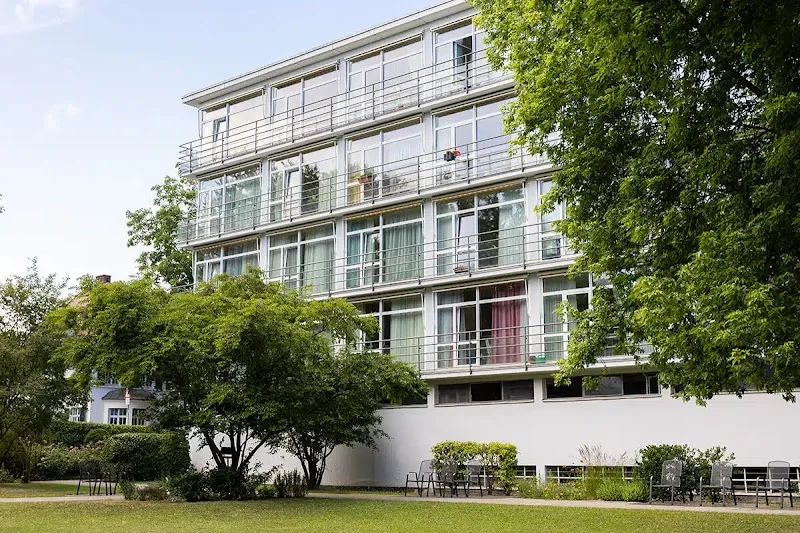
Friedrich-Ebert-Straße 178, Kassel
Friedrich-Ebert-Straße 178, 34119 Kassel, Germany
Aschrott-Altersheim-Stiftung | Photos & Address Kassel
The Aschrott-Altersheim-Stiftung on Friedrich-Ebert-Straße 178 is one of the most prominent social addresses in the Vorderer Westen of Kassel. Those looking for Aschrott-Altersheim photos usually want to see how the house looks today: bright, well-kept, quiet, and yet close to the city. This is exactly the image the institution conveys about itself. It describes itself as a traditional nursing home with care and support, as a home for women, and as a place where history, expertise, and humanity come together. The ensemble is located at Aschrottpark, making it one of the most defining neighborhoods in Kassel. At the same time, the history of the house refers to the bourgeois-Jewish foundation tradition of the Aschrott family, to early modern architecture, and to a clear social idea: older women should be offered a dignified and secure home. Today, this historical line and a contemporary care routine combine to create a house that is interesting both architecturally and socially. Therefore, four themes are particularly relevant for online searches: photos and first impressions, address and location, history and architecture, as well as living and care. ([aschrott-altersheim.de](https://aschrott-altersheim.de/ueber-uns/?utm_source=openai))
Photos and First Impressions of the Aschrott-Altersheim
When searching for photos of the Aschrott-Altersheim, it is rarely just about beautiful images, but about a concrete idea of daily life in the house. The official website shows and describes an environment with bright rooms, common areas, terraces, balconies, and garden facilities. This is important because the institution does not appear as an anonymous large structure, but as a living place with a personal atmosphere. The rooms are predominantly single rooms, individually customizable, and equipped with barrier-free bathrooms, according to the website. This creates an image in the external presentation that resembles a protected living space rather than a mere institution. This mix of privacy and community is central to the perception of the institution: those searching for photos want to know if the house appears open, friendly, and practical for everyday life. The answer to that is clearly positive. The house presents itself as bright, quiet, and clearly structured, with spaces that focus not on representation but on security and practical usability. At the same time, the interest in photos points to the historical character of the building, as the Aschrottheim is not a new building without history, but a historically significant or at least clearly tradition-shaped house with architectural identity. For interested parties, the visual impression is therefore closely linked to questions about care quality, living quality, and atmosphere. Those viewing pictures not only see architecture but also hints about the lifestyle the house enables: living in seclusion, community as needed, barrier-free living, and spending everyday life in a developed environment. ([aschrott-altersheim.de](https://aschrott-altersheim.de/wohnen/?utm_source=openai))
The location also contributes significantly to the impression. The house is located in the Vorderer Westen of Kassel, a district with good urban integration and a quiet residential character. The proximity to Aschrottpark significantly enhances this impression. The park is described as a landscaped city park shaped by Sigmund Aschrott, which today even allows for a wide view up to Bergpark Wilhelmshöhe and Hercules. For many visitors, this means: The Aschrottheim is not only functionally placed but also landscape-embedded. This embedding makes photo inquiries very understandable. Those interested in a facility for the elderly want to see not only interiors but also understand how the environment works, how much greenery is present, and how the building stands in the urban landscape. The official presentation of the house supports this impression with a focus on brightness, community, and garden connection. The possibility of a personal house tour fits into this because the building is apparently not meant to be conveyed solely through pictures but through the real impression on site. Thus, a consistent story emerges from photos, location, and architecture: a traditional house that does not define its dignity through size or splendor but through clarity, care, and a well-embedded living environment. ([visit.kassel.de](https://visit.kassel.de/en/poi/aschrottpark?utm_source=openai))
Address, Location, and Orientation in Kassel
The most important address of the Aschrott-Altersheim-Stiftung is quickly mentioned but is nevertheless crucial for many search queries: Friedrich-Ebert-Straße 178, 34119 Kassel. This address appears both on the foundation's website and in the address directory of the city of Kassel. For orientation, this is an important point, as search terms related to the location show that many users not only know the name but also want to check the exact location. The site is located in the district of Vorderer Westen, a well-known Kassel neighborhood with green surroundings, residential development, and urban historical significance. The city of Kassel provides a map representation, a route planner, and a public transport connection to the facility, making it easier for visitors, relatives, and interested parties to reach. Even though no detailed parking description is provided on the evaluated pages, it is clear that the location is in an inner-city residential area with good connections. For people seeking information about the house, this is more than just a navigation detail: the location says a lot about everyday life, visitability, and the character of the institution. The Aschrottheim is not located on the outskirts of the city but in the middle of a developed, historical, and lively neighborhood. This is particularly relevant for relatives looking for a facility with a close-to-home environment and easy accessibility. Additionally, the proximity to Aschrottpark, which serves as a municipal green space, creates a quiet environment and gives the house an additional spatial quality. Thus, the address does not only seem like a postal indication but like a part of the house's identity. Those searching for the Aschrottheim in Kassel are often also looking for a place where urban proximity and protected living come together. ([kassel.de](https://www.kassel.de/verzeichnisse/adressverzeichnis/pflegeheime/marie-von-boschan-aschrott-altersheim-stiftung.php))
The location in the Vorderer Westen is also historically charged. Sigmund Aschrott shaped the district with the former Hohenzollerviertel and donated numerous plots of land to the city, including for the construction of the town hall. The Aschrottheim is therefore not coincidentally located in this very district, but in an environment closely linked to the patronage activities of the family. This urban origin makes the location an important SEO and information factor. Those searching for Aschrott-Altersheim-Stiftung Kassel often want to know if the institution is centrally located, quiet, and in a well-accessible district. This is indeed the case here. At the same time, the proximity to the park helps classify the house as a place with living and recreational quality. In external perception, a realistic image emerges: The Aschrottheim is neither an isolated care facility nor a mere monument but a vibrant part of a historical urban quarter. For visitors, the combination of an exact address, good orientation, and a characterful environment is therefore particularly relevant. Especially in a facility that not only provides care but also housing, the location plays a central role in everyday life: paths, visits, walks, and the impression of the entire environment shape the experience of the house. ([aschrott-altersheim.de](https://aschrott-altersheim.de/ueber-uns/?utm_source=openai))
History of the Foundation and Bauhaus Architecture
The history of the Aschrott-Altersheim does not begin only with today's care routine but with a long tradition of foundations in Kassel. The Kassel patron Sigmund Aschrott laid important foundations for the Vorderer Westen with his donations and urban impact. His son Dr. Paul Felix Aschrott continued the patronage, and from his legacy, the Aschrott foundations were established in 1926. One of them is the Marie von Boschan-Aschrott-Altersheim-Stiftung, which has been committed to the welfare of older women in Kassel for more than a hundred years. The official history of the house emphasizes not only the social mission but also the continuity: the house is part of a developed philanthropic idea. Particularly exciting is the connection between social obligation and modern architecture. The building on Friedrich-Ebert-Straße was constructed by Otto Haesler in the Bauhaus style and was complemented or planned by Karl Völker. This classification is important for historical context because Haesler is one of the central representatives of modern, functional building. The design was described as exceptionally well thought out and was chosen for its successful communal spaces. Even the original conception showed that not just rooms should be built but a socially functional living ensemble. The complex consisted of two east-west oriented four-story lines connected by a two-story building. An entrance block, a heating center, and the clear orientation of the rooms made it clear how strongly usage logic, lighting, and everyday life were incorporated into the architecture. For that time, this was remarkably modern. Particularly the idea that each room should receive sunlight at the right time shows the quality of the planning. The Aschrottheim is therefore interesting not only as a care facility but also as a testimony to early social and architectural modernity in Kassel. ([aschrott-altersheim.de](https://aschrott-altersheim.de/ueber-uns/))
The original purpose of the house is also historically well documented. The founder stipulated that the home should be intended for single, non-working women from the bourgeoisie who should not yet be frail and should form a communal living community. This formulation reflects the social ideas of the time but also shows the ambition to create a dignified and orderly living environment. In architecture, this concept was implemented with clear functional structures: south-facing apartments, communal bathrooms and toilets at the end of the corridor, as well as reading, playing, dining, and music rooms in the cross wing. The house was thus from the beginning not just a sleeping or care place but a social living world. This is precisely where its special historical significance lies. Those searching for Aschrott-Altersheim-Stiftung photos or history today encounter a building that holds a firm place in architectural history. The later use as a nursing home led to changes, such as the installation of barrier-free bathrooms and an extension on the north side. Nevertheless, the fundamental character remained: a modern row structure with a clear structure, functional lighting, and a social center. This mix of preservation and adaptation makes the house credible. It is not a museum-like standstill but a historically grown building that translates its original spirit into contemporary use. ([otto-haesler-initiative.de](https://otto-haesler-initiative.de/bauten/1929-1931/marie-von-boschan-aschrott-altersheim))
Single Rooms, Common Areas, and Garden
Those interested in living in the Aschrottheim will find very concrete information about the facilities on the website. The institution offers bright single rooms and also double rooms, with the single rooms varying in size and initially equipped only with a nursing bed and a bedside table. This is intentionally designed so that residents can individually furnish their rooms with their own furniture. This possibility is important because it makes the transition to a home more personal rather than depersonalizing. Standard equipment includes barrier-free bathrooms with walk-in showers, toilets, sinks, and emergency call buttons. Additionally, each room has telephone and television connections. This speaks to a living situation that is oriented not only to care needs but also to everyday normality. The offer is complemented by spacious common areas where visitors can be received, read, played, or simply sit together. The website describes these areas as stylish and spacious, explicitly not as functional leftover spaces but as real places to stay. There are also terraces, balconies, and an appealing garden that open the house outward and allow for daily activities. In practice, this means: The Aschrottheim offers not only rooms but a small living world with retreat, encounter, and space for movement. For many search queries about Aschrott-Altersheim-Stiftung photos, this mix is crucial because it shows that the institution takes living quality seriously. The architecture of the 1930s has also been expanded in recent decades and equipped with bathrooms to meet today's standards. Thus, the house is an example of how historical substance and modern care requirements can be brought together. ([aschrott-altersheim.de](https://aschrott-altersheim.de/wohnen/?utm_source=openai))
From the users' perspective, the living situation is also interesting. The city of Kassel lists 136 single rooms with 152 places, while the operator states a total of 159 places on its website. These differing numbers are not unusual, as they may stem from various administrative and evaluation statuses. For interested parties, it is especially important that the house clearly focuses on single rooms and privacy. The website even emphasizes that most rooms are single rooms. This fits well with the ambition to provide residents with security and self-determination. The common areas form the counterpart: those seeking company will find it; those wanting peace can retreat. The garden area is also relevant for living quality. It creates a counterbalance to the dense urban location and allows for walks, outdoor stays, and small breaks. Especially in a nursing home, this connection between indoor and outdoor space is significant because it structures everyday life and makes quality of life visible. In the case of the Aschrottheim, it is added that the building itself, as a Bauhaus building, has a clear, factual, and light-oriented form. This architecture supports the living function in content: bright rooms, clear paths, functional floor plans, and a recognizable order. This makes the institution attractive to relatives and seekers who are not only checking care capacities but are looking for a coherent living environment. Thus, it becomes clear why terms like single rooms, garden, common areas, and photos are so dominant in search queries: they describe the real qualities of a house that visibly connects living and care. ([kassel.de](https://www.kassel.de/verzeichnisse/adressverzeichnis/pflegeheime/marie-von-boschan-aschrott-altersheim-stiftung.php))
Care, Support, and Daily Life for Women
The Aschrottheim explicitly sees itself today as a nursing home with care and support. The website mentions long-term care, short-term care, and transitional care, thus offering services for different life situations and support needs. This is an important signal because it shows that the house does not only know a single mode of provision but responds to individual situations. The institution emphasizes a warm environment, safety, and the preservation of individuality. This is not just a friendly marketing phrase but fits the described structures: private rooms, common areas, garden, personal furnishing options, and a team that covers various areas. On the house's pages, care, social support, administration, kitchen, housekeeping, and building technology are visible as part of daily operations. This creates the image of an institution that does not consist solely of caregivers but of a functioning everyday organization. It is also relevant for interested parties that the city of Kassel lists the house as a facility for women with 152 places, while the foundation states 159 places on its website and simultaneously speaks of 127 residents. These figures show that it is a rather personally structured house, not an anonymous large operation. The combination of a women's house, tradition, and care makes the institution unique in the local context. Therefore, those searching for Aschrott-Altersheim-Stiftung Kassel or Aschrott Altenheim are often looking for this mixture of protected living, clear orientation, and reliable support. Additionally, the central location in Kassel facilitates visits, organizational paths, and contact with relatives. The foundation also describes itself as non-profit and guided by the will of the founder, which underscores its social integration. For an SEO text, this is important because it answers the questions behind the search terms: Is the house only historically interesting? No. Is it also practical and livable? Yes. Is the care individualized enough? The service structure shows this very clearly. ([aschrott-altersheim.de](https://aschrott-altersheim.de/))
The daily life in the house is also shaped by its organizational structure. The website lists fixed contacts, including management, facility management, nursing management, and home administration. Such clear responsibilities are particularly important for relatives and interested parties because they show that questions do not disappear into an impersonal hotline. Additionally, the website points to viewing appointments and invites interested parties to personally get to know the rooms, common areas, and garden. Especially in a facility that exclusively accommodates women, this direct impression is crucial. It helps build trust and realistically assess the atmosphere of the house. The location at Aschrottpark also strengthens the everyday character: a house in green surroundings, but within Kassel, creates an environment that facilitates visits and walks while also providing tranquility. For search queries related to nursing homes, retirement homes, or women's homes, it is also significant that the foundation connects its historical mission with current care offerings. The house is thus not a static memorial object but a lively institution with everyday life, rules, team structure, and personal contact. Those looking closely can therefore recognize several levels simultaneously: historical foundation, modernized architecture, functional care operation, and livable environment. This multi-layeredness makes the Aschrottheim in Kassel so relevant for searches. Because many people today are not only researching a name but also concrete qualities such as care form, room type, location, garden, contacts, and viewing opportunities. The Aschrottheim answers these questions relatively clearly and presents itself as a tradition-conscious yet modern living and care address for women in the Vorderer Westen. ([aschrott-altersheim.de](https://aschrott-altersheim.de/ueber-uns/?utm_source=openai))
Capacity, Special Features, and Frequently Asked Questions
One of the most frequently asked questions is: How large is the Aschrottheim actually? The answer is nuanced. The operator states 159 places on its own website, while the address directory of the city of Kassel lists 152 places, including 136 single rooms. Additionally, the foundation describes that currently 127 residents live in the house. These numbers initially seem different but are important for an honest representation. They show that capacity information can vary slightly depending on the source and timing. Nevertheless, the search intention is clear: The Aschrottheim is a medium to larger institution with a strong focus on single rooms and women's living. Another special feature is the architectural character. The house was built between 1929 and 1931, shaped by the Bauhaus style, and originally very consistently oriented towards lighting, community, and functional processes. The later use as a nursing home did not eliminate the substance but adapted it to current requirements. This makes the institution a rare example of a historically grown house that has not lost its identity. The history of the foundation is also remarkable. It is directly connected to Sigmund Aschrott and Paul Felix Aschrott and thus tells a piece of Kassel's urban, social, and architectural history. For many users, such special features are precisely the reason to search for photos, addresses, and background information. They want to know not only where the house is located but also why it is significant as a place. The answer is: because of its history, its focus on women, its architecture, and its well-utilizable living form. ([aschrott-altersheim.de](https://aschrott-altersheim.de/ueber-uns/))
Practical questions also include viewing opportunities. The foundation explicitly invites people to get to know the house personally. This includes an individual house tour, insights into rooms and common areas, and the opportunity for exchange. For families, this is an important point because a care facility ideally convinces not only on paper but also in real impressions. The available contacts further facilitate this connection. Additionally, the website provides a fixed telephone availability and email contacts, making the search for Aschrottheim Kassel or Friedrich-Ebert-Straße 178 Kassel practically relevant. At the center is always the same profile: a house for women, with historical substance, good location, clear room structure, and care offerings for different life phases. Those entering the name Aschrott-Altersheim-Stiftung often seek not just an entry but a reliable decision-making aid. This function is fulfilled by a well-structured SEO text: it answers the most important questions, places the historical significance in context, and describes the house so that both search engines and people benefit from it. The Aschrottheim is thus one of the most interesting addresses for the topic of nursing home Kassel, women's home Kassel, single rooms, and Bauhaus architecture in Kassel. The combination of real living quality, social history, and urban location makes the site not interchangeable but clearly recognizable. ([aschrott-altersheim.de](https://aschrott-altersheim.de/ueber-uns/?utm_source=openai))
Sources:
Mehr anzeigenWeniger anzeigen
Aschrott-Altersheim-Stiftung | Photos & Address Kassel
The Aschrott-Altersheim-Stiftung on Friedrich-Ebert-Straße 178 is one of the most prominent social addresses in the Vorderer Westen of Kassel. Those looking for Aschrott-Altersheim photos usually want to see how the house looks today: bright, well-kept, quiet, and yet close to the city. This is exactly the image the institution conveys about itself. It describes itself as a traditional nursing home with care and support, as a home for women, and as a place where history, expertise, and humanity come together. The ensemble is located at Aschrottpark, making it one of the most defining neighborhoods in Kassel. At the same time, the history of the house refers to the bourgeois-Jewish foundation tradition of the Aschrott family, to early modern architecture, and to a clear social idea: older women should be offered a dignified and secure home. Today, this historical line and a contemporary care routine combine to create a house that is interesting both architecturally and socially. Therefore, four themes are particularly relevant for online searches: photos and first impressions, address and location, history and architecture, as well as living and care. ([aschrott-altersheim.de](https://aschrott-altersheim.de/ueber-uns/?utm_source=openai))
Photos and First Impressions of the Aschrott-Altersheim
When searching for photos of the Aschrott-Altersheim, it is rarely just about beautiful images, but about a concrete idea of daily life in the house. The official website shows and describes an environment with bright rooms, common areas, terraces, balconies, and garden facilities. This is important because the institution does not appear as an anonymous large structure, but as a living place with a personal atmosphere. The rooms are predominantly single rooms, individually customizable, and equipped with barrier-free bathrooms, according to the website. This creates an image in the external presentation that resembles a protected living space rather than a mere institution. This mix of privacy and community is central to the perception of the institution: those searching for photos want to know if the house appears open, friendly, and practical for everyday life. The answer to that is clearly positive. The house presents itself as bright, quiet, and clearly structured, with spaces that focus not on representation but on security and practical usability. At the same time, the interest in photos points to the historical character of the building, as the Aschrottheim is not a new building without history, but a historically significant or at least clearly tradition-shaped house with architectural identity. For interested parties, the visual impression is therefore closely linked to questions about care quality, living quality, and atmosphere. Those viewing pictures not only see architecture but also hints about the lifestyle the house enables: living in seclusion, community as needed, barrier-free living, and spending everyday life in a developed environment. ([aschrott-altersheim.de](https://aschrott-altersheim.de/wohnen/?utm_source=openai))
The location also contributes significantly to the impression. The house is located in the Vorderer Westen of Kassel, a district with good urban integration and a quiet residential character. The proximity to Aschrottpark significantly enhances this impression. The park is described as a landscaped city park shaped by Sigmund Aschrott, which today even allows for a wide view up to Bergpark Wilhelmshöhe and Hercules. For many visitors, this means: The Aschrottheim is not only functionally placed but also landscape-embedded. This embedding makes photo inquiries very understandable. Those interested in a facility for the elderly want to see not only interiors but also understand how the environment works, how much greenery is present, and how the building stands in the urban landscape. The official presentation of the house supports this impression with a focus on brightness, community, and garden connection. The possibility of a personal house tour fits into this because the building is apparently not meant to be conveyed solely through pictures but through the real impression on site. Thus, a consistent story emerges from photos, location, and architecture: a traditional house that does not define its dignity through size or splendor but through clarity, care, and a well-embedded living environment. ([visit.kassel.de](https://visit.kassel.de/en/poi/aschrottpark?utm_source=openai))
Address, Location, and Orientation in Kassel
The most important address of the Aschrott-Altersheim-Stiftung is quickly mentioned but is nevertheless crucial for many search queries: Friedrich-Ebert-Straße 178, 34119 Kassel. This address appears both on the foundation's website and in the address directory of the city of Kassel. For orientation, this is an important point, as search terms related to the location show that many users not only know the name but also want to check the exact location. The site is located in the district of Vorderer Westen, a well-known Kassel neighborhood with green surroundings, residential development, and urban historical significance. The city of Kassel provides a map representation, a route planner, and a public transport connection to the facility, making it easier for visitors, relatives, and interested parties to reach. Even though no detailed parking description is provided on the evaluated pages, it is clear that the location is in an inner-city residential area with good connections. For people seeking information about the house, this is more than just a navigation detail: the location says a lot about everyday life, visitability, and the character of the institution. The Aschrottheim is not located on the outskirts of the city but in the middle of a developed, historical, and lively neighborhood. This is particularly relevant for relatives looking for a facility with a close-to-home environment and easy accessibility. Additionally, the proximity to Aschrottpark, which serves as a municipal green space, creates a quiet environment and gives the house an additional spatial quality. Thus, the address does not only seem like a postal indication but like a part of the house's identity. Those searching for the Aschrottheim in Kassel are often also looking for a place where urban proximity and protected living come together. ([kassel.de](https://www.kassel.de/verzeichnisse/adressverzeichnis/pflegeheime/marie-von-boschan-aschrott-altersheim-stiftung.php))
The location in the Vorderer Westen is also historically charged. Sigmund Aschrott shaped the district with the former Hohenzollerviertel and donated numerous plots of land to the city, including for the construction of the town hall. The Aschrottheim is therefore not coincidentally located in this very district, but in an environment closely linked to the patronage activities of the family. This urban origin makes the location an important SEO and information factor. Those searching for Aschrott-Altersheim-Stiftung Kassel often want to know if the institution is centrally located, quiet, and in a well-accessible district. This is indeed the case here. At the same time, the proximity to the park helps classify the house as a place with living and recreational quality. In external perception, a realistic image emerges: The Aschrottheim is neither an isolated care facility nor a mere monument but a vibrant part of a historical urban quarter. For visitors, the combination of an exact address, good orientation, and a characterful environment is therefore particularly relevant. Especially in a facility that not only provides care but also housing, the location plays a central role in everyday life: paths, visits, walks, and the impression of the entire environment shape the experience of the house. ([aschrott-altersheim.de](https://aschrott-altersheim.de/ueber-uns/?utm_source=openai))
History of the Foundation and Bauhaus Architecture
The history of the Aschrott-Altersheim does not begin only with today's care routine but with a long tradition of foundations in Kassel. The Kassel patron Sigmund Aschrott laid important foundations for the Vorderer Westen with his donations and urban impact. His son Dr. Paul Felix Aschrott continued the patronage, and from his legacy, the Aschrott foundations were established in 1926. One of them is the Marie von Boschan-Aschrott-Altersheim-Stiftung, which has been committed to the welfare of older women in Kassel for more than a hundred years. The official history of the house emphasizes not only the social mission but also the continuity: the house is part of a developed philanthropic idea. Particularly exciting is the connection between social obligation and modern architecture. The building on Friedrich-Ebert-Straße was constructed by Otto Haesler in the Bauhaus style and was complemented or planned by Karl Völker. This classification is important for historical context because Haesler is one of the central representatives of modern, functional building. The design was described as exceptionally well thought out and was chosen for its successful communal spaces. Even the original conception showed that not just rooms should be built but a socially functional living ensemble. The complex consisted of two east-west oriented four-story lines connected by a two-story building. An entrance block, a heating center, and the clear orientation of the rooms made it clear how strongly usage logic, lighting, and everyday life were incorporated into the architecture. For that time, this was remarkably modern. Particularly the idea that each room should receive sunlight at the right time shows the quality of the planning. The Aschrottheim is therefore interesting not only as a care facility but also as a testimony to early social and architectural modernity in Kassel. ([aschrott-altersheim.de](https://aschrott-altersheim.de/ueber-uns/))
The original purpose of the house is also historically well documented. The founder stipulated that the home should be intended for single, non-working women from the bourgeoisie who should not yet be frail and should form a communal living community. This formulation reflects the social ideas of the time but also shows the ambition to create a dignified and orderly living environment. In architecture, this concept was implemented with clear functional structures: south-facing apartments, communal bathrooms and toilets at the end of the corridor, as well as reading, playing, dining, and music rooms in the cross wing. The house was thus from the beginning not just a sleeping or care place but a social living world. This is precisely where its special historical significance lies. Those searching for Aschrott-Altersheim-Stiftung photos or history today encounter a building that holds a firm place in architectural history. The later use as a nursing home led to changes, such as the installation of barrier-free bathrooms and an extension on the north side. Nevertheless, the fundamental character remained: a modern row structure with a clear structure, functional lighting, and a social center. This mix of preservation and adaptation makes the house credible. It is not a museum-like standstill but a historically grown building that translates its original spirit into contemporary use. ([otto-haesler-initiative.de](https://otto-haesler-initiative.de/bauten/1929-1931/marie-von-boschan-aschrott-altersheim))
Single Rooms, Common Areas, and Garden
Those interested in living in the Aschrottheim will find very concrete information about the facilities on the website. The institution offers bright single rooms and also double rooms, with the single rooms varying in size and initially equipped only with a nursing bed and a bedside table. This is intentionally designed so that residents can individually furnish their rooms with their own furniture. This possibility is important because it makes the transition to a home more personal rather than depersonalizing. Standard equipment includes barrier-free bathrooms with walk-in showers, toilets, sinks, and emergency call buttons. Additionally, each room has telephone and television connections. This speaks to a living situation that is oriented not only to care needs but also to everyday normality. The offer is complemented by spacious common areas where visitors can be received, read, played, or simply sit together. The website describes these areas as stylish and spacious, explicitly not as functional leftover spaces but as real places to stay. There are also terraces, balconies, and an appealing garden that open the house outward and allow for daily activities. In practice, this means: The Aschrottheim offers not only rooms but a small living world with retreat, encounter, and space for movement. For many search queries about Aschrott-Altersheim-Stiftung photos, this mix is crucial because it shows that the institution takes living quality seriously. The architecture of the 1930s has also been expanded in recent decades and equipped with bathrooms to meet today's standards. Thus, the house is an example of how historical substance and modern care requirements can be brought together. ([aschrott-altersheim.de](https://aschrott-altersheim.de/wohnen/?utm_source=openai))
From the users' perspective, the living situation is also interesting. The city of Kassel lists 136 single rooms with 152 places, while the operator states a total of 159 places on its website. These differing numbers are not unusual, as they may stem from various administrative and evaluation statuses. For interested parties, it is especially important that the house clearly focuses on single rooms and privacy. The website even emphasizes that most rooms are single rooms. This fits well with the ambition to provide residents with security and self-determination. The common areas form the counterpart: those seeking company will find it; those wanting peace can retreat. The garden area is also relevant for living quality. It creates a counterbalance to the dense urban location and allows for walks, outdoor stays, and small breaks. Especially in a nursing home, this connection between indoor and outdoor space is significant because it structures everyday life and makes quality of life visible. In the case of the Aschrottheim, it is added that the building itself, as a Bauhaus building, has a clear, factual, and light-oriented form. This architecture supports the living function in content: bright rooms, clear paths, functional floor plans, and a recognizable order. This makes the institution attractive to relatives and seekers who are not only checking care capacities but are looking for a coherent living environment. Thus, it becomes clear why terms like single rooms, garden, common areas, and photos are so dominant in search queries: they describe the real qualities of a house that visibly connects living and care. ([kassel.de](https://www.kassel.de/verzeichnisse/adressverzeichnis/pflegeheime/marie-von-boschan-aschrott-altersheim-stiftung.php))
Care, Support, and Daily Life for Women
The Aschrottheim explicitly sees itself today as a nursing home with care and support. The website mentions long-term care, short-term care, and transitional care, thus offering services for different life situations and support needs. This is an important signal because it shows that the house does not only know a single mode of provision but responds to individual situations. The institution emphasizes a warm environment, safety, and the preservation of individuality. This is not just a friendly marketing phrase but fits the described structures: private rooms, common areas, garden, personal furnishing options, and a team that covers various areas. On the house's pages, care, social support, administration, kitchen, housekeeping, and building technology are visible as part of daily operations. This creates the image of an institution that does not consist solely of caregivers but of a functioning everyday organization. It is also relevant for interested parties that the city of Kassel lists the house as a facility for women with 152 places, while the foundation states 159 places on its website and simultaneously speaks of 127 residents. These figures show that it is a rather personally structured house, not an anonymous large operation. The combination of a women's house, tradition, and care makes the institution unique in the local context. Therefore, those searching for Aschrott-Altersheim-Stiftung Kassel or Aschrott Altenheim are often looking for this mixture of protected living, clear orientation, and reliable support. Additionally, the central location in Kassel facilitates visits, organizational paths, and contact with relatives. The foundation also describes itself as non-profit and guided by the will of the founder, which underscores its social integration. For an SEO text, this is important because it answers the questions behind the search terms: Is the house only historically interesting? No. Is it also practical and livable? Yes. Is the care individualized enough? The service structure shows this very clearly. ([aschrott-altersheim.de](https://aschrott-altersheim.de/))
The daily life in the house is also shaped by its organizational structure. The website lists fixed contacts, including management, facility management, nursing management, and home administration. Such clear responsibilities are particularly important for relatives and interested parties because they show that questions do not disappear into an impersonal hotline. Additionally, the website points to viewing appointments and invites interested parties to personally get to know the rooms, common areas, and garden. Especially in a facility that exclusively accommodates women, this direct impression is crucial. It helps build trust and realistically assess the atmosphere of the house. The location at Aschrottpark also strengthens the everyday character: a house in green surroundings, but within Kassel, creates an environment that facilitates visits and walks while also providing tranquility. For search queries related to nursing homes, retirement homes, or women's homes, it is also significant that the foundation connects its historical mission with current care offerings. The house is thus not a static memorial object but a lively institution with everyday life, rules, team structure, and personal contact. Those looking closely can therefore recognize several levels simultaneously: historical foundation, modernized architecture, functional care operation, and livable environment. This multi-layeredness makes the Aschrottheim in Kassel so relevant for searches. Because many people today are not only researching a name but also concrete qualities such as care form, room type, location, garden, contacts, and viewing opportunities. The Aschrottheim answers these questions relatively clearly and presents itself as a tradition-conscious yet modern living and care address for women in the Vorderer Westen. ([aschrott-altersheim.de](https://aschrott-altersheim.de/ueber-uns/?utm_source=openai))
Capacity, Special Features, and Frequently Asked Questions
One of the most frequently asked questions is: How large is the Aschrottheim actually? The answer is nuanced. The operator states 159 places on its own website, while the address directory of the city of Kassel lists 152 places, including 136 single rooms. Additionally, the foundation describes that currently 127 residents live in the house. These numbers initially seem different but are important for an honest representation. They show that capacity information can vary slightly depending on the source and timing. Nevertheless, the search intention is clear: The Aschrottheim is a medium to larger institution with a strong focus on single rooms and women's living. Another special feature is the architectural character. The house was built between 1929 and 1931, shaped by the Bauhaus style, and originally very consistently oriented towards lighting, community, and functional processes. The later use as a nursing home did not eliminate the substance but adapted it to current requirements. This makes the institution a rare example of a historically grown house that has not lost its identity. The history of the foundation is also remarkable. It is directly connected to Sigmund Aschrott and Paul Felix Aschrott and thus tells a piece of Kassel's urban, social, and architectural history. For many users, such special features are precisely the reason to search for photos, addresses, and background information. They want to know not only where the house is located but also why it is significant as a place. The answer is: because of its history, its focus on women, its architecture, and its well-utilizable living form. ([aschrott-altersheim.de](https://aschrott-altersheim.de/ueber-uns/))
Practical questions also include viewing opportunities. The foundation explicitly invites people to get to know the house personally. This includes an individual house tour, insights into rooms and common areas, and the opportunity for exchange. For families, this is an important point because a care facility ideally convinces not only on paper but also in real impressions. The available contacts further facilitate this connection. Additionally, the website provides a fixed telephone availability and email contacts, making the search for Aschrottheim Kassel or Friedrich-Ebert-Straße 178 Kassel practically relevant. At the center is always the same profile: a house for women, with historical substance, good location, clear room structure, and care offerings for different life phases. Those entering the name Aschrott-Altersheim-Stiftung often seek not just an entry but a reliable decision-making aid. This function is fulfilled by a well-structured SEO text: it answers the most important questions, places the historical significance in context, and describes the house so that both search engines and people benefit from it. The Aschrottheim is thus one of the most interesting addresses for the topic of nursing home Kassel, women's home Kassel, single rooms, and Bauhaus architecture in Kassel. The combination of real living quality, social history, and urban location makes the site not interchangeable but clearly recognizable. ([aschrott-altersheim.de](https://aschrott-altersheim.de/ueber-uns/?utm_source=openai))
Sources:
Aschrott-Altersheim-Stiftung | Photos & Address Kassel
The Aschrott-Altersheim-Stiftung on Friedrich-Ebert-Straße 178 is one of the most prominent social addresses in the Vorderer Westen of Kassel. Those looking for Aschrott-Altersheim photos usually want to see how the house looks today: bright, well-kept, quiet, and yet close to the city. This is exactly the image the institution conveys about itself. It describes itself as a traditional nursing home with care and support, as a home for women, and as a place where history, expertise, and humanity come together. The ensemble is located at Aschrottpark, making it one of the most defining neighborhoods in Kassel. At the same time, the history of the house refers to the bourgeois-Jewish foundation tradition of the Aschrott family, to early modern architecture, and to a clear social idea: older women should be offered a dignified and secure home. Today, this historical line and a contemporary care routine combine to create a house that is interesting both architecturally and socially. Therefore, four themes are particularly relevant for online searches: photos and first impressions, address and location, history and architecture, as well as living and care. ([aschrott-altersheim.de](https://aschrott-altersheim.de/ueber-uns/?utm_source=openai))
Photos and First Impressions of the Aschrott-Altersheim
When searching for photos of the Aschrott-Altersheim, it is rarely just about beautiful images, but about a concrete idea of daily life in the house. The official website shows and describes an environment with bright rooms, common areas, terraces, balconies, and garden facilities. This is important because the institution does not appear as an anonymous large structure, but as a living place with a personal atmosphere. The rooms are predominantly single rooms, individually customizable, and equipped with barrier-free bathrooms, according to the website. This creates an image in the external presentation that resembles a protected living space rather than a mere institution. This mix of privacy and community is central to the perception of the institution: those searching for photos want to know if the house appears open, friendly, and practical for everyday life. The answer to that is clearly positive. The house presents itself as bright, quiet, and clearly structured, with spaces that focus not on representation but on security and practical usability. At the same time, the interest in photos points to the historical character of the building, as the Aschrottheim is not a new building without history, but a historically significant or at least clearly tradition-shaped house with architectural identity. For interested parties, the visual impression is therefore closely linked to questions about care quality, living quality, and atmosphere. Those viewing pictures not only see architecture but also hints about the lifestyle the house enables: living in seclusion, community as needed, barrier-free living, and spending everyday life in a developed environment. ([aschrott-altersheim.de](https://aschrott-altersheim.de/wohnen/?utm_source=openai))
The location also contributes significantly to the impression. The house is located in the Vorderer Westen of Kassel, a district with good urban integration and a quiet residential character. The proximity to Aschrottpark significantly enhances this impression. The park is described as a landscaped city park shaped by Sigmund Aschrott, which today even allows for a wide view up to Bergpark Wilhelmshöhe and Hercules. For many visitors, this means: The Aschrottheim is not only functionally placed but also landscape-embedded. This embedding makes photo inquiries very understandable. Those interested in a facility for the elderly want to see not only interiors but also understand how the environment works, how much greenery is present, and how the building stands in the urban landscape. The official presentation of the house supports this impression with a focus on brightness, community, and garden connection. The possibility of a personal house tour fits into this because the building is apparently not meant to be conveyed solely through pictures but through the real impression on site. Thus, a consistent story emerges from photos, location, and architecture: a traditional house that does not define its dignity through size or splendor but through clarity, care, and a well-embedded living environment. ([visit.kassel.de](https://visit.kassel.de/en/poi/aschrottpark?utm_source=openai))
Address, Location, and Orientation in Kassel
The most important address of the Aschrott-Altersheim-Stiftung is quickly mentioned but is nevertheless crucial for many search queries: Friedrich-Ebert-Straße 178, 34119 Kassel. This address appears both on the foundation's website and in the address directory of the city of Kassel. For orientation, this is an important point, as search terms related to the location show that many users not only know the name but also want to check the exact location. The site is located in the district of Vorderer Westen, a well-known Kassel neighborhood with green surroundings, residential development, and urban historical significance. The city of Kassel provides a map representation, a route planner, and a public transport connection to the facility, making it easier for visitors, relatives, and interested parties to reach. Even though no detailed parking description is provided on the evaluated pages, it is clear that the location is in an inner-city residential area with good connections. For people seeking information about the house, this is more than just a navigation detail: the location says a lot about everyday life, visitability, and the character of the institution. The Aschrottheim is not located on the outskirts of the city but in the middle of a developed, historical, and lively neighborhood. This is particularly relevant for relatives looking for a facility with a close-to-home environment and easy accessibility. Additionally, the proximity to Aschrottpark, which serves as a municipal green space, creates a quiet environment and gives the house an additional spatial quality. Thus, the address does not only seem like a postal indication but like a part of the house's identity. Those searching for the Aschrottheim in Kassel are often also looking for a place where urban proximity and protected living come together. ([kassel.de](https://www.kassel.de/verzeichnisse/adressverzeichnis/pflegeheime/marie-von-boschan-aschrott-altersheim-stiftung.php))
The location in the Vorderer Westen is also historically charged. Sigmund Aschrott shaped the district with the former Hohenzollerviertel and donated numerous plots of land to the city, including for the construction of the town hall. The Aschrottheim is therefore not coincidentally located in this very district, but in an environment closely linked to the patronage activities of the family. This urban origin makes the location an important SEO and information factor. Those searching for Aschrott-Altersheim-Stiftung Kassel often want to know if the institution is centrally located, quiet, and in a well-accessible district. This is indeed the case here. At the same time, the proximity to the park helps classify the house as a place with living and recreational quality. In external perception, a realistic image emerges: The Aschrottheim is neither an isolated care facility nor a mere monument but a vibrant part of a historical urban quarter. For visitors, the combination of an exact address, good orientation, and a characterful environment is therefore particularly relevant. Especially in a facility that not only provides care but also housing, the location plays a central role in everyday life: paths, visits, walks, and the impression of the entire environment shape the experience of the house. ([aschrott-altersheim.de](https://aschrott-altersheim.de/ueber-uns/?utm_source=openai))
History of the Foundation and Bauhaus Architecture
The history of the Aschrott-Altersheim does not begin only with today's care routine but with a long tradition of foundations in Kassel. The Kassel patron Sigmund Aschrott laid important foundations for the Vorderer Westen with his donations and urban impact. His son Dr. Paul Felix Aschrott continued the patronage, and from his legacy, the Aschrott foundations were established in 1926. One of them is the Marie von Boschan-Aschrott-Altersheim-Stiftung, which has been committed to the welfare of older women in Kassel for more than a hundred years. The official history of the house emphasizes not only the social mission but also the continuity: the house is part of a developed philanthropic idea. Particularly exciting is the connection between social obligation and modern architecture. The building on Friedrich-Ebert-Straße was constructed by Otto Haesler in the Bauhaus style and was complemented or planned by Karl Völker. This classification is important for historical context because Haesler is one of the central representatives of modern, functional building. The design was described as exceptionally well thought out and was chosen for its successful communal spaces. Even the original conception showed that not just rooms should be built but a socially functional living ensemble. The complex consisted of two east-west oriented four-story lines connected by a two-story building. An entrance block, a heating center, and the clear orientation of the rooms made it clear how strongly usage logic, lighting, and everyday life were incorporated into the architecture. For that time, this was remarkably modern. Particularly the idea that each room should receive sunlight at the right time shows the quality of the planning. The Aschrottheim is therefore interesting not only as a care facility but also as a testimony to early social and architectural modernity in Kassel. ([aschrott-altersheim.de](https://aschrott-altersheim.de/ueber-uns/))
The original purpose of the house is also historically well documented. The founder stipulated that the home should be intended for single, non-working women from the bourgeoisie who should not yet be frail and should form a communal living community. This formulation reflects the social ideas of the time but also shows the ambition to create a dignified and orderly living environment. In architecture, this concept was implemented with clear functional structures: south-facing apartments, communal bathrooms and toilets at the end of the corridor, as well as reading, playing, dining, and music rooms in the cross wing. The house was thus from the beginning not just a sleeping or care place but a social living world. This is precisely where its special historical significance lies. Those searching for Aschrott-Altersheim-Stiftung photos or history today encounter a building that holds a firm place in architectural history. The later use as a nursing home led to changes, such as the installation of barrier-free bathrooms and an extension on the north side. Nevertheless, the fundamental character remained: a modern row structure with a clear structure, functional lighting, and a social center. This mix of preservation and adaptation makes the house credible. It is not a museum-like standstill but a historically grown building that translates its original spirit into contemporary use. ([otto-haesler-initiative.de](https://otto-haesler-initiative.de/bauten/1929-1931/marie-von-boschan-aschrott-altersheim))
Single Rooms, Common Areas, and Garden
Those interested in living in the Aschrottheim will find very concrete information about the facilities on the website. The institution offers bright single rooms and also double rooms, with the single rooms varying in size and initially equipped only with a nursing bed and a bedside table. This is intentionally designed so that residents can individually furnish their rooms with their own furniture. This possibility is important because it makes the transition to a home more personal rather than depersonalizing. Standard equipment includes barrier-free bathrooms with walk-in showers, toilets, sinks, and emergency call buttons. Additionally, each room has telephone and television connections. This speaks to a living situation that is oriented not only to care needs but also to everyday normality. The offer is complemented by spacious common areas where visitors can be received, read, played, or simply sit together. The website describes these areas as stylish and spacious, explicitly not as functional leftover spaces but as real places to stay. There are also terraces, balconies, and an appealing garden that open the house outward and allow for daily activities. In practice, this means: The Aschrottheim offers not only rooms but a small living world with retreat, encounter, and space for movement. For many search queries about Aschrott-Altersheim-Stiftung photos, this mix is crucial because it shows that the institution takes living quality seriously. The architecture of the 1930s has also been expanded in recent decades and equipped with bathrooms to meet today's standards. Thus, the house is an example of how historical substance and modern care requirements can be brought together. ([aschrott-altersheim.de](https://aschrott-altersheim.de/wohnen/?utm_source=openai))
From the users' perspective, the living situation is also interesting. The city of Kassel lists 136 single rooms with 152 places, while the operator states a total of 159 places on its website. These differing numbers are not unusual, as they may stem from various administrative and evaluation statuses. For interested parties, it is especially important that the house clearly focuses on single rooms and privacy. The website even emphasizes that most rooms are single rooms. This fits well with the ambition to provide residents with security and self-determination. The common areas form the counterpart: those seeking company will find it; those wanting peace can retreat. The garden area is also relevant for living quality. It creates a counterbalance to the dense urban location and allows for walks, outdoor stays, and small breaks. Especially in a nursing home, this connection between indoor and outdoor space is significant because it structures everyday life and makes quality of life visible. In the case of the Aschrottheim, it is added that the building itself, as a Bauhaus building, has a clear, factual, and light-oriented form. This architecture supports the living function in content: bright rooms, clear paths, functional floor plans, and a recognizable order. This makes the institution attractive to relatives and seekers who are not only checking care capacities but are looking for a coherent living environment. Thus, it becomes clear why terms like single rooms, garden, common areas, and photos are so dominant in search queries: they describe the real qualities of a house that visibly connects living and care. ([kassel.de](https://www.kassel.de/verzeichnisse/adressverzeichnis/pflegeheime/marie-von-boschan-aschrott-altersheim-stiftung.php))
Care, Support, and Daily Life for Women
The Aschrottheim explicitly sees itself today as a nursing home with care and support. The website mentions long-term care, short-term care, and transitional care, thus offering services for different life situations and support needs. This is an important signal because it shows that the house does not only know a single mode of provision but responds to individual situations. The institution emphasizes a warm environment, safety, and the preservation of individuality. This is not just a friendly marketing phrase but fits the described structures: private rooms, common areas, garden, personal furnishing options, and a team that covers various areas. On the house's pages, care, social support, administration, kitchen, housekeeping, and building technology are visible as part of daily operations. This creates the image of an institution that does not consist solely of caregivers but of a functioning everyday organization. It is also relevant for interested parties that the city of Kassel lists the house as a facility for women with 152 places, while the foundation states 159 places on its website and simultaneously speaks of 127 residents. These figures show that it is a rather personally structured house, not an anonymous large operation. The combination of a women's house, tradition, and care makes the institution unique in the local context. Therefore, those searching for Aschrott-Altersheim-Stiftung Kassel or Aschrott Altenheim are often looking for this mixture of protected living, clear orientation, and reliable support. Additionally, the central location in Kassel facilitates visits, organizational paths, and contact with relatives. The foundation also describes itself as non-profit and guided by the will of the founder, which underscores its social integration. For an SEO text, this is important because it answers the questions behind the search terms: Is the house only historically interesting? No. Is it also practical and livable? Yes. Is the care individualized enough? The service structure shows this very clearly. ([aschrott-altersheim.de](https://aschrott-altersheim.de/))
The daily life in the house is also shaped by its organizational structure. The website lists fixed contacts, including management, facility management, nursing management, and home administration. Such clear responsibilities are particularly important for relatives and interested parties because they show that questions do not disappear into an impersonal hotline. Additionally, the website points to viewing appointments and invites interested parties to personally get to know the rooms, common areas, and garden. Especially in a facility that exclusively accommodates women, this direct impression is crucial. It helps build trust and realistically assess the atmosphere of the house. The location at Aschrottpark also strengthens the everyday character: a house in green surroundings, but within Kassel, creates an environment that facilitates visits and walks while also providing tranquility. For search queries related to nursing homes, retirement homes, or women's homes, it is also significant that the foundation connects its historical mission with current care offerings. The house is thus not a static memorial object but a lively institution with everyday life, rules, team structure, and personal contact. Those looking closely can therefore recognize several levels simultaneously: historical foundation, modernized architecture, functional care operation, and livable environment. This multi-layeredness makes the Aschrottheim in Kassel so relevant for searches. Because many people today are not only researching a name but also concrete qualities such as care form, room type, location, garden, contacts, and viewing opportunities. The Aschrottheim answers these questions relatively clearly and presents itself as a tradition-conscious yet modern living and care address for women in the Vorderer Westen. ([aschrott-altersheim.de](https://aschrott-altersheim.de/ueber-uns/?utm_source=openai))
Capacity, Special Features, and Frequently Asked Questions
One of the most frequently asked questions is: How large is the Aschrottheim actually? The answer is nuanced. The operator states 159 places on its own website, while the address directory of the city of Kassel lists 152 places, including 136 single rooms. Additionally, the foundation describes that currently 127 residents live in the house. These numbers initially seem different but are important for an honest representation. They show that capacity information can vary slightly depending on the source and timing. Nevertheless, the search intention is clear: The Aschrottheim is a medium to larger institution with a strong focus on single rooms and women's living. Another special feature is the architectural character. The house was built between 1929 and 1931, shaped by the Bauhaus style, and originally very consistently oriented towards lighting, community, and functional processes. The later use as a nursing home did not eliminate the substance but adapted it to current requirements. This makes the institution a rare example of a historically grown house that has not lost its identity. The history of the foundation is also remarkable. It is directly connected to Sigmund Aschrott and Paul Felix Aschrott and thus tells a piece of Kassel's urban, social, and architectural history. For many users, such special features are precisely the reason to search for photos, addresses, and background information. They want to know not only where the house is located but also why it is significant as a place. The answer is: because of its history, its focus on women, its architecture, and its well-utilizable living form. ([aschrott-altersheim.de](https://aschrott-altersheim.de/ueber-uns/))
Practical questions also include viewing opportunities. The foundation explicitly invites people to get to know the house personally. This includes an individual house tour, insights into rooms and common areas, and the opportunity for exchange. For families, this is an important point because a care facility ideally convinces not only on paper but also in real impressions. The available contacts further facilitate this connection. Additionally, the website provides a fixed telephone availability and email contacts, making the search for Aschrottheim Kassel or Friedrich-Ebert-Straße 178 Kassel practically relevant. At the center is always the same profile: a house for women, with historical substance, good location, clear room structure, and care offerings for different life phases. Those entering the name Aschrott-Altersheim-Stiftung often seek not just an entry but a reliable decision-making aid. This function is fulfilled by a well-structured SEO text: it answers the most important questions, places the historical significance in context, and describes the house so that both search engines and people benefit from it. The Aschrottheim is thus one of the most interesting addresses for the topic of nursing home Kassel, women's home Kassel, single rooms, and Bauhaus architecture in Kassel. The combination of real living quality, social history, and urban location makes the site not interchangeable but clearly recognizable. ([aschrott-altersheim.de](https://aschrott-altersheim.de/ueber-uns/?utm_source=openai))
Sources:
Upcoming Events
No events found
Frequently Asked Questions
Reviews
Tanja Schiller
25. February 2026
Very friendly and dedicated staff. Cleanliness: 5 stars.
Layla 17716
20. March 2023
My mother has been there for over a year and is generally very satisfied! Of course, there are shortages here – as in MOST other care homes (or actually EVERYWHERE???.....) – but the staff always remain friendly and try to compensate for the shortage as best they can. There's simply a lack of young people willing to work! I would particularly like to emphasize that there are ONLY single rooms here – for me, a FUNDAMENTAL requirement for a dignified life in old age.
Stefan Stankovic
1. March 2021
I'm thrilled; the staff is very courteous and dedicated. A very beautiful home with a great view of the Hercules and a large garden.
Philipp Hörning
19. January 2021
A beautifully situated establishment and very warm and helpful staff!
Nadine Dippel
18. January 2021
Super friendly staff!