
Kassel
Graf-Bernadotte-Platz 5, 34119 Kassel-Vorderer Westen, Deutschland
Federal Social Court | Rulings & Decisions
The Federal Social Court in Kassel is much more than an official building with a representative facade. It is the highest court of the federal government for social jurisdiction and thus the final professional instance for many questions regarding pensions, citizen's income, health insurance, care, employment promotion, and social compensation. Those searching for Federal Social Court Kassel, Federal Social Court rulings, Federal Social Court decisions, or even Federal Social Court location will therefore end up at an institution that combines legal clarity, federal order, and historical significance in one place. The court is located at Graf-Bernadotte-Platz 5 in Kassel, in the Vorderer Westen district at the border to Bad Wilhelmshöhe. The court sees itself as a pure legal instance: it does not establish new facts, but checks whether decisions of the lower courts are compatible with federal law and the law of the European Union. This combination of legal precision, public accessibility, and architectural presence makes the Federal Social Court equally exciting for visitors, legal stakeholders, and those seeking well-founded information. ([bsg.bund.de](https://www.bsg.bund.de/DE/Gericht/Aufgaben-und-Zustaendigkeit/aufgaben-und-zustaendigkeit_node.html))
Rulings and Decisions at the Federal Social Court
Those specifically searching for Federal Social Court rulings or Federal Social Court decisions will find a well-structured access to the court's resolutions and rulings on the official website. The site systematically publishes decisions from 2018 onwards by subject areas and chambers; older decisions are also documented, ensuring that the case law remains not only current but also historically traceable. Particularly helpful is that the distribution of cases clearly indicates which chamber is responsible for which area of law. Thus, complex topics such as statutory health insurance, accident insurance, pension insurance, unemployment insurance, basic security for job seekers, or disability law are not mixed in an unclear overall list but are organized in a comprehensible manner. Additionally, the website publishes hearing dates, making it visible in advance which questions are currently being heard at the Federal Social Court. For users interested in specific disputes such as Federal Social Court citizen's income or Federal Social Court pension, this transparency is particularly valuable as it facilitates the path from the general search term to the appropriate chamber and the relevant decision. The court itself emphasizes that it maintains legal unity and develops the law. This is precisely where the added value of its rulings lies: they provide orientation for courts, administration, lawyers, and those affected. ([bsg.bund.de](https://www.bsg.bund.de/DE/Gericht/Rechtsprechung/rechtsprechung_node.html))
For topics such as Federal Social Court Herrenberg ruling, Federal Social Court Leipzig, or similar search queries, the content classification is important. The Federal Social Court is not located in Leipzig but in Kassel; Leipzig is assigned to the highest federal courts such as the Federal Administrative Court. Therefore, anyone searching for a ruling or decision of the Federal Social Court should choose the Kassel institution as a starting point. The court focuses on questions of social security, which is why many search queries related to social law, pension law, health insurance, or basic security converge there. The chamber structure shows how broad the spectrum is: some chambers primarily deal with statutory health insurance, others with pension insurance, and still others with citizen's income, social assistance, or employment promotion. This is relevant for search engines as well as for users, as it results in very specific topic clusters from general terms such as rulings, decisions, or judges. Understanding the structure allows for faster access to the appropriate document, the responsible chamber, and the relevant legal line. This is precisely why Federal Social Court decisions are not just a search term but an entry into a very systematic form of legal information. ([bsg.bund.de](https://www.bsg.bund.de/DE/Verfahren/Geschaeftsverteilung/geschaeftsverteilung_node.html))
Citizen's Income, Pension, and Social Jurisdiction Responsibilities
The search terms Federal Social Court citizen's income and Federal Social Court pension reflect very precisely what the court is most often perceived for in public. In fact, its jurisdiction extends far beyond individual life situations and encompasses the core areas of the German social security system. This includes statutory pension insurance, statutory accident insurance, statutory and private long-term care insurance, statutory health insurance, artists' social insurance, contract physician law, tasks of the Federal Employment Agency, basic security for job seekers, social assistance, asylum seeker benefits, as well as social compensation and certain transfer payments such as parental allowance. These topics are not only legally important but also directly affect the lives of many people. For this reason, the Federal Social Court places great importance on developing nationwide uniform standards and checking the compatibility of decisions from lower courts with federal law. The thematic breadth also explains why search queries with terms such as Federal Social Court rulings, Federal Social Court decisions, and Federal Social Court citizen's income regularly occur together: many users are not looking for abstract legal information but rather an answer to a specific social question. The court is the central place for this because it shapes the authoritative interpretation and application of social law. ([bsg.bund.de](https://www.bsg.bund.de/DE/Gericht/Aufgaben-und-Zustaendigkeit/aufgaben-und-zustaendigkeit_node.html))
The professional organization of the court is particularly clear. The distribution of cases allocates tasks to twelve chambers, each covering specific areas of law. For example, the 4th chamber is responsible for basic security for job seekers, while the 5th chamber deals with statutory pension insurance, and the 1st chamber addresses statutory health insurance. The 11th chamber deals, among other things, with unemployment insurance and the remaining tasks of the Federal Employment Agency. Therefore, anyone searching for Federal Social Court citizen's income or Federal Social Court pension does not end up in a general legal collection but in a system of clearly assigned responsibilities. This structure also helps to understand the significance of the court as the highest instance: it administers justice through rulings and decisions, develops social law further, and ensures that similar cases are treated as uniformly as possible nationwide. This is precisely why the Federal Social Court is the central address for citizen's income questions, pension disputes, health insurance cases, and many other social law conflicts. Its function is not only institutional but also very practical: it connects individual case justice with legal clarity, thereby creating trust in a system that is existential for many people. ([bsg.bund.de](https://www.bsg.bund.de/DE/Verfahren/Geschaeftsverteilung/geschaeftsverteilung_node.html))
President, Judges, and Jobs at the Federal Social Court
The search terms Federal Social Court president, Federal Social Court judges, and Federal Social Court employees lead to clear, current facts. Since March 1, 2024, Dr. Christine Fuchsloch has been the first woman at the head of the court; she leads the Federal Social Court and simultaneously holds a special judicial position. Her permanent representative is Vice President Andreas Heinz, who has been in office since August 24, 2023. For users inquiring about the personnel structure, it is also interesting to note that as of January 1, 2026, the court employed a total of 19 professional female judges and 21 professional male judges, including several presiding judges. In addition, there are honorary judges who contribute their special expertise to many social court questions. This interplay of professional judges and honorary participation is typical for social jurisdiction and explains why the court functions not only as a legal machine but as a professionally broad-based organ. For public perception, it is also significant that the Federal Social Court explains its work extensively through its website, press releases, and publicly communicated hearing dates. ([bsg.bund.de](https://www.bsg.bund.de/DE/Gericht/Praesidentin_Vizepraesident/praesidentin_vizepraesident_node.html))
Those searching for Federal Social Court jobs or Federal Social Court Kassel jobs will find a section for job postings on the website. There, job advertisements and tenders from the awarding authority are published, if available. This is important because behind the search term are not only classic administrative jobs but also technical, scientific, or organizational roles. The chambers are also supported by scientific staff; these are usually judges from social courts who are seconded to the Federal Social Court for a period of regularly two years. Their main task is to assist the chambers in processing cases, for example, through preparatory work, opinions, and the examination of individual legal questions. It is clear that the court works not only with the visible judiciary but also with a multifaceted professional infrastructure. For Federal Social Court employees, therefore, not only the judicial level is relevant but also the scientific and administrative work in the background. Anyone interested in a career or a change should keep an eye on the job postings, the administrative area, and the information about the organization. ([bsg.bund.de](https://www.bsg.bund.de/SiteGlobals/Forms/Suche/DE/Expertensuche_Formular.html?dateOfIssue_dt=2020+2025+2016+2012+2011+2013+2024+2018+2014+2023+2021+2017>p=10536134_list%253D2&pageNo=0&queryResultId=null&sortOrder=dateOfIssue_dt+desc&utm_source=openai))
Where is the Federal Social Court located in Kassel?
The question Federal Social Court location can be answered quite clearly: the address is Graf-Bernadotte-Platz 5, 34119 Kassel. The building is located in the Kassel district of Vorderer Westen at the border to Bad Wilhelmshöhe and is already well classified from an urban planning perspective as a prominent structure. The city of Kassel describes the Federal Social Court as one of the five highest courts of the federal government, along with the federal courts in Erfurt, Munich, Karlsruhe, and Leipzig. This classification makes the location so interesting for visitors: this is not just any administration but a supreme federal court of nationwide significance. The city of Kassel also refers to map and route planner functions as well as to a public transport connection, making the location easy to find for guests without local knowledge. For all those searching for the term Federal Social Court seat, the location is thus clearly defined: Kassel, Graf-Bernadotte-Platz, directly at a prominent urban point in the west of the city. ([kassel.de](https://www.kassel.de/buerger/kunst_und_kultur/sehenswertes/bundessozialgericht.php))
The location is also well documented for arrival. The city of Kassel designates the area of Graf-Bernadotte-Platz as a paid parking zone, in close proximity to the Wilhelmshöhe train station. This is important for drivers because it allows for an advance assessment that parking in this area is not free and the parking regulations must be observed. The parking zone overview lists day and long-term parking options for Graf-Bernadotte-Platz; additionally, mobile parking is provided in this zone. For visitors who come to the court in the context of hearing dates, tours, or library use, the combination of a central location and urban parking management is particularly relevant. The location is therefore not only a postal address but a clearly organized urban place where justice, urban structure, and traffic converge. Those researching Federal Social Court Kassel, Federal Social Court seat, or Federal Social Court location should be aware of this location in the west of Kassel, as it significantly facilitates practical orientation on site. ([www1.kassel.de](https://www1.kassel.de/buerger/verkehr_und_mobilitaet/mit-dem-auto/inhaltsseiten/gebuehrenpflichte-parkzonen.php?utm_source=openai))
Access, Parking, Hearing Visits, and Cafeteria
The search terms Federal Social Court cafeteria, Federal Social Court Kassel jobs, and Federal Social Court citizen's income are different, but they often lead to the same practical questions: How do I get there, where can I park, and what can I expect on site? For hearing visits, it is important that the Federal Social Court generally conducts its oral hearings and rulings publicly. Individuals and groups can attend these dates, and tours of the court building are also possible for visitor groups. The city of Kassel also directly refers to a public transport connection, a route planner, and a map view, allowing for advance organization of the arrival. This is particularly helpful when planning an appointment in the Elisabeth Selbert Hall, a public hearing, or a visit to the library. Those arriving by car should keep an eye on the parking zone at Graf-Bernadotte-Platz as it is paid and located near the Wilhelmshöhe train station. For visitors who want to experience the atmosphere of the place, the accessibility is a clear advantage: the court is not isolated but situated in a well-connected urban location that works for both legal appointments and interested guests. ([bsg.bund.de](https://www.bsg.bund.de/SiteGlobals/Forms/Suche/DE/Expertensuche_Formular.html?dateOfIssue_dt=2025+2023+2019+2021+2018+2015>p=10536134_list%253D59&sortOrder=dateOfIssue_dt+desc&utm_source=openai))
The quality of stay is also enhanced by the infrastructure within the building itself. The Federal Social Court has a publicly accessible cafeteria that was newly created during the modernization. Thus, the often-searched term Federal Social Court cafeteria is well captured, even though the official designation is cafeteria. Additionally, for many visitors, the library, which is part of the Scientific Service and has been opened for external users, is worth a visit. The opening hours are clearly regulated: Monday to Thursday from 8 AM to 4 PM and Friday from 8 AM to 2 PM. This makes the place interesting not only for participants in proceedings but also for researchers, students, and lawyers. Therefore, anyone planning a visit should combine the arrival with a look at parking zones, public transport, and the type of appointment. Especially for public hearings or group tours, early planning is worthwhile. The Federal Social Court is thus a place where functional judicial architecture meets visitor friendliness: publicly accessible, clearly organized, and well anchored in the everyday life of the city of Kassel. ([bsg.bund.de](https://www.bsg.bund.de/DE/Gericht/Gerichtsgebaeude/gerichtsgebaeude_node.html?utm_source=openai))
History, Court Building, and Library
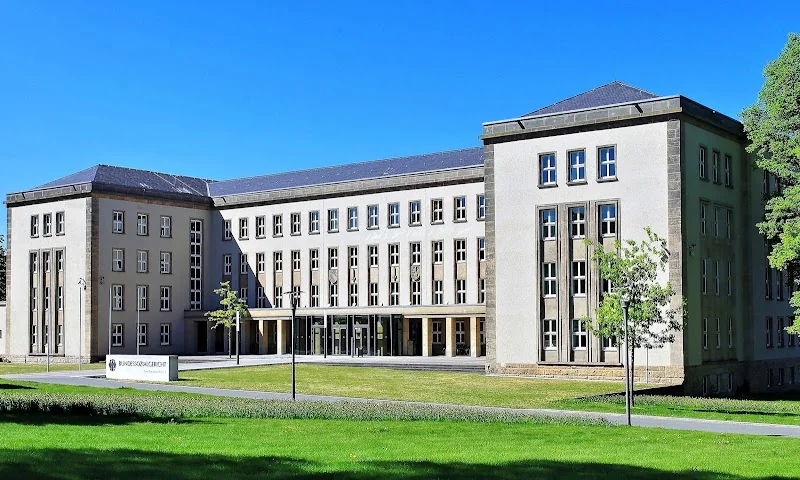
The history of the Federal Social Court is closely linked to the history of the building. The Social Court Act of September 3, 1953, established social jurisdiction; the ceremonial opening of the Federal Social Court took place on September 11, 1954, and the first public session followed on March 23, 1955. However, the current court building was constructed much earlier: the monumental neoclassical complex was built from 1936 to 1938 as a district military service building and general command. After World War II, the extensive area was initially used as an American military hospital before the Federal Labor Court and the Federal Social Court began their work there in 1954. Since 1999, the Federal Social Court has solely used the property after the Federal Labor Court was relocated to Erfurt. The entire complex is listed as a monument ensemble. This layering of the Nazi era, post-war history, the Federal Republic, and modern justice gives the place its special significance. Those searching for Federal Social Court Leipzig may realize that the geographical classification is important: the Kassel building is a historically charged judicial site with its own profile. ([kassel.de](https://www.kassel.de/buerger/kunst_und_kultur/sehenswertes/bundessozialgericht.php))
During the renovation and modernization in 2008 and 2009, the entrance area was relocated to the south towards Wilhelmshöher Allee, and the new large courtroom, the Elisabeth Selbert Hall, was created in the courtyard. Other halls such as Jacob Grimm Hall, Weißenstein Hall, and Bernadotte Hall were modernized or newly integrated into the structure of the building. The Elisabeth Selbert Hall is not only functionally important but also symbolically significant: it represents the liberal character of social jurisprudence and is accessible without barriers for participants in proceedings and visitors. The building thus combines modern use, historical substance, and a clear architectural narrative. Another central component is the library of the Federal Social Court, which was established with the founding of the court in 1954. By the end of 2024, it will have around 215,000 volumes, is also accessible to the public, and is used by researchers, students, and lawyers. Together with the cafeteria and the publicly accessible hearing dates, the library shows that the Federal Social Court is not only a place of decisions but also a place of knowledge, encounter, and legal orientation. This is precisely what makes the location in Kassel so special: historically significant, legally central, and surprisingly open to visitors. ([bsg.bund.de](https://www.bsg.bund.de/DE/Gericht/Gerichtsgebaeude/gerichtsgebaeude_node.html?utm_source=openai))
Sources:
- Federal Social Court - Tasks and Responsibilities
- Federal Social Court - Court Building
- Federal Social Court - President and Vice President
- Federal Social Court - Case Law
- Federal Social Court - Distribution of Cases
- Federal Social Court - Library
- City of Kassel - Federal Social Court
- City of Kassel - Paid Parking Zones
Mehr anzeigenWeniger anzeigen
Federal Social Court | Rulings & Decisions
The Federal Social Court in Kassel is much more than an official building with a representative facade. It is the highest court of the federal government for social jurisdiction and thus the final professional instance for many questions regarding pensions, citizen's income, health insurance, care, employment promotion, and social compensation. Those searching for Federal Social Court Kassel, Federal Social Court rulings, Federal Social Court decisions, or even Federal Social Court location will therefore end up at an institution that combines legal clarity, federal order, and historical significance in one place. The court is located at Graf-Bernadotte-Platz 5 in Kassel, in the Vorderer Westen district at the border to Bad Wilhelmshöhe. The court sees itself as a pure legal instance: it does not establish new facts, but checks whether decisions of the lower courts are compatible with federal law and the law of the European Union. This combination of legal precision, public accessibility, and architectural presence makes the Federal Social Court equally exciting for visitors, legal stakeholders, and those seeking well-founded information. ([bsg.bund.de](https://www.bsg.bund.de/DE/Gericht/Aufgaben-und-Zustaendigkeit/aufgaben-und-zustaendigkeit_node.html))
Rulings and Decisions at the Federal Social Court
Those specifically searching for Federal Social Court rulings or Federal Social Court decisions will find a well-structured access to the court's resolutions and rulings on the official website. The site systematically publishes decisions from 2018 onwards by subject areas and chambers; older decisions are also documented, ensuring that the case law remains not only current but also historically traceable. Particularly helpful is that the distribution of cases clearly indicates which chamber is responsible for which area of law. Thus, complex topics such as statutory health insurance, accident insurance, pension insurance, unemployment insurance, basic security for job seekers, or disability law are not mixed in an unclear overall list but are organized in a comprehensible manner. Additionally, the website publishes hearing dates, making it visible in advance which questions are currently being heard at the Federal Social Court. For users interested in specific disputes such as Federal Social Court citizen's income or Federal Social Court pension, this transparency is particularly valuable as it facilitates the path from the general search term to the appropriate chamber and the relevant decision. The court itself emphasizes that it maintains legal unity and develops the law. This is precisely where the added value of its rulings lies: they provide orientation for courts, administration, lawyers, and those affected. ([bsg.bund.de](https://www.bsg.bund.de/DE/Gericht/Rechtsprechung/rechtsprechung_node.html))
For topics such as Federal Social Court Herrenberg ruling, Federal Social Court Leipzig, or similar search queries, the content classification is important. The Federal Social Court is not located in Leipzig but in Kassel; Leipzig is assigned to the highest federal courts such as the Federal Administrative Court. Therefore, anyone searching for a ruling or decision of the Federal Social Court should choose the Kassel institution as a starting point. The court focuses on questions of social security, which is why many search queries related to social law, pension law, health insurance, or basic security converge there. The chamber structure shows how broad the spectrum is: some chambers primarily deal with statutory health insurance, others with pension insurance, and still others with citizen's income, social assistance, or employment promotion. This is relevant for search engines as well as for users, as it results in very specific topic clusters from general terms such as rulings, decisions, or judges. Understanding the structure allows for faster access to the appropriate document, the responsible chamber, and the relevant legal line. This is precisely why Federal Social Court decisions are not just a search term but an entry into a very systematic form of legal information. ([bsg.bund.de](https://www.bsg.bund.de/DE/Verfahren/Geschaeftsverteilung/geschaeftsverteilung_node.html))
Citizen's Income, Pension, and Social Jurisdiction Responsibilities
The search terms Federal Social Court citizen's income and Federal Social Court pension reflect very precisely what the court is most often perceived for in public. In fact, its jurisdiction extends far beyond individual life situations and encompasses the core areas of the German social security system. This includes statutory pension insurance, statutory accident insurance, statutory and private long-term care insurance, statutory health insurance, artists' social insurance, contract physician law, tasks of the Federal Employment Agency, basic security for job seekers, social assistance, asylum seeker benefits, as well as social compensation and certain transfer payments such as parental allowance. These topics are not only legally important but also directly affect the lives of many people. For this reason, the Federal Social Court places great importance on developing nationwide uniform standards and checking the compatibility of decisions from lower courts with federal law. The thematic breadth also explains why search queries with terms such as Federal Social Court rulings, Federal Social Court decisions, and Federal Social Court citizen's income regularly occur together: many users are not looking for abstract legal information but rather an answer to a specific social question. The court is the central place for this because it shapes the authoritative interpretation and application of social law. ([bsg.bund.de](https://www.bsg.bund.de/DE/Gericht/Aufgaben-und-Zustaendigkeit/aufgaben-und-zustaendigkeit_node.html))
The professional organization of the court is particularly clear. The distribution of cases allocates tasks to twelve chambers, each covering specific areas of law. For example, the 4th chamber is responsible for basic security for job seekers, while the 5th chamber deals with statutory pension insurance, and the 1st chamber addresses statutory health insurance. The 11th chamber deals, among other things, with unemployment insurance and the remaining tasks of the Federal Employment Agency. Therefore, anyone searching for Federal Social Court citizen's income or Federal Social Court pension does not end up in a general legal collection but in a system of clearly assigned responsibilities. This structure also helps to understand the significance of the court as the highest instance: it administers justice through rulings and decisions, develops social law further, and ensures that similar cases are treated as uniformly as possible nationwide. This is precisely why the Federal Social Court is the central address for citizen's income questions, pension disputes, health insurance cases, and many other social law conflicts. Its function is not only institutional but also very practical: it connects individual case justice with legal clarity, thereby creating trust in a system that is existential for many people. ([bsg.bund.de](https://www.bsg.bund.de/DE/Verfahren/Geschaeftsverteilung/geschaeftsverteilung_node.html))
President, Judges, and Jobs at the Federal Social Court
The search terms Federal Social Court president, Federal Social Court judges, and Federal Social Court employees lead to clear, current facts. Since March 1, 2024, Dr. Christine Fuchsloch has been the first woman at the head of the court; she leads the Federal Social Court and simultaneously holds a special judicial position. Her permanent representative is Vice President Andreas Heinz, who has been in office since August 24, 2023. For users inquiring about the personnel structure, it is also interesting to note that as of January 1, 2026, the court employed a total of 19 professional female judges and 21 professional male judges, including several presiding judges. In addition, there are honorary judges who contribute their special expertise to many social court questions. This interplay of professional judges and honorary participation is typical for social jurisdiction and explains why the court functions not only as a legal machine but as a professionally broad-based organ. For public perception, it is also significant that the Federal Social Court explains its work extensively through its website, press releases, and publicly communicated hearing dates. ([bsg.bund.de](https://www.bsg.bund.de/DE/Gericht/Praesidentin_Vizepraesident/praesidentin_vizepraesident_node.html))
Those searching for Federal Social Court jobs or Federal Social Court Kassel jobs will find a section for job postings on the website. There, job advertisements and tenders from the awarding authority are published, if available. This is important because behind the search term are not only classic administrative jobs but also technical, scientific, or organizational roles. The chambers are also supported by scientific staff; these are usually judges from social courts who are seconded to the Federal Social Court for a period of regularly two years. Their main task is to assist the chambers in processing cases, for example, through preparatory work, opinions, and the examination of individual legal questions. It is clear that the court works not only with the visible judiciary but also with a multifaceted professional infrastructure. For Federal Social Court employees, therefore, not only the judicial level is relevant but also the scientific and administrative work in the background. Anyone interested in a career or a change should keep an eye on the job postings, the administrative area, and the information about the organization. ([bsg.bund.de](https://www.bsg.bund.de/SiteGlobals/Forms/Suche/DE/Expertensuche_Formular.html?dateOfIssue_dt=2020+2025+2016+2012+2011+2013+2024+2018+2014+2023+2021+2017>p=10536134_list%253D2&pageNo=0&queryResultId=null&sortOrder=dateOfIssue_dt+desc&utm_source=openai))
Where is the Federal Social Court located in Kassel?
The question Federal Social Court location can be answered quite clearly: the address is Graf-Bernadotte-Platz 5, 34119 Kassel. The building is located in the Kassel district of Vorderer Westen at the border to Bad Wilhelmshöhe and is already well classified from an urban planning perspective as a prominent structure. The city of Kassel describes the Federal Social Court as one of the five highest courts of the federal government, along with the federal courts in Erfurt, Munich, Karlsruhe, and Leipzig. This classification makes the location so interesting for visitors: this is not just any administration but a supreme federal court of nationwide significance. The city of Kassel also refers to map and route planner functions as well as to a public transport connection, making the location easy to find for guests without local knowledge. For all those searching for the term Federal Social Court seat, the location is thus clearly defined: Kassel, Graf-Bernadotte-Platz, directly at a prominent urban point in the west of the city. ([kassel.de](https://www.kassel.de/buerger/kunst_und_kultur/sehenswertes/bundessozialgericht.php))
The location is also well documented for arrival. The city of Kassel designates the area of Graf-Bernadotte-Platz as a paid parking zone, in close proximity to the Wilhelmshöhe train station. This is important for drivers because it allows for an advance assessment that parking in this area is not free and the parking regulations must be observed. The parking zone overview lists day and long-term parking options for Graf-Bernadotte-Platz; additionally, mobile parking is provided in this zone. For visitors who come to the court in the context of hearing dates, tours, or library use, the combination of a central location and urban parking management is particularly relevant. The location is therefore not only a postal address but a clearly organized urban place where justice, urban structure, and traffic converge. Those researching Federal Social Court Kassel, Federal Social Court seat, or Federal Social Court location should be aware of this location in the west of Kassel, as it significantly facilitates practical orientation on site. ([www1.kassel.de](https://www1.kassel.de/buerger/verkehr_und_mobilitaet/mit-dem-auto/inhaltsseiten/gebuehrenpflichte-parkzonen.php?utm_source=openai))
Access, Parking, Hearing Visits, and Cafeteria
The search terms Federal Social Court cafeteria, Federal Social Court Kassel jobs, and Federal Social Court citizen's income are different, but they often lead to the same practical questions: How do I get there, where can I park, and what can I expect on site? For hearing visits, it is important that the Federal Social Court generally conducts its oral hearings and rulings publicly. Individuals and groups can attend these dates, and tours of the court building are also possible for visitor groups. The city of Kassel also directly refers to a public transport connection, a route planner, and a map view, allowing for advance organization of the arrival. This is particularly helpful when planning an appointment in the Elisabeth Selbert Hall, a public hearing, or a visit to the library. Those arriving by car should keep an eye on the parking zone at Graf-Bernadotte-Platz as it is paid and located near the Wilhelmshöhe train station. For visitors who want to experience the atmosphere of the place, the accessibility is a clear advantage: the court is not isolated but situated in a well-connected urban location that works for both legal appointments and interested guests. ([bsg.bund.de](https://www.bsg.bund.de/SiteGlobals/Forms/Suche/DE/Expertensuche_Formular.html?dateOfIssue_dt=2025+2023+2019+2021+2018+2015>p=10536134_list%253D59&sortOrder=dateOfIssue_dt+desc&utm_source=openai))
The quality of stay is also enhanced by the infrastructure within the building itself. The Federal Social Court has a publicly accessible cafeteria that was newly created during the modernization. Thus, the often-searched term Federal Social Court cafeteria is well captured, even though the official designation is cafeteria. Additionally, for many visitors, the library, which is part of the Scientific Service and has been opened for external users, is worth a visit. The opening hours are clearly regulated: Monday to Thursday from 8 AM to 4 PM and Friday from 8 AM to 2 PM. This makes the place interesting not only for participants in proceedings but also for researchers, students, and lawyers. Therefore, anyone planning a visit should combine the arrival with a look at parking zones, public transport, and the type of appointment. Especially for public hearings or group tours, early planning is worthwhile. The Federal Social Court is thus a place where functional judicial architecture meets visitor friendliness: publicly accessible, clearly organized, and well anchored in the everyday life of the city of Kassel. ([bsg.bund.de](https://www.bsg.bund.de/DE/Gericht/Gerichtsgebaeude/gerichtsgebaeude_node.html?utm_source=openai))
History, Court Building, and Library
The history of the Federal Social Court is closely linked to the history of the building. The Social Court Act of September 3, 1953, established social jurisdiction; the ceremonial opening of the Federal Social Court took place on September 11, 1954, and the first public session followed on March 23, 1955. However, the current court building was constructed much earlier: the monumental neoclassical complex was built from 1936 to 1938 as a district military service building and general command. After World War II, the extensive area was initially used as an American military hospital before the Federal Labor Court and the Federal Social Court began their work there in 1954. Since 1999, the Federal Social Court has solely used the property after the Federal Labor Court was relocated to Erfurt. The entire complex is listed as a monument ensemble. This layering of the Nazi era, post-war history, the Federal Republic, and modern justice gives the place its special significance. Those searching for Federal Social Court Leipzig may realize that the geographical classification is important: the Kassel building is a historically charged judicial site with its own profile. ([kassel.de](https://www.kassel.de/buerger/kunst_und_kultur/sehenswertes/bundessozialgericht.php))
During the renovation and modernization in 2008 and 2009, the entrance area was relocated to the south towards Wilhelmshöher Allee, and the new large courtroom, the Elisabeth Selbert Hall, was created in the courtyard. Other halls such as Jacob Grimm Hall, Weißenstein Hall, and Bernadotte Hall were modernized or newly integrated into the structure of the building. The Elisabeth Selbert Hall is not only functionally important but also symbolically significant: it represents the liberal character of social jurisprudence and is accessible without barriers for participants in proceedings and visitors. The building thus combines modern use, historical substance, and a clear architectural narrative. Another central component is the library of the Federal Social Court, which was established with the founding of the court in 1954. By the end of 2024, it will have around 215,000 volumes, is also accessible to the public, and is used by researchers, students, and lawyers. Together with the cafeteria and the publicly accessible hearing dates, the library shows that the Federal Social Court is not only a place of decisions but also a place of knowledge, encounter, and legal orientation. This is precisely what makes the location in Kassel so special: historically significant, legally central, and surprisingly open to visitors. ([bsg.bund.de](https://www.bsg.bund.de/DE/Gericht/Gerichtsgebaeude/gerichtsgebaeude_node.html?utm_source=openai))
Sources:
- Federal Social Court - Tasks and Responsibilities
- Federal Social Court - Court Building
- Federal Social Court - President and Vice President
- Federal Social Court - Case Law
- Federal Social Court - Distribution of Cases
- Federal Social Court - Library
- City of Kassel - Federal Social Court
- City of Kassel - Paid Parking Zones
Federal Social Court | Rulings & Decisions
The Federal Social Court in Kassel is much more than an official building with a representative facade. It is the highest court of the federal government for social jurisdiction and thus the final professional instance for many questions regarding pensions, citizen's income, health insurance, care, employment promotion, and social compensation. Those searching for Federal Social Court Kassel, Federal Social Court rulings, Federal Social Court decisions, or even Federal Social Court location will therefore end up at an institution that combines legal clarity, federal order, and historical significance in one place. The court is located at Graf-Bernadotte-Platz 5 in Kassel, in the Vorderer Westen district at the border to Bad Wilhelmshöhe. The court sees itself as a pure legal instance: it does not establish new facts, but checks whether decisions of the lower courts are compatible with federal law and the law of the European Union. This combination of legal precision, public accessibility, and architectural presence makes the Federal Social Court equally exciting for visitors, legal stakeholders, and those seeking well-founded information. ([bsg.bund.de](https://www.bsg.bund.de/DE/Gericht/Aufgaben-und-Zustaendigkeit/aufgaben-und-zustaendigkeit_node.html))
Rulings and Decisions at the Federal Social Court
Those specifically searching for Federal Social Court rulings or Federal Social Court decisions will find a well-structured access to the court's resolutions and rulings on the official website. The site systematically publishes decisions from 2018 onwards by subject areas and chambers; older decisions are also documented, ensuring that the case law remains not only current but also historically traceable. Particularly helpful is that the distribution of cases clearly indicates which chamber is responsible for which area of law. Thus, complex topics such as statutory health insurance, accident insurance, pension insurance, unemployment insurance, basic security for job seekers, or disability law are not mixed in an unclear overall list but are organized in a comprehensible manner. Additionally, the website publishes hearing dates, making it visible in advance which questions are currently being heard at the Federal Social Court. For users interested in specific disputes such as Federal Social Court citizen's income or Federal Social Court pension, this transparency is particularly valuable as it facilitates the path from the general search term to the appropriate chamber and the relevant decision. The court itself emphasizes that it maintains legal unity and develops the law. This is precisely where the added value of its rulings lies: they provide orientation for courts, administration, lawyers, and those affected. ([bsg.bund.de](https://www.bsg.bund.de/DE/Gericht/Rechtsprechung/rechtsprechung_node.html))
For topics such as Federal Social Court Herrenberg ruling, Federal Social Court Leipzig, or similar search queries, the content classification is important. The Federal Social Court is not located in Leipzig but in Kassel; Leipzig is assigned to the highest federal courts such as the Federal Administrative Court. Therefore, anyone searching for a ruling or decision of the Federal Social Court should choose the Kassel institution as a starting point. The court focuses on questions of social security, which is why many search queries related to social law, pension law, health insurance, or basic security converge there. The chamber structure shows how broad the spectrum is: some chambers primarily deal with statutory health insurance, others with pension insurance, and still others with citizen's income, social assistance, or employment promotion. This is relevant for search engines as well as for users, as it results in very specific topic clusters from general terms such as rulings, decisions, or judges. Understanding the structure allows for faster access to the appropriate document, the responsible chamber, and the relevant legal line. This is precisely why Federal Social Court decisions are not just a search term but an entry into a very systematic form of legal information. ([bsg.bund.de](https://www.bsg.bund.de/DE/Verfahren/Geschaeftsverteilung/geschaeftsverteilung_node.html))
Citizen's Income, Pension, and Social Jurisdiction Responsibilities
The search terms Federal Social Court citizen's income and Federal Social Court pension reflect very precisely what the court is most often perceived for in public. In fact, its jurisdiction extends far beyond individual life situations and encompasses the core areas of the German social security system. This includes statutory pension insurance, statutory accident insurance, statutory and private long-term care insurance, statutory health insurance, artists' social insurance, contract physician law, tasks of the Federal Employment Agency, basic security for job seekers, social assistance, asylum seeker benefits, as well as social compensation and certain transfer payments such as parental allowance. These topics are not only legally important but also directly affect the lives of many people. For this reason, the Federal Social Court places great importance on developing nationwide uniform standards and checking the compatibility of decisions from lower courts with federal law. The thematic breadth also explains why search queries with terms such as Federal Social Court rulings, Federal Social Court decisions, and Federal Social Court citizen's income regularly occur together: many users are not looking for abstract legal information but rather an answer to a specific social question. The court is the central place for this because it shapes the authoritative interpretation and application of social law. ([bsg.bund.de](https://www.bsg.bund.de/DE/Gericht/Aufgaben-und-Zustaendigkeit/aufgaben-und-zustaendigkeit_node.html))
The professional organization of the court is particularly clear. The distribution of cases allocates tasks to twelve chambers, each covering specific areas of law. For example, the 4th chamber is responsible for basic security for job seekers, while the 5th chamber deals with statutory pension insurance, and the 1st chamber addresses statutory health insurance. The 11th chamber deals, among other things, with unemployment insurance and the remaining tasks of the Federal Employment Agency. Therefore, anyone searching for Federal Social Court citizen's income or Federal Social Court pension does not end up in a general legal collection but in a system of clearly assigned responsibilities. This structure also helps to understand the significance of the court as the highest instance: it administers justice through rulings and decisions, develops social law further, and ensures that similar cases are treated as uniformly as possible nationwide. This is precisely why the Federal Social Court is the central address for citizen's income questions, pension disputes, health insurance cases, and many other social law conflicts. Its function is not only institutional but also very practical: it connects individual case justice with legal clarity, thereby creating trust in a system that is existential for many people. ([bsg.bund.de](https://www.bsg.bund.de/DE/Verfahren/Geschaeftsverteilung/geschaeftsverteilung_node.html))
President, Judges, and Jobs at the Federal Social Court
The search terms Federal Social Court president, Federal Social Court judges, and Federal Social Court employees lead to clear, current facts. Since March 1, 2024, Dr. Christine Fuchsloch has been the first woman at the head of the court; she leads the Federal Social Court and simultaneously holds a special judicial position. Her permanent representative is Vice President Andreas Heinz, who has been in office since August 24, 2023. For users inquiring about the personnel structure, it is also interesting to note that as of January 1, 2026, the court employed a total of 19 professional female judges and 21 professional male judges, including several presiding judges. In addition, there are honorary judges who contribute their special expertise to many social court questions. This interplay of professional judges and honorary participation is typical for social jurisdiction and explains why the court functions not only as a legal machine but as a professionally broad-based organ. For public perception, it is also significant that the Federal Social Court explains its work extensively through its website, press releases, and publicly communicated hearing dates. ([bsg.bund.de](https://www.bsg.bund.de/DE/Gericht/Praesidentin_Vizepraesident/praesidentin_vizepraesident_node.html))
Those searching for Federal Social Court jobs or Federal Social Court Kassel jobs will find a section for job postings on the website. There, job advertisements and tenders from the awarding authority are published, if available. This is important because behind the search term are not only classic administrative jobs but also technical, scientific, or organizational roles. The chambers are also supported by scientific staff; these are usually judges from social courts who are seconded to the Federal Social Court for a period of regularly two years. Their main task is to assist the chambers in processing cases, for example, through preparatory work, opinions, and the examination of individual legal questions. It is clear that the court works not only with the visible judiciary but also with a multifaceted professional infrastructure. For Federal Social Court employees, therefore, not only the judicial level is relevant but also the scientific and administrative work in the background. Anyone interested in a career or a change should keep an eye on the job postings, the administrative area, and the information about the organization. ([bsg.bund.de](https://www.bsg.bund.de/SiteGlobals/Forms/Suche/DE/Expertensuche_Formular.html?dateOfIssue_dt=2020+2025+2016+2012+2011+2013+2024+2018+2014+2023+2021+2017>p=10536134_list%253D2&pageNo=0&queryResultId=null&sortOrder=dateOfIssue_dt+desc&utm_source=openai))
Where is the Federal Social Court located in Kassel?
The question Federal Social Court location can be answered quite clearly: the address is Graf-Bernadotte-Platz 5, 34119 Kassel. The building is located in the Kassel district of Vorderer Westen at the border to Bad Wilhelmshöhe and is already well classified from an urban planning perspective as a prominent structure. The city of Kassel describes the Federal Social Court as one of the five highest courts of the federal government, along with the federal courts in Erfurt, Munich, Karlsruhe, and Leipzig. This classification makes the location so interesting for visitors: this is not just any administration but a supreme federal court of nationwide significance. The city of Kassel also refers to map and route planner functions as well as to a public transport connection, making the location easy to find for guests without local knowledge. For all those searching for the term Federal Social Court seat, the location is thus clearly defined: Kassel, Graf-Bernadotte-Platz, directly at a prominent urban point in the west of the city. ([kassel.de](https://www.kassel.de/buerger/kunst_und_kultur/sehenswertes/bundessozialgericht.php))
The location is also well documented for arrival. The city of Kassel designates the area of Graf-Bernadotte-Platz as a paid parking zone, in close proximity to the Wilhelmshöhe train station. This is important for drivers because it allows for an advance assessment that parking in this area is not free and the parking regulations must be observed. The parking zone overview lists day and long-term parking options for Graf-Bernadotte-Platz; additionally, mobile parking is provided in this zone. For visitors who come to the court in the context of hearing dates, tours, or library use, the combination of a central location and urban parking management is particularly relevant. The location is therefore not only a postal address but a clearly organized urban place where justice, urban structure, and traffic converge. Those researching Federal Social Court Kassel, Federal Social Court seat, or Federal Social Court location should be aware of this location in the west of Kassel, as it significantly facilitates practical orientation on site. ([www1.kassel.de](https://www1.kassel.de/buerger/verkehr_und_mobilitaet/mit-dem-auto/inhaltsseiten/gebuehrenpflichte-parkzonen.php?utm_source=openai))
Access, Parking, Hearing Visits, and Cafeteria
The search terms Federal Social Court cafeteria, Federal Social Court Kassel jobs, and Federal Social Court citizen's income are different, but they often lead to the same practical questions: How do I get there, where can I park, and what can I expect on site? For hearing visits, it is important that the Federal Social Court generally conducts its oral hearings and rulings publicly. Individuals and groups can attend these dates, and tours of the court building are also possible for visitor groups. The city of Kassel also directly refers to a public transport connection, a route planner, and a map view, allowing for advance organization of the arrival. This is particularly helpful when planning an appointment in the Elisabeth Selbert Hall, a public hearing, or a visit to the library. Those arriving by car should keep an eye on the parking zone at Graf-Bernadotte-Platz as it is paid and located near the Wilhelmshöhe train station. For visitors who want to experience the atmosphere of the place, the accessibility is a clear advantage: the court is not isolated but situated in a well-connected urban location that works for both legal appointments and interested guests. ([bsg.bund.de](https://www.bsg.bund.de/SiteGlobals/Forms/Suche/DE/Expertensuche_Formular.html?dateOfIssue_dt=2025+2023+2019+2021+2018+2015>p=10536134_list%253D59&sortOrder=dateOfIssue_dt+desc&utm_source=openai))
The quality of stay is also enhanced by the infrastructure within the building itself. The Federal Social Court has a publicly accessible cafeteria that was newly created during the modernization. Thus, the often-searched term Federal Social Court cafeteria is well captured, even though the official designation is cafeteria. Additionally, for many visitors, the library, which is part of the Scientific Service and has been opened for external users, is worth a visit. The opening hours are clearly regulated: Monday to Thursday from 8 AM to 4 PM and Friday from 8 AM to 2 PM. This makes the place interesting not only for participants in proceedings but also for researchers, students, and lawyers. Therefore, anyone planning a visit should combine the arrival with a look at parking zones, public transport, and the type of appointment. Especially for public hearings or group tours, early planning is worthwhile. The Federal Social Court is thus a place where functional judicial architecture meets visitor friendliness: publicly accessible, clearly organized, and well anchored in the everyday life of the city of Kassel. ([bsg.bund.de](https://www.bsg.bund.de/DE/Gericht/Gerichtsgebaeude/gerichtsgebaeude_node.html?utm_source=openai))
History, Court Building, and Library
The history of the Federal Social Court is closely linked to the history of the building. The Social Court Act of September 3, 1953, established social jurisdiction; the ceremonial opening of the Federal Social Court took place on September 11, 1954, and the first public session followed on March 23, 1955. However, the current court building was constructed much earlier: the monumental neoclassical complex was built from 1936 to 1938 as a district military service building and general command. After World War II, the extensive area was initially used as an American military hospital before the Federal Labor Court and the Federal Social Court began their work there in 1954. Since 1999, the Federal Social Court has solely used the property after the Federal Labor Court was relocated to Erfurt. The entire complex is listed as a monument ensemble. This layering of the Nazi era, post-war history, the Federal Republic, and modern justice gives the place its special significance. Those searching for Federal Social Court Leipzig may realize that the geographical classification is important: the Kassel building is a historically charged judicial site with its own profile. ([kassel.de](https://www.kassel.de/buerger/kunst_und_kultur/sehenswertes/bundessozialgericht.php))
During the renovation and modernization in 2008 and 2009, the entrance area was relocated to the south towards Wilhelmshöher Allee, and the new large courtroom, the Elisabeth Selbert Hall, was created in the courtyard. Other halls such as Jacob Grimm Hall, Weißenstein Hall, and Bernadotte Hall were modernized or newly integrated into the structure of the building. The Elisabeth Selbert Hall is not only functionally important but also symbolically significant: it represents the liberal character of social jurisprudence and is accessible without barriers for participants in proceedings and visitors. The building thus combines modern use, historical substance, and a clear architectural narrative. Another central component is the library of the Federal Social Court, which was established with the founding of the court in 1954. By the end of 2024, it will have around 215,000 volumes, is also accessible to the public, and is used by researchers, students, and lawyers. Together with the cafeteria and the publicly accessible hearing dates, the library shows that the Federal Social Court is not only a place of decisions but also a place of knowledge, encounter, and legal orientation. This is precisely what makes the location in Kassel so special: historically significant, legally central, and surprisingly open to visitors. ([bsg.bund.de](https://www.bsg.bund.de/DE/Gericht/Gerichtsgebaeude/gerichtsgebaeude_node.html?utm_source=openai))
Sources:
- Federal Social Court - Tasks and Responsibilities
- Federal Social Court - Court Building
- Federal Social Court - President and Vice President
- Federal Social Court - Case Law
- Federal Social Court - Distribution of Cases
- Federal Social Court - Library
- City of Kassel - Federal Social Court
- City of Kassel - Paid Parking Zones
Frequently Asked Questions
Reviews
No reviews found