
Niestetal
Breite Str. 9A, 34266 Niestetal, Deutschland
Evangelical Church Heiligenrode | Service Schedule & History
The Evangelical Church Heiligenrode is one of the most significant places in the old village center of Niestetal and at the same time a building that closely connects history, community life, and quiet presence. The district of Heiligenrode is described by the municipality of Niestetal as a linear village, with the church as its architectural centerpiece. This special location is still felt today: the church does not stand as an anonymous solitary structure on the edge, but forms the historical heart of a developed village landscape. The Evangelical congregation also informs that the church is open daily during the summer months and the key is located in the Evangelical community office. Thus, the church is not only a house of worship for Sunday services but also an open place for people seeking peace, village history, or a brief visit to the village center. ([niestetal.de](https://www.niestetal.de/gv_niestetal/Leben%20%26%20Wohnen/Gemeindeportr%C3%A4t/Geschichte/))
Visitors to the church encounter a building whose current form was likely completed in the late 18th century. The year 1768 on the weather vane most likely indicates the completion of the current church, according to the municipality. At the same time, the site shows much older traces: Gothic remnants of the defensive wall, a relocated pointed arch portal, discovered foundations, and even early burial sites provide evidence that this place has been used religiously and socially for centuries. In Heiligenrode, the church is not just a building but a visible repository of local history, where the Reformation, village development, and today's community life overlap. ([niestetal.de](https://www.niestetal.de/gv_niestetal/Freizeit%20%26%20Tourismus/Erlebnisspazierg%C3%A4nge%20Dorfgeschichte%28n%29/Heiligenr%C3%B6der%20Dorfgeschichten/1%20%7C%20Dorfentstehung%20und%20Kirche/))
Services and Service Schedule at the Evangelical Church Heiligenrode
The most important search interest regarding the Evangelical Church Heiligenrode concerns the services, and here the church community provides clear, up-to-date information. For the church in Heiligenrode, the service times are clearly described on the official page: on odd Sundays of the month, that is, on the 1st, 3rd, and 5th Sundays, the service begins at 9:30 AM. On even Sundays, that is, on the 2nd and 4th Sundays, the service begins at 11:00 AM. Additionally, children's services are offered on the 1st Sunday of the month at 11:00 AM. Thus, the weekly rhythm is not random but intentionally oriented towards a reliable community calendar that appeals to both regular visitors and families. ([evangelisch-in-niestetal.de](https://www.evangelisch-in-niesetal.de/gottesdienste/gottesdienste/))
The official service schedule is particularly helpful for visitors because the Evangelical Church Community Niestetal does not view its church in isolation but organizes it in conjunction with Sandershausen. This means: Those searching for "Service Schedule Heiligenrode" or "Services Heiligenrode" will find not only a date but a system of fixed times and changing focuses. This reliability is particularly important for a village church because it provides orientation in everyday life and visibly anchors the church in weekly life. The children's service adds a family-friendly component to this offer, and the community's page shows that Heiligenrode is not just a historical backdrop but a place of vibrant church practice. ([evangelisch-in-niestetal.de](https://www.evangelisch-in-niestetal.de/gottesdienste/gottesdienste/))
For search queries like "ev church heiligenrode" or "evangelical church community heiligenrode", this fixed rhythm is a central feature. The community presents the service schedule not merely as information but as an invitation to regularly use the church space. This is particularly important for those specifically looking for service times, children's services, or a brief respite in the church. In the context of Heiligenrode, this reliability fits well with the developed village structure: the church stands at the center, the dates are clearly traceable, and the opening in the summer months makes the place additionally accessible. Thus, the service schedule becomes a practical entry point into the entire church and local life. ([evangelisch-in-niestetal.de](https://www.evangelisch-in-niestetal.de/gottesdienste/gottesdienste/))
History of the Church Heiligenrode: Defensive Wall, Foundations, and Late Baroque Building
The history of the Church Heiligenrode goes back much further than the current building. The Evangelical Church Community states that it is unclear when the first small chapel or church in Heiligenrode was established, but it is certain that there was a place of worship before the current 18th-century church. Evidence of this is provided by the remains of a Gothic defensive wall surrounding the churchyard as well as the oldest houses of the village on the outside of this wall. According to the municipality, this protection was erected around 1384 when battles were fought between the landgrave and the archbishop of Mainz in the Kassel area. The churchyard served not only religious purposes at that time but also as a meeting place, court, and refuge in danger. ([evangelisch-in-niestetal.de](https://www.evangelisch-in-niestetal.de/wir-vor-ort/geschichte-der-kirche-heiligenrode/))
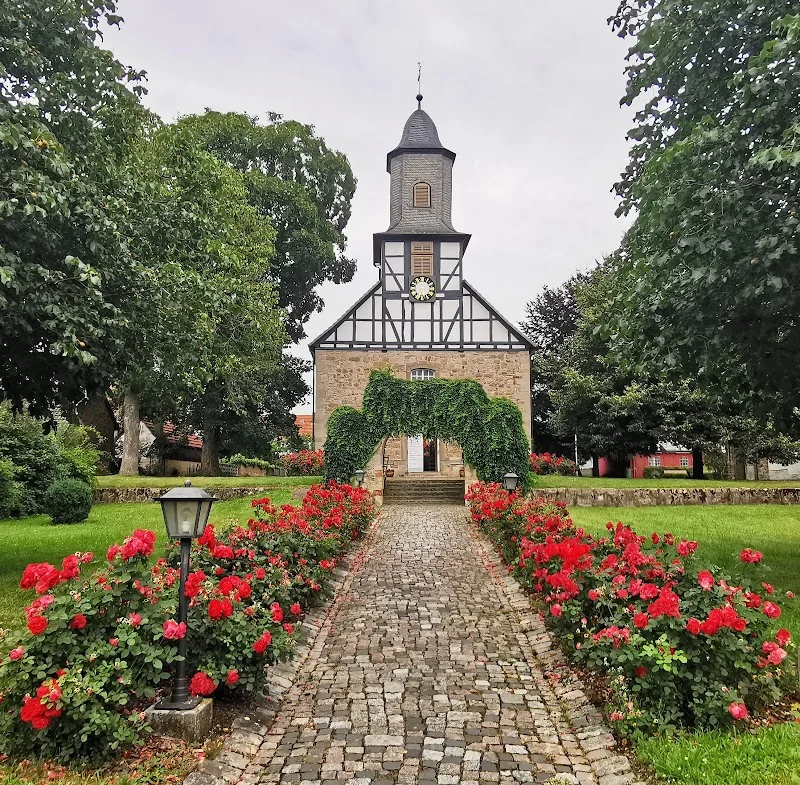
The current church itself is described as a late Baroque building constructed of rubble stone masonry, while the gable and tower are made of timber framing. High, flat-arched window openings with finely crafted sandstone give the building its bright, clear effect. The weather vane with the year 1768 is most likely an indication of its completion. During cellar work in 1959, old foundations were also discovered, suggesting an even smaller predecessor church. Between the old and younger foundations, bones were found, indicating that people were once buried directly next to the church under the protection of the walls. These findings connect architecture, piety, and everyday history in a very vivid way. ([niestetal.de](https://www.niestetal.de/gv_niestetal/Freizeit%20%26%20Tourismus/Erlebnisspazierg%C3%A4nge%20Dorfgeschichte%28n%29/Heiligenr%C3%B6der%20Dorfgeschichten/1%20%7C%20Dorfentstehung%20und%20Kirche/))
Among the special historical details is the Gothic pointed arch portal, which was relocated in 1933 and originally belonged to the southwest corner of the enclosing wall and was placed in front of the west portal of the church. The wall remains thus tell not only of ancient craftsmanship but also of later interventions in the monument. On the south side of the churchyard stand baroque gravestones of Pastor Alsfeld, who died in 1767, and the young Prince Ludwig Carl von Ysenburg, who died in 1758 and fell at the Battle of Sandershausen Hill. Additionally, there is an early Gothic bell from the 14th century, which is still in use as the third-largest bell. This mixture of building, grave, bell, and wall makes the church a place where the long history is not abstract but visibly and audibly present. ([niestetal.de](https://www.niestetal.de/gv_niestetal/Freizeit%20%26%20Tourismus/Erlebnisspazierg%C3%A4nge%20Dorfgeschichte%28n%29/Heiligenr%C3%B6der%20Dorfgeschichten/1%20%7C%20Dorfentstehung%20und%20Kirche/))
Bible Garden, Churchyard, and Special Atmosphere in the Middle of the Village
A significant part of the search queries regarding the Evangelical Church Heiligenrode focuses on atmosphere and special features, and here the Bible Garden at the church is a strong example. The church community describes the property as an ancient site in the middle of the village, with grassy areas around the church that were once burial sites, with a romantic archway and thick sandstone walls that shape the developed enclosure. There are also small half-timbered houses in the immediate vicinity. This place does not appear merely as a churchyard but as a historically rich space where village, religion, and memory intertwine. This is a significant attraction for visitors seeking a quiet, beautiful, and historically conscious environment. ([evangelisch-in-niestetal.de](https://www.evangelisch-in-niestetal.de/wir-vor-ort/bibelgarten-opferhof/))
The Bible Garden itself was created on the site of a fire ruin at the Opferhof. After the house of the Zuber family burned down in 2005 during Holy Week and a new building did not seem sensible, the family donated the fire ruin along with the property to the church community. The community had the remains demolished, initially secured the site provisionally, and then developed a permanent design starting in 2009. A path has been created with a tree disc around an existing blood beech and a second tree disc with an apple tree as a symbol of Christian hope. The forms of Alpha and Omega are reflected in the ground and remind of the biblical word about the beginning and the end. Dry stone walls, gravel, sandstone blocks, seating areas, and biblical plants such as roses, boxwood, lilies, and holly give the garden a calm, poetic shape. ([evangelisch-in-niestetal.de](https://www.evangelisch-in-niestetal.de/wir-vor-ort/bibelgarten-opferhof/))
It is particularly beautiful that the Bible Garden not only has a decorative effect but also conveys a theological idea without being didactic. The view remains unobstructed on the south side of the church while simultaneously creating a new connection between the church and the community house. The community describes the space as an inviting spot in the middle of the village where one can walk, sit, and reflect. For this reason, the Bible Garden fits so well with Heiligenrode: it connects the medieval historical layer of the churchyard with a modern, open form of community culture. Therefore, those who want to understand the church not only as a place of worship but as a place of reflection will find here a quiet yet very meaningful access. ([evangelisch-in-niestetal.de](https://www.evangelisch-in-niestetal.de/wir-vor-ort/bibelgarten-opferhof/))
Location, Access, and Orientation in Niestetal-Heiligenrode
The official church overview lists the Evangelical Church Heiligenrode at Breite Straße 1 in 34266 Niestetal. This places the house of worship clearly in the village center of Heiligenrode and not on the outskirts. For visitors, this central position is important because it makes the church understandable as part of the developed village structure. The municipality of Niestetal describes Heiligenrode as a linear village with the church as its architectural centerpiece, and this shapes the orientation on site. Therefore, those moving around in Heiligenrode quickly realize that the church is not only a destination but a reference point for the entire historical village image. ([evangelisch-in-niestetal.de](https://www.evangelisch-in-niestetal.de/wir-vor-ort/unsere-kirchen/))
For travel, the community context is also helpful. According to the municipality, Niestetal lies at the direct city limits of Kassel, with access to the BAB 7 and good public transport connections. The community also states that buses typically run every half hour to Kassel and back, and that the district of Heiligenrode has further infrastructure. This means for visitors to the church: Orientation is achieved not only through the address but also through the urban-rural connection of Kassel and Niestetal. Those visiting the church by car or bus move in a well-connected area that still retains its rural character. ([niestetal.de](https://www.niestetal.de/gv_niestetal/Leben%20%26%20Wohnen/?utm_source=openai))
The official church website does not mention a separate parking facility. This may not be a spectacular finding for search queries like "parking", but it is an honest piece of information: the church is a village-embedded location in the historical center, and the official site primarily refers to opening hours, community office, and service times, not to a designated visitor parking lot. Therefore, those planning a visit should consider the central location in the village center, local signage, and the structures of the village core. Especially with a church that has a long-established churchyard and a close historical environment, this orientation is often more helpful than the expectation of a large parking lot directly at the entrance. ([evangelisch-in-niestetal.de](https://www.evangelisch-in-niestetal.de/wir-vor-ort/unsere-kirchen/))
Community Life, Children's Services, and Cultural Offerings Around Heiligenrode
The Evangelical Church Heiligenrode is not only a monument but also an active part of community life in Niestetal. This is already evident in the children's service, which takes place on the 1st Sunday of the month at 11:00 AM, and in the clear structure of the service schedule. Furthermore, the church community collaborates with several church locations in Niestetal and continuously informs about offers and current dates on its website. This is important for families, regular visitors, and people who are just seeking access to the community: the church is open, predictable, and integrated into the life of the village. The summer opening and the key in the community office are practical signs of a church that does not isolate itself but invites. ([evangelisch-in-niestetal.de](https://www.evangelisch-in-niestetal.de/gottesdienste/gottesdienste/))
A cultural highlight is the Niestetal Chamber Concerts. The municipality of Niestetal states that this series has been taking place regularly for over 30 years and has become a fixed part of the Kassel music scene. Organized by the Evangelical Church Community and subsidized by the political community, the concerts reach not only people from the village but also an audience from the wider Kassel area. The community also emphasizes that the church and community house are acoustically and architecturally particularly well-suited and that there are pianos, concert pianos, chest organs, and an extended church organ available for use. This shows that Heiligenrode forms a strong place in the community area not only religiously but also musically. ([niestetal.de](https://www.niestetal.de/gv_niestetal/Freizeit%20%26%20Tourismus/Freizeitangebote/Niestetaler%20Kammerkonzerte/?utm_source=openai))
This connection of liturgy, music, and village history makes the Evangelical Church Heiligenrode so interesting for visitors looking for more than just a simple local church. Here, everyday piety, historical layering, and cultural openness meet. The church stands in the middle of the village, is open during the summer months, hosts regular services, and offers a quiet space to linger with the Bible Garden. At the same time, it is part of a larger community life that extends far beyond the classic Sunday framework with chamber concerts and reliable dates. Exactly therein lies the special quality of the place: Heiligenrode has grown historically but is by no means museum-like, but rather lively and current. ([evangelisch-in-niestetal.de](https://www.evangelisch-in-niestetal.de/wir-vor-ort/unsere-kirchen/))
Architecture, Renovations, and Visible Traces of Long Construction History
When viewing the Evangelical Church Heiligenrode as a structure, it quickly becomes apparent that several times overlap here. The current building is late Baroque, constructed of rubble stone masonry, and equipped with timber framing at the gable and tower. The sandstone frames of the windows, the clear bright effect, and the compact village church form give it a calm, dignified character. At the same time, various traces in and on the building contribute to the fact that the church does not hide its history. The recurring renovations show that the house of worship has not been conserved but continuously maintained. In the 1980s, the old mechanical control system of the church tower clock was replaced by a modern one, but the old system is still present in the tower and reminds of earlier times of maintenance and technology. ([niestetal.de](https://www.niestetal.de/gv_niestetal/Freizeit%20%26%20Tourismus/Erlebnisspazierg%C3%A4nge%20Dorfgeschichte%28n%29/Heiligenr%C3%B6der%20Dorfgeschichten/1%20%7C%20Dorfentstehung%20und%20Kirche/))
This care also continued in the interior. In 1984, a fundamental interior renovation took place, aiming to make the church brighter and friendlier. In 1991, the newly designed windows in the altar area were added, designed by Heide and Jürgen Müller. In 1996, the altar area received a new baptismal font and a new altar ensemble with candle holders, altar cross, and book support; everything was designed by Karin Bohrmann-Roth, who also created suitable paraments for the church year. Later, a lectern was added in 2010, a candle holder for the Easter candle in 2013, and new communion vessels for Pentecost 2000. The renewed extensive renovation in 2017 rounded off this care path and ensured that the church now appears simply bright and inviting again. ([evangelisch-in-niestetal.de](https://www.evangelisch-in-niestetal.de/wir-vor-ort/geschichte-der-kirche-heiligenrode/))
Among the outstanding individual pieces is the early Gothic bell from the 14th century, which is still in use as the third-largest bell. Its inscription with the call for peace makes it a religious and at the same time cultural-historical testimony. Together with the relocated pointed arch portal from 1933, the gravestones on the south side of the churchyard, and the foundations uncovered during construction work in 1959, a dense overall picture emerges. The church is thus not only beautiful or old but has been gently changed, repaired, and liturgically renewed over centuries. Exactly this mixture of continuity and change gives it its charm. ([niestetal.de](https://www.niestetal.de/gv_niestetal/Freizeit%20%26%20Tourismus/Erlebnisspazierg%C3%A4nge%20Dorfgeschichte%28n%29/Heiligenr%C3%B6der%20Dorfgeschichten/1%20%7C%20Dorfentstehung%20und%20Kirche/))
Sources:
- Evangelical Church Community Niestetal - Our Churches
- Evangelical Church Community Niestetal - History of the Church Heiligenrode
- Evangelical Church Community Niestetal - Services
- Evangelical Church Community Niestetal - Bible Garden Opferhof
- Municipality Niestetal - History
- Municipality Niestetal - Niestetal Chamber Concerts
Mehr anzeigenWeniger anzeigen
Evangelical Church Heiligenrode | Service Schedule & History
The Evangelical Church Heiligenrode is one of the most significant places in the old village center of Niestetal and at the same time a building that closely connects history, community life, and quiet presence. The district of Heiligenrode is described by the municipality of Niestetal as a linear village, with the church as its architectural centerpiece. This special location is still felt today: the church does not stand as an anonymous solitary structure on the edge, but forms the historical heart of a developed village landscape. The Evangelical congregation also informs that the church is open daily during the summer months and the key is located in the Evangelical community office. Thus, the church is not only a house of worship for Sunday services but also an open place for people seeking peace, village history, or a brief visit to the village center. ([niestetal.de](https://www.niestetal.de/gv_niestetal/Leben%20%26%20Wohnen/Gemeindeportr%C3%A4t/Geschichte/))
Visitors to the church encounter a building whose current form was likely completed in the late 18th century. The year 1768 on the weather vane most likely indicates the completion of the current church, according to the municipality. At the same time, the site shows much older traces: Gothic remnants of the defensive wall, a relocated pointed arch portal, discovered foundations, and even early burial sites provide evidence that this place has been used religiously and socially for centuries. In Heiligenrode, the church is not just a building but a visible repository of local history, where the Reformation, village development, and today's community life overlap. ([niestetal.de](https://www.niestetal.de/gv_niestetal/Freizeit%20%26%20Tourismus/Erlebnisspazierg%C3%A4nge%20Dorfgeschichte%28n%29/Heiligenr%C3%B6der%20Dorfgeschichten/1%20%7C%20Dorfentstehung%20und%20Kirche/))
Services and Service Schedule at the Evangelical Church Heiligenrode
The most important search interest regarding the Evangelical Church Heiligenrode concerns the services, and here the church community provides clear, up-to-date information. For the church in Heiligenrode, the service times are clearly described on the official page: on odd Sundays of the month, that is, on the 1st, 3rd, and 5th Sundays, the service begins at 9:30 AM. On even Sundays, that is, on the 2nd and 4th Sundays, the service begins at 11:00 AM. Additionally, children's services are offered on the 1st Sunday of the month at 11:00 AM. Thus, the weekly rhythm is not random but intentionally oriented towards a reliable community calendar that appeals to both regular visitors and families. ([evangelisch-in-niestetal.de](https://www.evangelisch-in-niesetal.de/gottesdienste/gottesdienste/))
The official service schedule is particularly helpful for visitors because the Evangelical Church Community Niestetal does not view its church in isolation but organizes it in conjunction with Sandershausen. This means: Those searching for "Service Schedule Heiligenrode" or "Services Heiligenrode" will find not only a date but a system of fixed times and changing focuses. This reliability is particularly important for a village church because it provides orientation in everyday life and visibly anchors the church in weekly life. The children's service adds a family-friendly component to this offer, and the community's page shows that Heiligenrode is not just a historical backdrop but a place of vibrant church practice. ([evangelisch-in-niestetal.de](https://www.evangelisch-in-niestetal.de/gottesdienste/gottesdienste/))
For search queries like "ev church heiligenrode" or "evangelical church community heiligenrode", this fixed rhythm is a central feature. The community presents the service schedule not merely as information but as an invitation to regularly use the church space. This is particularly important for those specifically looking for service times, children's services, or a brief respite in the church. In the context of Heiligenrode, this reliability fits well with the developed village structure: the church stands at the center, the dates are clearly traceable, and the opening in the summer months makes the place additionally accessible. Thus, the service schedule becomes a practical entry point into the entire church and local life. ([evangelisch-in-niestetal.de](https://www.evangelisch-in-niestetal.de/gottesdienste/gottesdienste/))
History of the Church Heiligenrode: Defensive Wall, Foundations, and Late Baroque Building
The history of the Church Heiligenrode goes back much further than the current building. The Evangelical Church Community states that it is unclear when the first small chapel or church in Heiligenrode was established, but it is certain that there was a place of worship before the current 18th-century church. Evidence of this is provided by the remains of a Gothic defensive wall surrounding the churchyard as well as the oldest houses of the village on the outside of this wall. According to the municipality, this protection was erected around 1384 when battles were fought between the landgrave and the archbishop of Mainz in the Kassel area. The churchyard served not only religious purposes at that time but also as a meeting place, court, and refuge in danger. ([evangelisch-in-niestetal.de](https://www.evangelisch-in-niestetal.de/wir-vor-ort/geschichte-der-kirche-heiligenrode/))
The current church itself is described as a late Baroque building constructed of rubble stone masonry, while the gable and tower are made of timber framing. High, flat-arched window openings with finely crafted sandstone give the building its bright, clear effect. The weather vane with the year 1768 is most likely an indication of its completion. During cellar work in 1959, old foundations were also discovered, suggesting an even smaller predecessor church. Between the old and younger foundations, bones were found, indicating that people were once buried directly next to the church under the protection of the walls. These findings connect architecture, piety, and everyday history in a very vivid way. ([niestetal.de](https://www.niestetal.de/gv_niestetal/Freizeit%20%26%20Tourismus/Erlebnisspazierg%C3%A4nge%20Dorfgeschichte%28n%29/Heiligenr%C3%B6der%20Dorfgeschichten/1%20%7C%20Dorfentstehung%20und%20Kirche/))
Among the special historical details is the Gothic pointed arch portal, which was relocated in 1933 and originally belonged to the southwest corner of the enclosing wall and was placed in front of the west portal of the church. The wall remains thus tell not only of ancient craftsmanship but also of later interventions in the monument. On the south side of the churchyard stand baroque gravestones of Pastor Alsfeld, who died in 1767, and the young Prince Ludwig Carl von Ysenburg, who died in 1758 and fell at the Battle of Sandershausen Hill. Additionally, there is an early Gothic bell from the 14th century, which is still in use as the third-largest bell. This mixture of building, grave, bell, and wall makes the church a place where the long history is not abstract but visibly and audibly present. ([niestetal.de](https://www.niestetal.de/gv_niestetal/Freizeit%20%26%20Tourismus/Erlebnisspazierg%C3%A4nge%20Dorfgeschichte%28n%29/Heiligenr%C3%B6der%20Dorfgeschichten/1%20%7C%20Dorfentstehung%20und%20Kirche/))
Bible Garden, Churchyard, and Special Atmosphere in the Middle of the Village
A significant part of the search queries regarding the Evangelical Church Heiligenrode focuses on atmosphere and special features, and here the Bible Garden at the church is a strong example. The church community describes the property as an ancient site in the middle of the village, with grassy areas around the church that were once burial sites, with a romantic archway and thick sandstone walls that shape the developed enclosure. There are also small half-timbered houses in the immediate vicinity. This place does not appear merely as a churchyard but as a historically rich space where village, religion, and memory intertwine. This is a significant attraction for visitors seeking a quiet, beautiful, and historically conscious environment. ([evangelisch-in-niestetal.de](https://www.evangelisch-in-niestetal.de/wir-vor-ort/bibelgarten-opferhof/))
The Bible Garden itself was created on the site of a fire ruin at the Opferhof. After the house of the Zuber family burned down in 2005 during Holy Week and a new building did not seem sensible, the family donated the fire ruin along with the property to the church community. The community had the remains demolished, initially secured the site provisionally, and then developed a permanent design starting in 2009. A path has been created with a tree disc around an existing blood beech and a second tree disc with an apple tree as a symbol of Christian hope. The forms of Alpha and Omega are reflected in the ground and remind of the biblical word about the beginning and the end. Dry stone walls, gravel, sandstone blocks, seating areas, and biblical plants such as roses, boxwood, lilies, and holly give the garden a calm, poetic shape. ([evangelisch-in-niestetal.de](https://www.evangelisch-in-niestetal.de/wir-vor-ort/bibelgarten-opferhof/))
It is particularly beautiful that the Bible Garden not only has a decorative effect but also conveys a theological idea without being didactic. The view remains unobstructed on the south side of the church while simultaneously creating a new connection between the church and the community house. The community describes the space as an inviting spot in the middle of the village where one can walk, sit, and reflect. For this reason, the Bible Garden fits so well with Heiligenrode: it connects the medieval historical layer of the churchyard with a modern, open form of community culture. Therefore, those who want to understand the church not only as a place of worship but as a place of reflection will find here a quiet yet very meaningful access. ([evangelisch-in-niestetal.de](https://www.evangelisch-in-niestetal.de/wir-vor-ort/bibelgarten-opferhof/))
Location, Access, and Orientation in Niestetal-Heiligenrode
The official church overview lists the Evangelical Church Heiligenrode at Breite Straße 1 in 34266 Niestetal. This places the house of worship clearly in the village center of Heiligenrode and not on the outskirts. For visitors, this central position is important because it makes the church understandable as part of the developed village structure. The municipality of Niestetal describes Heiligenrode as a linear village with the church as its architectural centerpiece, and this shapes the orientation on site. Therefore, those moving around in Heiligenrode quickly realize that the church is not only a destination but a reference point for the entire historical village image. ([evangelisch-in-niestetal.de](https://www.evangelisch-in-niestetal.de/wir-vor-ort/unsere-kirchen/))
For travel, the community context is also helpful. According to the municipality, Niestetal lies at the direct city limits of Kassel, with access to the BAB 7 and good public transport connections. The community also states that buses typically run every half hour to Kassel and back, and that the district of Heiligenrode has further infrastructure. This means for visitors to the church: Orientation is achieved not only through the address but also through the urban-rural connection of Kassel and Niestetal. Those visiting the church by car or bus move in a well-connected area that still retains its rural character. ([niestetal.de](https://www.niestetal.de/gv_niestetal/Leben%20%26%20Wohnen/?utm_source=openai))
The official church website does not mention a separate parking facility. This may not be a spectacular finding for search queries like "parking", but it is an honest piece of information: the church is a village-embedded location in the historical center, and the official site primarily refers to opening hours, community office, and service times, not to a designated visitor parking lot. Therefore, those planning a visit should consider the central location in the village center, local signage, and the structures of the village core. Especially with a church that has a long-established churchyard and a close historical environment, this orientation is often more helpful than the expectation of a large parking lot directly at the entrance. ([evangelisch-in-niestetal.de](https://www.evangelisch-in-niestetal.de/wir-vor-ort/unsere-kirchen/))
Community Life, Children's Services, and Cultural Offerings Around Heiligenrode
The Evangelical Church Heiligenrode is not only a monument but also an active part of community life in Niestetal. This is already evident in the children's service, which takes place on the 1st Sunday of the month at 11:00 AM, and in the clear structure of the service schedule. Furthermore, the church community collaborates with several church locations in Niestetal and continuously informs about offers and current dates on its website. This is important for families, regular visitors, and people who are just seeking access to the community: the church is open, predictable, and integrated into the life of the village. The summer opening and the key in the community office are practical signs of a church that does not isolate itself but invites. ([evangelisch-in-niestetal.de](https://www.evangelisch-in-niestetal.de/gottesdienste/gottesdienste/))
A cultural highlight is the Niestetal Chamber Concerts. The municipality of Niestetal states that this series has been taking place regularly for over 30 years and has become a fixed part of the Kassel music scene. Organized by the Evangelical Church Community and subsidized by the political community, the concerts reach not only people from the village but also an audience from the wider Kassel area. The community also emphasizes that the church and community house are acoustically and architecturally particularly well-suited and that there are pianos, concert pianos, chest organs, and an extended church organ available for use. This shows that Heiligenrode forms a strong place in the community area not only religiously but also musically. ([niestetal.de](https://www.niestetal.de/gv_niestetal/Freizeit%20%26%20Tourismus/Freizeitangebote/Niestetaler%20Kammerkonzerte/?utm_source=openai))
This connection of liturgy, music, and village history makes the Evangelical Church Heiligenrode so interesting for visitors looking for more than just a simple local church. Here, everyday piety, historical layering, and cultural openness meet. The church stands in the middle of the village, is open during the summer months, hosts regular services, and offers a quiet space to linger with the Bible Garden. At the same time, it is part of a larger community life that extends far beyond the classic Sunday framework with chamber concerts and reliable dates. Exactly therein lies the special quality of the place: Heiligenrode has grown historically but is by no means museum-like, but rather lively and current. ([evangelisch-in-niestetal.de](https://www.evangelisch-in-niestetal.de/wir-vor-ort/unsere-kirchen/))
Architecture, Renovations, and Visible Traces of Long Construction History
When viewing the Evangelical Church Heiligenrode as a structure, it quickly becomes apparent that several times overlap here. The current building is late Baroque, constructed of rubble stone masonry, and equipped with timber framing at the gable and tower. The sandstone frames of the windows, the clear bright effect, and the compact village church form give it a calm, dignified character. At the same time, various traces in and on the building contribute to the fact that the church does not hide its history. The recurring renovations show that the house of worship has not been conserved but continuously maintained. In the 1980s, the old mechanical control system of the church tower clock was replaced by a modern one, but the old system is still present in the tower and reminds of earlier times of maintenance and technology. ([niestetal.de](https://www.niestetal.de/gv_niestetal/Freizeit%20%26%20Tourismus/Erlebnisspazierg%C3%A4nge%20Dorfgeschichte%28n%29/Heiligenr%C3%B6der%20Dorfgeschichten/1%20%7C%20Dorfentstehung%20und%20Kirche/))
This care also continued in the interior. In 1984, a fundamental interior renovation took place, aiming to make the church brighter and friendlier. In 1991, the newly designed windows in the altar area were added, designed by Heide and Jürgen Müller. In 1996, the altar area received a new baptismal font and a new altar ensemble with candle holders, altar cross, and book support; everything was designed by Karin Bohrmann-Roth, who also created suitable paraments for the church year. Later, a lectern was added in 2010, a candle holder for the Easter candle in 2013, and new communion vessels for Pentecost 2000. The renewed extensive renovation in 2017 rounded off this care path and ensured that the church now appears simply bright and inviting again. ([evangelisch-in-niestetal.de](https://www.evangelisch-in-niestetal.de/wir-vor-ort/geschichte-der-kirche-heiligenrode/))
Among the outstanding individual pieces is the early Gothic bell from the 14th century, which is still in use as the third-largest bell. Its inscription with the call for peace makes it a religious and at the same time cultural-historical testimony. Together with the relocated pointed arch portal from 1933, the gravestones on the south side of the churchyard, and the foundations uncovered during construction work in 1959, a dense overall picture emerges. The church is thus not only beautiful or old but has been gently changed, repaired, and liturgically renewed over centuries. Exactly this mixture of continuity and change gives it its charm. ([niestetal.de](https://www.niestetal.de/gv_niestetal/Freizeit%20%26%20Tourismus/Erlebnisspazierg%C3%A4nge%20Dorfgeschichte%28n%29/Heiligenr%C3%B6der%20Dorfgeschichten/1%20%7C%20Dorfentstehung%20und%20Kirche/))
Sources:
- Evangelical Church Community Niestetal - Our Churches
- Evangelical Church Community Niestetal - History of the Church Heiligenrode
- Evangelical Church Community Niestetal - Services
- Evangelical Church Community Niestetal - Bible Garden Opferhof
- Municipality Niestetal - History
- Municipality Niestetal - Niestetal Chamber Concerts
Evangelical Church Heiligenrode | Service Schedule & History
The Evangelical Church Heiligenrode is one of the most significant places in the old village center of Niestetal and at the same time a building that closely connects history, community life, and quiet presence. The district of Heiligenrode is described by the municipality of Niestetal as a linear village, with the church as its architectural centerpiece. This special location is still felt today: the church does not stand as an anonymous solitary structure on the edge, but forms the historical heart of a developed village landscape. The Evangelical congregation also informs that the church is open daily during the summer months and the key is located in the Evangelical community office. Thus, the church is not only a house of worship for Sunday services but also an open place for people seeking peace, village history, or a brief visit to the village center. ([niestetal.de](https://www.niestetal.de/gv_niestetal/Leben%20%26%20Wohnen/Gemeindeportr%C3%A4t/Geschichte/))
Visitors to the church encounter a building whose current form was likely completed in the late 18th century. The year 1768 on the weather vane most likely indicates the completion of the current church, according to the municipality. At the same time, the site shows much older traces: Gothic remnants of the defensive wall, a relocated pointed arch portal, discovered foundations, and even early burial sites provide evidence that this place has been used religiously and socially for centuries. In Heiligenrode, the church is not just a building but a visible repository of local history, where the Reformation, village development, and today's community life overlap. ([niestetal.de](https://www.niestetal.de/gv_niestetal/Freizeit%20%26%20Tourismus/Erlebnisspazierg%C3%A4nge%20Dorfgeschichte%28n%29/Heiligenr%C3%B6der%20Dorfgeschichten/1%20%7C%20Dorfentstehung%20und%20Kirche/))
Services and Service Schedule at the Evangelical Church Heiligenrode
The most important search interest regarding the Evangelical Church Heiligenrode concerns the services, and here the church community provides clear, up-to-date information. For the church in Heiligenrode, the service times are clearly described on the official page: on odd Sundays of the month, that is, on the 1st, 3rd, and 5th Sundays, the service begins at 9:30 AM. On even Sundays, that is, on the 2nd and 4th Sundays, the service begins at 11:00 AM. Additionally, children's services are offered on the 1st Sunday of the month at 11:00 AM. Thus, the weekly rhythm is not random but intentionally oriented towards a reliable community calendar that appeals to both regular visitors and families. ([evangelisch-in-niestetal.de](https://www.evangelisch-in-niesetal.de/gottesdienste/gottesdienste/))
The official service schedule is particularly helpful for visitors because the Evangelical Church Community Niestetal does not view its church in isolation but organizes it in conjunction with Sandershausen. This means: Those searching for "Service Schedule Heiligenrode" or "Services Heiligenrode" will find not only a date but a system of fixed times and changing focuses. This reliability is particularly important for a village church because it provides orientation in everyday life and visibly anchors the church in weekly life. The children's service adds a family-friendly component to this offer, and the community's page shows that Heiligenrode is not just a historical backdrop but a place of vibrant church practice. ([evangelisch-in-niestetal.de](https://www.evangelisch-in-niestetal.de/gottesdienste/gottesdienste/))
For search queries like "ev church heiligenrode" or "evangelical church community heiligenrode", this fixed rhythm is a central feature. The community presents the service schedule not merely as information but as an invitation to regularly use the church space. This is particularly important for those specifically looking for service times, children's services, or a brief respite in the church. In the context of Heiligenrode, this reliability fits well with the developed village structure: the church stands at the center, the dates are clearly traceable, and the opening in the summer months makes the place additionally accessible. Thus, the service schedule becomes a practical entry point into the entire church and local life. ([evangelisch-in-niestetal.de](https://www.evangelisch-in-niestetal.de/gottesdienste/gottesdienste/))
History of the Church Heiligenrode: Defensive Wall, Foundations, and Late Baroque Building
The history of the Church Heiligenrode goes back much further than the current building. The Evangelical Church Community states that it is unclear when the first small chapel or church in Heiligenrode was established, but it is certain that there was a place of worship before the current 18th-century church. Evidence of this is provided by the remains of a Gothic defensive wall surrounding the churchyard as well as the oldest houses of the village on the outside of this wall. According to the municipality, this protection was erected around 1384 when battles were fought between the landgrave and the archbishop of Mainz in the Kassel area. The churchyard served not only religious purposes at that time but also as a meeting place, court, and refuge in danger. ([evangelisch-in-niestetal.de](https://www.evangelisch-in-niestetal.de/wir-vor-ort/geschichte-der-kirche-heiligenrode/))
The current church itself is described as a late Baroque building constructed of rubble stone masonry, while the gable and tower are made of timber framing. High, flat-arched window openings with finely crafted sandstone give the building its bright, clear effect. The weather vane with the year 1768 is most likely an indication of its completion. During cellar work in 1959, old foundations were also discovered, suggesting an even smaller predecessor church. Between the old and younger foundations, bones were found, indicating that people were once buried directly next to the church under the protection of the walls. These findings connect architecture, piety, and everyday history in a very vivid way. ([niestetal.de](https://www.niestetal.de/gv_niestetal/Freizeit%20%26%20Tourismus/Erlebnisspazierg%C3%A4nge%20Dorfgeschichte%28n%29/Heiligenr%C3%B6der%20Dorfgeschichten/1%20%7C%20Dorfentstehung%20und%20Kirche/))
Among the special historical details is the Gothic pointed arch portal, which was relocated in 1933 and originally belonged to the southwest corner of the enclosing wall and was placed in front of the west portal of the church. The wall remains thus tell not only of ancient craftsmanship but also of later interventions in the monument. On the south side of the churchyard stand baroque gravestones of Pastor Alsfeld, who died in 1767, and the young Prince Ludwig Carl von Ysenburg, who died in 1758 and fell at the Battle of Sandershausen Hill. Additionally, there is an early Gothic bell from the 14th century, which is still in use as the third-largest bell. This mixture of building, grave, bell, and wall makes the church a place where the long history is not abstract but visibly and audibly present. ([niestetal.de](https://www.niestetal.de/gv_niestetal/Freizeit%20%26%20Tourismus/Erlebnisspazierg%C3%A4nge%20Dorfgeschichte%28n%29/Heiligenr%C3%B6der%20Dorfgeschichten/1%20%7C%20Dorfentstehung%20und%20Kirche/))
Bible Garden, Churchyard, and Special Atmosphere in the Middle of the Village
A significant part of the search queries regarding the Evangelical Church Heiligenrode focuses on atmosphere and special features, and here the Bible Garden at the church is a strong example. The church community describes the property as an ancient site in the middle of the village, with grassy areas around the church that were once burial sites, with a romantic archway and thick sandstone walls that shape the developed enclosure. There are also small half-timbered houses in the immediate vicinity. This place does not appear merely as a churchyard but as a historically rich space where village, religion, and memory intertwine. This is a significant attraction for visitors seeking a quiet, beautiful, and historically conscious environment. ([evangelisch-in-niestetal.de](https://www.evangelisch-in-niestetal.de/wir-vor-ort/bibelgarten-opferhof/))
The Bible Garden itself was created on the site of a fire ruin at the Opferhof. After the house of the Zuber family burned down in 2005 during Holy Week and a new building did not seem sensible, the family donated the fire ruin along with the property to the church community. The community had the remains demolished, initially secured the site provisionally, and then developed a permanent design starting in 2009. A path has been created with a tree disc around an existing blood beech and a second tree disc with an apple tree as a symbol of Christian hope. The forms of Alpha and Omega are reflected in the ground and remind of the biblical word about the beginning and the end. Dry stone walls, gravel, sandstone blocks, seating areas, and biblical plants such as roses, boxwood, lilies, and holly give the garden a calm, poetic shape. ([evangelisch-in-niestetal.de](https://www.evangelisch-in-niestetal.de/wir-vor-ort/bibelgarten-opferhof/))
It is particularly beautiful that the Bible Garden not only has a decorative effect but also conveys a theological idea without being didactic. The view remains unobstructed on the south side of the church while simultaneously creating a new connection between the church and the community house. The community describes the space as an inviting spot in the middle of the village where one can walk, sit, and reflect. For this reason, the Bible Garden fits so well with Heiligenrode: it connects the medieval historical layer of the churchyard with a modern, open form of community culture. Therefore, those who want to understand the church not only as a place of worship but as a place of reflection will find here a quiet yet very meaningful access. ([evangelisch-in-niestetal.de](https://www.evangelisch-in-niestetal.de/wir-vor-ort/bibelgarten-opferhof/))
Location, Access, and Orientation in Niestetal-Heiligenrode
The official church overview lists the Evangelical Church Heiligenrode at Breite Straße 1 in 34266 Niestetal. This places the house of worship clearly in the village center of Heiligenrode and not on the outskirts. For visitors, this central position is important because it makes the church understandable as part of the developed village structure. The municipality of Niestetal describes Heiligenrode as a linear village with the church as its architectural centerpiece, and this shapes the orientation on site. Therefore, those moving around in Heiligenrode quickly realize that the church is not only a destination but a reference point for the entire historical village image. ([evangelisch-in-niestetal.de](https://www.evangelisch-in-niestetal.de/wir-vor-ort/unsere-kirchen/))
For travel, the community context is also helpful. According to the municipality, Niestetal lies at the direct city limits of Kassel, with access to the BAB 7 and good public transport connections. The community also states that buses typically run every half hour to Kassel and back, and that the district of Heiligenrode has further infrastructure. This means for visitors to the church: Orientation is achieved not only through the address but also through the urban-rural connection of Kassel and Niestetal. Those visiting the church by car or bus move in a well-connected area that still retains its rural character. ([niestetal.de](https://www.niestetal.de/gv_niestetal/Leben%20%26%20Wohnen/?utm_source=openai))
The official church website does not mention a separate parking facility. This may not be a spectacular finding for search queries like "parking", but it is an honest piece of information: the church is a village-embedded location in the historical center, and the official site primarily refers to opening hours, community office, and service times, not to a designated visitor parking lot. Therefore, those planning a visit should consider the central location in the village center, local signage, and the structures of the village core. Especially with a church that has a long-established churchyard and a close historical environment, this orientation is often more helpful than the expectation of a large parking lot directly at the entrance. ([evangelisch-in-niestetal.de](https://www.evangelisch-in-niestetal.de/wir-vor-ort/unsere-kirchen/))
Community Life, Children's Services, and Cultural Offerings Around Heiligenrode
The Evangelical Church Heiligenrode is not only a monument but also an active part of community life in Niestetal. This is already evident in the children's service, which takes place on the 1st Sunday of the month at 11:00 AM, and in the clear structure of the service schedule. Furthermore, the church community collaborates with several church locations in Niestetal and continuously informs about offers and current dates on its website. This is important for families, regular visitors, and people who are just seeking access to the community: the church is open, predictable, and integrated into the life of the village. The summer opening and the key in the community office are practical signs of a church that does not isolate itself but invites. ([evangelisch-in-niestetal.de](https://www.evangelisch-in-niestetal.de/gottesdienste/gottesdienste/))
A cultural highlight is the Niestetal Chamber Concerts. The municipality of Niestetal states that this series has been taking place regularly for over 30 years and has become a fixed part of the Kassel music scene. Organized by the Evangelical Church Community and subsidized by the political community, the concerts reach not only people from the village but also an audience from the wider Kassel area. The community also emphasizes that the church and community house are acoustically and architecturally particularly well-suited and that there are pianos, concert pianos, chest organs, and an extended church organ available for use. This shows that Heiligenrode forms a strong place in the community area not only religiously but also musically. ([niestetal.de](https://www.niestetal.de/gv_niestetal/Freizeit%20%26%20Tourismus/Freizeitangebote/Niestetaler%20Kammerkonzerte/?utm_source=openai))
This connection of liturgy, music, and village history makes the Evangelical Church Heiligenrode so interesting for visitors looking for more than just a simple local church. Here, everyday piety, historical layering, and cultural openness meet. The church stands in the middle of the village, is open during the summer months, hosts regular services, and offers a quiet space to linger with the Bible Garden. At the same time, it is part of a larger community life that extends far beyond the classic Sunday framework with chamber concerts and reliable dates. Exactly therein lies the special quality of the place: Heiligenrode has grown historically but is by no means museum-like, but rather lively and current. ([evangelisch-in-niestetal.de](https://www.evangelisch-in-niestetal.de/wir-vor-ort/unsere-kirchen/))
Architecture, Renovations, and Visible Traces of Long Construction History
When viewing the Evangelical Church Heiligenrode as a structure, it quickly becomes apparent that several times overlap here. The current building is late Baroque, constructed of rubble stone masonry, and equipped with timber framing at the gable and tower. The sandstone frames of the windows, the clear bright effect, and the compact village church form give it a calm, dignified character. At the same time, various traces in and on the building contribute to the fact that the church does not hide its history. The recurring renovations show that the house of worship has not been conserved but continuously maintained. In the 1980s, the old mechanical control system of the church tower clock was replaced by a modern one, but the old system is still present in the tower and reminds of earlier times of maintenance and technology. ([niestetal.de](https://www.niestetal.de/gv_niestetal/Freizeit%20%26%20Tourismus/Erlebnisspazierg%C3%A4nge%20Dorfgeschichte%28n%29/Heiligenr%C3%B6der%20Dorfgeschichten/1%20%7C%20Dorfentstehung%20und%20Kirche/))
This care also continued in the interior. In 1984, a fundamental interior renovation took place, aiming to make the church brighter and friendlier. In 1991, the newly designed windows in the altar area were added, designed by Heide and Jürgen Müller. In 1996, the altar area received a new baptismal font and a new altar ensemble with candle holders, altar cross, and book support; everything was designed by Karin Bohrmann-Roth, who also created suitable paraments for the church year. Later, a lectern was added in 2010, a candle holder for the Easter candle in 2013, and new communion vessels for Pentecost 2000. The renewed extensive renovation in 2017 rounded off this care path and ensured that the church now appears simply bright and inviting again. ([evangelisch-in-niestetal.de](https://www.evangelisch-in-niestetal.de/wir-vor-ort/geschichte-der-kirche-heiligenrode/))
Among the outstanding individual pieces is the early Gothic bell from the 14th century, which is still in use as the third-largest bell. Its inscription with the call for peace makes it a religious and at the same time cultural-historical testimony. Together with the relocated pointed arch portal from 1933, the gravestones on the south side of the churchyard, and the foundations uncovered during construction work in 1959, a dense overall picture emerges. The church is thus not only beautiful or old but has been gently changed, repaired, and liturgically renewed over centuries. Exactly this mixture of continuity and change gives it its charm. ([niestetal.de](https://www.niestetal.de/gv_niestetal/Freizeit%20%26%20Tourismus/Erlebnisspazierg%C3%A4nge%20Dorfgeschichte%28n%29/Heiligenr%C3%B6der%20Dorfgeschichten/1%20%7C%20Dorfentstehung%20und%20Kirche/))
Sources:
- Evangelical Church Community Niestetal - Our Churches
- Evangelical Church Community Niestetal - History of the Church Heiligenrode
- Evangelical Church Community Niestetal - Services
- Evangelical Church Community Niestetal - Bible Garden Opferhof
- Municipality Niestetal - History
- Municipality Niestetal - Niestetal Chamber Concerts
Upcoming Events
No events found
Frequently Asked Questions
Reviews
Tamara Arnold
9. September 2025
We had our church wedding in this church last week and were very satisfied. Overall, it’s a beautiful church, and the large square with the lovely flowers looks really nice. We were able to have our champagne reception on the square after the ceremony and took our group photos there. All in all, we had a great time there and were well supported by Ms. Astrid Schäfer from the preparation period until after the wedding.
S. Mann
13. April 2024
Really a beautiful church. In top shape. It's especially great for a wedding or a baptism. The central aisle is super beautiful.
Michael Kotthaus
3. December 2019
The family atmosphere of the old renovated church invites you to services, concerts, or spontaneous visits in the summer.
Angelika Großwiele
8. January 2020
Beautiful village church with enchanting outdoor grounds, friendly staff practicing a welcoming culture - and engaging services: I love going there!
Luchs in Dackelhausen
18. July 2019
A bit plain on the inside! Overall, there could be some youth work done.