
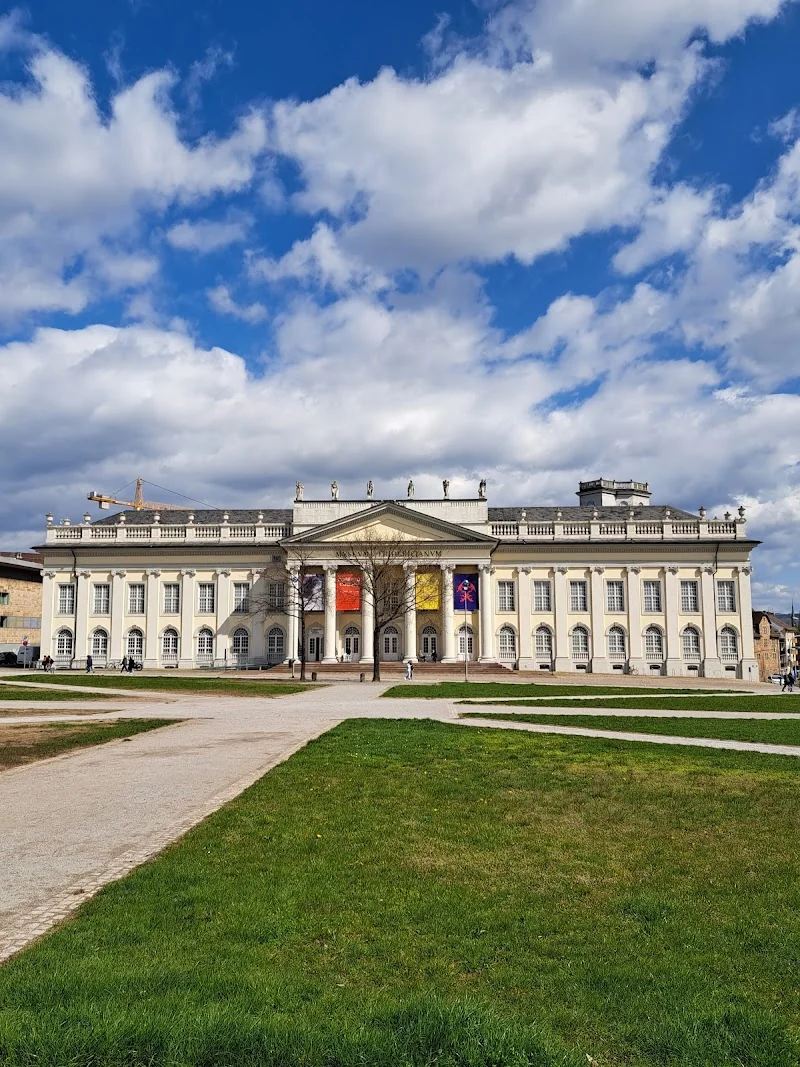
Untere Karlsstraße, Kassel
Friedrichsplatz, Untere Karlsstraße, 34117 Kassel, Germany
Friedrichsplatz Kassel | Parking & Events
The Friedrichsplatz is located in the heart of Kassel's city center directly in the pedestrian zone and is one of the most well-known places in the city. With 38,080 square meters, it is one of the largest undeveloped inner-city squares in Germany and at the same time a central venue for the documenta. Those who visit Kassel experience here not an anonymous transit area, but an urban space with history, culture, art, and short distances to important sights. This mix makes the square particularly attractive for city walks, cultural trips, event days, and spontaneous breaks. Especially practical: The square is closely connected to the Fridericianum, the State Theater, and the Ottoneum and is also near the Karlsaue. The connections are strong, as the Friedrichsplatz stop and the Friedrichsplatz underground garage are in direct proximity. For visitors looking for a central location, short distances, and a lively environment, Friedrichsplatz is therefore much more than a classic square - it is a piece of Kassel's identity. ([visit.kassel.de](https://visit.kassel.de/en/districts/district-mitte?utm_source=openai))
Access and Parking at Friedrichsplatz Kassel
Getting to Friedrichsplatz is uncomplicated because the square is located right in the center of Kassel and is well served for pedestrians, public transport, and individual traffic. The city of Kassel describes the Friedrichsplatz underground garage as a modern parking option that is directly connected to the Königs-Galerie, the pedestrian zone, and the Kassel State Theater. This is a clear advantage for drivers, as they park close to the action and reach the square without long distances. The entrances and exits are located at Steinweg / corner of Friedrichsplatz and in Du-Ry-Straße, with a maximum clearance height of 2.10 meters. The garage is open Monday to Saturday from 6 AM to midnight, and on Sundays and public holidays from 9 AM to midnight. Additional practical features include women's parking spaces, parent-child parking spaces, disabled parking spaces, an elevator, and charging points for electric cars and e-bikes. This makes the underground garage a comfortable solution for a city visit, for evening events, or for a stroll through the city center. ([kassel.de](https://www.kassel.de/buerger/verkehr_und_mobilitaet/mit-dem-auto/inhaltsseiten/parken/tiefgarage-friedrichsplatz.php?utm_source=openai))
Those arriving without a car also benefit from the very central location. The KVG explicitly points out for the City Summer Concerts 2026 that the tram brings passengers to the Friedrichsplatz stop, and the concert venue is just a few steps away from there. This short last stretch is typical for the square: Friedrichsplatz is so central that it can be easily reached on foot, by tram, or in combination with a parking garage. For large events, the logistics are additionally tailored to visitor-friendliness. The concert ticket for the City Summer Concerts also serves as a ticket in the KasselPlus area, valid up to two hours before and after the event. So, if you are planning a concert, a cultural event, or a stroll around Friedrichsplatz, you can organize your arrival stress-free and leave the car behind in many cases. Especially for people searching for parking, routes, or maps, this mix of direct connections, central location, and clear paths is a strong argument for the location. ([kvg.de](https://www.kvg.de/nachricht/stadtsommer-konzerte-2026-in-kassel/?utm_source=openai))
Even in everyday urban life, the good accessibility is evident. The location in the pedestrian zone means not only short distances to shops and cultural sites but also a high quality of stay because the entire area is geared towards smooth pedestrian traffic and public transport. For visitors who are not familiar with Kassel, this is particularly pleasant: Friedrichsplatz is quickly found, easily accessible, and well signposted due to its central role in the city center. Those arriving by car go to the underground garage; those arriving by tram get off at the Friedrichsplatz stop; those who are already in the city can easily reach the square on foot via Königsstraße or from the surrounding streets. This transforms a classic arrival situation into an uncomplicated city visit with clear orientation. This is precisely why Friedrichsplatz appears so frequently in search queries for routes, maps, and parking garages: The practical accessibility is an essential part of its utility and success as an event and cultural venue. ([visit.kassel.de](https://visit.kassel.de/en/districts/district-mitte?utm_source=openai))
History and Urban Significance of Friedrichsplatz
Friedrichsplatz is not only a central location but also a historically charged urban space. According to the city of Kassel, Landgrave Friedrich II commissioned his master builder Simon Louis du Ry to create a connection between the old town and the French Upper New Town on the no longer needed old fortress ring. This led to the development of the current square, which continues to shape the city today. This origin explains its special function: Friedrichsplatz has always been more than just an open space; it has been a connecting element in the urban structure of Kassel. This is also evident in its location between historical and cultural axes. The square is located on the upper Königsstraße between Königsplatz and the town hall and opens to the east towards the Orangerie. Thus, it forms a space that connects movement, sight lines, and urban representation. The current significance of the square is therefore closely linked to its historical planning. Those who visit Friedrichsplatz are not only moving through a vibrant city center but also through a piece of thoughtful urban history. ([visit.kassel.de](https://visit.kassel.de/en/poi/friedrichsplatz?utm_source=openai))
A particularly striking historical detail is the marble statue of Landgrave Friedrich II, which stands opposite the Fridericianum. It was created by Johann August and Samuel Nahl between 1781 and 1783 and is considered one of the most significant ruler monuments of the 18th century. Additionally, the architectural surroundings of the square further underscore its historical significance. The Fridericianum dominates the square and is described as the first purely neoclassical building in Germany and one of the first museums in Europe. It was founded in 1779 at the instigation of Landgrave Friedrich II and today showcases international contemporary art. This combination of square, monument, and museum building makes Friedrichsplatz a place where enlightenment, urban development, and cultural history visibly intersect. The State Theater and the Ottoneum also enhance this impression, as they frame the square like a cultural triangle. For visitors, this creates an ensemble that is not only beautiful to look at in Kassel but also makes the historical depth of the city particularly tangible. ([visit.kassel.de](https://visit.kassel.de/en/poi/friedrichsplatz?utm_source=openai))
The historical significance of Friedrichsplatz is also evident in its role as a place of identification for Kassel. The city refers to it, along with the Fridericianum, the State Theater, and the Ottoneum, as an outstanding square. In older and current representations, it is also highlighted as one of the most important historical squares in Kassel. This mix of classical architecture, art history, and urban function ensures that the square remains relevant for both locals and guests. It is one of the few places where one can experience the development of Kassel from the Baroque and neoclassical cityscape to today's documenta city so concentrated. History is therefore not just background knowledge but part of the daily perception of the square. Those standing here see not only buildings but also the layers of a city that has continually reinterpreted its public space. This makes Friedrichsplatz one of the most important landmarks in Kassel - historically, urbanistically, and culturally. ([kassel.de](https://www.kassel.de/buerger/stadtgeschichte/erinnerungskultur/kassel-vor-dem-Zweiten-Weltkrieg.php?utm_source=openai))
Events, Concerts, and documenta at Friedrichsplatz
Hardly any other place in Kassel is as closely associated with the documenta as Friedrichsplatz. The city and the documenta pages describe it as a central location for this international exhibition. A digital tour of the square shows that one can discover five documenta artworks along a distance of about 600 meters. Among the well-known works at and around the square are The Strangers by Thomas Schütte, 7000 Oaks by Joseph Beuys, the work The Vertical Earth Kilometer, and the frame construction at the documenta hall. This concentration makes Friedrichsplatz not only a venue for large exhibitions but also an open museum in the urban space. Those interested in art in public spaces experience here an unusually dense succession of works that shape the square far beyond the actual event time. This is one of the reasons why Friedrichsplatz regularly appears in search queries for concerts, programs, and documenta: The square is a permanent cultural area with changing uses and strong symbolic power. ([visit.kassel.de](https://visit.kassel.de/en/tour/digital-documenta-tour-across-friedrichsplatz?utm_source=openai))
Additionally, the role of the square as a stage for large-scale events throughout the year is significant. For the City Summer 2026, the city of Kassel announces three open-air concerts at Friedrichsplatz: Mark Forster, Roland Kaiser, and David Garrett. The concerts will transform the square into a large open-air stage over three consecutive evenings. For visitors, this is a good example of how flexibly the place can be used - a public square during the day, an event space in the evening with a special backdrop. Other recurring events also contribute to public perception. Earth Day uses the area around the closed Steinweg and Friedrichsplatz for information, cultural, and environmental offerings. During the pre-Christmas season, the square is traditionally the site of the Flic-Flac Festival of artists, and the city describes this performance as a firm Kassel tradition. Even the Casseler Spring Freedom uses Friedrichsplatz with a medieval market as an experience area. This creates an annual calendar that continually reinterprets the square and makes it interesting for music fans, families, cultural audiences, and city explorers alike. ([kvg.de](https://www.kvg.de/nachricht/stadtsommer-konzerte-2026-in-kassel/?utm_source=openai))
What is particularly exciting is that the events do not feel like isolated happenings but are embedded in the existing urban backdrop. Between Fridericianum, State Theater, documenta hall, and the open square area, an atmosphere is created that makes even large events comprehensible and tangible. Especially at open-air concerts or city festivals, the combination of historical architecture and public space is very strong. For visitors, this means: Friedrichsplatz is not only a place where one sees or hears something but a place where one is right in the middle of the action. This mix of culture, people, history, and urban open space creates its special charm. Those searching online for Friedrichsplatz Kassel concert, program, or events ultimately seek this experience - a place where large events and city center atmosphere do not disturb each other but rather enhance one another. ([kvg.de](https://www.kvg.de/nachricht/stadtsommer-konzerte-2026-in-kassel/?utm_source=openai))
Sights around Friedrichsplatz
Surrounding Friedrichsplatz are some of the most important sights in Kassel in immediate proximity. The most prominent building is the Fridericianum, which is considered one of the first museums in Europe and has been used as an exhibition space for contemporary art since 1988. Directly opposite or at the square itself are other notable cultural sites, including the Kassel State Theater and the Ottoneum. The city describes the State Theater as a house with the genres opera, concert, drama, dance, and young state theater; since 1959, the opera and drama house has been located at Friedrichsplatz, complemented by the studio theater tif. The Ottoneum, in turn, is one of the most popular excursion destinations in the region and offers a journey through various geological eras with its natural history museum. This architectural and thematic density is rare: art, theater, natural history, and urban history converge in a single square. This is precisely why Friedrichsplatz is an ideal starting point for a cultural walk, where one can experience not just a single destination but several attractions at once. ([visit.kassel.de](https://visit.kassel.de/en/poi/museum-fridericianum?utm_source=openai))
Even smaller details are worth a closer look. On the square stands the marble statue of Landgrave Friedrich II, which, along with the neoclassical surroundings, underscores the historical character. Furthermore, the city points to a three-dimensional bronze model of old Kassel, which stands on the longitudinal side of the square and provides a vivid picture of the former city shape. Those interested in photographic motifs will find many perspectives around Friedrichsplatz: the facades of the Fridericianum, the open square axes, the sight lines to the Karlsaue, and the striking connection between historical architecture and modern urban life. For a break, the Café Fridericianum, which is located directly at the square and, according to Kassel Marketing, offers a wide view of the activity at Friedrichsplatz, is also suitable. This transforms a purely cultural site into a place of stay where one can consciously let the atmosphere of Kassel's city center take effect. Thus, the square connects sights, everyday use, and enjoyment in a way that is particularly attractive to visitors. ([visit.kassel.de](https://visit.kassel.de/en/poi/friedrichsplatz?utm_source=openai))
Those who see Friedrichsplatz as part of a larger city experience quickly recognize its role as a hub. From here, paths lead further to Königsstraße, to the adjacent museums, and towards the green urban spaces. The city of Kassel describes the square not only as a sight but also as a starting point for documenta tours and other exploration tours. In just a few steps, one reaches other notable points in the city center, and this is precisely what makes the location so strong: One does not feel like switching between individual islands but rather moving within a cohesive cultural space. For guests who want to get to know Kassel in one day, Friedrichsplatz is therefore a particularly good anchor point. Here, architecture, history, art, and gastronomy condense into a single, easily comprehensible cityscape. This is one of the reasons why the square is popular not only among tourists but also among people who regularly visit Kassel and want to discover new details time and again. ([visit.kassel.de](https://visit.kassel.de/en/districts/district-mitte?utm_source=openai))
Practical Tips for Your Visit to Friedrichsplatz
For a successful visit to Friedrichsplatz, a quick look at the local conditions is worthwhile. The most important factor is the central location: The square is located directly in the city center and in the pedestrian zone, making it easily accessible on foot and by public transport. If you arrive by tram, the Friedrichsplatz stop is the obvious destination. If you come by car, the Friedrichsplatz underground garage is the right address. The combination of both makes the square interesting for different types of visits - from quick appointments to museum visits to evening programs with concerts or festivals. Because Friedrichsplatz is so centrally located, it can also be easily combined with a walk through Kassel's center. So, if you are already in the city, you can incorporate the square without detours and experience culture, gastronomy, and cityscape all in one place. ([visit.kassel.de](https://visit.kassel.de/en/districts/district-mitte?utm_source=openai))
It is also practical that the surroundings are designed for short distances. Between Fridericianum, State Theater, documenta hall, and the adjacent areas, there are only a few minutes of walking, allowing for flexible planning of a visit. This is especially pleasant on event days because the square is then not only a backdrop but an actual space for staying. Those arriving before a concert can still fit in a café visit, view an exhibition, or simply let the square and its architecture take effect. For families, groups, and individual travelers, this is a clear advantage over remote event locations. Even in special weather conditions or high visitor numbers, the central structure helps: Friedrichsplatz remains easily findable, well connected, and easily integrable into a larger city tour. This fulfills exactly the kind of function that many people expect from a central location today - not just a destination but a complete experience space with orientation, atmosphere, and cultural depth. ([kassel.de](https://www.kassel.de/buerger/kunst_und_kultur/sehenswertes/strassen-und-plaetze/friedrichsplatz.php?utm_source=openai))
If you are visiting Friedrichsplatz for the first time, a simple plan is often the best solution: Arrive by tram or underground garage, take a short walk around the square, look at the Fridericianum and State Theater, and then take a detour to the Ottoneum or have a coffee at the square. This structure fits well with search queries for maps, routes, and parking, as the location is central but very understandable due to its open form. Friedrichsplatz is not a place that needs to be complicated to access; it reveals itself quickly and still offers new details with each visit. This is particularly valuable for visitors because one can use the square for both a spontaneous stop and a planned cultural appointment. Therefore, those who are there for the first time should not only look at the specific destination but also at the surroundings, the history, and the special sight lines. This transforms a simple city visit into a lasting impression of Kassel's center that extends far beyond the moment. ([visit.kassel.de](https://visit.kassel.de/en/districts/district-mitte?utm_source=openai))
Sources:
Mehr anzeigenWeniger anzeigen
Friedrichsplatz Kassel | Parking & Events
The Friedrichsplatz is located in the heart of Kassel's city center directly in the pedestrian zone and is one of the most well-known places in the city. With 38,080 square meters, it is one of the largest undeveloped inner-city squares in Germany and at the same time a central venue for the documenta. Those who visit Kassel experience here not an anonymous transit area, but an urban space with history, culture, art, and short distances to important sights. This mix makes the square particularly attractive for city walks, cultural trips, event days, and spontaneous breaks. Especially practical: The square is closely connected to the Fridericianum, the State Theater, and the Ottoneum and is also near the Karlsaue. The connections are strong, as the Friedrichsplatz stop and the Friedrichsplatz underground garage are in direct proximity. For visitors looking for a central location, short distances, and a lively environment, Friedrichsplatz is therefore much more than a classic square - it is a piece of Kassel's identity. ([visit.kassel.de](https://visit.kassel.de/en/districts/district-mitte?utm_source=openai))
Access and Parking at Friedrichsplatz Kassel
Getting to Friedrichsplatz is uncomplicated because the square is located right in the center of Kassel and is well served for pedestrians, public transport, and individual traffic. The city of Kassel describes the Friedrichsplatz underground garage as a modern parking option that is directly connected to the Königs-Galerie, the pedestrian zone, and the Kassel State Theater. This is a clear advantage for drivers, as they park close to the action and reach the square without long distances. The entrances and exits are located at Steinweg / corner of Friedrichsplatz and in Du-Ry-Straße, with a maximum clearance height of 2.10 meters. The garage is open Monday to Saturday from 6 AM to midnight, and on Sundays and public holidays from 9 AM to midnight. Additional practical features include women's parking spaces, parent-child parking spaces, disabled parking spaces, an elevator, and charging points for electric cars and e-bikes. This makes the underground garage a comfortable solution for a city visit, for evening events, or for a stroll through the city center. ([kassel.de](https://www.kassel.de/buerger/verkehr_und_mobilitaet/mit-dem-auto/inhaltsseiten/parken/tiefgarage-friedrichsplatz.php?utm_source=openai))
Those arriving without a car also benefit from the very central location. The KVG explicitly points out for the City Summer Concerts 2026 that the tram brings passengers to the Friedrichsplatz stop, and the concert venue is just a few steps away from there. This short last stretch is typical for the square: Friedrichsplatz is so central that it can be easily reached on foot, by tram, or in combination with a parking garage. For large events, the logistics are additionally tailored to visitor-friendliness. The concert ticket for the City Summer Concerts also serves as a ticket in the KasselPlus area, valid up to two hours before and after the event. So, if you are planning a concert, a cultural event, or a stroll around Friedrichsplatz, you can organize your arrival stress-free and leave the car behind in many cases. Especially for people searching for parking, routes, or maps, this mix of direct connections, central location, and clear paths is a strong argument for the location. ([kvg.de](https://www.kvg.de/nachricht/stadtsommer-konzerte-2026-in-kassel/?utm_source=openai))
Even in everyday urban life, the good accessibility is evident. The location in the pedestrian zone means not only short distances to shops and cultural sites but also a high quality of stay because the entire area is geared towards smooth pedestrian traffic and public transport. For visitors who are not familiar with Kassel, this is particularly pleasant: Friedrichsplatz is quickly found, easily accessible, and well signposted due to its central role in the city center. Those arriving by car go to the underground garage; those arriving by tram get off at the Friedrichsplatz stop; those who are already in the city can easily reach the square on foot via Königsstraße or from the surrounding streets. This transforms a classic arrival situation into an uncomplicated city visit with clear orientation. This is precisely why Friedrichsplatz appears so frequently in search queries for routes, maps, and parking garages: The practical accessibility is an essential part of its utility and success as an event and cultural venue. ([visit.kassel.de](https://visit.kassel.de/en/districts/district-mitte?utm_source=openai))
History and Urban Significance of Friedrichsplatz
Friedrichsplatz is not only a central location but also a historically charged urban space. According to the city of Kassel, Landgrave Friedrich II commissioned his master builder Simon Louis du Ry to create a connection between the old town and the French Upper New Town on the no longer needed old fortress ring. This led to the development of the current square, which continues to shape the city today. This origin explains its special function: Friedrichsplatz has always been more than just an open space; it has been a connecting element in the urban structure of Kassel. This is also evident in its location between historical and cultural axes. The square is located on the upper Königsstraße between Königsplatz and the town hall and opens to the east towards the Orangerie. Thus, it forms a space that connects movement, sight lines, and urban representation. The current significance of the square is therefore closely linked to its historical planning. Those who visit Friedrichsplatz are not only moving through a vibrant city center but also through a piece of thoughtful urban history. ([visit.kassel.de](https://visit.kassel.de/en/poi/friedrichsplatz?utm_source=openai))
A particularly striking historical detail is the marble statue of Landgrave Friedrich II, which stands opposite the Fridericianum. It was created by Johann August and Samuel Nahl between 1781 and 1783 and is considered one of the most significant ruler monuments of the 18th century. Additionally, the architectural surroundings of the square further underscore its historical significance. The Fridericianum dominates the square and is described as the first purely neoclassical building in Germany and one of the first museums in Europe. It was founded in 1779 at the instigation of Landgrave Friedrich II and today showcases international contemporary art. This combination of square, monument, and museum building makes Friedrichsplatz a place where enlightenment, urban development, and cultural history visibly intersect. The State Theater and the Ottoneum also enhance this impression, as they frame the square like a cultural triangle. For visitors, this creates an ensemble that is not only beautiful to look at in Kassel but also makes the historical depth of the city particularly tangible. ([visit.kassel.de](https://visit.kassel.de/en/poi/friedrichsplatz?utm_source=openai))
The historical significance of Friedrichsplatz is also evident in its role as a place of identification for Kassel. The city refers to it, along with the Fridericianum, the State Theater, and the Ottoneum, as an outstanding square. In older and current representations, it is also highlighted as one of the most important historical squares in Kassel. This mix of classical architecture, art history, and urban function ensures that the square remains relevant for both locals and guests. It is one of the few places where one can experience the development of Kassel from the Baroque and neoclassical cityscape to today's documenta city so concentrated. History is therefore not just background knowledge but part of the daily perception of the square. Those standing here see not only buildings but also the layers of a city that has continually reinterpreted its public space. This makes Friedrichsplatz one of the most important landmarks in Kassel - historically, urbanistically, and culturally. ([kassel.de](https://www.kassel.de/buerger/stadtgeschichte/erinnerungskultur/kassel-vor-dem-Zweiten-Weltkrieg.php?utm_source=openai))
Events, Concerts, and documenta at Friedrichsplatz
Hardly any other place in Kassel is as closely associated with the documenta as Friedrichsplatz. The city and the documenta pages describe it as a central location for this international exhibition. A digital tour of the square shows that one can discover five documenta artworks along a distance of about 600 meters. Among the well-known works at and around the square are The Strangers by Thomas Schütte, 7000 Oaks by Joseph Beuys, the work The Vertical Earth Kilometer, and the frame construction at the documenta hall. This concentration makes Friedrichsplatz not only a venue for large exhibitions but also an open museum in the urban space. Those interested in art in public spaces experience here an unusually dense succession of works that shape the square far beyond the actual event time. This is one of the reasons why Friedrichsplatz regularly appears in search queries for concerts, programs, and documenta: The square is a permanent cultural area with changing uses and strong symbolic power. ([visit.kassel.de](https://visit.kassel.de/en/tour/digital-documenta-tour-across-friedrichsplatz?utm_source=openai))
Additionally, the role of the square as a stage for large-scale events throughout the year is significant. For the City Summer 2026, the city of Kassel announces three open-air concerts at Friedrichsplatz: Mark Forster, Roland Kaiser, and David Garrett. The concerts will transform the square into a large open-air stage over three consecutive evenings. For visitors, this is a good example of how flexibly the place can be used - a public square during the day, an event space in the evening with a special backdrop. Other recurring events also contribute to public perception. Earth Day uses the area around the closed Steinweg and Friedrichsplatz for information, cultural, and environmental offerings. During the pre-Christmas season, the square is traditionally the site of the Flic-Flac Festival of artists, and the city describes this performance as a firm Kassel tradition. Even the Casseler Spring Freedom uses Friedrichsplatz with a medieval market as an experience area. This creates an annual calendar that continually reinterprets the square and makes it interesting for music fans, families, cultural audiences, and city explorers alike. ([kvg.de](https://www.kvg.de/nachricht/stadtsommer-konzerte-2026-in-kassel/?utm_source=openai))
What is particularly exciting is that the events do not feel like isolated happenings but are embedded in the existing urban backdrop. Between Fridericianum, State Theater, documenta hall, and the open square area, an atmosphere is created that makes even large events comprehensible and tangible. Especially at open-air concerts or city festivals, the combination of historical architecture and public space is very strong. For visitors, this means: Friedrichsplatz is not only a place where one sees or hears something but a place where one is right in the middle of the action. This mix of culture, people, history, and urban open space creates its special charm. Those searching online for Friedrichsplatz Kassel concert, program, or events ultimately seek this experience - a place where large events and city center atmosphere do not disturb each other but rather enhance one another. ([kvg.de](https://www.kvg.de/nachricht/stadtsommer-konzerte-2026-in-kassel/?utm_source=openai))
Sights around Friedrichsplatz
Surrounding Friedrichsplatz are some of the most important sights in Kassel in immediate proximity. The most prominent building is the Fridericianum, which is considered one of the first museums in Europe and has been used as an exhibition space for contemporary art since 1988. Directly opposite or at the square itself are other notable cultural sites, including the Kassel State Theater and the Ottoneum. The city describes the State Theater as a house with the genres opera, concert, drama, dance, and young state theater; since 1959, the opera and drama house has been located at Friedrichsplatz, complemented by the studio theater tif. The Ottoneum, in turn, is one of the most popular excursion destinations in the region and offers a journey through various geological eras with its natural history museum. This architectural and thematic density is rare: art, theater, natural history, and urban history converge in a single square. This is precisely why Friedrichsplatz is an ideal starting point for a cultural walk, where one can experience not just a single destination but several attractions at once. ([visit.kassel.de](https://visit.kassel.de/en/poi/museum-fridericianum?utm_source=openai))
Even smaller details are worth a closer look. On the square stands the marble statue of Landgrave Friedrich II, which, along with the neoclassical surroundings, underscores the historical character. Furthermore, the city points to a three-dimensional bronze model of old Kassel, which stands on the longitudinal side of the square and provides a vivid picture of the former city shape. Those interested in photographic motifs will find many perspectives around Friedrichsplatz: the facades of the Fridericianum, the open square axes, the sight lines to the Karlsaue, and the striking connection between historical architecture and modern urban life. For a break, the Café Fridericianum, which is located directly at the square and, according to Kassel Marketing, offers a wide view of the activity at Friedrichsplatz, is also suitable. This transforms a purely cultural site into a place of stay where one can consciously let the atmosphere of Kassel's city center take effect. Thus, the square connects sights, everyday use, and enjoyment in a way that is particularly attractive to visitors. ([visit.kassel.de](https://visit.kassel.de/en/poi/friedrichsplatz?utm_source=openai))
Those who see Friedrichsplatz as part of a larger city experience quickly recognize its role as a hub. From here, paths lead further to Königsstraße, to the adjacent museums, and towards the green urban spaces. The city of Kassel describes the square not only as a sight but also as a starting point for documenta tours and other exploration tours. In just a few steps, one reaches other notable points in the city center, and this is precisely what makes the location so strong: One does not feel like switching between individual islands but rather moving within a cohesive cultural space. For guests who want to get to know Kassel in one day, Friedrichsplatz is therefore a particularly good anchor point. Here, architecture, history, art, and gastronomy condense into a single, easily comprehensible cityscape. This is one of the reasons why the square is popular not only among tourists but also among people who regularly visit Kassel and want to discover new details time and again. ([visit.kassel.de](https://visit.kassel.de/en/districts/district-mitte?utm_source=openai))
Practical Tips for Your Visit to Friedrichsplatz
For a successful visit to Friedrichsplatz, a quick look at the local conditions is worthwhile. The most important factor is the central location: The square is located directly in the city center and in the pedestrian zone, making it easily accessible on foot and by public transport. If you arrive by tram, the Friedrichsplatz stop is the obvious destination. If you come by car, the Friedrichsplatz underground garage is the right address. The combination of both makes the square interesting for different types of visits - from quick appointments to museum visits to evening programs with concerts or festivals. Because Friedrichsplatz is so centrally located, it can also be easily combined with a walk through Kassel's center. So, if you are already in the city, you can incorporate the square without detours and experience culture, gastronomy, and cityscape all in one place. ([visit.kassel.de](https://visit.kassel.de/en/districts/district-mitte?utm_source=openai))
It is also practical that the surroundings are designed for short distances. Between Fridericianum, State Theater, documenta hall, and the adjacent areas, there are only a few minutes of walking, allowing for flexible planning of a visit. This is especially pleasant on event days because the square is then not only a backdrop but an actual space for staying. Those arriving before a concert can still fit in a café visit, view an exhibition, or simply let the square and its architecture take effect. For families, groups, and individual travelers, this is a clear advantage over remote event locations. Even in special weather conditions or high visitor numbers, the central structure helps: Friedrichsplatz remains easily findable, well connected, and easily integrable into a larger city tour. This fulfills exactly the kind of function that many people expect from a central location today - not just a destination but a complete experience space with orientation, atmosphere, and cultural depth. ([kassel.de](https://www.kassel.de/buerger/kunst_und_kultur/sehenswertes/strassen-und-plaetze/friedrichsplatz.php?utm_source=openai))
If you are visiting Friedrichsplatz for the first time, a simple plan is often the best solution: Arrive by tram or underground garage, take a short walk around the square, look at the Fridericianum and State Theater, and then take a detour to the Ottoneum or have a coffee at the square. This structure fits well with search queries for maps, routes, and parking, as the location is central but very understandable due to its open form. Friedrichsplatz is not a place that needs to be complicated to access; it reveals itself quickly and still offers new details with each visit. This is particularly valuable for visitors because one can use the square for both a spontaneous stop and a planned cultural appointment. Therefore, those who are there for the first time should not only look at the specific destination but also at the surroundings, the history, and the special sight lines. This transforms a simple city visit into a lasting impression of Kassel's center that extends far beyond the moment. ([visit.kassel.de](https://visit.kassel.de/en/districts/district-mitte?utm_source=openai))
Sources:
Friedrichsplatz Kassel | Parking & Events
The Friedrichsplatz is located in the heart of Kassel's city center directly in the pedestrian zone and is one of the most well-known places in the city. With 38,080 square meters, it is one of the largest undeveloped inner-city squares in Germany and at the same time a central venue for the documenta. Those who visit Kassel experience here not an anonymous transit area, but an urban space with history, culture, art, and short distances to important sights. This mix makes the square particularly attractive for city walks, cultural trips, event days, and spontaneous breaks. Especially practical: The square is closely connected to the Fridericianum, the State Theater, and the Ottoneum and is also near the Karlsaue. The connections are strong, as the Friedrichsplatz stop and the Friedrichsplatz underground garage are in direct proximity. For visitors looking for a central location, short distances, and a lively environment, Friedrichsplatz is therefore much more than a classic square - it is a piece of Kassel's identity. ([visit.kassel.de](https://visit.kassel.de/en/districts/district-mitte?utm_source=openai))
Access and Parking at Friedrichsplatz Kassel
Getting to Friedrichsplatz is uncomplicated because the square is located right in the center of Kassel and is well served for pedestrians, public transport, and individual traffic. The city of Kassel describes the Friedrichsplatz underground garage as a modern parking option that is directly connected to the Königs-Galerie, the pedestrian zone, and the Kassel State Theater. This is a clear advantage for drivers, as they park close to the action and reach the square without long distances. The entrances and exits are located at Steinweg / corner of Friedrichsplatz and in Du-Ry-Straße, with a maximum clearance height of 2.10 meters. The garage is open Monday to Saturday from 6 AM to midnight, and on Sundays and public holidays from 9 AM to midnight. Additional practical features include women's parking spaces, parent-child parking spaces, disabled parking spaces, an elevator, and charging points for electric cars and e-bikes. This makes the underground garage a comfortable solution for a city visit, for evening events, or for a stroll through the city center. ([kassel.de](https://www.kassel.de/buerger/verkehr_und_mobilitaet/mit-dem-auto/inhaltsseiten/parken/tiefgarage-friedrichsplatz.php?utm_source=openai))
Those arriving without a car also benefit from the very central location. The KVG explicitly points out for the City Summer Concerts 2026 that the tram brings passengers to the Friedrichsplatz stop, and the concert venue is just a few steps away from there. This short last stretch is typical for the square: Friedrichsplatz is so central that it can be easily reached on foot, by tram, or in combination with a parking garage. For large events, the logistics are additionally tailored to visitor-friendliness. The concert ticket for the City Summer Concerts also serves as a ticket in the KasselPlus area, valid up to two hours before and after the event. So, if you are planning a concert, a cultural event, or a stroll around Friedrichsplatz, you can organize your arrival stress-free and leave the car behind in many cases. Especially for people searching for parking, routes, or maps, this mix of direct connections, central location, and clear paths is a strong argument for the location. ([kvg.de](https://www.kvg.de/nachricht/stadtsommer-konzerte-2026-in-kassel/?utm_source=openai))
Even in everyday urban life, the good accessibility is evident. The location in the pedestrian zone means not only short distances to shops and cultural sites but also a high quality of stay because the entire area is geared towards smooth pedestrian traffic and public transport. For visitors who are not familiar with Kassel, this is particularly pleasant: Friedrichsplatz is quickly found, easily accessible, and well signposted due to its central role in the city center. Those arriving by car go to the underground garage; those arriving by tram get off at the Friedrichsplatz stop; those who are already in the city can easily reach the square on foot via Königsstraße or from the surrounding streets. This transforms a classic arrival situation into an uncomplicated city visit with clear orientation. This is precisely why Friedrichsplatz appears so frequently in search queries for routes, maps, and parking garages: The practical accessibility is an essential part of its utility and success as an event and cultural venue. ([visit.kassel.de](https://visit.kassel.de/en/districts/district-mitte?utm_source=openai))
History and Urban Significance of Friedrichsplatz
Friedrichsplatz is not only a central location but also a historically charged urban space. According to the city of Kassel, Landgrave Friedrich II commissioned his master builder Simon Louis du Ry to create a connection between the old town and the French Upper New Town on the no longer needed old fortress ring. This led to the development of the current square, which continues to shape the city today. This origin explains its special function: Friedrichsplatz has always been more than just an open space; it has been a connecting element in the urban structure of Kassel. This is also evident in its location between historical and cultural axes. The square is located on the upper Königsstraße between Königsplatz and the town hall and opens to the east towards the Orangerie. Thus, it forms a space that connects movement, sight lines, and urban representation. The current significance of the square is therefore closely linked to its historical planning. Those who visit Friedrichsplatz are not only moving through a vibrant city center but also through a piece of thoughtful urban history. ([visit.kassel.de](https://visit.kassel.de/en/poi/friedrichsplatz?utm_source=openai))
A particularly striking historical detail is the marble statue of Landgrave Friedrich II, which stands opposite the Fridericianum. It was created by Johann August and Samuel Nahl between 1781 and 1783 and is considered one of the most significant ruler monuments of the 18th century. Additionally, the architectural surroundings of the square further underscore its historical significance. The Fridericianum dominates the square and is described as the first purely neoclassical building in Germany and one of the first museums in Europe. It was founded in 1779 at the instigation of Landgrave Friedrich II and today showcases international contemporary art. This combination of square, monument, and museum building makes Friedrichsplatz a place where enlightenment, urban development, and cultural history visibly intersect. The State Theater and the Ottoneum also enhance this impression, as they frame the square like a cultural triangle. For visitors, this creates an ensemble that is not only beautiful to look at in Kassel but also makes the historical depth of the city particularly tangible. ([visit.kassel.de](https://visit.kassel.de/en/poi/friedrichsplatz?utm_source=openai))
The historical significance of Friedrichsplatz is also evident in its role as a place of identification for Kassel. The city refers to it, along with the Fridericianum, the State Theater, and the Ottoneum, as an outstanding square. In older and current representations, it is also highlighted as one of the most important historical squares in Kassel. This mix of classical architecture, art history, and urban function ensures that the square remains relevant for both locals and guests. It is one of the few places where one can experience the development of Kassel from the Baroque and neoclassical cityscape to today's documenta city so concentrated. History is therefore not just background knowledge but part of the daily perception of the square. Those standing here see not only buildings but also the layers of a city that has continually reinterpreted its public space. This makes Friedrichsplatz one of the most important landmarks in Kassel - historically, urbanistically, and culturally. ([kassel.de](https://www.kassel.de/buerger/stadtgeschichte/erinnerungskultur/kassel-vor-dem-Zweiten-Weltkrieg.php?utm_source=openai))
Events, Concerts, and documenta at Friedrichsplatz
Hardly any other place in Kassel is as closely associated with the documenta as Friedrichsplatz. The city and the documenta pages describe it as a central location for this international exhibition. A digital tour of the square shows that one can discover five documenta artworks along a distance of about 600 meters. Among the well-known works at and around the square are The Strangers by Thomas Schütte, 7000 Oaks by Joseph Beuys, the work The Vertical Earth Kilometer, and the frame construction at the documenta hall. This concentration makes Friedrichsplatz not only a venue for large exhibitions but also an open museum in the urban space. Those interested in art in public spaces experience here an unusually dense succession of works that shape the square far beyond the actual event time. This is one of the reasons why Friedrichsplatz regularly appears in search queries for concerts, programs, and documenta: The square is a permanent cultural area with changing uses and strong symbolic power. ([visit.kassel.de](https://visit.kassel.de/en/tour/digital-documenta-tour-across-friedrichsplatz?utm_source=openai))
Additionally, the role of the square as a stage for large-scale events throughout the year is significant. For the City Summer 2026, the city of Kassel announces three open-air concerts at Friedrichsplatz: Mark Forster, Roland Kaiser, and David Garrett. The concerts will transform the square into a large open-air stage over three consecutive evenings. For visitors, this is a good example of how flexibly the place can be used - a public square during the day, an event space in the evening with a special backdrop. Other recurring events also contribute to public perception. Earth Day uses the area around the closed Steinweg and Friedrichsplatz for information, cultural, and environmental offerings. During the pre-Christmas season, the square is traditionally the site of the Flic-Flac Festival of artists, and the city describes this performance as a firm Kassel tradition. Even the Casseler Spring Freedom uses Friedrichsplatz with a medieval market as an experience area. This creates an annual calendar that continually reinterprets the square and makes it interesting for music fans, families, cultural audiences, and city explorers alike. ([kvg.de](https://www.kvg.de/nachricht/stadtsommer-konzerte-2026-in-kassel/?utm_source=openai))
What is particularly exciting is that the events do not feel like isolated happenings but are embedded in the existing urban backdrop. Between Fridericianum, State Theater, documenta hall, and the open square area, an atmosphere is created that makes even large events comprehensible and tangible. Especially at open-air concerts or city festivals, the combination of historical architecture and public space is very strong. For visitors, this means: Friedrichsplatz is not only a place where one sees or hears something but a place where one is right in the middle of the action. This mix of culture, people, history, and urban open space creates its special charm. Those searching online for Friedrichsplatz Kassel concert, program, or events ultimately seek this experience - a place where large events and city center atmosphere do not disturb each other but rather enhance one another. ([kvg.de](https://www.kvg.de/nachricht/stadtsommer-konzerte-2026-in-kassel/?utm_source=openai))
Sights around Friedrichsplatz
Surrounding Friedrichsplatz are some of the most important sights in Kassel in immediate proximity. The most prominent building is the Fridericianum, which is considered one of the first museums in Europe and has been used as an exhibition space for contemporary art since 1988. Directly opposite or at the square itself are other notable cultural sites, including the Kassel State Theater and the Ottoneum. The city describes the State Theater as a house with the genres opera, concert, drama, dance, and young state theater; since 1959, the opera and drama house has been located at Friedrichsplatz, complemented by the studio theater tif. The Ottoneum, in turn, is one of the most popular excursion destinations in the region and offers a journey through various geological eras with its natural history museum. This architectural and thematic density is rare: art, theater, natural history, and urban history converge in a single square. This is precisely why Friedrichsplatz is an ideal starting point for a cultural walk, where one can experience not just a single destination but several attractions at once. ([visit.kassel.de](https://visit.kassel.de/en/poi/museum-fridericianum?utm_source=openai))
Even smaller details are worth a closer look. On the square stands the marble statue of Landgrave Friedrich II, which, along with the neoclassical surroundings, underscores the historical character. Furthermore, the city points to a three-dimensional bronze model of old Kassel, which stands on the longitudinal side of the square and provides a vivid picture of the former city shape. Those interested in photographic motifs will find many perspectives around Friedrichsplatz: the facades of the Fridericianum, the open square axes, the sight lines to the Karlsaue, and the striking connection between historical architecture and modern urban life. For a break, the Café Fridericianum, which is located directly at the square and, according to Kassel Marketing, offers a wide view of the activity at Friedrichsplatz, is also suitable. This transforms a purely cultural site into a place of stay where one can consciously let the atmosphere of Kassel's city center take effect. Thus, the square connects sights, everyday use, and enjoyment in a way that is particularly attractive to visitors. ([visit.kassel.de](https://visit.kassel.de/en/poi/friedrichsplatz?utm_source=openai))
Those who see Friedrichsplatz as part of a larger city experience quickly recognize its role as a hub. From here, paths lead further to Königsstraße, to the adjacent museums, and towards the green urban spaces. The city of Kassel describes the square not only as a sight but also as a starting point for documenta tours and other exploration tours. In just a few steps, one reaches other notable points in the city center, and this is precisely what makes the location so strong: One does not feel like switching between individual islands but rather moving within a cohesive cultural space. For guests who want to get to know Kassel in one day, Friedrichsplatz is therefore a particularly good anchor point. Here, architecture, history, art, and gastronomy condense into a single, easily comprehensible cityscape. This is one of the reasons why the square is popular not only among tourists but also among people who regularly visit Kassel and want to discover new details time and again. ([visit.kassel.de](https://visit.kassel.de/en/districts/district-mitte?utm_source=openai))
Practical Tips for Your Visit to Friedrichsplatz
For a successful visit to Friedrichsplatz, a quick look at the local conditions is worthwhile. The most important factor is the central location: The square is located directly in the city center and in the pedestrian zone, making it easily accessible on foot and by public transport. If you arrive by tram, the Friedrichsplatz stop is the obvious destination. If you come by car, the Friedrichsplatz underground garage is the right address. The combination of both makes the square interesting for different types of visits - from quick appointments to museum visits to evening programs with concerts or festivals. Because Friedrichsplatz is so centrally located, it can also be easily combined with a walk through Kassel's center. So, if you are already in the city, you can incorporate the square without detours and experience culture, gastronomy, and cityscape all in one place. ([visit.kassel.de](https://visit.kassel.de/en/districts/district-mitte?utm_source=openai))
It is also practical that the surroundings are designed for short distances. Between Fridericianum, State Theater, documenta hall, and the adjacent areas, there are only a few minutes of walking, allowing for flexible planning of a visit. This is especially pleasant on event days because the square is then not only a backdrop but an actual space for staying. Those arriving before a concert can still fit in a café visit, view an exhibition, or simply let the square and its architecture take effect. For families, groups, and individual travelers, this is a clear advantage over remote event locations. Even in special weather conditions or high visitor numbers, the central structure helps: Friedrichsplatz remains easily findable, well connected, and easily integrable into a larger city tour. This fulfills exactly the kind of function that many people expect from a central location today - not just a destination but a complete experience space with orientation, atmosphere, and cultural depth. ([kassel.de](https://www.kassel.de/buerger/kunst_und_kultur/sehenswertes/strassen-und-plaetze/friedrichsplatz.php?utm_source=openai))
If you are visiting Friedrichsplatz for the first time, a simple plan is often the best solution: Arrive by tram or underground garage, take a short walk around the square, look at the Fridericianum and State Theater, and then take a detour to the Ottoneum or have a coffee at the square. This structure fits well with search queries for maps, routes, and parking, as the location is central but very understandable due to its open form. Friedrichsplatz is not a place that needs to be complicated to access; it reveals itself quickly and still offers new details with each visit. This is particularly valuable for visitors because one can use the square for both a spontaneous stop and a planned cultural appointment. Therefore, those who are there for the first time should not only look at the specific destination but also at the surroundings, the history, and the special sight lines. This transforms a simple city visit into a lasting impression of Kassel's center that extends far beyond the moment. ([visit.kassel.de](https://visit.kassel.de/en/districts/district-mitte?utm_source=openai))
Sources:
Frequently Asked Questions
Reviews
No reviews found