
Wilhelmsstraße 2, Kassel
Wilhelmsstraße 2, 34117 Kassel, Germany
Future Space Kassel | STEM Offers & Opening Hours
Future Space Kassel is a non-profit educational initiative located in the heart of downtown Kassel. The place combines experimentation, scientific work, and a very open access for people aged 9 to 99. The city of Kassel describes Future Space as a cozy place where people of all ages can learn, research, and try things out; the official website complements this claim with free offerings, learning spaces, and a consciously low-threshold interaction. This mix of open access, professional support, and clear educational orientation makes the location an unusual address for anyone looking for more than just an exhibition space. ([www1.kassel.de](https://www1.kassel.de/buerger/familie_und_soziales/kinder-und-jugendliche/freizeit--und-bildungsangebote/futurespace.php))
Future Space Kassel: Educational Initiative, Target Group, and Self-Understanding
The self-understanding of Future Space is remarkably clear: Good education begins where people can independently discover, ask questions, and actively explore their environment. That is why the site speaks of a space for ideas and innovation, where modern learning is promoted through experimentation and scientific work. Future Space does not see itself as a rigid teaching location, but as a place where interest is sparked, respect is practiced, and learning is conceived as a shared process. It is also fitting that the offerings are explicitly free of charge and aimed at school classes, groups, and individuals. The website already mentions 14,095 guests, 395 courses and events, and 106,855 people reached online for 2025; this shows that not only concepts are formulated here, but that a lot of practice is already taking place. ([futurespace.org](https://www.futurespace.org/))
Particularly important in the educational concept is the connection between autonomy, social integration, and competence development. Future Space works with learning islands, meaning stations where children, teenagers, and adults can independently engage with topics without being reduced to classic worksheets. Trust plays a significant role: Students should be able to tackle difficult tasks independently, but not be left alone. At the same time, the concept emphasizes that teachers and schools are involved, as they act as multipliers. This leads to free offerings that are aligned with the core curriculum while also making new forms of learning tangible. Future Space does not only think of the present in Kassel but also of further locations nationally and internationally. This makes the educational initiative a place that is locally anchored and at the same time future-oriented. ([futurespace.org](https://www.futurespace.org/unser-bildungskonzept/))
Opening Hours, Address, Barrier-Free Access, and Arrival
Those who wish to visit Future Space will find a central address at Wilhelmsstraße 2, 34117 Kassel, in the city center. The official opening hours are Monday to Friday from 10:00 AM to 6:00 PM and Saturday and Sunday from 2:00 PM to 6:00 PM. The city of Kassel explicitly points out that one can simply come by without prior registration. For school classes, additional options apply: Visits on weekdays can even start from 8:00 AM by prior arrangement of the appointment and topic via phone or email. This means the location is not only open but also very clearly organized. For contact, Future Space provides the email address info@futurespace.org and the phone number 05 61 / 49 94 41 97. ([www1.kassel.de](https://www1.kassel.de/buerger/familie_und_soziales/kinder-und-jugendliche/freizeit--und-bildungsangebote/futurespace.php))
Getting there is also uncomplicated. The official contact page lists Kassel Central Station as the train station and Kassel Rathaus, Scheidemannplatz, Ständeplatz, Rathaus Fünffensterstraße, and Stadtmuseum as nearby tram stops. The city of Kassel adds that there is barrier-free access available. This makes Future Space attractive for visitors who rely on short distances, public transport, or easy orientation in the city center. Those who want to combine their visit with a city walk will find a location that is right in the urban life and can be easily integrated into an appointment, a family outing, or a school morning. The official site also refers to geoportal, route planners, and public transport connections, which shows how strongly the location is focused on practical usability. ([www1.kassel.de](https://www1.kassel.de/buerger/familie_und_soziales/kinder-und-jugendliche/freizeit--und-bildungsangebote/futurespace.php))
Free Offers for School Classes, Learning Islands, and STEM Education
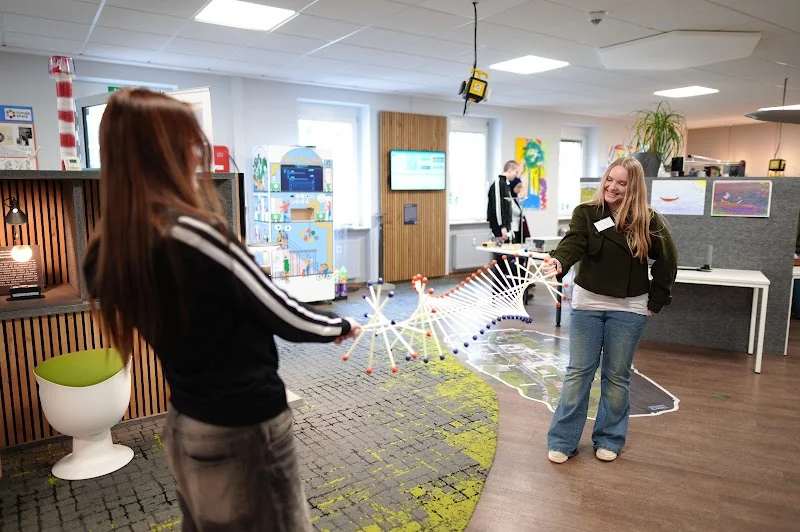
A central theme at Future Space is school classes and learning groups. The city of Kassel describes the morning hours as a time window when especially school classes and groups are welcome by prior arrangement. They can utilize offerings from mathematics, computer science, natural sciences, technology, and philosophy, accompanied by coaches. Additionally, the location offers training for teachers. Particularly exciting is the principle of learning islands: Children and teenagers from first grade to high school, as well as adults, can work there alone or in small groups at changing experimental and learning stations. This setup makes Future Space interesting for teaching as well as for project work, excursions, or support formats. Since all offerings are free of charge, a very accessible learning place is created that is not limited by admission barriers. ([www1.kassel.de](https://www1.kassel.de/buerger/familie_und_soziales/kinder-und-jugendliche/freizeit--und-bildungsangebote/futurespace.php))
The subject pages show how diverse these school offerings are. In astronomy, for example, it is about distances in the solar system and planet profiles; in physics about additive color mixing, acoustics, sound, and the application of electricity. Biology deals with DNA, genetic fingerprints, DNA to go, CRISPR-Cas9, and enzymes. Chemistry makes the periodic table experienceable with AR and VR and connects it with microscopy and atomic models. Computer science ranges from Scratch and 3D design to sensor technology with the Sensebox and sorting algorithms. Mathematics connects complex numbers with rotational bodies and 3D printing, while philosophy works with questions of knowledge, perception, and truth. The spectrum is not only broad but also methodologically modern: experimental, digital, close to everyday life, and clearly focused on learning progress. ([futurespace.org](https://www.futurespace.org/astronomie/))
Workshops, Lectures, and Weekly Formats for All Age Groups
Future Space is not only interesting for school classes but also for everyone who wants to learn outside of class. The homepage and the page For Everyone list several regular formats that well demonstrate the openness of the house. Skill Club Junior runs on Mondays from 2:00 PM to 4:00 PM for 5th and 6th grades; the History Club Kassel takes place on Mondays from 4:00 PM to 6:00 PM for ages 12 and up; Skill Club runs on Tuesdays from 2:00 PM to 5:00 PM for 7th grade and up; Matt in 1 is a chess offering for every level on Wednesdays from 3:00 PM to 6:00 PM; and Minecraft takes place on Fridays from 2:00 PM to 5:30 PM. Additionally, there are workshops for everyone on the 2nd and 4th Thursday of the month from 4:00 PM to 6:00 PM, as well as Thursday for the Curious, the knowledge talk in Future Space, each on the 2nd Thursday of the month at 6:00 PM. Many of these formats are free and accessible without fear of barriers. ([futurespace.org](https://www.futurespace.org/))
Content-wise, these formats are surprisingly diverse. Skill Club Junior playfully connects programming with the Code Box and Scratch. The Skill Club focuses on self-chosen projects and so-called quests, where participants can earn experience points and build a portfolio; possible areas include video and film production, game design, web design, VR and AR design, and climate sensor technology. The page For Everyone also mentions AUREA, the sensor park in Karlsaue, where citizens can build their own weather station in the afternoon and experiment with the support of coaches. This mix of technology, creativity, and practical research makes the weekly program a good example of how Future Space understands education as an experience. The lectures on Thursdays for the Curious also fit into this, as they bring scientific and social topics into an open format that invites reflection and further discussion. ([futurespace.org](https://www.futurespace.org/fuer-alle/))
Astronomy, Physics, Biology, Chemistry, Computer Science, and Philosophy
Those interested in the subject depth will quickly notice: Future Space is thematically much broader than one would expect from a simple participatory place. In astronomy, it is about making the size of the solar system tangible and making distances between celestial bodies understandable through real experiments and digital simulations. In physics, the spectrum ranges from color mixing with laser light to sound and acoustics to electricity and solar cells. These topics are not presented abstractly but are structured as workshops where practical experiences are at the center. This is particularly interesting for groups that do not just want to hear formulas but want to see, touch, and ideally explain physical relationships themselves. The designated subject responsibility is also clear: Astronomy is accompanied by Rico Janusch, and physics by Till MacCormac. ([futurespace.org](https://www.futurespace.org/astronomie/))
The other subjects are also strongly focused on experience and application. In biology, students can isolate DNA from bananas and from oral mucosa cells, create a genetic fingerprint, or engage with CRISPR-Cas9. In chemistry, the periodic table, AR and VR glasses, atomic models, and the microscope are in the foreground. Computer science ranges from Scratch for younger target groups to 3D design with SolidWorks and TinkerCad to sensor technology with the Sensebox and sorting algorithms. Mathematics connects the Gaussian number plane, complex numbers, and rotational bodies with 3D printing. Philosophy questions secure knowledge, perception, cognition, and truth and invites participants to examine perceptual phenomena themselves. Thus, Future Space not only covers classic STEM topics but also expands them to include thinking, reflection, and digital design. ([futurespace.org](https://www.futurespace.org/biologie/))
Photos, Visual Impressions, and Digital Future Travels
Those looking for photos or visual impressions will find a website at Future Space that heavily utilizes images, event teasers, and video elements. Even the homepage is visually structured, and on the Skill Club page, there is even a Legacy Gallery with a large image archive. Additionally, Future Space refers to video lectures and a YouTube channel where topics such as hydrogen or tunable lasers are presented. This means that the place is not only open in content but also richly documented visually. For users who want to get a picture before a visit, this is helpful. One quickly recognizes that Future Space feels more like a vibrant learning campus than a classic hall or a quiet exhibition space. The visual presence is part of the overall experience and supports the perception as a modern, youth-oriented learning place. ([futurespace.org](https://www.futurespace.org/))
The digital and playful part fits surprisingly well with the keywords around Future Space Travel, Exploration, Missions, and Station. On the Skill Club page, there is indeed a format called Future Space Explorer, which is described as an expedition into distant futures and the present. There, No Man's Sky is used, climate research stations are built on different planets, video sequences are produced, and one's own bases are later viewed in VR. Additionally, missions such as building a Climate Research Base, a video episode, and a personal web page for the station are included. In this context, the word station is not metaphorical but becomes tangible as a learning and project station in the digital space. Smart City K5 and other future projects also show how Future Space not only explains the future but constructs it playfully. Terms like travel, exploration, or missions are translated into an educational context that fundamentally remains focused on education, creativity, and teamwork. ([futurespace.org](https://www.futurespace.org/skillclub/))
Sources:
- Future Space – Homepage, Educational Concept, and Contact ([futurespace.org](https://www.futurespace.org/))
- City of Kassel – Future Space ([www1.kassel.de](https://www1.kassel.de/buerger/familie_und_soziales/kinder-und-jugendliche/freizeit--und-bildungsangebote/futurespace.php))
- Subject Pages Astronomy, Physics, Biology, Chemistry, Computer Science, Mathematics, and Philosophy ([futurespace.org](https://www.futurespace.org/astronomie/))
- Open Formats and Regular Offers ([futurespace.org](https://www.futurespace.org/donnerstag-fuer-neugierige/))
- Digital, Visual, and Playful Formats ([futurespace.org](https://www.futurespace.org/skillclub/))
Mehr anzeigenWeniger anzeigen
Future Space Kassel | STEM Offers & Opening Hours
Future Space Kassel is a non-profit educational initiative located in the heart of downtown Kassel. The place combines experimentation, scientific work, and a very open access for people aged 9 to 99. The city of Kassel describes Future Space as a cozy place where people of all ages can learn, research, and try things out; the official website complements this claim with free offerings, learning spaces, and a consciously low-threshold interaction. This mix of open access, professional support, and clear educational orientation makes the location an unusual address for anyone looking for more than just an exhibition space. ([www1.kassel.de](https://www1.kassel.de/buerger/familie_und_soziales/kinder-und-jugendliche/freizeit--und-bildungsangebote/futurespace.php))
Future Space Kassel: Educational Initiative, Target Group, and Self-Understanding
The self-understanding of Future Space is remarkably clear: Good education begins where people can independently discover, ask questions, and actively explore their environment. That is why the site speaks of a space for ideas and innovation, where modern learning is promoted through experimentation and scientific work. Future Space does not see itself as a rigid teaching location, but as a place where interest is sparked, respect is practiced, and learning is conceived as a shared process. It is also fitting that the offerings are explicitly free of charge and aimed at school classes, groups, and individuals. The website already mentions 14,095 guests, 395 courses and events, and 106,855 people reached online for 2025; this shows that not only concepts are formulated here, but that a lot of practice is already taking place. ([futurespace.org](https://www.futurespace.org/))
Particularly important in the educational concept is the connection between autonomy, social integration, and competence development. Future Space works with learning islands, meaning stations where children, teenagers, and adults can independently engage with topics without being reduced to classic worksheets. Trust plays a significant role: Students should be able to tackle difficult tasks independently, but not be left alone. At the same time, the concept emphasizes that teachers and schools are involved, as they act as multipliers. This leads to free offerings that are aligned with the core curriculum while also making new forms of learning tangible. Future Space does not only think of the present in Kassel but also of further locations nationally and internationally. This makes the educational initiative a place that is locally anchored and at the same time future-oriented. ([futurespace.org](https://www.futurespace.org/unser-bildungskonzept/))
Opening Hours, Address, Barrier-Free Access, and Arrival
Those who wish to visit Future Space will find a central address at Wilhelmsstraße 2, 34117 Kassel, in the city center. The official opening hours are Monday to Friday from 10:00 AM to 6:00 PM and Saturday and Sunday from 2:00 PM to 6:00 PM. The city of Kassel explicitly points out that one can simply come by without prior registration. For school classes, additional options apply: Visits on weekdays can even start from 8:00 AM by prior arrangement of the appointment and topic via phone or email. This means the location is not only open but also very clearly organized. For contact, Future Space provides the email address info@futurespace.org and the phone number 05 61 / 49 94 41 97. ([www1.kassel.de](https://www1.kassel.de/buerger/familie_und_soziales/kinder-und-jugendliche/freizeit--und-bildungsangebote/futurespace.php))
Getting there is also uncomplicated. The official contact page lists Kassel Central Station as the train station and Kassel Rathaus, Scheidemannplatz, Ständeplatz, Rathaus Fünffensterstraße, and Stadtmuseum as nearby tram stops. The city of Kassel adds that there is barrier-free access available. This makes Future Space attractive for visitors who rely on short distances, public transport, or easy orientation in the city center. Those who want to combine their visit with a city walk will find a location that is right in the urban life and can be easily integrated into an appointment, a family outing, or a school morning. The official site also refers to geoportal, route planners, and public transport connections, which shows how strongly the location is focused on practical usability. ([www1.kassel.de](https://www1.kassel.de/buerger/familie_und_soziales/kinder-und-jugendliche/freizeit--und-bildungsangebote/futurespace.php))
Free Offers for School Classes, Learning Islands, and STEM Education
A central theme at Future Space is school classes and learning groups. The city of Kassel describes the morning hours as a time window when especially school classes and groups are welcome by prior arrangement. They can utilize offerings from mathematics, computer science, natural sciences, technology, and philosophy, accompanied by coaches. Additionally, the location offers training for teachers. Particularly exciting is the principle of learning islands: Children and teenagers from first grade to high school, as well as adults, can work there alone or in small groups at changing experimental and learning stations. This setup makes Future Space interesting for teaching as well as for project work, excursions, or support formats. Since all offerings are free of charge, a very accessible learning place is created that is not limited by admission barriers. ([www1.kassel.de](https://www1.kassel.de/buerger/familie_und_soziales/kinder-und-jugendliche/freizeit--und-bildungsangebote/futurespace.php))
The subject pages show how diverse these school offerings are. In astronomy, for example, it is about distances in the solar system and planet profiles; in physics about additive color mixing, acoustics, sound, and the application of electricity. Biology deals with DNA, genetic fingerprints, DNA to go, CRISPR-Cas9, and enzymes. Chemistry makes the periodic table experienceable with AR and VR and connects it with microscopy and atomic models. Computer science ranges from Scratch and 3D design to sensor technology with the Sensebox and sorting algorithms. Mathematics connects complex numbers with rotational bodies and 3D printing, while philosophy works with questions of knowledge, perception, and truth. The spectrum is not only broad but also methodologically modern: experimental, digital, close to everyday life, and clearly focused on learning progress. ([futurespace.org](https://www.futurespace.org/astronomie/))
Workshops, Lectures, and Weekly Formats for All Age Groups
Future Space is not only interesting for school classes but also for everyone who wants to learn outside of class. The homepage and the page For Everyone list several regular formats that well demonstrate the openness of the house. Skill Club Junior runs on Mondays from 2:00 PM to 4:00 PM for 5th and 6th grades; the History Club Kassel takes place on Mondays from 4:00 PM to 6:00 PM for ages 12 and up; Skill Club runs on Tuesdays from 2:00 PM to 5:00 PM for 7th grade and up; Matt in 1 is a chess offering for every level on Wednesdays from 3:00 PM to 6:00 PM; and Minecraft takes place on Fridays from 2:00 PM to 5:30 PM. Additionally, there are workshops for everyone on the 2nd and 4th Thursday of the month from 4:00 PM to 6:00 PM, as well as Thursday for the Curious, the knowledge talk in Future Space, each on the 2nd Thursday of the month at 6:00 PM. Many of these formats are free and accessible without fear of barriers. ([futurespace.org](https://www.futurespace.org/))
Content-wise, these formats are surprisingly diverse. Skill Club Junior playfully connects programming with the Code Box and Scratch. The Skill Club focuses on self-chosen projects and so-called quests, where participants can earn experience points and build a portfolio; possible areas include video and film production, game design, web design, VR and AR design, and climate sensor technology. The page For Everyone also mentions AUREA, the sensor park in Karlsaue, where citizens can build their own weather station in the afternoon and experiment with the support of coaches. This mix of technology, creativity, and practical research makes the weekly program a good example of how Future Space understands education as an experience. The lectures on Thursdays for the Curious also fit into this, as they bring scientific and social topics into an open format that invites reflection and further discussion. ([futurespace.org](https://www.futurespace.org/fuer-alle/))
Astronomy, Physics, Biology, Chemistry, Computer Science, and Philosophy
Those interested in the subject depth will quickly notice: Future Space is thematically much broader than one would expect from a simple participatory place. In astronomy, it is about making the size of the solar system tangible and making distances between celestial bodies understandable through real experiments and digital simulations. In physics, the spectrum ranges from color mixing with laser light to sound and acoustics to electricity and solar cells. These topics are not presented abstractly but are structured as workshops where practical experiences are at the center. This is particularly interesting for groups that do not just want to hear formulas but want to see, touch, and ideally explain physical relationships themselves. The designated subject responsibility is also clear: Astronomy is accompanied by Rico Janusch, and physics by Till MacCormac. ([futurespace.org](https://www.futurespace.org/astronomie/))
The other subjects are also strongly focused on experience and application. In biology, students can isolate DNA from bananas and from oral mucosa cells, create a genetic fingerprint, or engage with CRISPR-Cas9. In chemistry, the periodic table, AR and VR glasses, atomic models, and the microscope are in the foreground. Computer science ranges from Scratch for younger target groups to 3D design with SolidWorks and TinkerCad to sensor technology with the Sensebox and sorting algorithms. Mathematics connects the Gaussian number plane, complex numbers, and rotational bodies with 3D printing. Philosophy questions secure knowledge, perception, cognition, and truth and invites participants to examine perceptual phenomena themselves. Thus, Future Space not only covers classic STEM topics but also expands them to include thinking, reflection, and digital design. ([futurespace.org](https://www.futurespace.org/biologie/))
Photos, Visual Impressions, and Digital Future Travels
Those looking for photos or visual impressions will find a website at Future Space that heavily utilizes images, event teasers, and video elements. Even the homepage is visually structured, and on the Skill Club page, there is even a Legacy Gallery with a large image archive. Additionally, Future Space refers to video lectures and a YouTube channel where topics such as hydrogen or tunable lasers are presented. This means that the place is not only open in content but also richly documented visually. For users who want to get a picture before a visit, this is helpful. One quickly recognizes that Future Space feels more like a vibrant learning campus than a classic hall or a quiet exhibition space. The visual presence is part of the overall experience and supports the perception as a modern, youth-oriented learning place. ([futurespace.org](https://www.futurespace.org/))
The digital and playful part fits surprisingly well with the keywords around Future Space Travel, Exploration, Missions, and Station. On the Skill Club page, there is indeed a format called Future Space Explorer, which is described as an expedition into distant futures and the present. There, No Man's Sky is used, climate research stations are built on different planets, video sequences are produced, and one's own bases are later viewed in VR. Additionally, missions such as building a Climate Research Base, a video episode, and a personal web page for the station are included. In this context, the word station is not metaphorical but becomes tangible as a learning and project station in the digital space. Smart City K5 and other future projects also show how Future Space not only explains the future but constructs it playfully. Terms like travel, exploration, or missions are translated into an educational context that fundamentally remains focused on education, creativity, and teamwork. ([futurespace.org](https://www.futurespace.org/skillclub/))
Sources:
- Future Space – Homepage, Educational Concept, and Contact ([futurespace.org](https://www.futurespace.org/))
- City of Kassel – Future Space ([www1.kassel.de](https://www1.kassel.de/buerger/familie_und_soziales/kinder-und-jugendliche/freizeit--und-bildungsangebote/futurespace.php))
- Subject Pages Astronomy, Physics, Biology, Chemistry, Computer Science, Mathematics, and Philosophy ([futurespace.org](https://www.futurespace.org/astronomie/))
- Open Formats and Regular Offers ([futurespace.org](https://www.futurespace.org/donnerstag-fuer-neugierige/))
- Digital, Visual, and Playful Formats ([futurespace.org](https://www.futurespace.org/skillclub/))
Future Space Kassel | STEM Offers & Opening Hours
Future Space Kassel is a non-profit educational initiative located in the heart of downtown Kassel. The place combines experimentation, scientific work, and a very open access for people aged 9 to 99. The city of Kassel describes Future Space as a cozy place where people of all ages can learn, research, and try things out; the official website complements this claim with free offerings, learning spaces, and a consciously low-threshold interaction. This mix of open access, professional support, and clear educational orientation makes the location an unusual address for anyone looking for more than just an exhibition space. ([www1.kassel.de](https://www1.kassel.de/buerger/familie_und_soziales/kinder-und-jugendliche/freizeit--und-bildungsangebote/futurespace.php))
Future Space Kassel: Educational Initiative, Target Group, and Self-Understanding
The self-understanding of Future Space is remarkably clear: Good education begins where people can independently discover, ask questions, and actively explore their environment. That is why the site speaks of a space for ideas and innovation, where modern learning is promoted through experimentation and scientific work. Future Space does not see itself as a rigid teaching location, but as a place where interest is sparked, respect is practiced, and learning is conceived as a shared process. It is also fitting that the offerings are explicitly free of charge and aimed at school classes, groups, and individuals. The website already mentions 14,095 guests, 395 courses and events, and 106,855 people reached online for 2025; this shows that not only concepts are formulated here, but that a lot of practice is already taking place. ([futurespace.org](https://www.futurespace.org/))
Particularly important in the educational concept is the connection between autonomy, social integration, and competence development. Future Space works with learning islands, meaning stations where children, teenagers, and adults can independently engage with topics without being reduced to classic worksheets. Trust plays a significant role: Students should be able to tackle difficult tasks independently, but not be left alone. At the same time, the concept emphasizes that teachers and schools are involved, as they act as multipliers. This leads to free offerings that are aligned with the core curriculum while also making new forms of learning tangible. Future Space does not only think of the present in Kassel but also of further locations nationally and internationally. This makes the educational initiative a place that is locally anchored and at the same time future-oriented. ([futurespace.org](https://www.futurespace.org/unser-bildungskonzept/))
Opening Hours, Address, Barrier-Free Access, and Arrival
Those who wish to visit Future Space will find a central address at Wilhelmsstraße 2, 34117 Kassel, in the city center. The official opening hours are Monday to Friday from 10:00 AM to 6:00 PM and Saturday and Sunday from 2:00 PM to 6:00 PM. The city of Kassel explicitly points out that one can simply come by without prior registration. For school classes, additional options apply: Visits on weekdays can even start from 8:00 AM by prior arrangement of the appointment and topic via phone or email. This means the location is not only open but also very clearly organized. For contact, Future Space provides the email address info@futurespace.org and the phone number 05 61 / 49 94 41 97. ([www1.kassel.de](https://www1.kassel.de/buerger/familie_und_soziales/kinder-und-jugendliche/freizeit--und-bildungsangebote/futurespace.php))
Getting there is also uncomplicated. The official contact page lists Kassel Central Station as the train station and Kassel Rathaus, Scheidemannplatz, Ständeplatz, Rathaus Fünffensterstraße, and Stadtmuseum as nearby tram stops. The city of Kassel adds that there is barrier-free access available. This makes Future Space attractive for visitors who rely on short distances, public transport, or easy orientation in the city center. Those who want to combine their visit with a city walk will find a location that is right in the urban life and can be easily integrated into an appointment, a family outing, or a school morning. The official site also refers to geoportal, route planners, and public transport connections, which shows how strongly the location is focused on practical usability. ([www1.kassel.de](https://www1.kassel.de/buerger/familie_und_soziales/kinder-und-jugendliche/freizeit--und-bildungsangebote/futurespace.php))
Free Offers for School Classes, Learning Islands, and STEM Education
A central theme at Future Space is school classes and learning groups. The city of Kassel describes the morning hours as a time window when especially school classes and groups are welcome by prior arrangement. They can utilize offerings from mathematics, computer science, natural sciences, technology, and philosophy, accompanied by coaches. Additionally, the location offers training for teachers. Particularly exciting is the principle of learning islands: Children and teenagers from first grade to high school, as well as adults, can work there alone or in small groups at changing experimental and learning stations. This setup makes Future Space interesting for teaching as well as for project work, excursions, or support formats. Since all offerings are free of charge, a very accessible learning place is created that is not limited by admission barriers. ([www1.kassel.de](https://www1.kassel.de/buerger/familie_und_soziales/kinder-und-jugendliche/freizeit--und-bildungsangebote/futurespace.php))
The subject pages show how diverse these school offerings are. In astronomy, for example, it is about distances in the solar system and planet profiles; in physics about additive color mixing, acoustics, sound, and the application of electricity. Biology deals with DNA, genetic fingerprints, DNA to go, CRISPR-Cas9, and enzymes. Chemistry makes the periodic table experienceable with AR and VR and connects it with microscopy and atomic models. Computer science ranges from Scratch and 3D design to sensor technology with the Sensebox and sorting algorithms. Mathematics connects complex numbers with rotational bodies and 3D printing, while philosophy works with questions of knowledge, perception, and truth. The spectrum is not only broad but also methodologically modern: experimental, digital, close to everyday life, and clearly focused on learning progress. ([futurespace.org](https://www.futurespace.org/astronomie/))
Workshops, Lectures, and Weekly Formats for All Age Groups
Future Space is not only interesting for school classes but also for everyone who wants to learn outside of class. The homepage and the page For Everyone list several regular formats that well demonstrate the openness of the house. Skill Club Junior runs on Mondays from 2:00 PM to 4:00 PM for 5th and 6th grades; the History Club Kassel takes place on Mondays from 4:00 PM to 6:00 PM for ages 12 and up; Skill Club runs on Tuesdays from 2:00 PM to 5:00 PM for 7th grade and up; Matt in 1 is a chess offering for every level on Wednesdays from 3:00 PM to 6:00 PM; and Minecraft takes place on Fridays from 2:00 PM to 5:30 PM. Additionally, there are workshops for everyone on the 2nd and 4th Thursday of the month from 4:00 PM to 6:00 PM, as well as Thursday for the Curious, the knowledge talk in Future Space, each on the 2nd Thursday of the month at 6:00 PM. Many of these formats are free and accessible without fear of barriers. ([futurespace.org](https://www.futurespace.org/))
Content-wise, these formats are surprisingly diverse. Skill Club Junior playfully connects programming with the Code Box and Scratch. The Skill Club focuses on self-chosen projects and so-called quests, where participants can earn experience points and build a portfolio; possible areas include video and film production, game design, web design, VR and AR design, and climate sensor technology. The page For Everyone also mentions AUREA, the sensor park in Karlsaue, where citizens can build their own weather station in the afternoon and experiment with the support of coaches. This mix of technology, creativity, and practical research makes the weekly program a good example of how Future Space understands education as an experience. The lectures on Thursdays for the Curious also fit into this, as they bring scientific and social topics into an open format that invites reflection and further discussion. ([futurespace.org](https://www.futurespace.org/fuer-alle/))
Astronomy, Physics, Biology, Chemistry, Computer Science, and Philosophy
Those interested in the subject depth will quickly notice: Future Space is thematically much broader than one would expect from a simple participatory place. In astronomy, it is about making the size of the solar system tangible and making distances between celestial bodies understandable through real experiments and digital simulations. In physics, the spectrum ranges from color mixing with laser light to sound and acoustics to electricity and solar cells. These topics are not presented abstractly but are structured as workshops where practical experiences are at the center. This is particularly interesting for groups that do not just want to hear formulas but want to see, touch, and ideally explain physical relationships themselves. The designated subject responsibility is also clear: Astronomy is accompanied by Rico Janusch, and physics by Till MacCormac. ([futurespace.org](https://www.futurespace.org/astronomie/))
The other subjects are also strongly focused on experience and application. In biology, students can isolate DNA from bananas and from oral mucosa cells, create a genetic fingerprint, or engage with CRISPR-Cas9. In chemistry, the periodic table, AR and VR glasses, atomic models, and the microscope are in the foreground. Computer science ranges from Scratch for younger target groups to 3D design with SolidWorks and TinkerCad to sensor technology with the Sensebox and sorting algorithms. Mathematics connects the Gaussian number plane, complex numbers, and rotational bodies with 3D printing. Philosophy questions secure knowledge, perception, cognition, and truth and invites participants to examine perceptual phenomena themselves. Thus, Future Space not only covers classic STEM topics but also expands them to include thinking, reflection, and digital design. ([futurespace.org](https://www.futurespace.org/biologie/))
Photos, Visual Impressions, and Digital Future Travels
Those looking for photos or visual impressions will find a website at Future Space that heavily utilizes images, event teasers, and video elements. Even the homepage is visually structured, and on the Skill Club page, there is even a Legacy Gallery with a large image archive. Additionally, Future Space refers to video lectures and a YouTube channel where topics such as hydrogen or tunable lasers are presented. This means that the place is not only open in content but also richly documented visually. For users who want to get a picture before a visit, this is helpful. One quickly recognizes that Future Space feels more like a vibrant learning campus than a classic hall or a quiet exhibition space. The visual presence is part of the overall experience and supports the perception as a modern, youth-oriented learning place. ([futurespace.org](https://www.futurespace.org/))
The digital and playful part fits surprisingly well with the keywords around Future Space Travel, Exploration, Missions, and Station. On the Skill Club page, there is indeed a format called Future Space Explorer, which is described as an expedition into distant futures and the present. There, No Man's Sky is used, climate research stations are built on different planets, video sequences are produced, and one's own bases are later viewed in VR. Additionally, missions such as building a Climate Research Base, a video episode, and a personal web page for the station are included. In this context, the word station is not metaphorical but becomes tangible as a learning and project station in the digital space. Smart City K5 and other future projects also show how Future Space not only explains the future but constructs it playfully. Terms like travel, exploration, or missions are translated into an educational context that fundamentally remains focused on education, creativity, and teamwork. ([futurespace.org](https://www.futurespace.org/skillclub/))
Sources:
- Future Space – Homepage, Educational Concept, and Contact ([futurespace.org](https://www.futurespace.org/))
- City of Kassel – Future Space ([www1.kassel.de](https://www1.kassel.de/buerger/familie_und_soziales/kinder-und-jugendliche/freizeit--und-bildungsangebote/futurespace.php))
- Subject Pages Astronomy, Physics, Biology, Chemistry, Computer Science, Mathematics, and Philosophy ([futurespace.org](https://www.futurespace.org/astronomie/))
- Open Formats and Regular Offers ([futurespace.org](https://www.futurespace.org/donnerstag-fuer-neugierige/))
- Digital, Visual, and Playful Formats ([futurespace.org](https://www.futurespace.org/skillclub/))
Upcoming Events
No events found
Frequently Asked Questions
Reviews
Jan
20. April 2025
Great place to visit and discover and discuss new things.
Jean Floressas des Esseintes
7. March 2026
I was dragged there against my will by my buddy's sons. It was the most educational kidnapping ever. I don't regret getting rid of science as quickly as possible in school, but after a short time, even as an adult, you sit blissfully in front of a microscope, hoping that the eight-year-old will soon let you see through it again.
Sarah Ho
10. October 2024
It was a fantastic experience for me and my 6th grade class. Felix and Eric, with their patience and pleasantly calm manner, created the perfect balance between concentration and fun, and the children enjoyed experimenting freely. The prepared workbooks were excellently designed, making the magnetism experiments a breeze. The AR glasses at the end were definitely a highlight. Thank you for this wonderful place! We'd love to come back!
Dark Sun
14. January 2025
👍My children and I love this place with its super competent and lovely staff, where they can cuddle giant snails 🐌🤗, develop their own computer games 🤖, and explore independently and freely ⚗️🧫🧬🔬🤓🎛🔊⚖️🧲, play chess ♟️, and even Minecraft 👾 on Wednesdays. We'll definitely be back!❣️
Rolf Karnbrock
23. May 2023
It's wonderful that there are still people in Kassel trying to stop the educational decline in Germany. Excellent presentation, great facilities, and hands-on, basic technical experiments are possible. May the sponsors' efforts bear fruit. Hats off!