
Kassel
Rainer-Dierichs-Platz 1, 34117 Kassel, Deutschland
Skywalker Kassel | Photos & Location
The Skywalker is one of those Kassel motifs that, once seen, is hardly forgotten. The upward-reaching figure by Jonathan Borofsky stands in front of the KulturBahnhof at Rainer-Dierichs-Platz 1, is officially known as Man Walking to the Sky, and was created in 1992 for documenta 9. Today, the work is one of the most famous outdoor artworks of documenta in the city and is also a place where art, train station atmosphere, and city identity come together directly. Therefore, those searching for photos, location, directions, or background information almost always end up at this ensemble of sculpture, forecourt, and KulturBahnhof. ([www1.kassel.de](https://www1.kassel.de/buerger/kunst_und_kultur/man-walking-to-the-sky-himmelsstuermer.php))
What is the Skywalker in Kassel and why does it attract so many gazes?
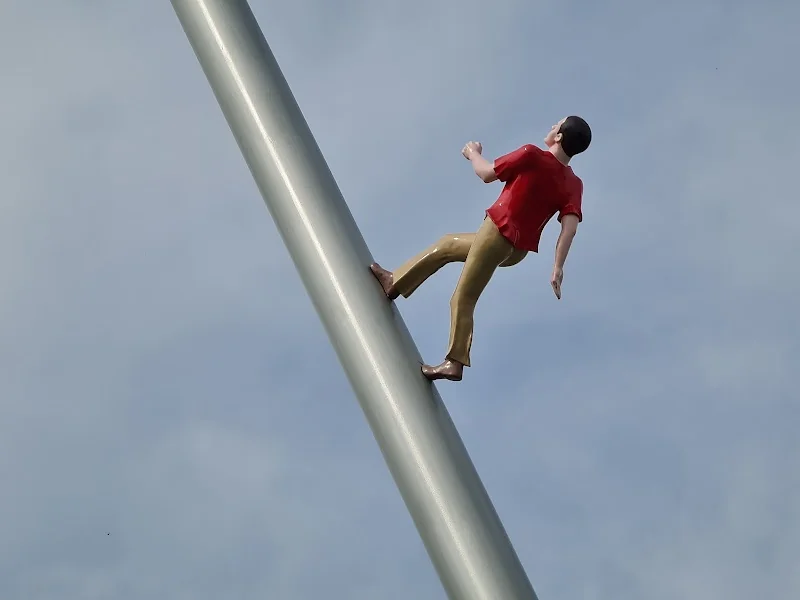
The Skywalker is much more than just a striking sculpture in front of a train station. The work depicts a man made of fiberglass who seems to be walking towards the sky on an inclined pipe. This gesture appears light and almost playful at first glance, yet it is also bold, risky, and somewhat challenging. A large part of its fascination lies in this: the figure symbolically represents departure, hope, ambition, and the desire to transcend boundaries without hiding the uncertainty of this path. The city of Kassel thus describes the artwork not only as a favorite among the public but also as a symbol of hope and the pursuit of happiness, while the documenta retrospective emphasizes the tension between ascent and possible downfall. This explains why the Skywalker repeatedly appears in tourism motifs, company logos, and city advertising, and still possesses strong recognizability today. At the same time, the work is so simple in its form that it is immediately understood: a single figure, a clear direction, an uncompromising movement upwards. This reduction makes it an ideal motif for people searching for photos, a special landmark, or a striking location in Kassel. Those visiting the Skywalker do not experience a closed museum label but an open piece of urban space that is supported by the surroundings. The location at the train station forecourt enhances this impression, as daily movement, arrival, departure, and stopover converge here. Thus, a sculpture becomes an urban sign that connects art history, everyday life, and visitor perspective in an unusually direct way. ([www1.kassel.de](https://www1.kassel.de/buerger/kunst_und_kultur/man-walking-to-the-sky-himmelsstuermer.php))
Jonathan Borofsky, documenta 9, and the creation of Man Walking to the Sky
The story of the Skywalker begins at documenta 9 in 1992. Jonathan Borofsky initially erected the work at Friedrichsplatz, where it became visible in the public space of Kassel for the first time as Man Walking to the Sky. The documenta retrospective describes the installation as a figure approximately 15 meters high on a 25-meter-long steel pipe, which was set up at an angle of 63 degrees. This makes it clear how strongly the work engages with the idea of movement and orientation: the figure does not walk along a straight axis but along an inclined line that conveys both stability and uncertainty. Borofsky himself is an artist known for large sculptures in public spaces; his official artist page explicitly lists Man Walking to the Sky as a documenta IX work for Kassel. Particularly significant for the history of Kassel was that the work did not disappear after the exhibition. The city and its citizens raised funds so that the sculpture could be purchased and permanently retained in Kassel. In 1995, it received its current location in front of the main train station, where it has since acted as one of the city's most famous landmarks. This change of location is crucial for understanding the Skywalker, as it transformed the artwork from a temporary documenta installation into a permanent urban symbol. From an exhibition sculpture, it became a place of identity that attracts not only art enthusiasts but also travelers, commuters, and passersby. Today, those searching for Skywalker photos or the history of the work will always encounter the special Kassel constellation of documenta, civic engagement, and urban memory. ([documenta.de](https://documenta.de/en/retrospective/documenta-ix))
In front of the KulturBahnhof: Why the location at Rainer-Dierichs-Platz is so formative
The current location of the Skywalker is not chosen randomly; it significantly shapes the impact of the work. It stands in front of the KulturBahnhof Kassel, at a point that mediates between travel, arrival, and cultural communication. The official address is Rainer-Dierichs-Platz 1 in 34117 Kassel. The city of Kassel describes the KulturBahnhof as a listed site with several preserved historical components, including the south wing, which is one of the few original parts of the former main train station. At the same time, the location is part of a larger cultural environment: in and around the KulturBahnhof are, among others, the Caricatura Gallery, the Kassel Architecture Center KAZ in KuBa, the Open Channel, the exhibition spaces Stellwerk, the areas of 387 in the south wing, and the BALi cinemas. This makes the Skywalker a gateway between public urban space and cultural infrastructure. Its view does not fall on a closed museum facade but on an urban place that thrives on audience, mobility, and changing uses. This fits perfectly with the gesture of the work: the figure seems to continue walking uninterrupted while people come and go around it. The KulturBahnhof itself sees itself as part of a new cultural quarter and as a successful conversion project that has transformed the former main train station into a place for exhibitions, events, cinema, art, and encounters. This gives the Skywalker a strong atmospheric connection to its surroundings. Those who visit it perceive not only a sculpture but also a piece of urban development, train station architecture, and cultural transformation. This is an important reason why so many people search for the location, the environment, and a good first impression of the Skywalker. The place itself is part of the narrative. ([www1.kassel.de](https://www1.kassel.de/buerger/kunst_und_kultur/kultur-vor-ort/veranstaltungsorte/kulturbahnhof-kassel.php))
Directions and parking at the Skywalker: Train, bus, bicycle, and car
The journey to the Skywalker is straightforward because the location is directly at the main train station. Those arriving by train can reach Kassel main station via local transport from Kassel-Wilhelmshöhe; the NVV mentions, among others, RegionalExpress, RegionalBahn, and RegioTram connections. Several bus lines also go directly to the main station, making the forecourt of the KulturBahnhof very well integrated into the Kassel public transport network. For cyclists, the situation is also practical: there are bicycle parking spaces at the south exit of the station, and there is also a nextbike station directly at Rainer-Dierichs-Platz. Those arriving by car will find the recommended parking lot on the south side of the main station, i.e., P1 on the site plan, according to NVV. It is located on the left side of the main portal, behind the taxi stand, and is subject to fees. For navigation, NVV recommends entering Franz-Ulrich-Straße. This makes the location not only central but also easy to plan for a short visit. Especially for those who want to use the Skywalker as a photo stop, intermediate destination, or starting point for a city tour, this location is a significant advantage. One does not have to plan an elaborate journey but essentially steps directly into the urban action. Those coming from the station often see the sculpture after just a few steps in the vicinity of the forecourt. Those arriving by bicycle or car benefit from the fact that the station area is designed for short stays. The Skywalker thus serves as a destination for spontaneous visitors as well as for deliberately planned outings. This everyday practicality also explains why it frequently appears in search queries related to Skywalker directions and Skywalker parking. The practical aspect is closely linked to the place: city, station, culture, and transport come together in a small space. ([nvv.de](https://www.nvv.de/anreise))
Skywalker Photos: Why the sculpture is so photogenic
Those searching for Skywalker photos are usually looking for a motif with a clear line, strong symbolism, and an immediately recognizable composition. Exactly this is offered by the work in Kassel. The inclined pipe structure on which the figure seems to walk creates a powerful diagonal in the image. This diagonal is particularly appealing photographically because it makes movement visible while simultaneously creating an unusual tension. Unlike a classic standing figure that is viewed head-on, the Skywalker thrives on perspective, angle, and distance. Even from below, the sculpture appears large and almost surreal; from a slightly greater distance, the embedding in the train station forecourt and the architecture of the KulturBahnhof become apparent. This results in very different photographic opportunities: detail-oriented, atmospheric, wide-angle, or as an urban motif. The city of Kassel also points out that the Skywalker is often used for advertising, company logos, and various products. This is a strong indication of how striking the silhouette is and how well it functions in collective memory. For visitors, this means: the figure is not only a popular motif but also a visual shorthand for Kassel itself. Thus, when photographing the location, one is not just capturing a sculpture but an urban symbol. The proximity to other documenta outdoor artworks is also interesting because the Skywalker is part of a larger art trail. Visit Kassel includes it in the documenta outdoor artworks and connects it with city tours, making the visit combinable with other art locations. This makes the motif particularly attractive for guests planning short city walks. The Skywalker not only provides a photo but also a story: a person who continues walking even though the path is visibly finite. This dual readability makes the work one of the most photographically and thematically powerful art locations in Kassel. ([www1.kassel.de](https://www1.kassel.de/buerger/kunst_und_kultur/man-walking-to-the-sky-himmelsstuermer.php))
Experience KulturBahnhof Kassel: Environment, other art locations, and practical tips
The Skywalker is best understood when viewed not in isolation but as part of the KulturBahnhof environment. The KulturBahnhof Kassel has evolved from the former main train station and was established as a cultural venue in the mid-1990s. The official representation of the city and the KulturBahnhof describes it as a successful conversion measure and as the seed of a new cultural quarter. With the opening of the ICE station Kassel-Wilhelmshöhe, the main train station lost its former role in long-distance transport but gained new significance through cultural repurposing. Particularly in the south wing, in the Stellwerk rooms, at Caricatura, in KAZ in KuBa, and in other institutions, it becomes evident how diverse this place functions today. There are exhibitions, conferences, cinemas, media projects, and cultural events taking place there. The KulturBahnhof is thus not just a backdrop for the Skywalker but a vibrant cultural space where art, communication, and urban life overlap. It is also practical that the location is part of various documenta tours. Therefore, those visiting the Skywalker can plan additional places in the urban space depending on their time and interests. This is particularly interesting for guests who want to experience Kassel as a documenta city and are not just looking for a single photo motif. The close connection to train station life and urban mobility adds to the appeal: here, travelers, cultural audiences, commuters, and strollers meet in a place that does not feel museum-like but remains open and permeable. For a relaxed visit, it is worth planning some time for the surroundings, paying attention to the axis of the forecourt, and also looking at the architecture of the station and other cultural locations. This way, a short photo stop becomes a small city tour with history, art, and the present. ([kulturbahnhof-kassel.de](https://kulturbahnhof-kassel.de/ueber-uns/))
Sources:
Mehr anzeigenWeniger anzeigen
Skywalker Kassel | Photos & Location
The Skywalker is one of those Kassel motifs that, once seen, is hardly forgotten. The upward-reaching figure by Jonathan Borofsky stands in front of the KulturBahnhof at Rainer-Dierichs-Platz 1, is officially known as Man Walking to the Sky, and was created in 1992 for documenta 9. Today, the work is one of the most famous outdoor artworks of documenta in the city and is also a place where art, train station atmosphere, and city identity come together directly. Therefore, those searching for photos, location, directions, or background information almost always end up at this ensemble of sculpture, forecourt, and KulturBahnhof. ([www1.kassel.de](https://www1.kassel.de/buerger/kunst_und_kultur/man-walking-to-the-sky-himmelsstuermer.php))
What is the Skywalker in Kassel and why does it attract so many gazes?
The Skywalker is much more than just a striking sculpture in front of a train station. The work depicts a man made of fiberglass who seems to be walking towards the sky on an inclined pipe. This gesture appears light and almost playful at first glance, yet it is also bold, risky, and somewhat challenging. A large part of its fascination lies in this: the figure symbolically represents departure, hope, ambition, and the desire to transcend boundaries without hiding the uncertainty of this path. The city of Kassel thus describes the artwork not only as a favorite among the public but also as a symbol of hope and the pursuit of happiness, while the documenta retrospective emphasizes the tension between ascent and possible downfall. This explains why the Skywalker repeatedly appears in tourism motifs, company logos, and city advertising, and still possesses strong recognizability today. At the same time, the work is so simple in its form that it is immediately understood: a single figure, a clear direction, an uncompromising movement upwards. This reduction makes it an ideal motif for people searching for photos, a special landmark, or a striking location in Kassel. Those visiting the Skywalker do not experience a closed museum label but an open piece of urban space that is supported by the surroundings. The location at the train station forecourt enhances this impression, as daily movement, arrival, departure, and stopover converge here. Thus, a sculpture becomes an urban sign that connects art history, everyday life, and visitor perspective in an unusually direct way. ([www1.kassel.de](https://www1.kassel.de/buerger/kunst_und_kultur/man-walking-to-the-sky-himmelsstuermer.php))
Jonathan Borofsky, documenta 9, and the creation of Man Walking to the Sky
The story of the Skywalker begins at documenta 9 in 1992. Jonathan Borofsky initially erected the work at Friedrichsplatz, where it became visible in the public space of Kassel for the first time as Man Walking to the Sky. The documenta retrospective describes the installation as a figure approximately 15 meters high on a 25-meter-long steel pipe, which was set up at an angle of 63 degrees. This makes it clear how strongly the work engages with the idea of movement and orientation: the figure does not walk along a straight axis but along an inclined line that conveys both stability and uncertainty. Borofsky himself is an artist known for large sculptures in public spaces; his official artist page explicitly lists Man Walking to the Sky as a documenta IX work for Kassel. Particularly significant for the history of Kassel was that the work did not disappear after the exhibition. The city and its citizens raised funds so that the sculpture could be purchased and permanently retained in Kassel. In 1995, it received its current location in front of the main train station, where it has since acted as one of the city's most famous landmarks. This change of location is crucial for understanding the Skywalker, as it transformed the artwork from a temporary documenta installation into a permanent urban symbol. From an exhibition sculpture, it became a place of identity that attracts not only art enthusiasts but also travelers, commuters, and passersby. Today, those searching for Skywalker photos or the history of the work will always encounter the special Kassel constellation of documenta, civic engagement, and urban memory. ([documenta.de](https://documenta.de/en/retrospective/documenta-ix))
In front of the KulturBahnhof: Why the location at Rainer-Dierichs-Platz is so formative
The current location of the Skywalker is not chosen randomly; it significantly shapes the impact of the work. It stands in front of the KulturBahnhof Kassel, at a point that mediates between travel, arrival, and cultural communication. The official address is Rainer-Dierichs-Platz 1 in 34117 Kassel. The city of Kassel describes the KulturBahnhof as a listed site with several preserved historical components, including the south wing, which is one of the few original parts of the former main train station. At the same time, the location is part of a larger cultural environment: in and around the KulturBahnhof are, among others, the Caricatura Gallery, the Kassel Architecture Center KAZ in KuBa, the Open Channel, the exhibition spaces Stellwerk, the areas of 387 in the south wing, and the BALi cinemas. This makes the Skywalker a gateway between public urban space and cultural infrastructure. Its view does not fall on a closed museum facade but on an urban place that thrives on audience, mobility, and changing uses. This fits perfectly with the gesture of the work: the figure seems to continue walking uninterrupted while people come and go around it. The KulturBahnhof itself sees itself as part of a new cultural quarter and as a successful conversion project that has transformed the former main train station into a place for exhibitions, events, cinema, art, and encounters. This gives the Skywalker a strong atmospheric connection to its surroundings. Those who visit it perceive not only a sculpture but also a piece of urban development, train station architecture, and cultural transformation. This is an important reason why so many people search for the location, the environment, and a good first impression of the Skywalker. The place itself is part of the narrative. ([www1.kassel.de](https://www1.kassel.de/buerger/kunst_und_kultur/kultur-vor-ort/veranstaltungsorte/kulturbahnhof-kassel.php))
Directions and parking at the Skywalker: Train, bus, bicycle, and car
The journey to the Skywalker is straightforward because the location is directly at the main train station. Those arriving by train can reach Kassel main station via local transport from Kassel-Wilhelmshöhe; the NVV mentions, among others, RegionalExpress, RegionalBahn, and RegioTram connections. Several bus lines also go directly to the main station, making the forecourt of the KulturBahnhof very well integrated into the Kassel public transport network. For cyclists, the situation is also practical: there are bicycle parking spaces at the south exit of the station, and there is also a nextbike station directly at Rainer-Dierichs-Platz. Those arriving by car will find the recommended parking lot on the south side of the main station, i.e., P1 on the site plan, according to NVV. It is located on the left side of the main portal, behind the taxi stand, and is subject to fees. For navigation, NVV recommends entering Franz-Ulrich-Straße. This makes the location not only central but also easy to plan for a short visit. Especially for those who want to use the Skywalker as a photo stop, intermediate destination, or starting point for a city tour, this location is a significant advantage. One does not have to plan an elaborate journey but essentially steps directly into the urban action. Those coming from the station often see the sculpture after just a few steps in the vicinity of the forecourt. Those arriving by bicycle or car benefit from the fact that the station area is designed for short stays. The Skywalker thus serves as a destination for spontaneous visitors as well as for deliberately planned outings. This everyday practicality also explains why it frequently appears in search queries related to Skywalker directions and Skywalker parking. The practical aspect is closely linked to the place: city, station, culture, and transport come together in a small space. ([nvv.de](https://www.nvv.de/anreise))
Skywalker Photos: Why the sculpture is so photogenic
Those searching for Skywalker photos are usually looking for a motif with a clear line, strong symbolism, and an immediately recognizable composition. Exactly this is offered by the work in Kassel. The inclined pipe structure on which the figure seems to walk creates a powerful diagonal in the image. This diagonal is particularly appealing photographically because it makes movement visible while simultaneously creating an unusual tension. Unlike a classic standing figure that is viewed head-on, the Skywalker thrives on perspective, angle, and distance. Even from below, the sculpture appears large and almost surreal; from a slightly greater distance, the embedding in the train station forecourt and the architecture of the KulturBahnhof become apparent. This results in very different photographic opportunities: detail-oriented, atmospheric, wide-angle, or as an urban motif. The city of Kassel also points out that the Skywalker is often used for advertising, company logos, and various products. This is a strong indication of how striking the silhouette is and how well it functions in collective memory. For visitors, this means: the figure is not only a popular motif but also a visual shorthand for Kassel itself. Thus, when photographing the location, one is not just capturing a sculpture but an urban symbol. The proximity to other documenta outdoor artworks is also interesting because the Skywalker is part of a larger art trail. Visit Kassel includes it in the documenta outdoor artworks and connects it with city tours, making the visit combinable with other art locations. This makes the motif particularly attractive for guests planning short city walks. The Skywalker not only provides a photo but also a story: a person who continues walking even though the path is visibly finite. This dual readability makes the work one of the most photographically and thematically powerful art locations in Kassel. ([www1.kassel.de](https://www1.kassel.de/buerger/kunst_und_kultur/man-walking-to-the-sky-himmelsstuermer.php))
Experience KulturBahnhof Kassel: Environment, other art locations, and practical tips
The Skywalker is best understood when viewed not in isolation but as part of the KulturBahnhof environment. The KulturBahnhof Kassel has evolved from the former main train station and was established as a cultural venue in the mid-1990s. The official representation of the city and the KulturBahnhof describes it as a successful conversion measure and as the seed of a new cultural quarter. With the opening of the ICE station Kassel-Wilhelmshöhe, the main train station lost its former role in long-distance transport but gained new significance through cultural repurposing. Particularly in the south wing, in the Stellwerk rooms, at Caricatura, in KAZ in KuBa, and in other institutions, it becomes evident how diverse this place functions today. There are exhibitions, conferences, cinemas, media projects, and cultural events taking place there. The KulturBahnhof is thus not just a backdrop for the Skywalker but a vibrant cultural space where art, communication, and urban life overlap. It is also practical that the location is part of various documenta tours. Therefore, those visiting the Skywalker can plan additional places in the urban space depending on their time and interests. This is particularly interesting for guests who want to experience Kassel as a documenta city and are not just looking for a single photo motif. The close connection to train station life and urban mobility adds to the appeal: here, travelers, cultural audiences, commuters, and strollers meet in a place that does not feel museum-like but remains open and permeable. For a relaxed visit, it is worth planning some time for the surroundings, paying attention to the axis of the forecourt, and also looking at the architecture of the station and other cultural locations. This way, a short photo stop becomes a small city tour with history, art, and the present. ([kulturbahnhof-kassel.de](https://kulturbahnhof-kassel.de/ueber-uns/))
Sources:
Skywalker Kassel | Photos & Location
The Skywalker is one of those Kassel motifs that, once seen, is hardly forgotten. The upward-reaching figure by Jonathan Borofsky stands in front of the KulturBahnhof at Rainer-Dierichs-Platz 1, is officially known as Man Walking to the Sky, and was created in 1992 for documenta 9. Today, the work is one of the most famous outdoor artworks of documenta in the city and is also a place where art, train station atmosphere, and city identity come together directly. Therefore, those searching for photos, location, directions, or background information almost always end up at this ensemble of sculpture, forecourt, and KulturBahnhof. ([www1.kassel.de](https://www1.kassel.de/buerger/kunst_und_kultur/man-walking-to-the-sky-himmelsstuermer.php))
What is the Skywalker in Kassel and why does it attract so many gazes?
The Skywalker is much more than just a striking sculpture in front of a train station. The work depicts a man made of fiberglass who seems to be walking towards the sky on an inclined pipe. This gesture appears light and almost playful at first glance, yet it is also bold, risky, and somewhat challenging. A large part of its fascination lies in this: the figure symbolically represents departure, hope, ambition, and the desire to transcend boundaries without hiding the uncertainty of this path. The city of Kassel thus describes the artwork not only as a favorite among the public but also as a symbol of hope and the pursuit of happiness, while the documenta retrospective emphasizes the tension between ascent and possible downfall. This explains why the Skywalker repeatedly appears in tourism motifs, company logos, and city advertising, and still possesses strong recognizability today. At the same time, the work is so simple in its form that it is immediately understood: a single figure, a clear direction, an uncompromising movement upwards. This reduction makes it an ideal motif for people searching for photos, a special landmark, or a striking location in Kassel. Those visiting the Skywalker do not experience a closed museum label but an open piece of urban space that is supported by the surroundings. The location at the train station forecourt enhances this impression, as daily movement, arrival, departure, and stopover converge here. Thus, a sculpture becomes an urban sign that connects art history, everyday life, and visitor perspective in an unusually direct way. ([www1.kassel.de](https://www1.kassel.de/buerger/kunst_und_kultur/man-walking-to-the-sky-himmelsstuermer.php))
Jonathan Borofsky, documenta 9, and the creation of Man Walking to the Sky
The story of the Skywalker begins at documenta 9 in 1992. Jonathan Borofsky initially erected the work at Friedrichsplatz, where it became visible in the public space of Kassel for the first time as Man Walking to the Sky. The documenta retrospective describes the installation as a figure approximately 15 meters high on a 25-meter-long steel pipe, which was set up at an angle of 63 degrees. This makes it clear how strongly the work engages with the idea of movement and orientation: the figure does not walk along a straight axis but along an inclined line that conveys both stability and uncertainty. Borofsky himself is an artist known for large sculptures in public spaces; his official artist page explicitly lists Man Walking to the Sky as a documenta IX work for Kassel. Particularly significant for the history of Kassel was that the work did not disappear after the exhibition. The city and its citizens raised funds so that the sculpture could be purchased and permanently retained in Kassel. In 1995, it received its current location in front of the main train station, where it has since acted as one of the city's most famous landmarks. This change of location is crucial for understanding the Skywalker, as it transformed the artwork from a temporary documenta installation into a permanent urban symbol. From an exhibition sculpture, it became a place of identity that attracts not only art enthusiasts but also travelers, commuters, and passersby. Today, those searching for Skywalker photos or the history of the work will always encounter the special Kassel constellation of documenta, civic engagement, and urban memory. ([documenta.de](https://documenta.de/en/retrospective/documenta-ix))
In front of the KulturBahnhof: Why the location at Rainer-Dierichs-Platz is so formative
The current location of the Skywalker is not chosen randomly; it significantly shapes the impact of the work. It stands in front of the KulturBahnhof Kassel, at a point that mediates between travel, arrival, and cultural communication. The official address is Rainer-Dierichs-Platz 1 in 34117 Kassel. The city of Kassel describes the KulturBahnhof as a listed site with several preserved historical components, including the south wing, which is one of the few original parts of the former main train station. At the same time, the location is part of a larger cultural environment: in and around the KulturBahnhof are, among others, the Caricatura Gallery, the Kassel Architecture Center KAZ in KuBa, the Open Channel, the exhibition spaces Stellwerk, the areas of 387 in the south wing, and the BALi cinemas. This makes the Skywalker a gateway between public urban space and cultural infrastructure. Its view does not fall on a closed museum facade but on an urban place that thrives on audience, mobility, and changing uses. This fits perfectly with the gesture of the work: the figure seems to continue walking uninterrupted while people come and go around it. The KulturBahnhof itself sees itself as part of a new cultural quarter and as a successful conversion project that has transformed the former main train station into a place for exhibitions, events, cinema, art, and encounters. This gives the Skywalker a strong atmospheric connection to its surroundings. Those who visit it perceive not only a sculpture but also a piece of urban development, train station architecture, and cultural transformation. This is an important reason why so many people search for the location, the environment, and a good first impression of the Skywalker. The place itself is part of the narrative. ([www1.kassel.de](https://www1.kassel.de/buerger/kunst_und_kultur/kultur-vor-ort/veranstaltungsorte/kulturbahnhof-kassel.php))
Directions and parking at the Skywalker: Train, bus, bicycle, and car
The journey to the Skywalker is straightforward because the location is directly at the main train station. Those arriving by train can reach Kassel main station via local transport from Kassel-Wilhelmshöhe; the NVV mentions, among others, RegionalExpress, RegionalBahn, and RegioTram connections. Several bus lines also go directly to the main station, making the forecourt of the KulturBahnhof very well integrated into the Kassel public transport network. For cyclists, the situation is also practical: there are bicycle parking spaces at the south exit of the station, and there is also a nextbike station directly at Rainer-Dierichs-Platz. Those arriving by car will find the recommended parking lot on the south side of the main station, i.e., P1 on the site plan, according to NVV. It is located on the left side of the main portal, behind the taxi stand, and is subject to fees. For navigation, NVV recommends entering Franz-Ulrich-Straße. This makes the location not only central but also easy to plan for a short visit. Especially for those who want to use the Skywalker as a photo stop, intermediate destination, or starting point for a city tour, this location is a significant advantage. One does not have to plan an elaborate journey but essentially steps directly into the urban action. Those coming from the station often see the sculpture after just a few steps in the vicinity of the forecourt. Those arriving by bicycle or car benefit from the fact that the station area is designed for short stays. The Skywalker thus serves as a destination for spontaneous visitors as well as for deliberately planned outings. This everyday practicality also explains why it frequently appears in search queries related to Skywalker directions and Skywalker parking. The practical aspect is closely linked to the place: city, station, culture, and transport come together in a small space. ([nvv.de](https://www.nvv.de/anreise))
Skywalker Photos: Why the sculpture is so photogenic
Those searching for Skywalker photos are usually looking for a motif with a clear line, strong symbolism, and an immediately recognizable composition. Exactly this is offered by the work in Kassel. The inclined pipe structure on which the figure seems to walk creates a powerful diagonal in the image. This diagonal is particularly appealing photographically because it makes movement visible while simultaneously creating an unusual tension. Unlike a classic standing figure that is viewed head-on, the Skywalker thrives on perspective, angle, and distance. Even from below, the sculpture appears large and almost surreal; from a slightly greater distance, the embedding in the train station forecourt and the architecture of the KulturBahnhof become apparent. This results in very different photographic opportunities: detail-oriented, atmospheric, wide-angle, or as an urban motif. The city of Kassel also points out that the Skywalker is often used for advertising, company logos, and various products. This is a strong indication of how striking the silhouette is and how well it functions in collective memory. For visitors, this means: the figure is not only a popular motif but also a visual shorthand for Kassel itself. Thus, when photographing the location, one is not just capturing a sculpture but an urban symbol. The proximity to other documenta outdoor artworks is also interesting because the Skywalker is part of a larger art trail. Visit Kassel includes it in the documenta outdoor artworks and connects it with city tours, making the visit combinable with other art locations. This makes the motif particularly attractive for guests planning short city walks. The Skywalker not only provides a photo but also a story: a person who continues walking even though the path is visibly finite. This dual readability makes the work one of the most photographically and thematically powerful art locations in Kassel. ([www1.kassel.de](https://www1.kassel.de/buerger/kunst_und_kultur/man-walking-to-the-sky-himmelsstuermer.php))
Experience KulturBahnhof Kassel: Environment, other art locations, and practical tips
The Skywalker is best understood when viewed not in isolation but as part of the KulturBahnhof environment. The KulturBahnhof Kassel has evolved from the former main train station and was established as a cultural venue in the mid-1990s. The official representation of the city and the KulturBahnhof describes it as a successful conversion measure and as the seed of a new cultural quarter. With the opening of the ICE station Kassel-Wilhelmshöhe, the main train station lost its former role in long-distance transport but gained new significance through cultural repurposing. Particularly in the south wing, in the Stellwerk rooms, at Caricatura, in KAZ in KuBa, and in other institutions, it becomes evident how diverse this place functions today. There are exhibitions, conferences, cinemas, media projects, and cultural events taking place there. The KulturBahnhof is thus not just a backdrop for the Skywalker but a vibrant cultural space where art, communication, and urban life overlap. It is also practical that the location is part of various documenta tours. Therefore, those visiting the Skywalker can plan additional places in the urban space depending on their time and interests. This is particularly interesting for guests who want to experience Kassel as a documenta city and are not just looking for a single photo motif. The close connection to train station life and urban mobility adds to the appeal: here, travelers, cultural audiences, commuters, and strollers meet in a place that does not feel museum-like but remains open and permeable. For a relaxed visit, it is worth planning some time for the surroundings, paying attention to the axis of the forecourt, and also looking at the architecture of the station and other cultural locations. This way, a short photo stop becomes a small city tour with history, art, and the present. ([kulturbahnhof-kassel.de](https://kulturbahnhof-kassel.de/ueber-uns/))
Sources:
Upcoming Events
No events found
Frequently Asked Questions
Reviews
Ghareeb Aleleiwi
10. August 2023
Beautiful
Tomasz S.
28. March 2016
The famous documenta statue directing you to the skies
Maha A
18. June 2016
First thing to see out of the hbh. Pleasant surprise
Kazimir Schulz (_Sinplay_)
6. February 2019
It's an inspiring piece of art.
Kai Se
10. August 2019
Okay