
Kassel
Friedrichsstraße 25, 34117 Kassel, Deutschland
Huguenot House Kassel | Events & History
The Huguenot House in Kassel is much more than a historic building at Friedrichsstraße 25. It represents an unusual combination of monument, art venue, and vibrant meeting point in the heart of the city. The official city website describes the house as a place for art, culture, and encounters, built in the early 19th century and reflecting a turbulent history. Today, it is used by the Moving School e.V. and the Huguenot House gGmbH as an open space for events, workshops, exhibitions, social projects, and healing formats. This very mix is what makes the house appealing: historical substance remains visible while new things continuously emerge inside and in the programs. Therefore, those searching for Huguenot House Kassel are often looking for not just a building, but a place with character, attitude, and urban flair. The house is also located in a particularly significant part of the city center, near Brüder-Grimm-Platz and surrounded by other cultural addresses that shape Kassel's cityscape. The Huguenot history of the city resonates in the name, as Kassel has been significantly influenced by the Huguenots since the 17th century. In this tension between city history, contemporary culture, and experimental use, the Huguenot House unfolds its special effect. ([kassel.de](https://www.kassel.de/buerger/kunst_und_kultur/kultur-vor-ort/bildende-kunst/hugenottenhaus.php))
Events, Exhibitions, and Program 2025
When it comes to events at the Huguenot House Kassel, it quickly becomes clear that this is not a rigid house with a single format, but an open cultural house with changing impulses. The official website and the pages of the city of Kassel document a wide range: exhibition openings, house tours, workshops, performance formats, discussion rounds, creative classrooms, and participatory projects. For example, the homepage of the house announced openings, art exhibitions, Tetra Pak printmaking, film screenings, lecture-performance workshops, and sessions. The city of Kassel describes the program as a mix of art, culture, social issues, and healing under one roof. This makes the house particularly relevant for searches like events, exhibitions, or program 2025. Those looking for specific program points will also find a very hands-on offering in 2025: a creative writing workshop, a children's workshop for candle making, summer camps for children, the urban art project House of Walls, and an exhibition by Roswitha Wagner-Jordan. This mix shows that the Huguenot House not only promotes spectatorship but also participation. It is a place where visitors can not only consume but also become active themselves. ([kassel.de](https://www.kassel.de/buerger/kunst_und_kultur/kultur-vor-ort/bildende-kunst/hugenottenhaus.php))
An important aspect of the program is the close connection between exhibition and education. The city of Kassel explicitly describes the Huguenot House as a space where artistic research, discovery, and lifelong learning come together. It fits that many works are developed directly for the respective exhibition in the more than 20 rooms of the house, allowing it to be experienced anew time and again. This idea was particularly evident in the House of Walls project, where over 25 national and international artists transformed the building into a walk-in total art world. Rooms became independent artistic experiences, and behind each door opened a new perspective. The Museum Night Kassel also lists the Huguenot House as a venue, showing how strongly it is anchored in the city's cultural calendar. For the search for Huguenot House Kassel 2025, it is also important: the program does not consist of a single major event but a variety of smaller, often surprising formats that connect art, dialogue, and community. This openness is a crucial part of the house's appeal. ([visit.kassel.de](https://visit.kassel.de/en/poi/huguenot-house))
History of the Huguenot House in Kassel
The history of the Huguenot House is closely linked to the history of the city of Kassel. According to the city of Kassel, the house was built in the first decades of the 19th century and has since had a tumultuous history of use, characterized by cultural use and longer phases of vacancy. The current transformation began with the exhibition Vacant Rooms in 2019, which is considered the starting point for the permanent conversion into a house for art and culture. Since 2019, the Huguenot House has been managed by the artist couple Silvia and Lutz Freyer together with Udo Wendland; the city website additionally emphasizes the close collaboration with the Moving School e.V. and the Huguenot House gGmbH. Particularly interesting is its classification as a monument: in a development plan document from the city of Kassel, the building is described as the only remaining bourgeois rental house from the first decades of the 19th century and as the last example of the building type five-window house from the former Oberneustadt. This is precisely why it is so frequently referred to as the Huguenot House. This historical classification explains why the name is not just a label but refers to urban planning and cultural-historical layers. Those interested in the history of Huguenot House Kassel will therefore discover not just an old house, but a building that reflects the development of Kassel over two centuries. ([visit.kassel.de](https://visit.kassel.de/en/poi/huguenot-house))
The name Huguenot House also refers to the significant Huguenot history of Kassel. The city of Kassel reminds us that Landgrave Karl began accepting French religious refugees in 1685, granting them freedom of belief, protection, and economic support. The Huguenots significantly shaped social, economic, and cultural life in Kassel. The Huguenot House thus symbolically stands in a historical line that goes far beyond the individual building. The artwork by Lawrence Weiner on the facade is also part of this history: the city of Kassel documents the wall design THE MIDDLE OF THE MIDDLE OF THE MIDDLE OF as a documenta-13 work from 2012 at the Huguenot House in Friedrichsstraße 25. This work makes it clear how the house is integrated into the canon of contemporary art in Kassel. It is thus a building that links historical memory, monument preservation significance, and international art history. Those searching for Huguenot House Kassel history are thereby automatically also looking for the relationship between Kassel's migration heritage, urban expansion, monument preservation, and modern cultural production. The Huguenot House answers this search in a very vivid way: not abstractly, but in a real, walkable house with visible traces of time. ([kassel.de](https://www.kassel.de/buerger/stadtgeschichte/stadtarchiv/geschichten-aus-dem-stadtarchiv/inhalt-geschichten-aus-dem-stadtarchiv/hugenotten-in-kassel.php))
Directions and Parking at Friedrichsstraße 25
The Huguenot House is located in the middle of Kassel's city center and is therefore well integrated into a city tour or cultural walk. The official page of the house offers both directions by car and public transport; at the same time, the address is clearly stated as Friedrichsstraße 25, 34117 Kassel. For visitors arriving by car, the Friedrichsplatz underground garage is particularly interesting. The city of Kassel describes it as a modern underground garage that is directly connected to the Königs-Galerie, the pedestrian zone, and the Kassel State Theatre. Thus, it is located in a central area that is particularly practical for events, exhibitions, and city visits. The garage has entrances and exits at Steinweg / corner of Friedrichsplatz and in Du-Ry-Straße. According to the city of Kassel, it is open Monday to Saturday from 6 AM to midnight and on Sundays and public holidays from 9 AM to midnight. Additional practical details include women’s parking spaces, parent-child parking spaces, disabled parking spaces, elevators, electric charging stations, and license plate recognition for billing. For the search intention Huguenot House Kassel parking, these are very relevant pieces of information as they make access in the city center manageable. Especially for evening events, openings, or museum night appointments, this proximity to a large underground garage can significantly ease the visit. ([kassel.de](https://www.kassel.de/buerger/kunst_und_kultur/kultur-vor-ort/bildende-kunst/hugenottenhaus.php))
The urban environment is also important for orientation. The Brüder-Grimm-Platz is described by the city of Kassel as the entrance to the inner-city museum island, which includes the Huguenot House in Friedrichsstraße. Also mentioned are the Hessian State Museum, the GRIMMWELT, the Museum of Sepulchral Culture, and the Murhard Library. This shows that those visiting the Huguenot House are moving in one of the densest cultural corridors of the city. The location is therefore not only practical but also atmospherically appealing. For visitors without a car, this is an advantage because the house is well integrated into the inner-city mobility and public transport network. The city refers to its travel service by bus and train, and the Huguenot House itself offers a direct connection to navigation through its location functions. Thus, the journey becomes not a hindrance but part of the visit experience: first through the city center, then into a place where historical substance and contemporary culture meet directly. For Huguenot House Kassel directions and parking, the core message is therefore clear: central location, well-planned access, and excellent integration into the city center structure. ([kassel.de](https://www.kassel.de/buerger/kunst_und_kultur/sehenswertes/strassen-und-plaetze/brueder-grimm-platz.php?utm_source=openai))
Rooms, Studios, Café, and Special Use
A key to understanding the Huguenot House is its spatial structure. Visit Kassel describes the building as a house with more than 20 rooms, many of which are used for exhibition purposes and where a large part of the works is created on-site. This makes each tour individual: not a single large hall shapes the experience, but a sequence of rooms, perspectives, and artistic placements. This is where part of the special fascination lies, as visitors experience the house not just as a backdrop but as a changing overall experience. The city of Kassel adds that several artists have studios in the Huguenot House and that there is also a room for coaching and therapy. This expands the function of the house far beyond classical cultural mediation. The house is not only a venue for exhibitions but also a workplace, retreat, and meeting place. The official representation also states that the Moving School offers an educational program in the Huguenot House that is based on artistic research, discovery, and lifelong learning. This combination of art, learning, and social practice makes the building interesting for many target groups: art audiences, families, workshop seekers, cultural travelers, and people looking for places with attitude. ([visit.kassel.de](https://visit.kassel.de/en/poi/huguenot-house))
Particularly noteworthy is also the Café Perle 2, which, according to Visit Kassel, has developed into an essential part of the art and cultural venue in recent years and even offers its own program. This is important for a place like the Huguenot House because it extends the visit and facilitates the transition between art exhibition, conversation, and stay. Those searching for Huguenot House photos often see this mix of history, spatial depth, and informal atmosphere. The place does not feel like a closed museum but like a living house where different uses overlap. It fits that the city of Kassel mentions projects like the International Kassel Art Residency, Social Catwalk – Fashion for Integration, and the Nature & Art Festival at the Waldschule Kassel. These projects show that the house and its surroundings not only present art but also initiate social, ecological, and intercultural processes. It is about exchange, creativity, and practical participation. Therefore, anyone looking for a location that not only provides space but also generates content and community will find the Huguenot House to be a particularly versatile place. This aspect makes the house very strong for searches related to exhibitions, workshops, and special event formats. ([visit.kassel.de](https://visit.kassel.de/en/poi/huguenot-house))
Photos, Monument, and Special Highlights
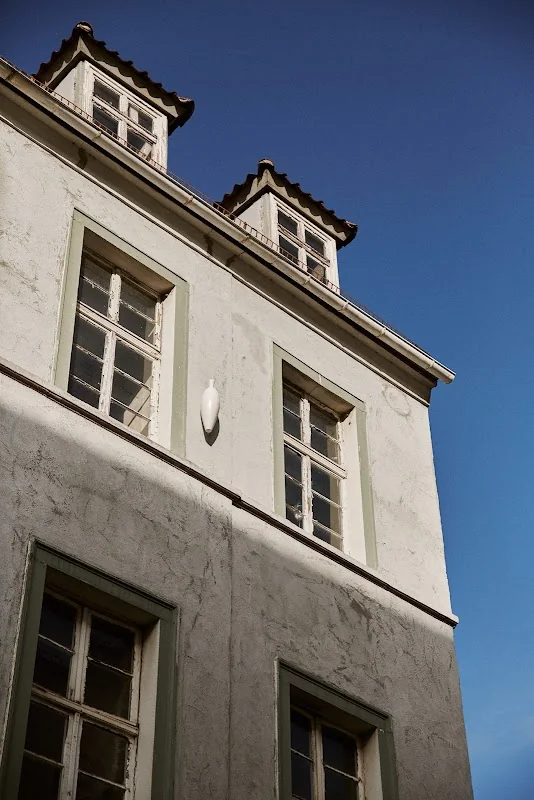
The Huguenot House is also highly searchable because it instantly generates recognition in photos: historic facade, prominent location, and a contemporary use that clearly distinguishes it from a typical old building. The monument documents of the city of Kassel emphasize that monument protection aims to secure the historical substance, including facades, windows, and roof structures. This is particularly relevant for search terms like Huguenot House monument photos, as the house is not only beautiful to look at but also historically interesting. Additionally, there is the integration into the documenta history: Lawrence Weiner's wall work from 2012 makes the house a public art carrier in the urban space. This means that the building creates an image from the outside that inscribes itself into the visual memory of Kassel. In conjunction with the central city location, the house thus becomes an anchor point for city walks, cultural trips, and architectural discoveries. Those interested in historic buildings will find a rare example here of how monument and contemporary use do not work against each other but rather reinforce each other. The Huguenot House is therefore an ideal place for people who want to not only consume in Kassel but also look, read, understand, and compare. ([ratsinfo.kassel.de](https://ratsinfo.kassel.de/sdnet4/sdnetrim/UGhVM0hpd2NXNFdFcExjZYxf8SBuS3roczJu4M4CQa9jb2PgUo7J_ppoZcuHtCtn/101.19.1350_Anlage_2-_Begruendung_zum_Bebauungsplanentwurf.pdf))
Another highlight lies in the special mix of history and openness. The city of Kassel describes the house as an inn of humanity and a place where people can approach each other with curiosity. This claim is not just poetic but is made visible through the program: workshops, exhibitions, performances, education, and social projects interlink. This is exactly what makes the Huguenot House so special in the urban fabric. It does not stand isolated but belongs to a cultural network around Friedrichsplatz, Brüder-Grimm-Platz, and the broader museum landscape of Kassel. Therefore, it is a destination for content and image motifs for visitors searching for Huguenot House photos, Huguenot House Kassel history, or Huguenot House Kassel exhibition. The facade, the proximity to other cultural places, and the visible artistic use create a multifaceted overall picture. Those visiting the place experience not only a monument but a house that remains in constant motion. This may be the strongest characteristic of the Huguenot House: it is both old and new, protected and open, locally rooted and artistically internationally connected. ([kassel.de](https://www.kassel.de/buerger/kunst_und_kultur/kultur-vor-ort/bildende-kunst/hugenottenhaus.php))
Sources:
Mehr anzeigenWeniger anzeigen
Huguenot House Kassel | Events & History
The Huguenot House in Kassel is much more than a historic building at Friedrichsstraße 25. It represents an unusual combination of monument, art venue, and vibrant meeting point in the heart of the city. The official city website describes the house as a place for art, culture, and encounters, built in the early 19th century and reflecting a turbulent history. Today, it is used by the Moving School e.V. and the Huguenot House gGmbH as an open space for events, workshops, exhibitions, social projects, and healing formats. This very mix is what makes the house appealing: historical substance remains visible while new things continuously emerge inside and in the programs. Therefore, those searching for Huguenot House Kassel are often looking for not just a building, but a place with character, attitude, and urban flair. The house is also located in a particularly significant part of the city center, near Brüder-Grimm-Platz and surrounded by other cultural addresses that shape Kassel's cityscape. The Huguenot history of the city resonates in the name, as Kassel has been significantly influenced by the Huguenots since the 17th century. In this tension between city history, contemporary culture, and experimental use, the Huguenot House unfolds its special effect. ([kassel.de](https://www.kassel.de/buerger/kunst_und_kultur/kultur-vor-ort/bildende-kunst/hugenottenhaus.php))
Events, Exhibitions, and Program 2025
When it comes to events at the Huguenot House Kassel, it quickly becomes clear that this is not a rigid house with a single format, but an open cultural house with changing impulses. The official website and the pages of the city of Kassel document a wide range: exhibition openings, house tours, workshops, performance formats, discussion rounds, creative classrooms, and participatory projects. For example, the homepage of the house announced openings, art exhibitions, Tetra Pak printmaking, film screenings, lecture-performance workshops, and sessions. The city of Kassel describes the program as a mix of art, culture, social issues, and healing under one roof. This makes the house particularly relevant for searches like events, exhibitions, or program 2025. Those looking for specific program points will also find a very hands-on offering in 2025: a creative writing workshop, a children's workshop for candle making, summer camps for children, the urban art project House of Walls, and an exhibition by Roswitha Wagner-Jordan. This mix shows that the Huguenot House not only promotes spectatorship but also participation. It is a place where visitors can not only consume but also become active themselves. ([kassel.de](https://www.kassel.de/buerger/kunst_und_kultur/kultur-vor-ort/bildende-kunst/hugenottenhaus.php))
An important aspect of the program is the close connection between exhibition and education. The city of Kassel explicitly describes the Huguenot House as a space where artistic research, discovery, and lifelong learning come together. It fits that many works are developed directly for the respective exhibition in the more than 20 rooms of the house, allowing it to be experienced anew time and again. This idea was particularly evident in the House of Walls project, where over 25 national and international artists transformed the building into a walk-in total art world. Rooms became independent artistic experiences, and behind each door opened a new perspective. The Museum Night Kassel also lists the Huguenot House as a venue, showing how strongly it is anchored in the city's cultural calendar. For the search for Huguenot House Kassel 2025, it is also important: the program does not consist of a single major event but a variety of smaller, often surprising formats that connect art, dialogue, and community. This openness is a crucial part of the house's appeal. ([visit.kassel.de](https://visit.kassel.de/en/poi/huguenot-house))
History of the Huguenot House in Kassel
The history of the Huguenot House is closely linked to the history of the city of Kassel. According to the city of Kassel, the house was built in the first decades of the 19th century and has since had a tumultuous history of use, characterized by cultural use and longer phases of vacancy. The current transformation began with the exhibition Vacant Rooms in 2019, which is considered the starting point for the permanent conversion into a house for art and culture. Since 2019, the Huguenot House has been managed by the artist couple Silvia and Lutz Freyer together with Udo Wendland; the city website additionally emphasizes the close collaboration with the Moving School e.V. and the Huguenot House gGmbH. Particularly interesting is its classification as a monument: in a development plan document from the city of Kassel, the building is described as the only remaining bourgeois rental house from the first decades of the 19th century and as the last example of the building type five-window house from the former Oberneustadt. This is precisely why it is so frequently referred to as the Huguenot House. This historical classification explains why the name is not just a label but refers to urban planning and cultural-historical layers. Those interested in the history of Huguenot House Kassel will therefore discover not just an old house, but a building that reflects the development of Kassel over two centuries. ([visit.kassel.de](https://visit.kassel.de/en/poi/huguenot-house))
The name Huguenot House also refers to the significant Huguenot history of Kassel. The city of Kassel reminds us that Landgrave Karl began accepting French religious refugees in 1685, granting them freedom of belief, protection, and economic support. The Huguenots significantly shaped social, economic, and cultural life in Kassel. The Huguenot House thus symbolically stands in a historical line that goes far beyond the individual building. The artwork by Lawrence Weiner on the facade is also part of this history: the city of Kassel documents the wall design THE MIDDLE OF THE MIDDLE OF THE MIDDLE OF as a documenta-13 work from 2012 at the Huguenot House in Friedrichsstraße 25. This work makes it clear how the house is integrated into the canon of contemporary art in Kassel. It is thus a building that links historical memory, monument preservation significance, and international art history. Those searching for Huguenot House Kassel history are thereby automatically also looking for the relationship between Kassel's migration heritage, urban expansion, monument preservation, and modern cultural production. The Huguenot House answers this search in a very vivid way: not abstractly, but in a real, walkable house with visible traces of time. ([kassel.de](https://www.kassel.de/buerger/stadtgeschichte/stadtarchiv/geschichten-aus-dem-stadtarchiv/inhalt-geschichten-aus-dem-stadtarchiv/hugenotten-in-kassel.php))
Directions and Parking at Friedrichsstraße 25
The Huguenot House is located in the middle of Kassel's city center and is therefore well integrated into a city tour or cultural walk. The official page of the house offers both directions by car and public transport; at the same time, the address is clearly stated as Friedrichsstraße 25, 34117 Kassel. For visitors arriving by car, the Friedrichsplatz underground garage is particularly interesting. The city of Kassel describes it as a modern underground garage that is directly connected to the Königs-Galerie, the pedestrian zone, and the Kassel State Theatre. Thus, it is located in a central area that is particularly practical for events, exhibitions, and city visits. The garage has entrances and exits at Steinweg / corner of Friedrichsplatz and in Du-Ry-Straße. According to the city of Kassel, it is open Monday to Saturday from 6 AM to midnight and on Sundays and public holidays from 9 AM to midnight. Additional practical details include women’s parking spaces, parent-child parking spaces, disabled parking spaces, elevators, electric charging stations, and license plate recognition for billing. For the search intention Huguenot House Kassel parking, these are very relevant pieces of information as they make access in the city center manageable. Especially for evening events, openings, or museum night appointments, this proximity to a large underground garage can significantly ease the visit. ([kassel.de](https://www.kassel.de/buerger/kunst_und_kultur/kultur-vor-ort/bildende-kunst/hugenottenhaus.php))
The urban environment is also important for orientation. The Brüder-Grimm-Platz is described by the city of Kassel as the entrance to the inner-city museum island, which includes the Huguenot House in Friedrichsstraße. Also mentioned are the Hessian State Museum, the GRIMMWELT, the Museum of Sepulchral Culture, and the Murhard Library. This shows that those visiting the Huguenot House are moving in one of the densest cultural corridors of the city. The location is therefore not only practical but also atmospherically appealing. For visitors without a car, this is an advantage because the house is well integrated into the inner-city mobility and public transport network. The city refers to its travel service by bus and train, and the Huguenot House itself offers a direct connection to navigation through its location functions. Thus, the journey becomes not a hindrance but part of the visit experience: first through the city center, then into a place where historical substance and contemporary culture meet directly. For Huguenot House Kassel directions and parking, the core message is therefore clear: central location, well-planned access, and excellent integration into the city center structure. ([kassel.de](https://www.kassel.de/buerger/kunst_und_kultur/sehenswertes/strassen-und-plaetze/brueder-grimm-platz.php?utm_source=openai))
Rooms, Studios, Café, and Special Use
A key to understanding the Huguenot House is its spatial structure. Visit Kassel describes the building as a house with more than 20 rooms, many of which are used for exhibition purposes and where a large part of the works is created on-site. This makes each tour individual: not a single large hall shapes the experience, but a sequence of rooms, perspectives, and artistic placements. This is where part of the special fascination lies, as visitors experience the house not just as a backdrop but as a changing overall experience. The city of Kassel adds that several artists have studios in the Huguenot House and that there is also a room for coaching and therapy. This expands the function of the house far beyond classical cultural mediation. The house is not only a venue for exhibitions but also a workplace, retreat, and meeting place. The official representation also states that the Moving School offers an educational program in the Huguenot House that is based on artistic research, discovery, and lifelong learning. This combination of art, learning, and social practice makes the building interesting for many target groups: art audiences, families, workshop seekers, cultural travelers, and people looking for places with attitude. ([visit.kassel.de](https://visit.kassel.de/en/poi/huguenot-house))
Particularly noteworthy is also the Café Perle 2, which, according to Visit Kassel, has developed into an essential part of the art and cultural venue in recent years and even offers its own program. This is important for a place like the Huguenot House because it extends the visit and facilitates the transition between art exhibition, conversation, and stay. Those searching for Huguenot House photos often see this mix of history, spatial depth, and informal atmosphere. The place does not feel like a closed museum but like a living house where different uses overlap. It fits that the city of Kassel mentions projects like the International Kassel Art Residency, Social Catwalk – Fashion for Integration, and the Nature & Art Festival at the Waldschule Kassel. These projects show that the house and its surroundings not only present art but also initiate social, ecological, and intercultural processes. It is about exchange, creativity, and practical participation. Therefore, anyone looking for a location that not only provides space but also generates content and community will find the Huguenot House to be a particularly versatile place. This aspect makes the house very strong for searches related to exhibitions, workshops, and special event formats. ([visit.kassel.de](https://visit.kassel.de/en/poi/huguenot-house))
Photos, Monument, and Special Highlights
The Huguenot House is also highly searchable because it instantly generates recognition in photos: historic facade, prominent location, and a contemporary use that clearly distinguishes it from a typical old building. The monument documents of the city of Kassel emphasize that monument protection aims to secure the historical substance, including facades, windows, and roof structures. This is particularly relevant for search terms like Huguenot House monument photos, as the house is not only beautiful to look at but also historically interesting. Additionally, there is the integration into the documenta history: Lawrence Weiner's wall work from 2012 makes the house a public art carrier in the urban space. This means that the building creates an image from the outside that inscribes itself into the visual memory of Kassel. In conjunction with the central city location, the house thus becomes an anchor point for city walks, cultural trips, and architectural discoveries. Those interested in historic buildings will find a rare example here of how monument and contemporary use do not work against each other but rather reinforce each other. The Huguenot House is therefore an ideal place for people who want to not only consume in Kassel but also look, read, understand, and compare. ([ratsinfo.kassel.de](https://ratsinfo.kassel.de/sdnet4/sdnetrim/UGhVM0hpd2NXNFdFcExjZYxf8SBuS3roczJu4M4CQa9jb2PgUo7J_ppoZcuHtCtn/101.19.1350_Anlage_2-_Begruendung_zum_Bebauungsplanentwurf.pdf))
Another highlight lies in the special mix of history and openness. The city of Kassel describes the house as an inn of humanity and a place where people can approach each other with curiosity. This claim is not just poetic but is made visible through the program: workshops, exhibitions, performances, education, and social projects interlink. This is exactly what makes the Huguenot House so special in the urban fabric. It does not stand isolated but belongs to a cultural network around Friedrichsplatz, Brüder-Grimm-Platz, and the broader museum landscape of Kassel. Therefore, it is a destination for content and image motifs for visitors searching for Huguenot House photos, Huguenot House Kassel history, or Huguenot House Kassel exhibition. The facade, the proximity to other cultural places, and the visible artistic use create a multifaceted overall picture. Those visiting the place experience not only a monument but a house that remains in constant motion. This may be the strongest characteristic of the Huguenot House: it is both old and new, protected and open, locally rooted and artistically internationally connected. ([kassel.de](https://www.kassel.de/buerger/kunst_und_kultur/kultur-vor-ort/bildende-kunst/hugenottenhaus.php))
Sources:
Huguenot House Kassel | Events & History
The Huguenot House in Kassel is much more than a historic building at Friedrichsstraße 25. It represents an unusual combination of monument, art venue, and vibrant meeting point in the heart of the city. The official city website describes the house as a place for art, culture, and encounters, built in the early 19th century and reflecting a turbulent history. Today, it is used by the Moving School e.V. and the Huguenot House gGmbH as an open space for events, workshops, exhibitions, social projects, and healing formats. This very mix is what makes the house appealing: historical substance remains visible while new things continuously emerge inside and in the programs. Therefore, those searching for Huguenot House Kassel are often looking for not just a building, but a place with character, attitude, and urban flair. The house is also located in a particularly significant part of the city center, near Brüder-Grimm-Platz and surrounded by other cultural addresses that shape Kassel's cityscape. The Huguenot history of the city resonates in the name, as Kassel has been significantly influenced by the Huguenots since the 17th century. In this tension between city history, contemporary culture, and experimental use, the Huguenot House unfolds its special effect. ([kassel.de](https://www.kassel.de/buerger/kunst_und_kultur/kultur-vor-ort/bildende-kunst/hugenottenhaus.php))
Events, Exhibitions, and Program 2025
When it comes to events at the Huguenot House Kassel, it quickly becomes clear that this is not a rigid house with a single format, but an open cultural house with changing impulses. The official website and the pages of the city of Kassel document a wide range: exhibition openings, house tours, workshops, performance formats, discussion rounds, creative classrooms, and participatory projects. For example, the homepage of the house announced openings, art exhibitions, Tetra Pak printmaking, film screenings, lecture-performance workshops, and sessions. The city of Kassel describes the program as a mix of art, culture, social issues, and healing under one roof. This makes the house particularly relevant for searches like events, exhibitions, or program 2025. Those looking for specific program points will also find a very hands-on offering in 2025: a creative writing workshop, a children's workshop for candle making, summer camps for children, the urban art project House of Walls, and an exhibition by Roswitha Wagner-Jordan. This mix shows that the Huguenot House not only promotes spectatorship but also participation. It is a place where visitors can not only consume but also become active themselves. ([kassel.de](https://www.kassel.de/buerger/kunst_und_kultur/kultur-vor-ort/bildende-kunst/hugenottenhaus.php))
An important aspect of the program is the close connection between exhibition and education. The city of Kassel explicitly describes the Huguenot House as a space where artistic research, discovery, and lifelong learning come together. It fits that many works are developed directly for the respective exhibition in the more than 20 rooms of the house, allowing it to be experienced anew time and again. This idea was particularly evident in the House of Walls project, where over 25 national and international artists transformed the building into a walk-in total art world. Rooms became independent artistic experiences, and behind each door opened a new perspective. The Museum Night Kassel also lists the Huguenot House as a venue, showing how strongly it is anchored in the city's cultural calendar. For the search for Huguenot House Kassel 2025, it is also important: the program does not consist of a single major event but a variety of smaller, often surprising formats that connect art, dialogue, and community. This openness is a crucial part of the house's appeal. ([visit.kassel.de](https://visit.kassel.de/en/poi/huguenot-house))
History of the Huguenot House in Kassel
The history of the Huguenot House is closely linked to the history of the city of Kassel. According to the city of Kassel, the house was built in the first decades of the 19th century and has since had a tumultuous history of use, characterized by cultural use and longer phases of vacancy. The current transformation began with the exhibition Vacant Rooms in 2019, which is considered the starting point for the permanent conversion into a house for art and culture. Since 2019, the Huguenot House has been managed by the artist couple Silvia and Lutz Freyer together with Udo Wendland; the city website additionally emphasizes the close collaboration with the Moving School e.V. and the Huguenot House gGmbH. Particularly interesting is its classification as a monument: in a development plan document from the city of Kassel, the building is described as the only remaining bourgeois rental house from the first decades of the 19th century and as the last example of the building type five-window house from the former Oberneustadt. This is precisely why it is so frequently referred to as the Huguenot House. This historical classification explains why the name is not just a label but refers to urban planning and cultural-historical layers. Those interested in the history of Huguenot House Kassel will therefore discover not just an old house, but a building that reflects the development of Kassel over two centuries. ([visit.kassel.de](https://visit.kassel.de/en/poi/huguenot-house))
The name Huguenot House also refers to the significant Huguenot history of Kassel. The city of Kassel reminds us that Landgrave Karl began accepting French religious refugees in 1685, granting them freedom of belief, protection, and economic support. The Huguenots significantly shaped social, economic, and cultural life in Kassel. The Huguenot House thus symbolically stands in a historical line that goes far beyond the individual building. The artwork by Lawrence Weiner on the facade is also part of this history: the city of Kassel documents the wall design THE MIDDLE OF THE MIDDLE OF THE MIDDLE OF as a documenta-13 work from 2012 at the Huguenot House in Friedrichsstraße 25. This work makes it clear how the house is integrated into the canon of contemporary art in Kassel. It is thus a building that links historical memory, monument preservation significance, and international art history. Those searching for Huguenot House Kassel history are thereby automatically also looking for the relationship between Kassel's migration heritage, urban expansion, monument preservation, and modern cultural production. The Huguenot House answers this search in a very vivid way: not abstractly, but in a real, walkable house with visible traces of time. ([kassel.de](https://www.kassel.de/buerger/stadtgeschichte/stadtarchiv/geschichten-aus-dem-stadtarchiv/inhalt-geschichten-aus-dem-stadtarchiv/hugenotten-in-kassel.php))
Directions and Parking at Friedrichsstraße 25
The Huguenot House is located in the middle of Kassel's city center and is therefore well integrated into a city tour or cultural walk. The official page of the house offers both directions by car and public transport; at the same time, the address is clearly stated as Friedrichsstraße 25, 34117 Kassel. For visitors arriving by car, the Friedrichsplatz underground garage is particularly interesting. The city of Kassel describes it as a modern underground garage that is directly connected to the Königs-Galerie, the pedestrian zone, and the Kassel State Theatre. Thus, it is located in a central area that is particularly practical for events, exhibitions, and city visits. The garage has entrances and exits at Steinweg / corner of Friedrichsplatz and in Du-Ry-Straße. According to the city of Kassel, it is open Monday to Saturday from 6 AM to midnight and on Sundays and public holidays from 9 AM to midnight. Additional practical details include women’s parking spaces, parent-child parking spaces, disabled parking spaces, elevators, electric charging stations, and license plate recognition for billing. For the search intention Huguenot House Kassel parking, these are very relevant pieces of information as they make access in the city center manageable. Especially for evening events, openings, or museum night appointments, this proximity to a large underground garage can significantly ease the visit. ([kassel.de](https://www.kassel.de/buerger/kunst_und_kultur/kultur-vor-ort/bildende-kunst/hugenottenhaus.php))
The urban environment is also important for orientation. The Brüder-Grimm-Platz is described by the city of Kassel as the entrance to the inner-city museum island, which includes the Huguenot House in Friedrichsstraße. Also mentioned are the Hessian State Museum, the GRIMMWELT, the Museum of Sepulchral Culture, and the Murhard Library. This shows that those visiting the Huguenot House are moving in one of the densest cultural corridors of the city. The location is therefore not only practical but also atmospherically appealing. For visitors without a car, this is an advantage because the house is well integrated into the inner-city mobility and public transport network. The city refers to its travel service by bus and train, and the Huguenot House itself offers a direct connection to navigation through its location functions. Thus, the journey becomes not a hindrance but part of the visit experience: first through the city center, then into a place where historical substance and contemporary culture meet directly. For Huguenot House Kassel directions and parking, the core message is therefore clear: central location, well-planned access, and excellent integration into the city center structure. ([kassel.de](https://www.kassel.de/buerger/kunst_und_kultur/sehenswertes/strassen-und-plaetze/brueder-grimm-platz.php?utm_source=openai))
Rooms, Studios, Café, and Special Use
A key to understanding the Huguenot House is its spatial structure. Visit Kassel describes the building as a house with more than 20 rooms, many of which are used for exhibition purposes and where a large part of the works is created on-site. This makes each tour individual: not a single large hall shapes the experience, but a sequence of rooms, perspectives, and artistic placements. This is where part of the special fascination lies, as visitors experience the house not just as a backdrop but as a changing overall experience. The city of Kassel adds that several artists have studios in the Huguenot House and that there is also a room for coaching and therapy. This expands the function of the house far beyond classical cultural mediation. The house is not only a venue for exhibitions but also a workplace, retreat, and meeting place. The official representation also states that the Moving School offers an educational program in the Huguenot House that is based on artistic research, discovery, and lifelong learning. This combination of art, learning, and social practice makes the building interesting for many target groups: art audiences, families, workshop seekers, cultural travelers, and people looking for places with attitude. ([visit.kassel.de](https://visit.kassel.de/en/poi/huguenot-house))
Particularly noteworthy is also the Café Perle 2, which, according to Visit Kassel, has developed into an essential part of the art and cultural venue in recent years and even offers its own program. This is important for a place like the Huguenot House because it extends the visit and facilitates the transition between art exhibition, conversation, and stay. Those searching for Huguenot House photos often see this mix of history, spatial depth, and informal atmosphere. The place does not feel like a closed museum but like a living house where different uses overlap. It fits that the city of Kassel mentions projects like the International Kassel Art Residency, Social Catwalk – Fashion for Integration, and the Nature & Art Festival at the Waldschule Kassel. These projects show that the house and its surroundings not only present art but also initiate social, ecological, and intercultural processes. It is about exchange, creativity, and practical participation. Therefore, anyone looking for a location that not only provides space but also generates content and community will find the Huguenot House to be a particularly versatile place. This aspect makes the house very strong for searches related to exhibitions, workshops, and special event formats. ([visit.kassel.de](https://visit.kassel.de/en/poi/huguenot-house))
Photos, Monument, and Special Highlights
The Huguenot House is also highly searchable because it instantly generates recognition in photos: historic facade, prominent location, and a contemporary use that clearly distinguishes it from a typical old building. The monument documents of the city of Kassel emphasize that monument protection aims to secure the historical substance, including facades, windows, and roof structures. This is particularly relevant for search terms like Huguenot House monument photos, as the house is not only beautiful to look at but also historically interesting. Additionally, there is the integration into the documenta history: Lawrence Weiner's wall work from 2012 makes the house a public art carrier in the urban space. This means that the building creates an image from the outside that inscribes itself into the visual memory of Kassel. In conjunction with the central city location, the house thus becomes an anchor point for city walks, cultural trips, and architectural discoveries. Those interested in historic buildings will find a rare example here of how monument and contemporary use do not work against each other but rather reinforce each other. The Huguenot House is therefore an ideal place for people who want to not only consume in Kassel but also look, read, understand, and compare. ([ratsinfo.kassel.de](https://ratsinfo.kassel.de/sdnet4/sdnetrim/UGhVM0hpd2NXNFdFcExjZYxf8SBuS3roczJu4M4CQa9jb2PgUo7J_ppoZcuHtCtn/101.19.1350_Anlage_2-_Begruendung_zum_Bebauungsplanentwurf.pdf))
Another highlight lies in the special mix of history and openness. The city of Kassel describes the house as an inn of humanity and a place where people can approach each other with curiosity. This claim is not just poetic but is made visible through the program: workshops, exhibitions, performances, education, and social projects interlink. This is exactly what makes the Huguenot House so special in the urban fabric. It does not stand isolated but belongs to a cultural network around Friedrichsplatz, Brüder-Grimm-Platz, and the broader museum landscape of Kassel. Therefore, it is a destination for content and image motifs for visitors searching for Huguenot House photos, Huguenot House Kassel history, or Huguenot House Kassel exhibition. The facade, the proximity to other cultural places, and the visible artistic use create a multifaceted overall picture. Those visiting the place experience not only a monument but a house that remains in constant motion. This may be the strongest characteristic of the Huguenot House: it is both old and new, protected and open, locally rooted and artistically internationally connected. ([kassel.de](https://www.kassel.de/buerger/kunst_und_kultur/kultur-vor-ort/bildende-kunst/hugenottenhaus.php))
Sources:
Frequently Asked Questions
Reviews
Reza Afisina
16. June 2022
Not only just a place but also space for meeting many friends.
Sibonisiwe Siswana
11. October 2021
Great place to hangout.
S N
7. August 2020
Amazing location!
Andreas Hocek
4. September 2022
Cool location
Elisabeth Engelmeyer
9. August 2020
IN ART WE TRUST - not in the mammon that undermines society. Silvia and Lutz Freyer have created spaces for a vibrant art and this time also music scene with the exhibition "Bewegte Zimmer". At the Hugenottenhaus, from Friday to Sunday between 10 AM and 5 PM, there are interesting objects, events, and stories to discover. Much unfolds over time or in conversation with the artists. Maren Freyer serves cool and warm drinks at "Perle 2". There are plenty of seating options inside and outside. An interesting, exciting place!