
Kassel
Königspl., 34117 Kassel, Germany
Königsplatz Kassel | Access & Parking
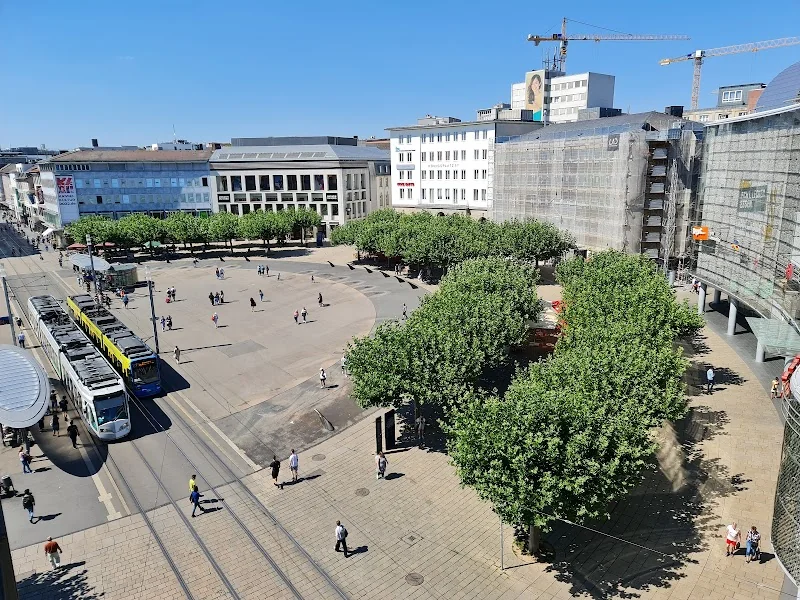
The Königsplatz in Kassel is much more than just a name on the city map. It is the central square of the city center, the geographical center of Kassel, and a place where history, mobility, shopping experiences, and urban life overlap directly. Those who arrive here are not at an arbitrary traffic junction, but in the midst of one of the most important urban spaces in Northern Hesse. The square is located in the heart of the pedestrian zone and, together with Königsstraße and the surrounding streets, forms the natural center for walks, shopping, transfers, and events. Its current role as a meeting point and orientation point has historical depth: The Königsplatz was created after the demolition of the old fortifications and developed from an urban restructuring that continues to shape Kassel to this day. For visitors, this is particularly practical, as the square combines classic city center atmosphere with very good accessibility. This mixture makes it one of the most important points for anyone arriving in Kassel, shopping, transferring, or simply experiencing the center. ([visit.kassel.de](https://visit.kassel.de/en/poi/koenigsplatz))
Why the Königsplatz Kassel is the Heart of the City Center
The Königsplatz is not only geographically central but also functionally the heart of the Kassel city center. The official representation describes it as the center of the city, located in the pedestrian zone and framed by radiating streets. The urban planning idea behind it is still recognizable today: The square connects the historical grid with the dynamics of a modern city. Those who walk further from the Königsplatz reach Königsstraße, the main shopping street of Kassel, in just a few steps. There, shops, department stores, and experience galleries line up, while museums and parks are also within walking distance. For a visit to the city center, this is ideal because the Königsplatz serves as a starting point for almost all typical routes: for shopping, dining, transferring to tram or bus, or attending events. Especially in comparison to anonymous traffic points, the square has a clear identity. It is open, urban, and lively, yet so clear that visitors can quickly orient themselves. This makes it a place that not only reflects the city center but actually organizes it in everyday life. ([visit.kassel.de](https://visit.kassel.de/en/poi/koenigsplatz))
The spatial form also contributes to the special effect of the Königsplatz. The square was designed as a circular urban space and is, from a historical perspective, an example of classical city planning from the 18th century. Its creation is closely linked to the dismantling of the old city walls, as only then did the free space emerge in which Kassel could open up outward. The Königsplatz thus symbolizes the transition from the fortified residence to the open city. Today, one may not perceive this history at first glance while strolling, but it is still visible in the layout: The square layout bundles paths, sightlines, and movements, ensuring that many everyday routes intersect here. Additionally, there is the special elevation, as the Königsplatz is also situated at an altitude of 163 meters above sea level. Such details may initially seem small, but they clearly show how precisely this place is anchored in urban space. Therefore, those who visit the Königsplatz experience not just an address but a truly identity-forming place of the city of Kassel. ([visit.kassel.de](https://visit.kassel.de/en/poi/koenigsplatz))
How the Königsplatz Came to Be
The history of the Königsplatz begins with a radical urban transformation. After the old city fortifications were demolished around 1760, Kassel gained space for a new, representative square. The design was shaped by Simon Louis du Ry, who laid out the Königsplatz in 1767 as part of a modern urban structure. The square's design was oriented towards contemporary European models and combined representative order with functional urban development. The radiating shape is particularly striking: Several streets converge on the square, making it a natural junction to this day. At the same time, the square was named after Landgrave Friedrich I, whose title was associated with the Swedish royal dignity of his time. Even this name shows that the place was conceived from the beginning not only as practical but also symbolically. The city was to open up outward while preserving its historical dignity. This explains why the Königsplatz is still perceived as so important today: It is not an accidental free space but the result of a conscious urban restructuring. ([kassel.de](https://www.kassel.de/buerger/stadtgeschichte/erinnerungskultur/koenigsplatz.php))
Over time, the Königsplatz has been used and interpreted in various ways. Since the end of the 18th century, there has been a market there, initially selling goods such as butter, poultry, eggs, vegetables, and fruits. This shows that the square was not only a representative space but also took on an everyday function for the city's population early on. Later, the offerings and uses changed, but the central role as a meeting point remained. The historical surrounding buildings are also interesting: Where a large shopping gallery stands today, there used to be the old post building, which was both an inn and a hotel. Johann Wolfgang von Goethe is said to have stopped here several times. Such details make the Königsplatz particularly multifaceted, as they show how closely traffic, trade, hospitality, and city history are intertwined here. For today's visitors, the square appears modern and urban, but beneath this surface lies a remarkably dense historical foundation. Therefore, those who visit the Königsplatz enter not just a city center but a developed stage of urban development. ([kassel.de](https://www.kassel.de/buerger/stadtgeschichte/erinnerungskultur/koenigsplatz.php))
The historical significance of the Königsplatz is also revealed by the fact that it cannot be viewed in isolation. Together with the surrounding city center, it forms an ensemble in which the development of Kassel can be read very well. The connection to the Oberneustadt and the Old Town was an important step because it brought formerly separated parts of the city together. That the square was subsequently shaped by trade, markets, and later by modern city mobility is no coincidence but a direct result of its location and planning. Today, the Königsplatz often appears as a self-evident meeting and transfer point, but its function is the result of centuries of urban adaptation. For this reason, it is an excellent starting point for exploring the city: Those who start here can trace the development of Kassel from a fortified residence to a market and trading city, and finally to a modern shopping and event city all in one place. This makes the Königsplatz not only beautiful to look at but also historically readable. ([kassel.de](https://www.kassel.de/buerger/stadtgeschichte/erinnerungskultur/koenigsplatz.php))
Access by Tram, RegioTram, and Public Transport
For arrival, the Königsplatz is one of the most convenient places in Kassel. The official tram overview of KVG shows several lines that connect directly to the square. These include lines 1, 3, 4, 5, and 6, whose routes serve the Königsplatz in a central location. Particularly important is not only the variety of lines but also the fact that the square functions as a connection point between the city center, districts, and surrounding areas. Therefore, those arriving by tram do not end up in a peripheral area but directly in the heart of the city. The stationary infrastructure around the stop area is also well developed. The overview map for Königsplatz and Mauerstraße indicates ticket machines, bike-sharing offers, and the NVV customer center. This makes the location particularly practical for spontaneous trips, transfers, and questions about fares. For visitors, this is a real advantage, as one can not only arrive here but also orient themselves, transfer, and plan further directly. ([kvg.de](https://www.kvg.de/plaene/fahrplaene/tram/))
Another plus is the proximity to the NVV customer center in the Kurfürsten Galerie. It is located in the Mauerstraße area and is very well accessible from the Königsplatz/Mauerstraße stop area. There, passengers receive advice on buses, trams, RegioTram, tickets, and other mobility offers. This is particularly helpful for guests who do not visit Kassel regularly, as the city center is not only accessed through timetables but also through real service points. The map of the stop also shows that the Königsplatz/Mauerstraße area is a highly connected location where night lines and other connections in the Kassel network converge. For everyday life, this means: The Königsplatz is not just a stop but a central mobility space. Those coming from the districts or the surrounding area find here a stable orientation point from which almost everything in the city center is within walking distance. This is precisely why the Königsplatz is so relevant for search intentions regarding access, routes, and public transport. ([kvg.de](https://www.kvg.de/fileadmin/kvg/Dokumente/Plaene/3D_Haltestellen/2024/Kassel_Koenigsplatz.pdf))
Even at night or during special transport offers, the Königsplatz remains an important reference point. The official network and stop overview lists the location of Königsplatz and the area of Königsplatz/Mauerstraße as part of the Kassel transport system. This is particularly relevant for anyone planning events, evening appointments, or late returns. The square acts as a natural transfer hub in the city center, from which various destinations in Kassel and the surrounding area can be reached. For visitors, this means: If you arrange to meet at the Königsplatz, you are meeting at a place that the city has clearly defined in terms of mobility. This clarity is an advantage because it facilitates access and return. In a city center that is both a shopping area, pedestrian zone, and event space, the public transport connection ensures that the square remains flexibly usable. This is exactly why the Königsplatz is attractive for passengers, commuters, and event visitors alike. ([kvg.de](https://www.kvg.de/fileadmin/kvg/Dokumente/Plaene/3D_Haltestellen/2024/Kassel_Koenigsplatz.pdf))
Parking at Königsplatz: Suitable Parking Garages Nearby
Those arriving by car will find several good parking options around the Königsplatz. Particularly practical is the Kurfürsten Galerie parking garage. It is located in the eponymous shopping center, and it is just a few meters on foot to the Königsplatz and the pedestrian zone. The facility is open daily, allows long-term parking, and has entrances via Spohrstraße and Mauerstraße. For visitors to the city center, this is a very convenient solution, as one can park the car in direct proximity to the city center and then take care of everything on foot. The location is ideal for shopping and dining visits, as the Königsplatz does not have to be accessed via longer routes but is immediately nearby. Additionally, the parking garage is part of the dense city center structure, making the combination of access, parking, and walking through the city very simple. ([visit.kassel.de](https://visit.kassel.de/en/poi/car-park-kurfuersten-galerie?utm_source=openai))
A second very good option is the Friedrichsplatz underground garage. It is directly connected to the Königs-Galerie, the pedestrian zone, and the State Theater, providing an excellent starting point for visiting the city center. The official information states opening hours from Monday to Saturday from 6 a.m. to midnight and on Sundays and public holidays from 9 a.m. to midnight. The maximum entrance height is clearly indicated at 2.10 meters. Additionally, the underground garage offers extras such as women’s parking spaces, parent-child parking spaces, disabled parking spaces, elevators, and charging points for e-cars and e-bikes. This is a significant advantage, especially for longer city stays or evening events. Therefore, those who value comfort, short distances, and good accessibility will find a solid parking infrastructure in the vicinity of the Königsplatz. The combination of parking garage, shopping center, and pedestrian zone makes parking here not only functional but part of a relaxed city center visit. ([visit.kassel.de](https://visit.kassel.de/en/poi/underground-car-park-friedrichsplatz?utm_source=openai))
The decision between the parking garages mainly depends on what one plans to do in Kassel. For quick errands or a shopping visit, the Kurfürsten Galerie parking garage is particularly practical because it is very close to the Königsplatz and the shopping area. For event visits or longer stays, the Friedrichsplatz underground garage is recommended, as it is connected to several central points and impresses with longer opening hours and additional services. Those with taller vehicles should pay attention to the maximum entrance height, as the two facilities have different height specifications. Overall, however, it is evident: No one has to search long for a parking space at the Königsplatz, as the city center offers several well-documented and easily accessible options. The location is so central that after parking, one can quickly continue on foot. This is often crucial in a city center with many pedestrian paths and event spaces. ([visit.kassel.de](https://visit.kassel.de/en/poi/car-park-kurfuersten-galerie?utm_source=openai))
Events and City Festivals at Königsplatz
The Königsplatz is not only a traffic junction but also a stage for the public life of the city. This is particularly visible during the Old Town Festival when the stage at Königsplatz is placed right in the urban action. The official description speaks of a location in the heart of the Kassel city center, surrounded by shopping, gastronomy, and urban flair. There, music fans and strollers meet to experience a varied stage program. This mix of everyday life and events fits the character of the square: It is open enough for large crowds and at the same time so centrally located that events here immediately become part of the cityscape. For visitors, this means that depending on the occasion, the Königsplatz serves as a meeting point, festival area, and shopping space. This versatility makes it highly relevant for event search queries. The square is not fixed to a single use but can visibly transform depending on the event. ([kassel.de](https://www.kassel.de/altstadtfest/veranstalungen-kasseler-altstadtfest/veranstaltungsorte/buehne-koenigsplatz.php))
Another good example is the Casseler Spring Freedom. The official event description explicitly names the Königsplatz as one of the central places of the festival mile. There, a family fair creates an atmosphere, while Friedrichsplatz and other city center areas complement the program. For the 2026 edition, the festival was announced from April 9 to 12, and once again, the Königsplatz was at the center of the city's spring experience. Such events clearly show that the square does not just function as a backdrop but is actively integrated into the program. Additionally, there are other city center actions, such as parades or festive program points that pass through the Königsplatz. Therefore, those interested in concerts, markets, or seasonal city festivals will find a place here where Kassel prominently showcases its public side. The Königsplatz is thus not only a geographical center but also one of the most important stages of urban community. ([visit.kassel.de](https://visit.kassel.de/event/casseler-fruehlings-freyheit))
For visitor planning, it is important to know that events at the Königsplatz are often open, dynamic, and not comparable to a classic hall format. Instead of fixed seating rows, there are stage areas, walking areas, action zones, or market stalls depending on the occasion. This creates freedom but also requires some flexibility. Therefore, anyone wishing to attend an event at the Königsplatz should not expect a fixed hall structure but rather an open public space that is organized for the respective occasion. This is ideal for open-air formats, city festivals, and stage programs. It also underscores how closely the square is connected to the everyday life of the city center: during the day, a shopping and transfer point, in the evening an event space, and in between a meeting point for walks and breaks. This versatility makes the Königsplatz one of the liveliest places in Kassel. Those attending an event here experience the city not just as a backdrop but as a direct, open, and communal experience. ([kassel.de](https://www.kassel.de/altstadtfest/veranstalungen-kasseler-altstadtfest/veranstaltungsorte/buehne-koenigsplatz.php))
Shopping, Gastronomy, and Practical Tips for Your Visit
A visit to the Königsplatz can be excellently combined with shopping and gastronomy. Directly adjacent begins Königsstraße, Kassel's most important shopping street, where shops, department stores, and experience galleries invite you to stroll. The official city description also emphasizes that museums and parks can be reached on foot from here. Thus, the Königsplatz is an ideal starting point for anyone who wants to design a city day flexibly. Upon arrival, one can first shop, then take a coffee break, later visit a museum, and finally return comfortably by tram or on foot. Especially because the square is located right in the pedestrian zone, this transition works particularly smoothly. For guests visiting Kassel for the first time, this is an important advantage: One does not waste time with complicated routes but can experience the city center immediately. This makes the Königsplatz a practical and atmospheric starting point for almost any form of city visit. ([kassel.de](https://www.kassel.de/buerger/kunst_und_kultur/sehenswertes/strassen-und-plaetze/koenigsstrasse.php))
Another practical point is the orientation on site. The Königsplatz is easily recognizable due to its central location and is an excellent meeting point. This is particularly useful when several people are arriving from different directions. The stop overview for Königsplatz and Mauerstraße additionally shows that not only traffic but also service is visibly bundled on site: Ticket machines, bike-sharing, and the NVV customer center facilitate the use of public transport. Therefore, if one spontaneously decides not to continue on foot or needs additional information, there are corresponding contact points directly at the location. For everyday life in the city center, this means a lot of comfort. The square is not only beautiful and historical but also very helpful organizationally. This mixture of orientation, service, and urban density makes the Königsplatz a location where visitors can quickly find their way around. ([kvg.de](https://www.kvg.de/fileadmin/kvg/Dokumente/Plaene/3D_Haltestellen/2024/Kassel_Koenigsplatz.pdf))
To fully understand the Königsplatz in all its functions, it is best not to view it in isolation but as part of a larger city center tour. The square connects history, modern mobility, and urban use in a compact space. This also clarifies why there is no classic seating plan and no fixed capacity like in a hall: The Königsplatz is an open city square that is played differently depending on the occasion. This openness is part of its character. For the visitor, this means that one experiences the place best with some flexibility but without complicated preparation. Whether one comes for shopping, attends an event, transfers, or takes a walk through the city center: The Königsplatz remains one of the best starting points in Kassel. It is historically significant, clearly defined in urban planning, and today as practical as it is attractive. This is what makes it one of the most exciting places in the city. ([visit.kassel.de](https://visit.kassel.de/en/poi/koenigsplatz))
Sources:
- Kassel Marketing - Königsplatz
- City of Kassel - Around the Königsplatz
- KVG Kassel - Overview of Tram Lines
- NVV/KVG - Overview Map of Königsplatz/Mauerstraße
- City of Kassel - Kurfürsten Galerie Parking Garage
- Kassel Marketing - Underground Car Park Friedrichsplatz
- City of Kassel - Stage Königsplatz at the Old Town Festival
- Kassel Marketing - Casseler Spring Freedom
Mehr anzeigenWeniger anzeigen
Königsplatz Kassel | Access & Parking
The Königsplatz in Kassel is much more than just a name on the city map. It is the central square of the city center, the geographical center of Kassel, and a place where history, mobility, shopping experiences, and urban life overlap directly. Those who arrive here are not at an arbitrary traffic junction, but in the midst of one of the most important urban spaces in Northern Hesse. The square is located in the heart of the pedestrian zone and, together with Königsstraße and the surrounding streets, forms the natural center for walks, shopping, transfers, and events. Its current role as a meeting point and orientation point has historical depth: The Königsplatz was created after the demolition of the old fortifications and developed from an urban restructuring that continues to shape Kassel to this day. For visitors, this is particularly practical, as the square combines classic city center atmosphere with very good accessibility. This mixture makes it one of the most important points for anyone arriving in Kassel, shopping, transferring, or simply experiencing the center. ([visit.kassel.de](https://visit.kassel.de/en/poi/koenigsplatz))
Why the Königsplatz Kassel is the Heart of the City Center
The Königsplatz is not only geographically central but also functionally the heart of the Kassel city center. The official representation describes it as the center of the city, located in the pedestrian zone and framed by radiating streets. The urban planning idea behind it is still recognizable today: The square connects the historical grid with the dynamics of a modern city. Those who walk further from the Königsplatz reach Königsstraße, the main shopping street of Kassel, in just a few steps. There, shops, department stores, and experience galleries line up, while museums and parks are also within walking distance. For a visit to the city center, this is ideal because the Königsplatz serves as a starting point for almost all typical routes: for shopping, dining, transferring to tram or bus, or attending events. Especially in comparison to anonymous traffic points, the square has a clear identity. It is open, urban, and lively, yet so clear that visitors can quickly orient themselves. This makes it a place that not only reflects the city center but actually organizes it in everyday life. ([visit.kassel.de](https://visit.kassel.de/en/poi/koenigsplatz))
The spatial form also contributes to the special effect of the Königsplatz. The square was designed as a circular urban space and is, from a historical perspective, an example of classical city planning from the 18th century. Its creation is closely linked to the dismantling of the old city walls, as only then did the free space emerge in which Kassel could open up outward. The Königsplatz thus symbolizes the transition from the fortified residence to the open city. Today, one may not perceive this history at first glance while strolling, but it is still visible in the layout: The square layout bundles paths, sightlines, and movements, ensuring that many everyday routes intersect here. Additionally, there is the special elevation, as the Königsplatz is also situated at an altitude of 163 meters above sea level. Such details may initially seem small, but they clearly show how precisely this place is anchored in urban space. Therefore, those who visit the Königsplatz experience not just an address but a truly identity-forming place of the city of Kassel. ([visit.kassel.de](https://visit.kassel.de/en/poi/koenigsplatz))
How the Königsplatz Came to Be
The history of the Königsplatz begins with a radical urban transformation. After the old city fortifications were demolished around 1760, Kassel gained space for a new, representative square. The design was shaped by Simon Louis du Ry, who laid out the Königsplatz in 1767 as part of a modern urban structure. The square's design was oriented towards contemporary European models and combined representative order with functional urban development. The radiating shape is particularly striking: Several streets converge on the square, making it a natural junction to this day. At the same time, the square was named after Landgrave Friedrich I, whose title was associated with the Swedish royal dignity of his time. Even this name shows that the place was conceived from the beginning not only as practical but also symbolically. The city was to open up outward while preserving its historical dignity. This explains why the Königsplatz is still perceived as so important today: It is not an accidental free space but the result of a conscious urban restructuring. ([kassel.de](https://www.kassel.de/buerger/stadtgeschichte/erinnerungskultur/koenigsplatz.php))
Over time, the Königsplatz has been used and interpreted in various ways. Since the end of the 18th century, there has been a market there, initially selling goods such as butter, poultry, eggs, vegetables, and fruits. This shows that the square was not only a representative space but also took on an everyday function for the city's population early on. Later, the offerings and uses changed, but the central role as a meeting point remained. The historical surrounding buildings are also interesting: Where a large shopping gallery stands today, there used to be the old post building, which was both an inn and a hotel. Johann Wolfgang von Goethe is said to have stopped here several times. Such details make the Königsplatz particularly multifaceted, as they show how closely traffic, trade, hospitality, and city history are intertwined here. For today's visitors, the square appears modern and urban, but beneath this surface lies a remarkably dense historical foundation. Therefore, those who visit the Königsplatz enter not just a city center but a developed stage of urban development. ([kassel.de](https://www.kassel.de/buerger/stadtgeschichte/erinnerungskultur/koenigsplatz.php))
The historical significance of the Königsplatz is also revealed by the fact that it cannot be viewed in isolation. Together with the surrounding city center, it forms an ensemble in which the development of Kassel can be read very well. The connection to the Oberneustadt and the Old Town was an important step because it brought formerly separated parts of the city together. That the square was subsequently shaped by trade, markets, and later by modern city mobility is no coincidence but a direct result of its location and planning. Today, the Königsplatz often appears as a self-evident meeting and transfer point, but its function is the result of centuries of urban adaptation. For this reason, it is an excellent starting point for exploring the city: Those who start here can trace the development of Kassel from a fortified residence to a market and trading city, and finally to a modern shopping and event city all in one place. This makes the Königsplatz not only beautiful to look at but also historically readable. ([kassel.de](https://www.kassel.de/buerger/stadtgeschichte/erinnerungskultur/koenigsplatz.php))
Access by Tram, RegioTram, and Public Transport
For arrival, the Königsplatz is one of the most convenient places in Kassel. The official tram overview of KVG shows several lines that connect directly to the square. These include lines 1, 3, 4, 5, and 6, whose routes serve the Königsplatz in a central location. Particularly important is not only the variety of lines but also the fact that the square functions as a connection point between the city center, districts, and surrounding areas. Therefore, those arriving by tram do not end up in a peripheral area but directly in the heart of the city. The stationary infrastructure around the stop area is also well developed. The overview map for Königsplatz and Mauerstraße indicates ticket machines, bike-sharing offers, and the NVV customer center. This makes the location particularly practical for spontaneous trips, transfers, and questions about fares. For visitors, this is a real advantage, as one can not only arrive here but also orient themselves, transfer, and plan further directly. ([kvg.de](https://www.kvg.de/plaene/fahrplaene/tram/))
Another plus is the proximity to the NVV customer center in the Kurfürsten Galerie. It is located in the Mauerstraße area and is very well accessible from the Königsplatz/Mauerstraße stop area. There, passengers receive advice on buses, trams, RegioTram, tickets, and other mobility offers. This is particularly helpful for guests who do not visit Kassel regularly, as the city center is not only accessed through timetables but also through real service points. The map of the stop also shows that the Königsplatz/Mauerstraße area is a highly connected location where night lines and other connections in the Kassel network converge. For everyday life, this means: The Königsplatz is not just a stop but a central mobility space. Those coming from the districts or the surrounding area find here a stable orientation point from which almost everything in the city center is within walking distance. This is precisely why the Königsplatz is so relevant for search intentions regarding access, routes, and public transport. ([kvg.de](https://www.kvg.de/fileadmin/kvg/Dokumente/Plaene/3D_Haltestellen/2024/Kassel_Koenigsplatz.pdf))
Even at night or during special transport offers, the Königsplatz remains an important reference point. The official network and stop overview lists the location of Königsplatz and the area of Königsplatz/Mauerstraße as part of the Kassel transport system. This is particularly relevant for anyone planning events, evening appointments, or late returns. The square acts as a natural transfer hub in the city center, from which various destinations in Kassel and the surrounding area can be reached. For visitors, this means: If you arrange to meet at the Königsplatz, you are meeting at a place that the city has clearly defined in terms of mobility. This clarity is an advantage because it facilitates access and return. In a city center that is both a shopping area, pedestrian zone, and event space, the public transport connection ensures that the square remains flexibly usable. This is exactly why the Königsplatz is attractive for passengers, commuters, and event visitors alike. ([kvg.de](https://www.kvg.de/fileadmin/kvg/Dokumente/Plaene/3D_Haltestellen/2024/Kassel_Koenigsplatz.pdf))
Parking at Königsplatz: Suitable Parking Garages Nearby
Those arriving by car will find several good parking options around the Königsplatz. Particularly practical is the Kurfürsten Galerie parking garage. It is located in the eponymous shopping center, and it is just a few meters on foot to the Königsplatz and the pedestrian zone. The facility is open daily, allows long-term parking, and has entrances via Spohrstraße and Mauerstraße. For visitors to the city center, this is a very convenient solution, as one can park the car in direct proximity to the city center and then take care of everything on foot. The location is ideal for shopping and dining visits, as the Königsplatz does not have to be accessed via longer routes but is immediately nearby. Additionally, the parking garage is part of the dense city center structure, making the combination of access, parking, and walking through the city very simple. ([visit.kassel.de](https://visit.kassel.de/en/poi/car-park-kurfuersten-galerie?utm_source=openai))
A second very good option is the Friedrichsplatz underground garage. It is directly connected to the Königs-Galerie, the pedestrian zone, and the State Theater, providing an excellent starting point for visiting the city center. The official information states opening hours from Monday to Saturday from 6 a.m. to midnight and on Sundays and public holidays from 9 a.m. to midnight. The maximum entrance height is clearly indicated at 2.10 meters. Additionally, the underground garage offers extras such as women’s parking spaces, parent-child parking spaces, disabled parking spaces, elevators, and charging points for e-cars and e-bikes. This is a significant advantage, especially for longer city stays or evening events. Therefore, those who value comfort, short distances, and good accessibility will find a solid parking infrastructure in the vicinity of the Königsplatz. The combination of parking garage, shopping center, and pedestrian zone makes parking here not only functional but part of a relaxed city center visit. ([visit.kassel.de](https://visit.kassel.de/en/poi/underground-car-park-friedrichsplatz?utm_source=openai))
The decision between the parking garages mainly depends on what one plans to do in Kassel. For quick errands or a shopping visit, the Kurfürsten Galerie parking garage is particularly practical because it is very close to the Königsplatz and the shopping area. For event visits or longer stays, the Friedrichsplatz underground garage is recommended, as it is connected to several central points and impresses with longer opening hours and additional services. Those with taller vehicles should pay attention to the maximum entrance height, as the two facilities have different height specifications. Overall, however, it is evident: No one has to search long for a parking space at the Königsplatz, as the city center offers several well-documented and easily accessible options. The location is so central that after parking, one can quickly continue on foot. This is often crucial in a city center with many pedestrian paths and event spaces. ([visit.kassel.de](https://visit.kassel.de/en/poi/car-park-kurfuersten-galerie?utm_source=openai))
Events and City Festivals at Königsplatz
The Königsplatz is not only a traffic junction but also a stage for the public life of the city. This is particularly visible during the Old Town Festival when the stage at Königsplatz is placed right in the urban action. The official description speaks of a location in the heart of the Kassel city center, surrounded by shopping, gastronomy, and urban flair. There, music fans and strollers meet to experience a varied stage program. This mix of everyday life and events fits the character of the square: It is open enough for large crowds and at the same time so centrally located that events here immediately become part of the cityscape. For visitors, this means that depending on the occasion, the Königsplatz serves as a meeting point, festival area, and shopping space. This versatility makes it highly relevant for event search queries. The square is not fixed to a single use but can visibly transform depending on the event. ([kassel.de](https://www.kassel.de/altstadtfest/veranstalungen-kasseler-altstadtfest/veranstaltungsorte/buehne-koenigsplatz.php))
Another good example is the Casseler Spring Freedom. The official event description explicitly names the Königsplatz as one of the central places of the festival mile. There, a family fair creates an atmosphere, while Friedrichsplatz and other city center areas complement the program. For the 2026 edition, the festival was announced from April 9 to 12, and once again, the Königsplatz was at the center of the city's spring experience. Such events clearly show that the square does not just function as a backdrop but is actively integrated into the program. Additionally, there are other city center actions, such as parades or festive program points that pass through the Königsplatz. Therefore, those interested in concerts, markets, or seasonal city festivals will find a place here where Kassel prominently showcases its public side. The Königsplatz is thus not only a geographical center but also one of the most important stages of urban community. ([visit.kassel.de](https://visit.kassel.de/event/casseler-fruehlings-freyheit))
For visitor planning, it is important to know that events at the Königsplatz are often open, dynamic, and not comparable to a classic hall format. Instead of fixed seating rows, there are stage areas, walking areas, action zones, or market stalls depending on the occasion. This creates freedom but also requires some flexibility. Therefore, anyone wishing to attend an event at the Königsplatz should not expect a fixed hall structure but rather an open public space that is organized for the respective occasion. This is ideal for open-air formats, city festivals, and stage programs. It also underscores how closely the square is connected to the everyday life of the city center: during the day, a shopping and transfer point, in the evening an event space, and in between a meeting point for walks and breaks. This versatility makes the Königsplatz one of the liveliest places in Kassel. Those attending an event here experience the city not just as a backdrop but as a direct, open, and communal experience. ([kassel.de](https://www.kassel.de/altstadtfest/veranstalungen-kasseler-altstadtfest/veranstaltungsorte/buehne-koenigsplatz.php))
Shopping, Gastronomy, and Practical Tips for Your Visit
A visit to the Königsplatz can be excellently combined with shopping and gastronomy. Directly adjacent begins Königsstraße, Kassel's most important shopping street, where shops, department stores, and experience galleries invite you to stroll. The official city description also emphasizes that museums and parks can be reached on foot from here. Thus, the Königsplatz is an ideal starting point for anyone who wants to design a city day flexibly. Upon arrival, one can first shop, then take a coffee break, later visit a museum, and finally return comfortably by tram or on foot. Especially because the square is located right in the pedestrian zone, this transition works particularly smoothly. For guests visiting Kassel for the first time, this is an important advantage: One does not waste time with complicated routes but can experience the city center immediately. This makes the Königsplatz a practical and atmospheric starting point for almost any form of city visit. ([kassel.de](https://www.kassel.de/buerger/kunst_und_kultur/sehenswertes/strassen-und-plaetze/koenigsstrasse.php))
Another practical point is the orientation on site. The Königsplatz is easily recognizable due to its central location and is an excellent meeting point. This is particularly useful when several people are arriving from different directions. The stop overview for Königsplatz and Mauerstraße additionally shows that not only traffic but also service is visibly bundled on site: Ticket machines, bike-sharing, and the NVV customer center facilitate the use of public transport. Therefore, if one spontaneously decides not to continue on foot or needs additional information, there are corresponding contact points directly at the location. For everyday life in the city center, this means a lot of comfort. The square is not only beautiful and historical but also very helpful organizationally. This mixture of orientation, service, and urban density makes the Königsplatz a location where visitors can quickly find their way around. ([kvg.de](https://www.kvg.de/fileadmin/kvg/Dokumente/Plaene/3D_Haltestellen/2024/Kassel_Koenigsplatz.pdf))
To fully understand the Königsplatz in all its functions, it is best not to view it in isolation but as part of a larger city center tour. The square connects history, modern mobility, and urban use in a compact space. This also clarifies why there is no classic seating plan and no fixed capacity like in a hall: The Königsplatz is an open city square that is played differently depending on the occasion. This openness is part of its character. For the visitor, this means that one experiences the place best with some flexibility but without complicated preparation. Whether one comes for shopping, attends an event, transfers, or takes a walk through the city center: The Königsplatz remains one of the best starting points in Kassel. It is historically significant, clearly defined in urban planning, and today as practical as it is attractive. This is what makes it one of the most exciting places in the city. ([visit.kassel.de](https://visit.kassel.de/en/poi/koenigsplatz))
Sources:
- Kassel Marketing - Königsplatz
- City of Kassel - Around the Königsplatz
- KVG Kassel - Overview of Tram Lines
- NVV/KVG - Overview Map of Königsplatz/Mauerstraße
- City of Kassel - Kurfürsten Galerie Parking Garage
- Kassel Marketing - Underground Car Park Friedrichsplatz
- City of Kassel - Stage Königsplatz at the Old Town Festival
- Kassel Marketing - Casseler Spring Freedom
Königsplatz Kassel | Access & Parking
The Königsplatz in Kassel is much more than just a name on the city map. It is the central square of the city center, the geographical center of Kassel, and a place where history, mobility, shopping experiences, and urban life overlap directly. Those who arrive here are not at an arbitrary traffic junction, but in the midst of one of the most important urban spaces in Northern Hesse. The square is located in the heart of the pedestrian zone and, together with Königsstraße and the surrounding streets, forms the natural center for walks, shopping, transfers, and events. Its current role as a meeting point and orientation point has historical depth: The Königsplatz was created after the demolition of the old fortifications and developed from an urban restructuring that continues to shape Kassel to this day. For visitors, this is particularly practical, as the square combines classic city center atmosphere with very good accessibility. This mixture makes it one of the most important points for anyone arriving in Kassel, shopping, transferring, or simply experiencing the center. ([visit.kassel.de](https://visit.kassel.de/en/poi/koenigsplatz))
Why the Königsplatz Kassel is the Heart of the City Center
The Königsplatz is not only geographically central but also functionally the heart of the Kassel city center. The official representation describes it as the center of the city, located in the pedestrian zone and framed by radiating streets. The urban planning idea behind it is still recognizable today: The square connects the historical grid with the dynamics of a modern city. Those who walk further from the Königsplatz reach Königsstraße, the main shopping street of Kassel, in just a few steps. There, shops, department stores, and experience galleries line up, while museums and parks are also within walking distance. For a visit to the city center, this is ideal because the Königsplatz serves as a starting point for almost all typical routes: for shopping, dining, transferring to tram or bus, or attending events. Especially in comparison to anonymous traffic points, the square has a clear identity. It is open, urban, and lively, yet so clear that visitors can quickly orient themselves. This makes it a place that not only reflects the city center but actually organizes it in everyday life. ([visit.kassel.de](https://visit.kassel.de/en/poi/koenigsplatz))
The spatial form also contributes to the special effect of the Königsplatz. The square was designed as a circular urban space and is, from a historical perspective, an example of classical city planning from the 18th century. Its creation is closely linked to the dismantling of the old city walls, as only then did the free space emerge in which Kassel could open up outward. The Königsplatz thus symbolizes the transition from the fortified residence to the open city. Today, one may not perceive this history at first glance while strolling, but it is still visible in the layout: The square layout bundles paths, sightlines, and movements, ensuring that many everyday routes intersect here. Additionally, there is the special elevation, as the Königsplatz is also situated at an altitude of 163 meters above sea level. Such details may initially seem small, but they clearly show how precisely this place is anchored in urban space. Therefore, those who visit the Königsplatz experience not just an address but a truly identity-forming place of the city of Kassel. ([visit.kassel.de](https://visit.kassel.de/en/poi/koenigsplatz))
How the Königsplatz Came to Be
The history of the Königsplatz begins with a radical urban transformation. After the old city fortifications were demolished around 1760, Kassel gained space for a new, representative square. The design was shaped by Simon Louis du Ry, who laid out the Königsplatz in 1767 as part of a modern urban structure. The square's design was oriented towards contemporary European models and combined representative order with functional urban development. The radiating shape is particularly striking: Several streets converge on the square, making it a natural junction to this day. At the same time, the square was named after Landgrave Friedrich I, whose title was associated with the Swedish royal dignity of his time. Even this name shows that the place was conceived from the beginning not only as practical but also symbolically. The city was to open up outward while preserving its historical dignity. This explains why the Königsplatz is still perceived as so important today: It is not an accidental free space but the result of a conscious urban restructuring. ([kassel.de](https://www.kassel.de/buerger/stadtgeschichte/erinnerungskultur/koenigsplatz.php))
Over time, the Königsplatz has been used and interpreted in various ways. Since the end of the 18th century, there has been a market there, initially selling goods such as butter, poultry, eggs, vegetables, and fruits. This shows that the square was not only a representative space but also took on an everyday function for the city's population early on. Later, the offerings and uses changed, but the central role as a meeting point remained. The historical surrounding buildings are also interesting: Where a large shopping gallery stands today, there used to be the old post building, which was both an inn and a hotel. Johann Wolfgang von Goethe is said to have stopped here several times. Such details make the Königsplatz particularly multifaceted, as they show how closely traffic, trade, hospitality, and city history are intertwined here. For today's visitors, the square appears modern and urban, but beneath this surface lies a remarkably dense historical foundation. Therefore, those who visit the Königsplatz enter not just a city center but a developed stage of urban development. ([kassel.de](https://www.kassel.de/buerger/stadtgeschichte/erinnerungskultur/koenigsplatz.php))
The historical significance of the Königsplatz is also revealed by the fact that it cannot be viewed in isolation. Together with the surrounding city center, it forms an ensemble in which the development of Kassel can be read very well. The connection to the Oberneustadt and the Old Town was an important step because it brought formerly separated parts of the city together. That the square was subsequently shaped by trade, markets, and later by modern city mobility is no coincidence but a direct result of its location and planning. Today, the Königsplatz often appears as a self-evident meeting and transfer point, but its function is the result of centuries of urban adaptation. For this reason, it is an excellent starting point for exploring the city: Those who start here can trace the development of Kassel from a fortified residence to a market and trading city, and finally to a modern shopping and event city all in one place. This makes the Königsplatz not only beautiful to look at but also historically readable. ([kassel.de](https://www.kassel.de/buerger/stadtgeschichte/erinnerungskultur/koenigsplatz.php))
Access by Tram, RegioTram, and Public Transport
For arrival, the Königsplatz is one of the most convenient places in Kassel. The official tram overview of KVG shows several lines that connect directly to the square. These include lines 1, 3, 4, 5, and 6, whose routes serve the Königsplatz in a central location. Particularly important is not only the variety of lines but also the fact that the square functions as a connection point between the city center, districts, and surrounding areas. Therefore, those arriving by tram do not end up in a peripheral area but directly in the heart of the city. The stationary infrastructure around the stop area is also well developed. The overview map for Königsplatz and Mauerstraße indicates ticket machines, bike-sharing offers, and the NVV customer center. This makes the location particularly practical for spontaneous trips, transfers, and questions about fares. For visitors, this is a real advantage, as one can not only arrive here but also orient themselves, transfer, and plan further directly. ([kvg.de](https://www.kvg.de/plaene/fahrplaene/tram/))
Another plus is the proximity to the NVV customer center in the Kurfürsten Galerie. It is located in the Mauerstraße area and is very well accessible from the Königsplatz/Mauerstraße stop area. There, passengers receive advice on buses, trams, RegioTram, tickets, and other mobility offers. This is particularly helpful for guests who do not visit Kassel regularly, as the city center is not only accessed through timetables but also through real service points. The map of the stop also shows that the Königsplatz/Mauerstraße area is a highly connected location where night lines and other connections in the Kassel network converge. For everyday life, this means: The Königsplatz is not just a stop but a central mobility space. Those coming from the districts or the surrounding area find here a stable orientation point from which almost everything in the city center is within walking distance. This is precisely why the Königsplatz is so relevant for search intentions regarding access, routes, and public transport. ([kvg.de](https://www.kvg.de/fileadmin/kvg/Dokumente/Plaene/3D_Haltestellen/2024/Kassel_Koenigsplatz.pdf))
Even at night or during special transport offers, the Königsplatz remains an important reference point. The official network and stop overview lists the location of Königsplatz and the area of Königsplatz/Mauerstraße as part of the Kassel transport system. This is particularly relevant for anyone planning events, evening appointments, or late returns. The square acts as a natural transfer hub in the city center, from which various destinations in Kassel and the surrounding area can be reached. For visitors, this means: If you arrange to meet at the Königsplatz, you are meeting at a place that the city has clearly defined in terms of mobility. This clarity is an advantage because it facilitates access and return. In a city center that is both a shopping area, pedestrian zone, and event space, the public transport connection ensures that the square remains flexibly usable. This is exactly why the Königsplatz is attractive for passengers, commuters, and event visitors alike. ([kvg.de](https://www.kvg.de/fileadmin/kvg/Dokumente/Plaene/3D_Haltestellen/2024/Kassel_Koenigsplatz.pdf))
Parking at Königsplatz: Suitable Parking Garages Nearby
Those arriving by car will find several good parking options around the Königsplatz. Particularly practical is the Kurfürsten Galerie parking garage. It is located in the eponymous shopping center, and it is just a few meters on foot to the Königsplatz and the pedestrian zone. The facility is open daily, allows long-term parking, and has entrances via Spohrstraße and Mauerstraße. For visitors to the city center, this is a very convenient solution, as one can park the car in direct proximity to the city center and then take care of everything on foot. The location is ideal for shopping and dining visits, as the Königsplatz does not have to be accessed via longer routes but is immediately nearby. Additionally, the parking garage is part of the dense city center structure, making the combination of access, parking, and walking through the city very simple. ([visit.kassel.de](https://visit.kassel.de/en/poi/car-park-kurfuersten-galerie?utm_source=openai))
A second very good option is the Friedrichsplatz underground garage. It is directly connected to the Königs-Galerie, the pedestrian zone, and the State Theater, providing an excellent starting point for visiting the city center. The official information states opening hours from Monday to Saturday from 6 a.m. to midnight and on Sundays and public holidays from 9 a.m. to midnight. The maximum entrance height is clearly indicated at 2.10 meters. Additionally, the underground garage offers extras such as women’s parking spaces, parent-child parking spaces, disabled parking spaces, elevators, and charging points for e-cars and e-bikes. This is a significant advantage, especially for longer city stays or evening events. Therefore, those who value comfort, short distances, and good accessibility will find a solid parking infrastructure in the vicinity of the Königsplatz. The combination of parking garage, shopping center, and pedestrian zone makes parking here not only functional but part of a relaxed city center visit. ([visit.kassel.de](https://visit.kassel.de/en/poi/underground-car-park-friedrichsplatz?utm_source=openai))
The decision between the parking garages mainly depends on what one plans to do in Kassel. For quick errands or a shopping visit, the Kurfürsten Galerie parking garage is particularly practical because it is very close to the Königsplatz and the shopping area. For event visits or longer stays, the Friedrichsplatz underground garage is recommended, as it is connected to several central points and impresses with longer opening hours and additional services. Those with taller vehicles should pay attention to the maximum entrance height, as the two facilities have different height specifications. Overall, however, it is evident: No one has to search long for a parking space at the Königsplatz, as the city center offers several well-documented and easily accessible options. The location is so central that after parking, one can quickly continue on foot. This is often crucial in a city center with many pedestrian paths and event spaces. ([visit.kassel.de](https://visit.kassel.de/en/poi/car-park-kurfuersten-galerie?utm_source=openai))
Events and City Festivals at Königsplatz
The Königsplatz is not only a traffic junction but also a stage for the public life of the city. This is particularly visible during the Old Town Festival when the stage at Königsplatz is placed right in the urban action. The official description speaks of a location in the heart of the Kassel city center, surrounded by shopping, gastronomy, and urban flair. There, music fans and strollers meet to experience a varied stage program. This mix of everyday life and events fits the character of the square: It is open enough for large crowds and at the same time so centrally located that events here immediately become part of the cityscape. For visitors, this means that depending on the occasion, the Königsplatz serves as a meeting point, festival area, and shopping space. This versatility makes it highly relevant for event search queries. The square is not fixed to a single use but can visibly transform depending on the event. ([kassel.de](https://www.kassel.de/altstadtfest/veranstalungen-kasseler-altstadtfest/veranstaltungsorte/buehne-koenigsplatz.php))
Another good example is the Casseler Spring Freedom. The official event description explicitly names the Königsplatz as one of the central places of the festival mile. There, a family fair creates an atmosphere, while Friedrichsplatz and other city center areas complement the program. For the 2026 edition, the festival was announced from April 9 to 12, and once again, the Königsplatz was at the center of the city's spring experience. Such events clearly show that the square does not just function as a backdrop but is actively integrated into the program. Additionally, there are other city center actions, such as parades or festive program points that pass through the Königsplatz. Therefore, those interested in concerts, markets, or seasonal city festivals will find a place here where Kassel prominently showcases its public side. The Königsplatz is thus not only a geographical center but also one of the most important stages of urban community. ([visit.kassel.de](https://visit.kassel.de/event/casseler-fruehlings-freyheit))
For visitor planning, it is important to know that events at the Königsplatz are often open, dynamic, and not comparable to a classic hall format. Instead of fixed seating rows, there are stage areas, walking areas, action zones, or market stalls depending on the occasion. This creates freedom but also requires some flexibility. Therefore, anyone wishing to attend an event at the Königsplatz should not expect a fixed hall structure but rather an open public space that is organized for the respective occasion. This is ideal for open-air formats, city festivals, and stage programs. It also underscores how closely the square is connected to the everyday life of the city center: during the day, a shopping and transfer point, in the evening an event space, and in between a meeting point for walks and breaks. This versatility makes the Königsplatz one of the liveliest places in Kassel. Those attending an event here experience the city not just as a backdrop but as a direct, open, and communal experience. ([kassel.de](https://www.kassel.de/altstadtfest/veranstalungen-kasseler-altstadtfest/veranstaltungsorte/buehne-koenigsplatz.php))
Shopping, Gastronomy, and Practical Tips for Your Visit
A visit to the Königsplatz can be excellently combined with shopping and gastronomy. Directly adjacent begins Königsstraße, Kassel's most important shopping street, where shops, department stores, and experience galleries invite you to stroll. The official city description also emphasizes that museums and parks can be reached on foot from here. Thus, the Königsplatz is an ideal starting point for anyone who wants to design a city day flexibly. Upon arrival, one can first shop, then take a coffee break, later visit a museum, and finally return comfortably by tram or on foot. Especially because the square is located right in the pedestrian zone, this transition works particularly smoothly. For guests visiting Kassel for the first time, this is an important advantage: One does not waste time with complicated routes but can experience the city center immediately. This makes the Königsplatz a practical and atmospheric starting point for almost any form of city visit. ([kassel.de](https://www.kassel.de/buerger/kunst_und_kultur/sehenswertes/strassen-und-plaetze/koenigsstrasse.php))
Another practical point is the orientation on site. The Königsplatz is easily recognizable due to its central location and is an excellent meeting point. This is particularly useful when several people are arriving from different directions. The stop overview for Königsplatz and Mauerstraße additionally shows that not only traffic but also service is visibly bundled on site: Ticket machines, bike-sharing, and the NVV customer center facilitate the use of public transport. Therefore, if one spontaneously decides not to continue on foot or needs additional information, there are corresponding contact points directly at the location. For everyday life in the city center, this means a lot of comfort. The square is not only beautiful and historical but also very helpful organizationally. This mixture of orientation, service, and urban density makes the Königsplatz a location where visitors can quickly find their way around. ([kvg.de](https://www.kvg.de/fileadmin/kvg/Dokumente/Plaene/3D_Haltestellen/2024/Kassel_Koenigsplatz.pdf))
To fully understand the Königsplatz in all its functions, it is best not to view it in isolation but as part of a larger city center tour. The square connects history, modern mobility, and urban use in a compact space. This also clarifies why there is no classic seating plan and no fixed capacity like in a hall: The Königsplatz is an open city square that is played differently depending on the occasion. This openness is part of its character. For the visitor, this means that one experiences the place best with some flexibility but without complicated preparation. Whether one comes for shopping, attends an event, transfers, or takes a walk through the city center: The Königsplatz remains one of the best starting points in Kassel. It is historically significant, clearly defined in urban planning, and today as practical as it is attractive. This is what makes it one of the most exciting places in the city. ([visit.kassel.de](https://visit.kassel.de/en/poi/koenigsplatz))
Sources:
- Kassel Marketing - Königsplatz
- City of Kassel - Around the Königsplatz
- KVG Kassel - Overview of Tram Lines
- NVV/KVG - Overview Map of Königsplatz/Mauerstraße
- City of Kassel - Kurfürsten Galerie Parking Garage
- Kassel Marketing - Underground Car Park Friedrichsplatz
- City of Kassel - Stage Königsplatz at the Old Town Festival
- Kassel Marketing - Casseler Spring Freedom
Upcoming Events
No events found
Frequently Asked Questions
Reviews
No reviews found