
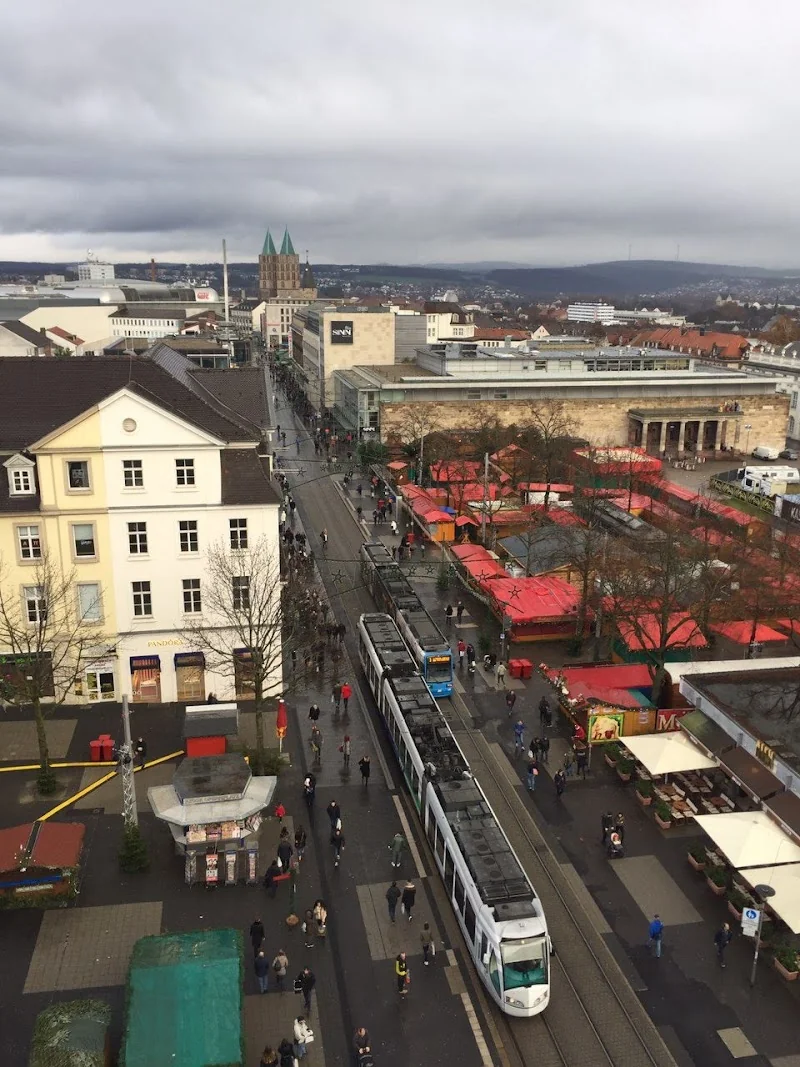
Mitte, Kassel
Mitte, 34 Kassel, Germany
Mitte Kassel | City Center & Shopping
Kassel's Mitte is much more than just a geographical point on the city map. Entering the city center, one experiences the compact heart of the documenta city with short distances, closely situated attractions, lively shopping streets, and a mix of history, present, and urban everyday life. The official city description emphasizes that the actual city center extends to the Schöne Aussicht, opening up views of the Karlsaue and the surrounding landscape. At the same time, shopping, culture, gastronomy, and public mobility converge here. This mixture makes Mitte one of the most important destinations for both locals and visitors alike. Whether planning a stroll through the pedestrian zone, combining a museum visit with a theater evening, or simply seeking good orientation for arrival: Mitte functions as a compact, versatile city center with clear connection points. Particularly striking is how close everything is in Kassel. The Treppenstraße leads directly from the main train station into the city, Friedrichsplatz forms a large open stage in the midst of the urban space, the market hall is just a few steps away, and several shopping galleries can be found around Königsstraße. This creates an image of the city center that cannot be reduced to a single highlight but consists of many building blocks. That is why Mitte is excellent for a longer city stroll, for cultural appointments, or for a spontaneous visit. Those who want to understand Kassel should start here. ([kassel.de](https://www.kassel.de/buerger/bauen_und_wohnen/stadtteile/mitte/mitte.php))
Access, Public Transport, and Parking in Kassel's Mitte
Accessibility is one of the greatest advantages of Kassel's city center. According to the official representation, the center is directly served by bus and tram; Königsstraße is a central hub for arrival and orientation. The NVV customer center of the KVG is also located in the heart of Kassel's Mitte, in the Kurfürsten Galerie at one of the central bus stops in the city center. For visitors, this means: those with questions about schedules, fares, or connections will find a well-accessible point right in the midst of the action. This is an important plus for guests who are not from Kassel, as they can get the most important information about buses, trams, and regional mobility right where they need it. ([visit.kassel.de](https://visit.kassel.de/poi/shopping-in-kassels-mitte))
Drivers also find numerous options in the city center. The city of Kassel operates an up-to-date occupancy of parking garages and parking spaces in the city center on its official overview page. Mentioned are, among others, City Point, Friedrichsplatz, Galeria, Kurfürsten Galerie, Martinskirche, Rathaus, and Wilhelmsstraße. Particularly practical is the underground garage at Friedrichsplatz, which, according to Kassel Marketing, is directly connected to the Königs-Galerie, the pedestrian zone, and the state theater. This makes it equally interesting for cultural and shopping visits. Additionally, the city of Kassel offers another option for cheaper parking in the city center with the online parking card; for the underground garage at Friedrichsplatz, the first half hour is free. So, those arriving by car can target the city depending on their destination and do not have to circle unnecessarily in the center. Especially in a city center that relies heavily on short distances, choosing the right parking garage is worthwhile, as many destinations are easily reachable on foot from there. ([www1.kassel.de](https://www1.kassel.de/buerger/verkehr_und_mobilitaet/mit-dem-auto/inhaltsseiten/parkhaeuser-parkplaetze-innenstadt.php))
That Kassel's Mitte is not only well organized for pedestrians but also for everyday life is evident in the interplay between mobility and urban space. According to the city of Kassel, the city center is equipped with several parking garages and underground garages, while the pedestrian zone and the central stops take on the actual core of the route guidance. This makes the district attractive for day visitors, commuters, and cultural audiences alike. For example, someone traveling to the city center in the morning can shop at noon, take care of an appointment in the afternoon, and visit a theater or exhibition in the evening without having to change areas. This uncomplicated transition between modes of transport and destinations is typical for Kassel's Mitte and an important part of its urban character. ([www1.kassel.de](https://www1.kassel.de/buerger/verkehr_und_mobilitaet/mit-dem-auto/inhaltsseiten/parkhaeuser-parkplaetze-innenstadt.php))
Shopping, Königsstraße, and Treppenstraße
Shopping is one of the defining search and experience occasions in Kassel's Mitte. The official tourism site describes the city center as a shopping paradise with three shopping galleries and around 600 specialty shops in the pedestrian zone. Well-known names include the Königs-Galerie, the Kurfürsten Galerie, City Point, and GALERIA. Thus, walking through Königsstraße means not just moving through any shopping street, but through the commercial center of the city with a high density of brands, services, and supply offers. This structure makes Mitte particularly attractive for visitors who are not just looking for individual shops but planning a whole city stroll. At the same time, the mix of shopping galleries and classic pedestrian zones shows that Kassel does not reduce its shopping function to a modern shopping center but has embedded it into a historically grown urban ensemble. ([visit.kassel.de](https://visit.kassel.de/poi/shopping-in-kassels-mitte))
A special milestone is the Treppenstraße, which opened in 1953 as the first planned pedestrian zone in Germany. It leads visitors directly from the main train station into the bustling city center and opens up views of Friedrichsplatz as well as access to the Karlsaue. It is precisely at this point that the connection between movement, urban space, and quality of stay becomes visible. The Treppenstraße is not just a path but an urban planning idea that still works very well today: one arrives, continues on foot, and immerses oneself in the city without detours. For many guests, this is the most pleasant way to experience Kassel's Mitte, as shop windows, cafés, architecture, and wide plaza spaces alternate along the way. Those exploring the city center in this way quickly understand why Kassel's center is perceived as compact and surprisingly versatile. ([visit.kassel.de](https://visit.kassel.de/poi/shopping-in-kassels-mitte))
Shopping also plays a significant role in everyday life in Mitte, as the city center is not only a destination for outings but also a supply area for the city. The market and shopping area around Königsstraße, Treppenstraße, galleries, and adjacent streets connects fashion, books, drugstores, gastronomy, and service offers in a compact space. This is especially practical for visitors who want to combine several errands. A coffee in the morning, a stroll through the galleries, a quick visit to the market hall, and perhaps an evening program at Friedrichsplatz later: In Kassel's Mitte, a whole day can be arranged very differently without having to cover long distances. This is precisely the strength of this city center area. ([visit.kassel.de](https://visit.kassel.de/poi/shopping-in-kassels-mitte))
Friedrichsplatz, documenta, and the Cultural Heart of the City
Friedrichsplatz is one of the most significant places in Kassel's Mitte and is also a square of national importance. The official tourism description calls it one of the largest inner-city squares in Germany and a central location for the documenta. Historically, its layout goes back to Landgrave Friedrich II and his master builder Simon Louis du Ry, who created a connection between the old town and the upper new town on the old, no longer needed fortress ring. Today, standing there, one can still feel this urban generosity: the square is open, wide, and yet clearly defined. It is not merely a passageway but a place for lingering, meeting, and cultural density. That is why Friedrichsplatz is the emotional center of the city center for many visitors. ([visit.kassel.de](https://visit.kassel.de/en/poi/friedrichsplatz))
Surrounding the square are some of Kassel's most important cultural addresses. The Fridericianum is described by the city of Kassel as one of the first museums in Europe and the first purely neoclassical building in Germany. It was founded in 1779 and has been associated with changing exhibitions of contemporary art since 1988. Additionally, the State Theater Kassel has been present at Friedrichsplatz since 1959 with an opera house and drama theater. The theater offers a wide program with its divisions of opera, concert, drama, dance, and young state theater. For the city center, this means: culture is not a marginal topic here but visibly integrated into the city center. The paths between the museum, square, and stage are short, allowing visitors to combine culture with a walk or a restaurant visit. ([visit.kassel.de](https://visit.kassel.de/en/poi/museum-fridericianum))
The design of the square itself also tells history. In front of the Fridericianum stands the marble statue of Landgrave Friedrich II, and along the length of the square, there is a three-dimensional bronze model of old Kassel. These are not decorative side notes but deliberately placed memorial signs that make the city's development visible. In connection with the documenta references, a public space is created that can be read as both historical and contemporary. This combination is typical for Kassel's Mitte: the place is not just a backdrop but a bearer of urban identity. Those who want to experience culture, history, and urban space in a single glance will find one of the strongest places in the city at Friedrichsplatz. ([visit.kassel.de](https://visit.kassel.de/en/poi/friedrichsplatz))
Market Hall, Enjoyment, and Urban Everyday Life
The market hall is one of the places in Kassel's Mitte where one perceives urban life particularly directly. According to Kassel Marketing, it is an ideal place to immerse oneself in the lifestyle of Kassel. Regional vendors sell their goods there on Thursdays, Fridays, and Saturdays, and visitors can try North Hesse specialties such as Ahle Wurscht. The market hall is described not only as a shopping place but explicitly also as a meeting place. This is an important point because the city center thus consists not only of shop windows and attractions but also of a social space where people meet, shop, and linger. The rustic atmosphere in the historic Marstall makes the market hall particularly special and firmly anchors it in the character of the city. ([visit.kassel.de](https://visit.kassel.de/en/poi/market-hall))
For orientation in Mitte, the market hall is also a good reference point as it lies between the city center, Entenanger, and the adjacent urban areas. The city of Kassel describes the area around Entenanger and the market hall as a smaller residential and commercial district that extends to the Fulda and the boat landing. This shows that Mitte is not only made up of large axes and large squares but also of smaller quarters with their own rhythm. Those who are out and about there experience another side of the city center: less representative, but closer to everyday life. It is precisely this mix of a large public stage and small urban niches that makes Kassel's Mitte so versatile. One can shop, eat, visit a market, and then stand back in just a few minutes in the large plaza spaces. ([kassel.de](https://www.kassel.de/buerger/bauen_und_wohnen/stadtteile/mitte/mitte.php))
Even for visitors who are not primarily coming for shopping or culture, the market hall is a worthwhile anchor point. It is a place where regional products and city center atmosphere come together. For example, someone with only half a day in Kassel can combine a visit there with a stroll to Königsstraße, a detour to Friedrichsplatz, or a coffee nearby. This interconnectivity makes Mitte so strong: the distances are short, the offerings diverse, and the city remains readable at all times. Instead of isolated individual destinations, there is a close network of places that complement each other. The market hall plays a central role in this because it combines enjoyment, authenticity, and closeness to everyday life. ([visit.kassel.de](https://visit.kassel.de/en/poi/market-hall))
History from the Seed of Kassel to the Modern City Center
The historical depth of Kassel's Mitte does not begin only with today's shopping streets or the documenta fame but much earlier. The city of Kassel refers to a fortification called castellum near the Fulda river as the seed of the city. The place was first mentioned in documents in 913 as Chassella and received city rights in the 12th century. Until the 18th century, the growth of the old town was limited by the fortress works. This development explains why today's urban space is so clearly structured and why squares like Friedrichsplatz emerged on a former fortress ring. The historical structure is therefore not coincidental but the result of a long urban transformation. ([kassel.de](https://www.kassel.de/buerger/bauen_und_wohnen/stadtteile/mitte/mitte.php))
From this history, the current significance of Mitte can also be better understood. The official city website describes the district as divided into three areas: the actual city center up to the Schöne Aussicht, the residential and commercial area around Entenanger and the market hall, and the western district from Weinberg to the old main train station and today's cultural train station. Along Friedrich-Ebert-Straße and Königstor, the city center atmosphere continues with shops, cafés, and trendy pubs. This means: Mitte is not a narrowly defined core but a multifaceted center with different sub-areas. Some areas appear more historical and representative, while others seem more everyday and residential. Together, they create a cohesive image of urban density. This mix of old town reference, business life, and culture has made the city center so robust over time. ([kassel.de](https://www.kassel.de/buerger/bauen_und_wohnen/stadtteile/mitte/mitte.php))
For visitors, this historical development is particularly interesting because it explains the urban space. Why is Friedrichsplatz so prominent? Why are Karlsaue, Schöne Aussicht, and the city center so closely linked? Why do important axes end at cultural buildings and not at pure traffic spaces? The answer lies in the long history of Kassel as a grown residence and trading city. Those walking through Mitte today are therefore not just moving through a modern city center but through a piece of city history that continues to live on in square forms, street layouts, and sightlines. That is why it is worthwhile to pay attention not only to shop windows and facades during a stroll but also to the structure of the urban space itself. ([kassel.de](https://www.kassel.de/buerger/bauen_und_wohnen/stadtteile/mitte/mitte.php))
Practical Tips for Visiting, Orientation, and Short Distances
A visit to Kassel's Mitte becomes particularly pleasant when one consciously utilizes the compact distances. The city center is designed so that shopping, culture, market visits, and gastronomy can be very well combined. Those starting in the morning on Königsstraße can then continue to the market hall, linger at Friedrichsplatz at noon, and aim for the Fridericianum or the state theater in the afternoon. This spatial proximity is a real added value because it makes the day flexible and spontaneous. It does not have to be planned down to the minute in advance; often a rough framework is enough, and the rest unfolds along the way. Especially visitors who have only a short stay in Kassel benefit from this structure. They get a good impression of how the city works in just a few hours: open, walkable, and with a dense network of offerings. ([visit.kassel.de](https://visit.kassel.de/poi/shopping-in-kassels-mitte))
Another tip is the combination of city center and green space. The city of Kassel describes the actual city center up to the Schöne Aussicht with views of the extensive park landscape of the Karlsaue, and the official park pages emphasize the proximity of the large green areas to the city center. This gives Mitte a special quality: one is in the middle of the city and yet only a few steps away from open landscape references. This is not a given in many large cities. In Kassel, however, one can combine a city stroll with a view of the Karlsaue, a detour to the Fulda, or a short stay outdoors. It is precisely these transitions between urban and green that make the stay varied and pleasant. Therefore, those planning to stay longer in the city center should not only include shops and attractions but also the open urban spaces. ([kassel.de](https://www.kassel.de/buerger/bauen_und_wohnen/stadtteile/mitte/mitte.php))
In the end, Kassel's Mitte is primarily a place for people who appreciate short distances and high density. The city center combines central arrival, good parking options, strong public transport connections, a wide range of shopping, significant cultural sites, and historical depth. This combination makes the district so interesting for day visitors, culture fans, shopping visitors, and city explorers. Those looking for just a name to describe the geographical center of Kassel are short-sighted. Mitte is not just a center on the city map but the place where Kassel shows itself in all its complexity. And that may be the most fitting description of all: a center that lives, moves, and continually opens up new access points. ([kassel.de](https://www.kassel.de/buerger/bauen_und_wohnen/stadtteile/mitte/mitte.php))
Sources:
- City of Kassel - District Mitte
- Kassel Tourism - Shopping in Kassel's Mitte
- Kassel Tourism - Friedrichsplatz
- Kassel Tourism - Underground Garage Friedrichsplatz
- City of Kassel - Parking in the City Center
- Kassel Tourism - Market Hall
- Kassel Tourism - State Theatre
- Kassel Tourism - Museum Fridericianum
- KVG - NVV Customer Center in Kassel's Mitte
Mehr anzeigenWeniger anzeigen
Mitte Kassel | City Center & Shopping
Kassel's Mitte is much more than just a geographical point on the city map. Entering the city center, one experiences the compact heart of the documenta city with short distances, closely situated attractions, lively shopping streets, and a mix of history, present, and urban everyday life. The official city description emphasizes that the actual city center extends to the Schöne Aussicht, opening up views of the Karlsaue and the surrounding landscape. At the same time, shopping, culture, gastronomy, and public mobility converge here. This mixture makes Mitte one of the most important destinations for both locals and visitors alike. Whether planning a stroll through the pedestrian zone, combining a museum visit with a theater evening, or simply seeking good orientation for arrival: Mitte functions as a compact, versatile city center with clear connection points. Particularly striking is how close everything is in Kassel. The Treppenstraße leads directly from the main train station into the city, Friedrichsplatz forms a large open stage in the midst of the urban space, the market hall is just a few steps away, and several shopping galleries can be found around Königsstraße. This creates an image of the city center that cannot be reduced to a single highlight but consists of many building blocks. That is why Mitte is excellent for a longer city stroll, for cultural appointments, or for a spontaneous visit. Those who want to understand Kassel should start here. ([kassel.de](https://www.kassel.de/buerger/bauen_und_wohnen/stadtteile/mitte/mitte.php))
Access, Public Transport, and Parking in Kassel's Mitte
Accessibility is one of the greatest advantages of Kassel's city center. According to the official representation, the center is directly served by bus and tram; Königsstraße is a central hub for arrival and orientation. The NVV customer center of the KVG is also located in the heart of Kassel's Mitte, in the Kurfürsten Galerie at one of the central bus stops in the city center. For visitors, this means: those with questions about schedules, fares, or connections will find a well-accessible point right in the midst of the action. This is an important plus for guests who are not from Kassel, as they can get the most important information about buses, trams, and regional mobility right where they need it. ([visit.kassel.de](https://visit.kassel.de/poi/shopping-in-kassels-mitte))
Drivers also find numerous options in the city center. The city of Kassel operates an up-to-date occupancy of parking garages and parking spaces in the city center on its official overview page. Mentioned are, among others, City Point, Friedrichsplatz, Galeria, Kurfürsten Galerie, Martinskirche, Rathaus, and Wilhelmsstraße. Particularly practical is the underground garage at Friedrichsplatz, which, according to Kassel Marketing, is directly connected to the Königs-Galerie, the pedestrian zone, and the state theater. This makes it equally interesting for cultural and shopping visits. Additionally, the city of Kassel offers another option for cheaper parking in the city center with the online parking card; for the underground garage at Friedrichsplatz, the first half hour is free. So, those arriving by car can target the city depending on their destination and do not have to circle unnecessarily in the center. Especially in a city center that relies heavily on short distances, choosing the right parking garage is worthwhile, as many destinations are easily reachable on foot from there. ([www1.kassel.de](https://www1.kassel.de/buerger/verkehr_und_mobilitaet/mit-dem-auto/inhaltsseiten/parkhaeuser-parkplaetze-innenstadt.php))
That Kassel's Mitte is not only well organized for pedestrians but also for everyday life is evident in the interplay between mobility and urban space. According to the city of Kassel, the city center is equipped with several parking garages and underground garages, while the pedestrian zone and the central stops take on the actual core of the route guidance. This makes the district attractive for day visitors, commuters, and cultural audiences alike. For example, someone traveling to the city center in the morning can shop at noon, take care of an appointment in the afternoon, and visit a theater or exhibition in the evening without having to change areas. This uncomplicated transition between modes of transport and destinations is typical for Kassel's Mitte and an important part of its urban character. ([www1.kassel.de](https://www1.kassel.de/buerger/verkehr_und_mobilitaet/mit-dem-auto/inhaltsseiten/parkhaeuser-parkplaetze-innenstadt.php))
Shopping, Königsstraße, and Treppenstraße
Shopping is one of the defining search and experience occasions in Kassel's Mitte. The official tourism site describes the city center as a shopping paradise with three shopping galleries and around 600 specialty shops in the pedestrian zone. Well-known names include the Königs-Galerie, the Kurfürsten Galerie, City Point, and GALERIA. Thus, walking through Königsstraße means not just moving through any shopping street, but through the commercial center of the city with a high density of brands, services, and supply offers. This structure makes Mitte particularly attractive for visitors who are not just looking for individual shops but planning a whole city stroll. At the same time, the mix of shopping galleries and classic pedestrian zones shows that Kassel does not reduce its shopping function to a modern shopping center but has embedded it into a historically grown urban ensemble. ([visit.kassel.de](https://visit.kassel.de/poi/shopping-in-kassels-mitte))
A special milestone is the Treppenstraße, which opened in 1953 as the first planned pedestrian zone in Germany. It leads visitors directly from the main train station into the bustling city center and opens up views of Friedrichsplatz as well as access to the Karlsaue. It is precisely at this point that the connection between movement, urban space, and quality of stay becomes visible. The Treppenstraße is not just a path but an urban planning idea that still works very well today: one arrives, continues on foot, and immerses oneself in the city without detours. For many guests, this is the most pleasant way to experience Kassel's Mitte, as shop windows, cafés, architecture, and wide plaza spaces alternate along the way. Those exploring the city center in this way quickly understand why Kassel's center is perceived as compact and surprisingly versatile. ([visit.kassel.de](https://visit.kassel.de/poi/shopping-in-kassels-mitte))
Shopping also plays a significant role in everyday life in Mitte, as the city center is not only a destination for outings but also a supply area for the city. The market and shopping area around Königsstraße, Treppenstraße, galleries, and adjacent streets connects fashion, books, drugstores, gastronomy, and service offers in a compact space. This is especially practical for visitors who want to combine several errands. A coffee in the morning, a stroll through the galleries, a quick visit to the market hall, and perhaps an evening program at Friedrichsplatz later: In Kassel's Mitte, a whole day can be arranged very differently without having to cover long distances. This is precisely the strength of this city center area. ([visit.kassel.de](https://visit.kassel.de/poi/shopping-in-kassels-mitte))
Friedrichsplatz, documenta, and the Cultural Heart of the City
Friedrichsplatz is one of the most significant places in Kassel's Mitte and is also a square of national importance. The official tourism description calls it one of the largest inner-city squares in Germany and a central location for the documenta. Historically, its layout goes back to Landgrave Friedrich II and his master builder Simon Louis du Ry, who created a connection between the old town and the upper new town on the old, no longer needed fortress ring. Today, standing there, one can still feel this urban generosity: the square is open, wide, and yet clearly defined. It is not merely a passageway but a place for lingering, meeting, and cultural density. That is why Friedrichsplatz is the emotional center of the city center for many visitors. ([visit.kassel.de](https://visit.kassel.de/en/poi/friedrichsplatz))
Surrounding the square are some of Kassel's most important cultural addresses. The Fridericianum is described by the city of Kassel as one of the first museums in Europe and the first purely neoclassical building in Germany. It was founded in 1779 and has been associated with changing exhibitions of contemporary art since 1988. Additionally, the State Theater Kassel has been present at Friedrichsplatz since 1959 with an opera house and drama theater. The theater offers a wide program with its divisions of opera, concert, drama, dance, and young state theater. For the city center, this means: culture is not a marginal topic here but visibly integrated into the city center. The paths between the museum, square, and stage are short, allowing visitors to combine culture with a walk or a restaurant visit. ([visit.kassel.de](https://visit.kassel.de/en/poi/museum-fridericianum))
The design of the square itself also tells history. In front of the Fridericianum stands the marble statue of Landgrave Friedrich II, and along the length of the square, there is a three-dimensional bronze model of old Kassel. These are not decorative side notes but deliberately placed memorial signs that make the city's development visible. In connection with the documenta references, a public space is created that can be read as both historical and contemporary. This combination is typical for Kassel's Mitte: the place is not just a backdrop but a bearer of urban identity. Those who want to experience culture, history, and urban space in a single glance will find one of the strongest places in the city at Friedrichsplatz. ([visit.kassel.de](https://visit.kassel.de/en/poi/friedrichsplatz))
Market Hall, Enjoyment, and Urban Everyday Life
The market hall is one of the places in Kassel's Mitte where one perceives urban life particularly directly. According to Kassel Marketing, it is an ideal place to immerse oneself in the lifestyle of Kassel. Regional vendors sell their goods there on Thursdays, Fridays, and Saturdays, and visitors can try North Hesse specialties such as Ahle Wurscht. The market hall is described not only as a shopping place but explicitly also as a meeting place. This is an important point because the city center thus consists not only of shop windows and attractions but also of a social space where people meet, shop, and linger. The rustic atmosphere in the historic Marstall makes the market hall particularly special and firmly anchors it in the character of the city. ([visit.kassel.de](https://visit.kassel.de/en/poi/market-hall))
For orientation in Mitte, the market hall is also a good reference point as it lies between the city center, Entenanger, and the adjacent urban areas. The city of Kassel describes the area around Entenanger and the market hall as a smaller residential and commercial district that extends to the Fulda and the boat landing. This shows that Mitte is not only made up of large axes and large squares but also of smaller quarters with their own rhythm. Those who are out and about there experience another side of the city center: less representative, but closer to everyday life. It is precisely this mix of a large public stage and small urban niches that makes Kassel's Mitte so versatile. One can shop, eat, visit a market, and then stand back in just a few minutes in the large plaza spaces. ([kassel.de](https://www.kassel.de/buerger/bauen_und_wohnen/stadtteile/mitte/mitte.php))
Even for visitors who are not primarily coming for shopping or culture, the market hall is a worthwhile anchor point. It is a place where regional products and city center atmosphere come together. For example, someone with only half a day in Kassel can combine a visit there with a stroll to Königsstraße, a detour to Friedrichsplatz, or a coffee nearby. This interconnectivity makes Mitte so strong: the distances are short, the offerings diverse, and the city remains readable at all times. Instead of isolated individual destinations, there is a close network of places that complement each other. The market hall plays a central role in this because it combines enjoyment, authenticity, and closeness to everyday life. ([visit.kassel.de](https://visit.kassel.de/en/poi/market-hall))
History from the Seed of Kassel to the Modern City Center
The historical depth of Kassel's Mitte does not begin only with today's shopping streets or the documenta fame but much earlier. The city of Kassel refers to a fortification called castellum near the Fulda river as the seed of the city. The place was first mentioned in documents in 913 as Chassella and received city rights in the 12th century. Until the 18th century, the growth of the old town was limited by the fortress works. This development explains why today's urban space is so clearly structured and why squares like Friedrichsplatz emerged on a former fortress ring. The historical structure is therefore not coincidental but the result of a long urban transformation. ([kassel.de](https://www.kassel.de/buerger/bauen_und_wohnen/stadtteile/mitte/mitte.php))
From this history, the current significance of Mitte can also be better understood. The official city website describes the district as divided into three areas: the actual city center up to the Schöne Aussicht, the residential and commercial area around Entenanger and the market hall, and the western district from Weinberg to the old main train station and today's cultural train station. Along Friedrich-Ebert-Straße and Königstor, the city center atmosphere continues with shops, cafés, and trendy pubs. This means: Mitte is not a narrowly defined core but a multifaceted center with different sub-areas. Some areas appear more historical and representative, while others seem more everyday and residential. Together, they create a cohesive image of urban density. This mix of old town reference, business life, and culture has made the city center so robust over time. ([kassel.de](https://www.kassel.de/buerger/bauen_und_wohnen/stadtteile/mitte/mitte.php))
For visitors, this historical development is particularly interesting because it explains the urban space. Why is Friedrichsplatz so prominent? Why are Karlsaue, Schöne Aussicht, and the city center so closely linked? Why do important axes end at cultural buildings and not at pure traffic spaces? The answer lies in the long history of Kassel as a grown residence and trading city. Those walking through Mitte today are therefore not just moving through a modern city center but through a piece of city history that continues to live on in square forms, street layouts, and sightlines. That is why it is worthwhile to pay attention not only to shop windows and facades during a stroll but also to the structure of the urban space itself. ([kassel.de](https://www.kassel.de/buerger/bauen_und_wohnen/stadtteile/mitte/mitte.php))
Practical Tips for Visiting, Orientation, and Short Distances
A visit to Kassel's Mitte becomes particularly pleasant when one consciously utilizes the compact distances. The city center is designed so that shopping, culture, market visits, and gastronomy can be very well combined. Those starting in the morning on Königsstraße can then continue to the market hall, linger at Friedrichsplatz at noon, and aim for the Fridericianum or the state theater in the afternoon. This spatial proximity is a real added value because it makes the day flexible and spontaneous. It does not have to be planned down to the minute in advance; often a rough framework is enough, and the rest unfolds along the way. Especially visitors who have only a short stay in Kassel benefit from this structure. They get a good impression of how the city works in just a few hours: open, walkable, and with a dense network of offerings. ([visit.kassel.de](https://visit.kassel.de/poi/shopping-in-kassels-mitte))
Another tip is the combination of city center and green space. The city of Kassel describes the actual city center up to the Schöne Aussicht with views of the extensive park landscape of the Karlsaue, and the official park pages emphasize the proximity of the large green areas to the city center. This gives Mitte a special quality: one is in the middle of the city and yet only a few steps away from open landscape references. This is not a given in many large cities. In Kassel, however, one can combine a city stroll with a view of the Karlsaue, a detour to the Fulda, or a short stay outdoors. It is precisely these transitions between urban and green that make the stay varied and pleasant. Therefore, those planning to stay longer in the city center should not only include shops and attractions but also the open urban spaces. ([kassel.de](https://www.kassel.de/buerger/bauen_und_wohnen/stadtteile/mitte/mitte.php))
In the end, Kassel's Mitte is primarily a place for people who appreciate short distances and high density. The city center combines central arrival, good parking options, strong public transport connections, a wide range of shopping, significant cultural sites, and historical depth. This combination makes the district so interesting for day visitors, culture fans, shopping visitors, and city explorers. Those looking for just a name to describe the geographical center of Kassel are short-sighted. Mitte is not just a center on the city map but the place where Kassel shows itself in all its complexity. And that may be the most fitting description of all: a center that lives, moves, and continually opens up new access points. ([kassel.de](https://www.kassel.de/buerger/bauen_und_wohnen/stadtteile/mitte/mitte.php))
Sources:
- City of Kassel - District Mitte
- Kassel Tourism - Shopping in Kassel's Mitte
- Kassel Tourism - Friedrichsplatz
- Kassel Tourism - Underground Garage Friedrichsplatz
- City of Kassel - Parking in the City Center
- Kassel Tourism - Market Hall
- Kassel Tourism - State Theatre
- Kassel Tourism - Museum Fridericianum
- KVG - NVV Customer Center in Kassel's Mitte
Mitte Kassel | City Center & Shopping
Kassel's Mitte is much more than just a geographical point on the city map. Entering the city center, one experiences the compact heart of the documenta city with short distances, closely situated attractions, lively shopping streets, and a mix of history, present, and urban everyday life. The official city description emphasizes that the actual city center extends to the Schöne Aussicht, opening up views of the Karlsaue and the surrounding landscape. At the same time, shopping, culture, gastronomy, and public mobility converge here. This mixture makes Mitte one of the most important destinations for both locals and visitors alike. Whether planning a stroll through the pedestrian zone, combining a museum visit with a theater evening, or simply seeking good orientation for arrival: Mitte functions as a compact, versatile city center with clear connection points. Particularly striking is how close everything is in Kassel. The Treppenstraße leads directly from the main train station into the city, Friedrichsplatz forms a large open stage in the midst of the urban space, the market hall is just a few steps away, and several shopping galleries can be found around Königsstraße. This creates an image of the city center that cannot be reduced to a single highlight but consists of many building blocks. That is why Mitte is excellent for a longer city stroll, for cultural appointments, or for a spontaneous visit. Those who want to understand Kassel should start here. ([kassel.de](https://www.kassel.de/buerger/bauen_und_wohnen/stadtteile/mitte/mitte.php))
Access, Public Transport, and Parking in Kassel's Mitte
Accessibility is one of the greatest advantages of Kassel's city center. According to the official representation, the center is directly served by bus and tram; Königsstraße is a central hub for arrival and orientation. The NVV customer center of the KVG is also located in the heart of Kassel's Mitte, in the Kurfürsten Galerie at one of the central bus stops in the city center. For visitors, this means: those with questions about schedules, fares, or connections will find a well-accessible point right in the midst of the action. This is an important plus for guests who are not from Kassel, as they can get the most important information about buses, trams, and regional mobility right where they need it. ([visit.kassel.de](https://visit.kassel.de/poi/shopping-in-kassels-mitte))
Drivers also find numerous options in the city center. The city of Kassel operates an up-to-date occupancy of parking garages and parking spaces in the city center on its official overview page. Mentioned are, among others, City Point, Friedrichsplatz, Galeria, Kurfürsten Galerie, Martinskirche, Rathaus, and Wilhelmsstraße. Particularly practical is the underground garage at Friedrichsplatz, which, according to Kassel Marketing, is directly connected to the Königs-Galerie, the pedestrian zone, and the state theater. This makes it equally interesting for cultural and shopping visits. Additionally, the city of Kassel offers another option for cheaper parking in the city center with the online parking card; for the underground garage at Friedrichsplatz, the first half hour is free. So, those arriving by car can target the city depending on their destination and do not have to circle unnecessarily in the center. Especially in a city center that relies heavily on short distances, choosing the right parking garage is worthwhile, as many destinations are easily reachable on foot from there. ([www1.kassel.de](https://www1.kassel.de/buerger/verkehr_und_mobilitaet/mit-dem-auto/inhaltsseiten/parkhaeuser-parkplaetze-innenstadt.php))
That Kassel's Mitte is not only well organized for pedestrians but also for everyday life is evident in the interplay between mobility and urban space. According to the city of Kassel, the city center is equipped with several parking garages and underground garages, while the pedestrian zone and the central stops take on the actual core of the route guidance. This makes the district attractive for day visitors, commuters, and cultural audiences alike. For example, someone traveling to the city center in the morning can shop at noon, take care of an appointment in the afternoon, and visit a theater or exhibition in the evening without having to change areas. This uncomplicated transition between modes of transport and destinations is typical for Kassel's Mitte and an important part of its urban character. ([www1.kassel.de](https://www1.kassel.de/buerger/verkehr_und_mobilitaet/mit-dem-auto/inhaltsseiten/parkhaeuser-parkplaetze-innenstadt.php))
Shopping, Königsstraße, and Treppenstraße
Shopping is one of the defining search and experience occasions in Kassel's Mitte. The official tourism site describes the city center as a shopping paradise with three shopping galleries and around 600 specialty shops in the pedestrian zone. Well-known names include the Königs-Galerie, the Kurfürsten Galerie, City Point, and GALERIA. Thus, walking through Königsstraße means not just moving through any shopping street, but through the commercial center of the city with a high density of brands, services, and supply offers. This structure makes Mitte particularly attractive for visitors who are not just looking for individual shops but planning a whole city stroll. At the same time, the mix of shopping galleries and classic pedestrian zones shows that Kassel does not reduce its shopping function to a modern shopping center but has embedded it into a historically grown urban ensemble. ([visit.kassel.de](https://visit.kassel.de/poi/shopping-in-kassels-mitte))
A special milestone is the Treppenstraße, which opened in 1953 as the first planned pedestrian zone in Germany. It leads visitors directly from the main train station into the bustling city center and opens up views of Friedrichsplatz as well as access to the Karlsaue. It is precisely at this point that the connection between movement, urban space, and quality of stay becomes visible. The Treppenstraße is not just a path but an urban planning idea that still works very well today: one arrives, continues on foot, and immerses oneself in the city without detours. For many guests, this is the most pleasant way to experience Kassel's Mitte, as shop windows, cafés, architecture, and wide plaza spaces alternate along the way. Those exploring the city center in this way quickly understand why Kassel's center is perceived as compact and surprisingly versatile. ([visit.kassel.de](https://visit.kassel.de/poi/shopping-in-kassels-mitte))
Shopping also plays a significant role in everyday life in Mitte, as the city center is not only a destination for outings but also a supply area for the city. The market and shopping area around Königsstraße, Treppenstraße, galleries, and adjacent streets connects fashion, books, drugstores, gastronomy, and service offers in a compact space. This is especially practical for visitors who want to combine several errands. A coffee in the morning, a stroll through the galleries, a quick visit to the market hall, and perhaps an evening program at Friedrichsplatz later: In Kassel's Mitte, a whole day can be arranged very differently without having to cover long distances. This is precisely the strength of this city center area. ([visit.kassel.de](https://visit.kassel.de/poi/shopping-in-kassels-mitte))
Friedrichsplatz, documenta, and the Cultural Heart of the City
Friedrichsplatz is one of the most significant places in Kassel's Mitte and is also a square of national importance. The official tourism description calls it one of the largest inner-city squares in Germany and a central location for the documenta. Historically, its layout goes back to Landgrave Friedrich II and his master builder Simon Louis du Ry, who created a connection between the old town and the upper new town on the old, no longer needed fortress ring. Today, standing there, one can still feel this urban generosity: the square is open, wide, and yet clearly defined. It is not merely a passageway but a place for lingering, meeting, and cultural density. That is why Friedrichsplatz is the emotional center of the city center for many visitors. ([visit.kassel.de](https://visit.kassel.de/en/poi/friedrichsplatz))
Surrounding the square are some of Kassel's most important cultural addresses. The Fridericianum is described by the city of Kassel as one of the first museums in Europe and the first purely neoclassical building in Germany. It was founded in 1779 and has been associated with changing exhibitions of contemporary art since 1988. Additionally, the State Theater Kassel has been present at Friedrichsplatz since 1959 with an opera house and drama theater. The theater offers a wide program with its divisions of opera, concert, drama, dance, and young state theater. For the city center, this means: culture is not a marginal topic here but visibly integrated into the city center. The paths between the museum, square, and stage are short, allowing visitors to combine culture with a walk or a restaurant visit. ([visit.kassel.de](https://visit.kassel.de/en/poi/museum-fridericianum))
The design of the square itself also tells history. In front of the Fridericianum stands the marble statue of Landgrave Friedrich II, and along the length of the square, there is a three-dimensional bronze model of old Kassel. These are not decorative side notes but deliberately placed memorial signs that make the city's development visible. In connection with the documenta references, a public space is created that can be read as both historical and contemporary. This combination is typical for Kassel's Mitte: the place is not just a backdrop but a bearer of urban identity. Those who want to experience culture, history, and urban space in a single glance will find one of the strongest places in the city at Friedrichsplatz. ([visit.kassel.de](https://visit.kassel.de/en/poi/friedrichsplatz))
Market Hall, Enjoyment, and Urban Everyday Life
The market hall is one of the places in Kassel's Mitte where one perceives urban life particularly directly. According to Kassel Marketing, it is an ideal place to immerse oneself in the lifestyle of Kassel. Regional vendors sell their goods there on Thursdays, Fridays, and Saturdays, and visitors can try North Hesse specialties such as Ahle Wurscht. The market hall is described not only as a shopping place but explicitly also as a meeting place. This is an important point because the city center thus consists not only of shop windows and attractions but also of a social space where people meet, shop, and linger. The rustic atmosphere in the historic Marstall makes the market hall particularly special and firmly anchors it in the character of the city. ([visit.kassel.de](https://visit.kassel.de/en/poi/market-hall))
For orientation in Mitte, the market hall is also a good reference point as it lies between the city center, Entenanger, and the adjacent urban areas. The city of Kassel describes the area around Entenanger and the market hall as a smaller residential and commercial district that extends to the Fulda and the boat landing. This shows that Mitte is not only made up of large axes and large squares but also of smaller quarters with their own rhythm. Those who are out and about there experience another side of the city center: less representative, but closer to everyday life. It is precisely this mix of a large public stage and small urban niches that makes Kassel's Mitte so versatile. One can shop, eat, visit a market, and then stand back in just a few minutes in the large plaza spaces. ([kassel.de](https://www.kassel.de/buerger/bauen_und_wohnen/stadtteile/mitte/mitte.php))
Even for visitors who are not primarily coming for shopping or culture, the market hall is a worthwhile anchor point. It is a place where regional products and city center atmosphere come together. For example, someone with only half a day in Kassel can combine a visit there with a stroll to Königsstraße, a detour to Friedrichsplatz, or a coffee nearby. This interconnectivity makes Mitte so strong: the distances are short, the offerings diverse, and the city remains readable at all times. Instead of isolated individual destinations, there is a close network of places that complement each other. The market hall plays a central role in this because it combines enjoyment, authenticity, and closeness to everyday life. ([visit.kassel.de](https://visit.kassel.de/en/poi/market-hall))
History from the Seed of Kassel to the Modern City Center
The historical depth of Kassel's Mitte does not begin only with today's shopping streets or the documenta fame but much earlier. The city of Kassel refers to a fortification called castellum near the Fulda river as the seed of the city. The place was first mentioned in documents in 913 as Chassella and received city rights in the 12th century. Until the 18th century, the growth of the old town was limited by the fortress works. This development explains why today's urban space is so clearly structured and why squares like Friedrichsplatz emerged on a former fortress ring. The historical structure is therefore not coincidental but the result of a long urban transformation. ([kassel.de](https://www.kassel.de/buerger/bauen_und_wohnen/stadtteile/mitte/mitte.php))
From this history, the current significance of Mitte can also be better understood. The official city website describes the district as divided into three areas: the actual city center up to the Schöne Aussicht, the residential and commercial area around Entenanger and the market hall, and the western district from Weinberg to the old main train station and today's cultural train station. Along Friedrich-Ebert-Straße and Königstor, the city center atmosphere continues with shops, cafés, and trendy pubs. This means: Mitte is not a narrowly defined core but a multifaceted center with different sub-areas. Some areas appear more historical and representative, while others seem more everyday and residential. Together, they create a cohesive image of urban density. This mix of old town reference, business life, and culture has made the city center so robust over time. ([kassel.de](https://www.kassel.de/buerger/bauen_und_wohnen/stadtteile/mitte/mitte.php))
For visitors, this historical development is particularly interesting because it explains the urban space. Why is Friedrichsplatz so prominent? Why are Karlsaue, Schöne Aussicht, and the city center so closely linked? Why do important axes end at cultural buildings and not at pure traffic spaces? The answer lies in the long history of Kassel as a grown residence and trading city. Those walking through Mitte today are therefore not just moving through a modern city center but through a piece of city history that continues to live on in square forms, street layouts, and sightlines. That is why it is worthwhile to pay attention not only to shop windows and facades during a stroll but also to the structure of the urban space itself. ([kassel.de](https://www.kassel.de/buerger/bauen_und_wohnen/stadtteile/mitte/mitte.php))
Practical Tips for Visiting, Orientation, and Short Distances
A visit to Kassel's Mitte becomes particularly pleasant when one consciously utilizes the compact distances. The city center is designed so that shopping, culture, market visits, and gastronomy can be very well combined. Those starting in the morning on Königsstraße can then continue to the market hall, linger at Friedrichsplatz at noon, and aim for the Fridericianum or the state theater in the afternoon. This spatial proximity is a real added value because it makes the day flexible and spontaneous. It does not have to be planned down to the minute in advance; often a rough framework is enough, and the rest unfolds along the way. Especially visitors who have only a short stay in Kassel benefit from this structure. They get a good impression of how the city works in just a few hours: open, walkable, and with a dense network of offerings. ([visit.kassel.de](https://visit.kassel.de/poi/shopping-in-kassels-mitte))
Another tip is the combination of city center and green space. The city of Kassel describes the actual city center up to the Schöne Aussicht with views of the extensive park landscape of the Karlsaue, and the official park pages emphasize the proximity of the large green areas to the city center. This gives Mitte a special quality: one is in the middle of the city and yet only a few steps away from open landscape references. This is not a given in many large cities. In Kassel, however, one can combine a city stroll with a view of the Karlsaue, a detour to the Fulda, or a short stay outdoors. It is precisely these transitions between urban and green that make the stay varied and pleasant. Therefore, those planning to stay longer in the city center should not only include shops and attractions but also the open urban spaces. ([kassel.de](https://www.kassel.de/buerger/bauen_und_wohnen/stadtteile/mitte/mitte.php))
In the end, Kassel's Mitte is primarily a place for people who appreciate short distances and high density. The city center combines central arrival, good parking options, strong public transport connections, a wide range of shopping, significant cultural sites, and historical depth. This combination makes the district so interesting for day visitors, culture fans, shopping visitors, and city explorers. Those looking for just a name to describe the geographical center of Kassel are short-sighted. Mitte is not just a center on the city map but the place where Kassel shows itself in all its complexity. And that may be the most fitting description of all: a center that lives, moves, and continually opens up new access points. ([kassel.de](https://www.kassel.de/buerger/bauen_und_wohnen/stadtteile/mitte/mitte.php))
Sources:
- City of Kassel - District Mitte
- Kassel Tourism - Shopping in Kassel's Mitte
- Kassel Tourism - Friedrichsplatz
- Kassel Tourism - Underground Garage Friedrichsplatz
- City of Kassel - Parking in the City Center
- Kassel Tourism - Market Hall
- Kassel Tourism - State Theatre
- Kassel Tourism - Museum Fridericianum
- KVG - NVV Customer Center in Kassel's Mitte
Upcoming Events
No events found
Frequently Asked Questions
Reviews
No reviews found