
1048 5th Ave, New York
1048 5th Ave, New York, NY 10028, USA
Neue Galerie New York | Opening Hours & Free Admission
The Neue Galerie New York is not a loud, overcrowded museum, but a carefully curated place for German and Austrian art and design from the early 20th century. Those walking along Museum Mile between Fifth Avenue and Central Park experience a combination of collection, architecture, and Viennese café culture that has become rare in New York. The house opened in November 2001, stemming from the initiative of Ronald S. Lauder and Serge Sabarsky, and is housed in a historic Gilded-Age mansion, which is itself part of the experience. The mix of Klimt, Schiele, Bauhaus, Wiener Werkstätte, Café Sabarsky, and Design Shop makes the Neue Galerie not just a museum, but a very unique cultural venue where art appreciation, architecture, and breaks with coffee or breakfast complement each other meaningfully. ([neuegalerie.org](https://www.neuegalerie.org/visit/faq))
Opening Hours, Tickets, and Free Admission
Those planning a visit should first adhere to the current opening hours: The Neue Galerie is open Monday and Wednesday to Sunday from 10 AM to 6 PM, and closed on Tuesdays. The last entry to the galleries is at 5:30 PM. Tickets can be purchased on-site on the same day, and advance tickets are also available online. This is convenient because the gallery is a popular destination, and wait times can occur, especially on weekends or during special exhibitions. Members receive free, unlimited annual membership and, according to the museum, also preferred entry. Those wishing to visit the gallery flexibly should also note that altered times may apply on selected holidays or during special events. Therefore, the official pages explicitly recommend planning the visit in advance. ([neuegalerie.org](https://www.neuegalerie.org/visit?utm_source=openai))
For many visitors, free admission is a special incentive. The Neue Galerie offers free access to the galleries every first Friday of the month from 5 PM to 8 PM as part of First Fridays. Entry is then on a first come, first served basis, and a queue may form at the entrance. Additionally, there are other forms of free or discounted admission: Members have free entry, holders of an ICOM card receive free admission for themselves and a guest, AAM cards are also accepted, and SNAP/EBT eligible individuals receive free entry according to museum rules. This combination of regular ticketing and recurring free times makes the house attractive for both spontaneous visits and carefully planned cultural appointments. Those wishing to combine the evening with dinner or a visit to the shop will find First Fridays a particularly pleasant option. ([neuegalerie.org](https://www.neuegalerie.org/visit/faq))
Klimt, Woman in Gold, and the Collection
The heart of the Neue Galerie is its collection. Officially, the museum is dedicated to art and design from Germany and Austria between 1890 and 1940, featuring paintings, sculptures, works on paper, decorative arts, and photographs. Significant names include Gustav Klimt, Egon Schiele, Oskar Kokoschka, Alfred Kubin, Richard Gerstl, Ernst Ludwig Kirchner, Karl Schmidt-Rottluff, Emil Nolde, Vasily Kandinsky, Franz Marc, Gabriele Münter, Max Beckmann, Otto Dix, Christian Schad, George Grosz, and Paul Klee. In terms of design and architecture, the spectrum ranges from Otto Wagner and Adolf Loos to Josef Hoffmann, Koloman Moser, and Dagobert Peche, up to Marcel Breuer, Ludwig Mies van der Rohe, and Marianne Brandt. This makes the collection not only aesthetically pleasing but also historically coherent, as it demonstrates the interplay between fine art and applied arts. ([neuegalerie.org](https://www.neuegalerie.org/collection?utm_source=openai))
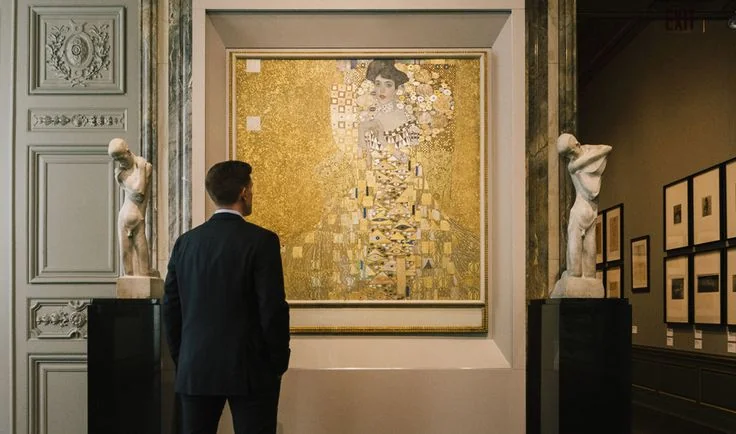
The connection of the house to Gustav Klimt is particularly strong. The gallery describes its Klimt collection as one of its greatest attractions, and Portrait of Adele Bloch-Bauer I, widely known as Woman in Gold, is permanently on display there. The work was acquired in 2006 by Ronald S. Lauder for the Neue Galerie and has since been permanently hung in the museum, in accordance with the family's wishes. For many visitors, this painting is precisely the reason to visit the gallery; for others, it serves as an ideal introduction to a broader engagement with the art of the Viennese Modernism. The official presentation also shows that the Neue Galerie does not present the work in isolation but as part of a larger context of Austrian masterworks, design, and cultural history. Thus, those seeking the Woman in Gold will find not only an iconic painting but a whole curatorial environment that considers its creation and provenance history. ([neuegalerie.org](https://www.neuegalerie.org/womaningold?utm_source=openai))
Café Sabarsky, Café Fledermaus, and the Museum Shop
The culinary profile of the Neue Galerie is almost as well-known as its collection. Café Sabarsky on the main floor is designed as a modern homage to Viennese café culture and bears the name of co-founder Serge Sabarsky. According to the museum, breakfast and lunch are served on a first come, first served basis; reservations for dinner can be made via Resy. Additionally, the café offers to-go options, including whole cakes and savory dishes. Café Sabarsky is also led by Executive Chef Christopher Engel. Complementing this is Café Fledermaus on the lower level, which is open on selected days and offers the same menu as Café Sabarsky. This makes it easy to combine a museum visit with a real break without having to leave the building. ([neuegalerie.org](https://www.neuegalerie.org/quicklinks))
The shop area is also strongly integrated into the museum's identity. The Book Store and Design Shop are located on the main floor and are not just souvenir spaces but carefully curated extensions of the collection. The Book Store focuses on publications related to art, architecture, and decorative arts from Austria, Germany, and related Central European cultures; the Design Shop offers objects that are often developed in direct relation to the exhibitions and the collection. The museum also emphasizes that many products are created exclusively for the Neue Galerie. Therefore, those wishing to combine a visit with a special gift or an art-historically meaningful souvenir will find a consistently curated selection here. Members also benefit from discounts depending on their level, and the official site refers to a 24/7 availability of the online shops. The combination of café, book selection, and design items makes the Neue Galerie a very complete place even beyond the gallery spaces. ([neuegalerie.org](https://www.neuegalerie.org/quicklinks))
Directions, Subway, and Parking on Museum Mile
The Neue Galerie New York is located at 1048 Fifth Avenue, at the southeast corner of Fifth Avenue and East 86th Street. This is the simplest orientation for many visitors, as the museum is situated in the heart of the Upper East Side and on Museum Mile. Those arriving by subway have several convenient options: lines 4, 5, and 6 to 86th Street at Lexington Avenue, lines B and C to 86th Street at Central Park West, and lines N, Q, and R to 86th Street at Second Avenue. Additionally, bus lines M86 to 86th Street at Fifth Avenue and M1, M2, M3, and M4 to 86th Street at Madison Avenue also serve the area. This makes the gallery relatively easy to reach from both Midtown and Downtown without having to rely on a car. ([neuegalerie.org](https://www.neuegalerie.org/quicklinks))
However, for those still arriving by car, the official website lists several parking garages nearby; availability and hourly rates should be inquired directly with the garages. The museum itself does not specify a fixed garage but refers to local providers, which is realistic and sensible for Manhattan. Especially due to its location on Fifth Avenue, arriving by public transport is usually less stressful. Additionally, the building itself becomes an attraction: The house was completed in 1914 by Carrère & Hastings, is a designated landmark, and is considered one of the most remarkable buildings on Fifth Avenue. The historical context, the location on Museum Mile, and the good public transport connections make the Neue Galerie a destination that fits well into a whole New York cultural walk. For those wishing to continue after the museum visit, Central Park and several other institutions are in close proximity. ([neuegalerie.org](https://www.neuegalerie.org/learn/building?utm_source=openai))
Visitor Rules, Photos, Audio Guide, and Recommended Duration
The Neue Galerie is known for its clear visitor regulations. Upon entry, all guests are checked by security, bags may be inspected, and only one bag per person with a maximum size of 13 x 17 x 4 inches is allowed. Larger bags, strollers, large umbrellas, liquids, weapons, and wrapped gifts are not permitted in the galleries. There is a free coat check; certain items may also be left at the discretion of the staff. Children under 12 years are not allowed in the galleries during regular opening hours, while children aged 12 to 16 must be accompanied by an adult. At the same time, children are welcome in the shops and café. These rules are strict, but they correspond to the protection concept of the house, which preserves particularly sensitive works of decorative art and consciously displays them without vitrines or barriers. ([neuegalerie.org](https://www.neuegalerie.org/visit/visitor-policies))
Those who inform themselves in advance avoid stress on-site. Photography is only allowed on the ground floor and the lower level, but not in the galleries. Phone calls are prohibited in the exhibition rooms and in the lobby. On the positive side, the gallery offers a free English-language audio guide via Bloomberg Connects; it can be used on-site or outside the museum, but visitors should bring their own headphones. Accessibility is also well addressed: All four levels are wheelchair accessible, and wheelchairs are available for loan. For time planning, it is especially important to note that the gallery offers two exhibition floors as well as café and shop areas. A realistic visit often lasts about one and a half to three hours; those who sit additionally in the café, study the collection intensively, or use the audio guide should plan for more time. This is not an official museum statement but a practical estimate based on the layout and visitor offerings of the gallery. ([neuegalerie.org](https://www.neuegalerie.org/visit/visitor-policies))
Ronald S. Lauder, Serge Sabarsky, the Historic House, Jobs, and Internships
The Neue Galerie is closely connected to its founders. Ronald S. Lauder and art dealer and collector Serge Sabarsky founded the museum; it opened in November 2001. However, the building itself tells a much longer story. The construction was completed in 1914 by Carrère & Hastings, originally built for industrialist William Starr Miller, later inhabited by Mrs. Cornelius Vanderbilt III, and then used by the YIVO Institute for Jewish Research. In 1994, Lauder and Sabarsky acquired the house with the aim of transforming it into a museum for German and Austrian art. The renovation was undertaken by Annabelle Selldorf, who restored the building to its original condition while also bringing it up to modern museum standards. For visitors, this means that the architecture is not just a backdrop but part of the curatorial program, and the journey from Gilded-Age mansion to museum is readable in every room. ([neuegalerie.org](https://www.neuegalerie.org/visit/faq))
The house is also active as a workplace and training location. The official Opportunities page lists open positions for motivated part-time associates and paid internships for qualified candidates who are allowed to work in the USA. Internships are offered year-round, last at least three months, and can provide insights into general administration, public relations, exhibition work, research, and educational work, depending on interest. It is important for interested individuals to know that the gallery does not always update its current positions only on its own website but also through external job platforms like nyfa.org. At the same time, the museum remains an independent private house that operates without institutional ties to other museums. Therefore, those interested in jobs, internships, or collaboration will find a genuine professional environment with a clear specialization in art and design from the first half of the 20th century. Especially because the house is small and curatorially focused, professional roles are often closely related to collection, mediation, and visitor service. ([neuegalerie.org](https://www.neuegalerie.org/learn/opportunities?utm_source=openai))
Sources:
- Neue Galerie New York - Official Website ([neuegalerie.org](https://www.neuegalerie.org/visit?utm_source=openai))
- Neue Galerie New York - Plan Your Visit ([neuegalerie.org](https://www.neuegalerie.org/visit?utm_source=openai))
- Neue Galerie New York - Frequently Asked Questions ([neuegalerie.org](https://www.neuegalerie.org/visit/faq))
- Neue Galerie New York - Visitor Policies ([neuegalerie.org](https://www.neuegalerie.org/visit/visitor-policies))
- Neue Galerie New York - Collection ([neuegalerie.org](https://www.neuegalerie.org/collection?utm_source=openai))
- Neue Galerie New York - Portrait of Adele Bloch Bauer I ([neuegalerie.org](https://www.neuegalerie.org/womaningold?utm_source=openai))
- Neue Galerie New York - Café Sabarsky ([neuegalerie.org](https://www.neuegalerie.org/cafesabarsky?utm_source=openai))
- Neue Galerie New York - Shop ([neuegalerie.org](https://www.neuegalerie.org/shop?utm_source=openai))
- Neue Galerie New York - The Building ([neuegalerie.org](https://www.neuegalerie.org/learn/building?utm_source=openai))
- Neue Galerie New York - Opportunities ([neuegalerie.org](https://www.neuegalerie.org/learn/opportunities?utm_source=openai))
Mehr anzeigenWeniger anzeigen
Neue Galerie New York | Opening Hours & Free Admission
The Neue Galerie New York is not a loud, overcrowded museum, but a carefully curated place for German and Austrian art and design from the early 20th century. Those walking along Museum Mile between Fifth Avenue and Central Park experience a combination of collection, architecture, and Viennese café culture that has become rare in New York. The house opened in November 2001, stemming from the initiative of Ronald S. Lauder and Serge Sabarsky, and is housed in a historic Gilded-Age mansion, which is itself part of the experience. The mix of Klimt, Schiele, Bauhaus, Wiener Werkstätte, Café Sabarsky, and Design Shop makes the Neue Galerie not just a museum, but a very unique cultural venue where art appreciation, architecture, and breaks with coffee or breakfast complement each other meaningfully. ([neuegalerie.org](https://www.neuegalerie.org/visit/faq))
Opening Hours, Tickets, and Free Admission
Those planning a visit should first adhere to the current opening hours: The Neue Galerie is open Monday and Wednesday to Sunday from 10 AM to 6 PM, and closed on Tuesdays. The last entry to the galleries is at 5:30 PM. Tickets can be purchased on-site on the same day, and advance tickets are also available online. This is convenient because the gallery is a popular destination, and wait times can occur, especially on weekends or during special exhibitions. Members receive free, unlimited annual membership and, according to the museum, also preferred entry. Those wishing to visit the gallery flexibly should also note that altered times may apply on selected holidays or during special events. Therefore, the official pages explicitly recommend planning the visit in advance. ([neuegalerie.org](https://www.neuegalerie.org/visit?utm_source=openai))
For many visitors, free admission is a special incentive. The Neue Galerie offers free access to the galleries every first Friday of the month from 5 PM to 8 PM as part of First Fridays. Entry is then on a first come, first served basis, and a queue may form at the entrance. Additionally, there are other forms of free or discounted admission: Members have free entry, holders of an ICOM card receive free admission for themselves and a guest, AAM cards are also accepted, and SNAP/EBT eligible individuals receive free entry according to museum rules. This combination of regular ticketing and recurring free times makes the house attractive for both spontaneous visits and carefully planned cultural appointments. Those wishing to combine the evening with dinner or a visit to the shop will find First Fridays a particularly pleasant option. ([neuegalerie.org](https://www.neuegalerie.org/visit/faq))
Klimt, Woman in Gold, and the Collection
The heart of the Neue Galerie is its collection. Officially, the museum is dedicated to art and design from Germany and Austria between 1890 and 1940, featuring paintings, sculptures, works on paper, decorative arts, and photographs. Significant names include Gustav Klimt, Egon Schiele, Oskar Kokoschka, Alfred Kubin, Richard Gerstl, Ernst Ludwig Kirchner, Karl Schmidt-Rottluff, Emil Nolde, Vasily Kandinsky, Franz Marc, Gabriele Münter, Max Beckmann, Otto Dix, Christian Schad, George Grosz, and Paul Klee. In terms of design and architecture, the spectrum ranges from Otto Wagner and Adolf Loos to Josef Hoffmann, Koloman Moser, and Dagobert Peche, up to Marcel Breuer, Ludwig Mies van der Rohe, and Marianne Brandt. This makes the collection not only aesthetically pleasing but also historically coherent, as it demonstrates the interplay between fine art and applied arts. ([neuegalerie.org](https://www.neuegalerie.org/collection?utm_source=openai))
The connection of the house to Gustav Klimt is particularly strong. The gallery describes its Klimt collection as one of its greatest attractions, and Portrait of Adele Bloch-Bauer I, widely known as Woman in Gold, is permanently on display there. The work was acquired in 2006 by Ronald S. Lauder for the Neue Galerie and has since been permanently hung in the museum, in accordance with the family's wishes. For many visitors, this painting is precisely the reason to visit the gallery; for others, it serves as an ideal introduction to a broader engagement with the art of the Viennese Modernism. The official presentation also shows that the Neue Galerie does not present the work in isolation but as part of a larger context of Austrian masterworks, design, and cultural history. Thus, those seeking the Woman in Gold will find not only an iconic painting but a whole curatorial environment that considers its creation and provenance history. ([neuegalerie.org](https://www.neuegalerie.org/womaningold?utm_source=openai))
Café Sabarsky, Café Fledermaus, and the Museum Shop
The culinary profile of the Neue Galerie is almost as well-known as its collection. Café Sabarsky on the main floor is designed as a modern homage to Viennese café culture and bears the name of co-founder Serge Sabarsky. According to the museum, breakfast and lunch are served on a first come, first served basis; reservations for dinner can be made via Resy. Additionally, the café offers to-go options, including whole cakes and savory dishes. Café Sabarsky is also led by Executive Chef Christopher Engel. Complementing this is Café Fledermaus on the lower level, which is open on selected days and offers the same menu as Café Sabarsky. This makes it easy to combine a museum visit with a real break without having to leave the building. ([neuegalerie.org](https://www.neuegalerie.org/quicklinks))
The shop area is also strongly integrated into the museum's identity. The Book Store and Design Shop are located on the main floor and are not just souvenir spaces but carefully curated extensions of the collection. The Book Store focuses on publications related to art, architecture, and decorative arts from Austria, Germany, and related Central European cultures; the Design Shop offers objects that are often developed in direct relation to the exhibitions and the collection. The museum also emphasizes that many products are created exclusively for the Neue Galerie. Therefore, those wishing to combine a visit with a special gift or an art-historically meaningful souvenir will find a consistently curated selection here. Members also benefit from discounts depending on their level, and the official site refers to a 24/7 availability of the online shops. The combination of café, book selection, and design items makes the Neue Galerie a very complete place even beyond the gallery spaces. ([neuegalerie.org](https://www.neuegalerie.org/quicklinks))
Directions, Subway, and Parking on Museum Mile
The Neue Galerie New York is located at 1048 Fifth Avenue, at the southeast corner of Fifth Avenue and East 86th Street. This is the simplest orientation for many visitors, as the museum is situated in the heart of the Upper East Side and on Museum Mile. Those arriving by subway have several convenient options: lines 4, 5, and 6 to 86th Street at Lexington Avenue, lines B and C to 86th Street at Central Park West, and lines N, Q, and R to 86th Street at Second Avenue. Additionally, bus lines M86 to 86th Street at Fifth Avenue and M1, M2, M3, and M4 to 86th Street at Madison Avenue also serve the area. This makes the gallery relatively easy to reach from both Midtown and Downtown without having to rely on a car. ([neuegalerie.org](https://www.neuegalerie.org/quicklinks))
However, for those still arriving by car, the official website lists several parking garages nearby; availability and hourly rates should be inquired directly with the garages. The museum itself does not specify a fixed garage but refers to local providers, which is realistic and sensible for Manhattan. Especially due to its location on Fifth Avenue, arriving by public transport is usually less stressful. Additionally, the building itself becomes an attraction: The house was completed in 1914 by Carrère & Hastings, is a designated landmark, and is considered one of the most remarkable buildings on Fifth Avenue. The historical context, the location on Museum Mile, and the good public transport connections make the Neue Galerie a destination that fits well into a whole New York cultural walk. For those wishing to continue after the museum visit, Central Park and several other institutions are in close proximity. ([neuegalerie.org](https://www.neuegalerie.org/learn/building?utm_source=openai))
Visitor Rules, Photos, Audio Guide, and Recommended Duration
The Neue Galerie is known for its clear visitor regulations. Upon entry, all guests are checked by security, bags may be inspected, and only one bag per person with a maximum size of 13 x 17 x 4 inches is allowed. Larger bags, strollers, large umbrellas, liquids, weapons, and wrapped gifts are not permitted in the galleries. There is a free coat check; certain items may also be left at the discretion of the staff. Children under 12 years are not allowed in the galleries during regular opening hours, while children aged 12 to 16 must be accompanied by an adult. At the same time, children are welcome in the shops and café. These rules are strict, but they correspond to the protection concept of the house, which preserves particularly sensitive works of decorative art and consciously displays them without vitrines or barriers. ([neuegalerie.org](https://www.neuegalerie.org/visit/visitor-policies))
Those who inform themselves in advance avoid stress on-site. Photography is only allowed on the ground floor and the lower level, but not in the galleries. Phone calls are prohibited in the exhibition rooms and in the lobby. On the positive side, the gallery offers a free English-language audio guide via Bloomberg Connects; it can be used on-site or outside the museum, but visitors should bring their own headphones. Accessibility is also well addressed: All four levels are wheelchair accessible, and wheelchairs are available for loan. For time planning, it is especially important to note that the gallery offers two exhibition floors as well as café and shop areas. A realistic visit often lasts about one and a half to three hours; those who sit additionally in the café, study the collection intensively, or use the audio guide should plan for more time. This is not an official museum statement but a practical estimate based on the layout and visitor offerings of the gallery. ([neuegalerie.org](https://www.neuegalerie.org/visit/visitor-policies))
Ronald S. Lauder, Serge Sabarsky, the Historic House, Jobs, and Internships
The Neue Galerie is closely connected to its founders. Ronald S. Lauder and art dealer and collector Serge Sabarsky founded the museum; it opened in November 2001. However, the building itself tells a much longer story. The construction was completed in 1914 by Carrère & Hastings, originally built for industrialist William Starr Miller, later inhabited by Mrs. Cornelius Vanderbilt III, and then used by the YIVO Institute for Jewish Research. In 1994, Lauder and Sabarsky acquired the house with the aim of transforming it into a museum for German and Austrian art. The renovation was undertaken by Annabelle Selldorf, who restored the building to its original condition while also bringing it up to modern museum standards. For visitors, this means that the architecture is not just a backdrop but part of the curatorial program, and the journey from Gilded-Age mansion to museum is readable in every room. ([neuegalerie.org](https://www.neuegalerie.org/visit/faq))
The house is also active as a workplace and training location. The official Opportunities page lists open positions for motivated part-time associates and paid internships for qualified candidates who are allowed to work in the USA. Internships are offered year-round, last at least three months, and can provide insights into general administration, public relations, exhibition work, research, and educational work, depending on interest. It is important for interested individuals to know that the gallery does not always update its current positions only on its own website but also through external job platforms like nyfa.org. At the same time, the museum remains an independent private house that operates without institutional ties to other museums. Therefore, those interested in jobs, internships, or collaboration will find a genuine professional environment with a clear specialization in art and design from the first half of the 20th century. Especially because the house is small and curatorially focused, professional roles are often closely related to collection, mediation, and visitor service. ([neuegalerie.org](https://www.neuegalerie.org/learn/opportunities?utm_source=openai))
Sources:
- Neue Galerie New York - Official Website ([neuegalerie.org](https://www.neuegalerie.org/visit?utm_source=openai))
- Neue Galerie New York - Plan Your Visit ([neuegalerie.org](https://www.neuegalerie.org/visit?utm_source=openai))
- Neue Galerie New York - Frequently Asked Questions ([neuegalerie.org](https://www.neuegalerie.org/visit/faq))
- Neue Galerie New York - Visitor Policies ([neuegalerie.org](https://www.neuegalerie.org/visit/visitor-policies))
- Neue Galerie New York - Collection ([neuegalerie.org](https://www.neuegalerie.org/collection?utm_source=openai))
- Neue Galerie New York - Portrait of Adele Bloch Bauer I ([neuegalerie.org](https://www.neuegalerie.org/womaningold?utm_source=openai))
- Neue Galerie New York - Café Sabarsky ([neuegalerie.org](https://www.neuegalerie.org/cafesabarsky?utm_source=openai))
- Neue Galerie New York - Shop ([neuegalerie.org](https://www.neuegalerie.org/shop?utm_source=openai))
- Neue Galerie New York - The Building ([neuegalerie.org](https://www.neuegalerie.org/learn/building?utm_source=openai))
- Neue Galerie New York - Opportunities ([neuegalerie.org](https://www.neuegalerie.org/learn/opportunities?utm_source=openai))
Neue Galerie New York | Opening Hours & Free Admission
The Neue Galerie New York is not a loud, overcrowded museum, but a carefully curated place for German and Austrian art and design from the early 20th century. Those walking along Museum Mile between Fifth Avenue and Central Park experience a combination of collection, architecture, and Viennese café culture that has become rare in New York. The house opened in November 2001, stemming from the initiative of Ronald S. Lauder and Serge Sabarsky, and is housed in a historic Gilded-Age mansion, which is itself part of the experience. The mix of Klimt, Schiele, Bauhaus, Wiener Werkstätte, Café Sabarsky, and Design Shop makes the Neue Galerie not just a museum, but a very unique cultural venue where art appreciation, architecture, and breaks with coffee or breakfast complement each other meaningfully. ([neuegalerie.org](https://www.neuegalerie.org/visit/faq))
Opening Hours, Tickets, and Free Admission
Those planning a visit should first adhere to the current opening hours: The Neue Galerie is open Monday and Wednesday to Sunday from 10 AM to 6 PM, and closed on Tuesdays. The last entry to the galleries is at 5:30 PM. Tickets can be purchased on-site on the same day, and advance tickets are also available online. This is convenient because the gallery is a popular destination, and wait times can occur, especially on weekends or during special exhibitions. Members receive free, unlimited annual membership and, according to the museum, also preferred entry. Those wishing to visit the gallery flexibly should also note that altered times may apply on selected holidays or during special events. Therefore, the official pages explicitly recommend planning the visit in advance. ([neuegalerie.org](https://www.neuegalerie.org/visit?utm_source=openai))
For many visitors, free admission is a special incentive. The Neue Galerie offers free access to the galleries every first Friday of the month from 5 PM to 8 PM as part of First Fridays. Entry is then on a first come, first served basis, and a queue may form at the entrance. Additionally, there are other forms of free or discounted admission: Members have free entry, holders of an ICOM card receive free admission for themselves and a guest, AAM cards are also accepted, and SNAP/EBT eligible individuals receive free entry according to museum rules. This combination of regular ticketing and recurring free times makes the house attractive for both spontaneous visits and carefully planned cultural appointments. Those wishing to combine the evening with dinner or a visit to the shop will find First Fridays a particularly pleasant option. ([neuegalerie.org](https://www.neuegalerie.org/visit/faq))
Klimt, Woman in Gold, and the Collection
The heart of the Neue Galerie is its collection. Officially, the museum is dedicated to art and design from Germany and Austria between 1890 and 1940, featuring paintings, sculptures, works on paper, decorative arts, and photographs. Significant names include Gustav Klimt, Egon Schiele, Oskar Kokoschka, Alfred Kubin, Richard Gerstl, Ernst Ludwig Kirchner, Karl Schmidt-Rottluff, Emil Nolde, Vasily Kandinsky, Franz Marc, Gabriele Münter, Max Beckmann, Otto Dix, Christian Schad, George Grosz, and Paul Klee. In terms of design and architecture, the spectrum ranges from Otto Wagner and Adolf Loos to Josef Hoffmann, Koloman Moser, and Dagobert Peche, up to Marcel Breuer, Ludwig Mies van der Rohe, and Marianne Brandt. This makes the collection not only aesthetically pleasing but also historically coherent, as it demonstrates the interplay between fine art and applied arts. ([neuegalerie.org](https://www.neuegalerie.org/collection?utm_source=openai))
The connection of the house to Gustav Klimt is particularly strong. The gallery describes its Klimt collection as one of its greatest attractions, and Portrait of Adele Bloch-Bauer I, widely known as Woman in Gold, is permanently on display there. The work was acquired in 2006 by Ronald S. Lauder for the Neue Galerie and has since been permanently hung in the museum, in accordance with the family's wishes. For many visitors, this painting is precisely the reason to visit the gallery; for others, it serves as an ideal introduction to a broader engagement with the art of the Viennese Modernism. The official presentation also shows that the Neue Galerie does not present the work in isolation but as part of a larger context of Austrian masterworks, design, and cultural history. Thus, those seeking the Woman in Gold will find not only an iconic painting but a whole curatorial environment that considers its creation and provenance history. ([neuegalerie.org](https://www.neuegalerie.org/womaningold?utm_source=openai))
Café Sabarsky, Café Fledermaus, and the Museum Shop
The culinary profile of the Neue Galerie is almost as well-known as its collection. Café Sabarsky on the main floor is designed as a modern homage to Viennese café culture and bears the name of co-founder Serge Sabarsky. According to the museum, breakfast and lunch are served on a first come, first served basis; reservations for dinner can be made via Resy. Additionally, the café offers to-go options, including whole cakes and savory dishes. Café Sabarsky is also led by Executive Chef Christopher Engel. Complementing this is Café Fledermaus on the lower level, which is open on selected days and offers the same menu as Café Sabarsky. This makes it easy to combine a museum visit with a real break without having to leave the building. ([neuegalerie.org](https://www.neuegalerie.org/quicklinks))
The shop area is also strongly integrated into the museum's identity. The Book Store and Design Shop are located on the main floor and are not just souvenir spaces but carefully curated extensions of the collection. The Book Store focuses on publications related to art, architecture, and decorative arts from Austria, Germany, and related Central European cultures; the Design Shop offers objects that are often developed in direct relation to the exhibitions and the collection. The museum also emphasizes that many products are created exclusively for the Neue Galerie. Therefore, those wishing to combine a visit with a special gift or an art-historically meaningful souvenir will find a consistently curated selection here. Members also benefit from discounts depending on their level, and the official site refers to a 24/7 availability of the online shops. The combination of café, book selection, and design items makes the Neue Galerie a very complete place even beyond the gallery spaces. ([neuegalerie.org](https://www.neuegalerie.org/quicklinks))
Directions, Subway, and Parking on Museum Mile
The Neue Galerie New York is located at 1048 Fifth Avenue, at the southeast corner of Fifth Avenue and East 86th Street. This is the simplest orientation for many visitors, as the museum is situated in the heart of the Upper East Side and on Museum Mile. Those arriving by subway have several convenient options: lines 4, 5, and 6 to 86th Street at Lexington Avenue, lines B and C to 86th Street at Central Park West, and lines N, Q, and R to 86th Street at Second Avenue. Additionally, bus lines M86 to 86th Street at Fifth Avenue and M1, M2, M3, and M4 to 86th Street at Madison Avenue also serve the area. This makes the gallery relatively easy to reach from both Midtown and Downtown without having to rely on a car. ([neuegalerie.org](https://www.neuegalerie.org/quicklinks))
However, for those still arriving by car, the official website lists several parking garages nearby; availability and hourly rates should be inquired directly with the garages. The museum itself does not specify a fixed garage but refers to local providers, which is realistic and sensible for Manhattan. Especially due to its location on Fifth Avenue, arriving by public transport is usually less stressful. Additionally, the building itself becomes an attraction: The house was completed in 1914 by Carrère & Hastings, is a designated landmark, and is considered one of the most remarkable buildings on Fifth Avenue. The historical context, the location on Museum Mile, and the good public transport connections make the Neue Galerie a destination that fits well into a whole New York cultural walk. For those wishing to continue after the museum visit, Central Park and several other institutions are in close proximity. ([neuegalerie.org](https://www.neuegalerie.org/learn/building?utm_source=openai))
Visitor Rules, Photos, Audio Guide, and Recommended Duration
The Neue Galerie is known for its clear visitor regulations. Upon entry, all guests are checked by security, bags may be inspected, and only one bag per person with a maximum size of 13 x 17 x 4 inches is allowed. Larger bags, strollers, large umbrellas, liquids, weapons, and wrapped gifts are not permitted in the galleries. There is a free coat check; certain items may also be left at the discretion of the staff. Children under 12 years are not allowed in the galleries during regular opening hours, while children aged 12 to 16 must be accompanied by an adult. At the same time, children are welcome in the shops and café. These rules are strict, but they correspond to the protection concept of the house, which preserves particularly sensitive works of decorative art and consciously displays them without vitrines or barriers. ([neuegalerie.org](https://www.neuegalerie.org/visit/visitor-policies))
Those who inform themselves in advance avoid stress on-site. Photography is only allowed on the ground floor and the lower level, but not in the galleries. Phone calls are prohibited in the exhibition rooms and in the lobby. On the positive side, the gallery offers a free English-language audio guide via Bloomberg Connects; it can be used on-site or outside the museum, but visitors should bring their own headphones. Accessibility is also well addressed: All four levels are wheelchair accessible, and wheelchairs are available for loan. For time planning, it is especially important to note that the gallery offers two exhibition floors as well as café and shop areas. A realistic visit often lasts about one and a half to three hours; those who sit additionally in the café, study the collection intensively, or use the audio guide should plan for more time. This is not an official museum statement but a practical estimate based on the layout and visitor offerings of the gallery. ([neuegalerie.org](https://www.neuegalerie.org/visit/visitor-policies))
Ronald S. Lauder, Serge Sabarsky, the Historic House, Jobs, and Internships
The Neue Galerie is closely connected to its founders. Ronald S. Lauder and art dealer and collector Serge Sabarsky founded the museum; it opened in November 2001. However, the building itself tells a much longer story. The construction was completed in 1914 by Carrère & Hastings, originally built for industrialist William Starr Miller, later inhabited by Mrs. Cornelius Vanderbilt III, and then used by the YIVO Institute for Jewish Research. In 1994, Lauder and Sabarsky acquired the house with the aim of transforming it into a museum for German and Austrian art. The renovation was undertaken by Annabelle Selldorf, who restored the building to its original condition while also bringing it up to modern museum standards. For visitors, this means that the architecture is not just a backdrop but part of the curatorial program, and the journey from Gilded-Age mansion to museum is readable in every room. ([neuegalerie.org](https://www.neuegalerie.org/visit/faq))
The house is also active as a workplace and training location. The official Opportunities page lists open positions for motivated part-time associates and paid internships for qualified candidates who are allowed to work in the USA. Internships are offered year-round, last at least three months, and can provide insights into general administration, public relations, exhibition work, research, and educational work, depending on interest. It is important for interested individuals to know that the gallery does not always update its current positions only on its own website but also through external job platforms like nyfa.org. At the same time, the museum remains an independent private house that operates without institutional ties to other museums. Therefore, those interested in jobs, internships, or collaboration will find a genuine professional environment with a clear specialization in art and design from the first half of the 20th century. Especially because the house is small and curatorially focused, professional roles are often closely related to collection, mediation, and visitor service. ([neuegalerie.org](https://www.neuegalerie.org/learn/opportunities?utm_source=openai))
Sources:
- Neue Galerie New York - Official Website ([neuegalerie.org](https://www.neuegalerie.org/visit?utm_source=openai))
- Neue Galerie New York - Plan Your Visit ([neuegalerie.org](https://www.neuegalerie.org/visit?utm_source=openai))
- Neue Galerie New York - Frequently Asked Questions ([neuegalerie.org](https://www.neuegalerie.org/visit/faq))
- Neue Galerie New York - Visitor Policies ([neuegalerie.org](https://www.neuegalerie.org/visit/visitor-policies))
- Neue Galerie New York - Collection ([neuegalerie.org](https://www.neuegalerie.org/collection?utm_source=openai))
- Neue Galerie New York - Portrait of Adele Bloch Bauer I ([neuegalerie.org](https://www.neuegalerie.org/womaningold?utm_source=openai))
- Neue Galerie New York - Café Sabarsky ([neuegalerie.org](https://www.neuegalerie.org/cafesabarsky?utm_source=openai))
- Neue Galerie New York - Shop ([neuegalerie.org](https://www.neuegalerie.org/shop?utm_source=openai))
- Neue Galerie New York - The Building ([neuegalerie.org](https://www.neuegalerie.org/learn/building?utm_source=openai))
- Neue Galerie New York - Opportunities ([neuegalerie.org](https://www.neuegalerie.org/learn/opportunities?utm_source=openai))
Upcoming Events
No events found
Frequently Asked Questions
Reviews
Maurice Boucher
22. February 2026
Out of all the museums I’ve visited so far, this one feels the most comfortable to me. Maybe I’m just a fan of naïve and so-called “degenerate” art — but there’s something about this place that feels intimate rather than overwhelming. You’re not flooded with an impossible volume of works to rush through. The curation is thoughtful — the placement, the sequence, the dialogue between paintings and decorative objects all feel intentional and balanced. You can actually breathe and take it in. I was especially in awe of the architectural design itself. The building — a former Gilded Age mansion on Museum Mile — adds another layer to the experience. It feels refined yet warm. The collection of German and Austrian art and design is exceptional, featuring works by artists like Gustav Klimt (including Portrait of Adele Bloch-Bauer I), Egon Schiele, and Wassily Kandinsky, alongside pieces from the Wiener Werkstätte and Bauhaus movements. It’s a powerful combination of fine art and design. I also loved that you can dine inside. If the café on the first floor is full, there’s another option downstairs — equally charming. Just note: no photography in the galleries. And honestly, that’s part of the beauty. You’re forced to slow down, look closely, and let the works speak to you. Loved every part of it.
Rebecca Meador
7. March 2026
Beautiful museum of German and Austrian art on Museum Mile of 5th Ave. The building itself is historic and a work of art, and the collection is stunning. Lovely gift shops, a cafe, and friendly staff make this a very worthwhile stop on your art sightseeing tour. I went for a guided tour and learned a lot, saw provocative and thought-provoking pieces and was impressed at the variety in each exhibit. 10/10 highly recommend.
Jason Z
1. March 2026
Located on the upper east side right across from Central Park, I had no expectations other than reviewers complaining about staff harassing them. You enter via an unimpressive side entrance and immediately must go through a security check - the staff were friendly but stern - no liquids allowed to enter at all (we were forced to drink our bottled water on the sidewalk). Once inside you purchase tickets from a very friendly staff person ($28, similar to the $30 at MET, MOMA, and Frick) and are directed to complimentary coat check in the basement. You may WEAR your coat/jacket/sweatshirt but the moment you take any of these off, their security/staff will immediately tell you to put them back on or take them to coat check. FYI - we found the building to be very warm in the winter. No photographs allowed anywhere and the minute you take out your phone, they immediately have eyes on what you are doing. That said, they do have some nice audio commentary for many of their pieces so it is worthwhile to download the app (FREE) and bring your earbuds. Their rules are published so I suppose fair game for them to so vigilantly enforce them, but it is the most strict of any museum I have been to and did make the whole visit a little less relaxing (if not for myself, than for other people always being reprimanded). Do yourself a favor and just plan to follow the rules. While the museum is in an older home, it definitely has more of a museum vibe than a luxurious mansion vibe. Overall we had a nice 30-40 minute visit - this isn't a large collection. Yes they have some amazing Klimts, as well as some other nice pieces......but if you aren't a big Klimt fan, I am not sure I would go out of my way or pay this relatively higher price (considering the smaller collection) compared to other much more varied and larger volume at the other museums. I am glad I went and had a nice visit (big Klimt fan) but can't see myself making much effort to return very often.
Sterling Glen
21. January 2026
If you’re visiting Manhattan, don’t let the Neue Galerie slip past you. In a city dense with spectacle, it waits quietly, and that quiet is its power. Situated in a beautiful Beaux-Arts mansion on the corner of Fifth Avenue and East 86th Street, directly across from Central Park, the Neue doesn’t feel like a destination. It feels like a return. As if you’ve been here before, not in life, but in memory. From the moment you step inside, there’s a gentle recognition that’s hard to name. The space seems to have been waiting, fully formed, quietly assured. It lacks the polite distance of most public institutions. Instead, it opens to you like a well-loved home. Intimate, calm, and entirely at ease with itself. Nothing prepares you for the Klimt paintings. The shock is not scale or drama, but vitality. The gold leaf isn’t decorative flatness. It’s a living surface that breathes, flickers, and shifts with the light and with your movement. What photographs reduce to ornament becomes deeply human in person. These are not paintings to be taken in from across a room. You move closer. You stand with them. There’s a moment where something passes between viewer and work, subtle and private, as if the painting is aware of your presence too. It is the restraint of the architecture that releases the power of the paintings. Nothing competes. Nothing intrudes. Like a beautiful woman in a simple white dress, everything unnecessary falls away, and what remains becomes undeniable. The rooms don’t impose themselves. They receive you. Scale is modest. Proportions are calm. The pacing encourages stillness rather than momentum. Thoughtfully placed benches invite you to sit and stay. From there, you begin to notice the quiet marriage between art and architecture, how walls, light, and space don’t serve as backdrop but as partner. One can’t help but imagine Klimt himself sitting on one of those benches, approving of the restraint, the intimacy, the way the gold is allowed to breathe without spectacle. The art isn’t announced. It’s kept, protected, understood. Don’t miss the opportunity to step back in time and pause over lunch on the first floor, a space that’s surprisingly easy to pass by. Warm wood, the soft clink of glasses, afternoon light holding steady. It feels like a Viennese dining room in a grand private home or old mansion: cultured without display, elegant without effort. A place designed for staying awhile. Conversation softens. Time loosens its grip. Nothing rushes you along. The Neue doesn’t try to impress you with size or spectacle. It doesn’t need to. It wins you quietly, with grace. You leave carrying something intangible but unmistakable: a quiet glow, the dimensional gold stamped into memory, long after the doors close behind you.
Tong Chen
5. January 2026
Great small museum, it worth the visiting if just only for the Gustav Klimt 4 beautiful woman portrait. Waiting in a long line in cold for 1 hour, because it's free Friday evening. They put a small heater, it cannot help such a long line, but it warm my heart.