
Kassel
Pfarrei St. Maria, Kirchweg 71, 34119 Kassel, Deutschland
Parish St. Mary in Kassel | Services & Parking
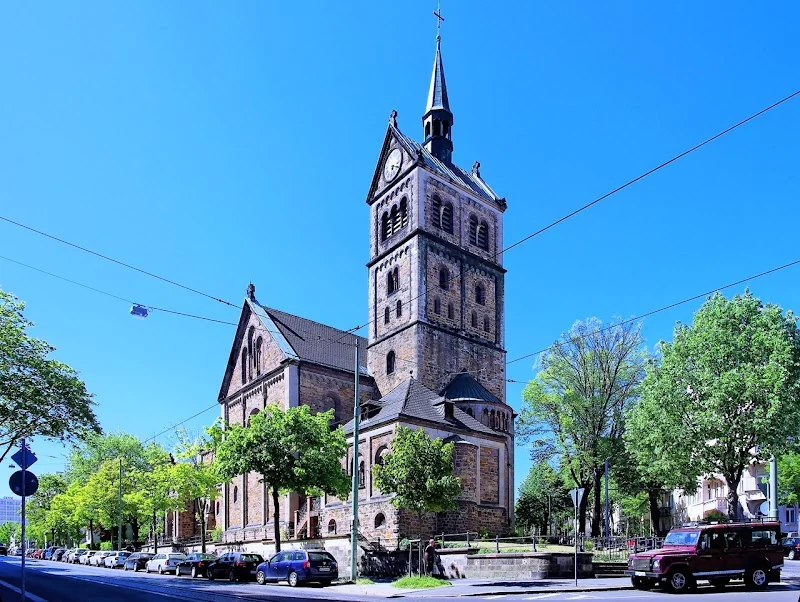
The Parish St. Mary in Kassel is primarily known to many people as the Rosary Church at Bebelplatz, right in the vibrant Vorderer Westen. Those heading to Kirchweg 71 will find not only a distinctive Catholic church but also a place with a clear identity, long history, and high recognizability in the urban landscape. The city of Kassel lists St. Mary as a Catholic church with about 3500 Catholics in the parish area, while the official parish page documents the developed ecclesiastical and architectural character of the building in detail. For visitors, this is both practical and atmospheric: St. Mary is not a remote sacred space but a central point of contact for services, pastoral care, conversations, and church festivals. The location at Bebelplatz makes the church a fixed point of orientation in the neighborhood, characterized by commerce, daily life, short distances, and a dense urban structure. At the same time, the traditional name Rosary Church reminds us of the patronal feast on October 7, which makes the connection between place, liturgy, and ecclesiastical tradition particularly clear for many people. ([kassel.de](https://www.kassel.de/verzeichnisse/adressverzeichnis/gotteshaeuser/katholische-kirchen/st.maria.php))
Rosary Church, Parish, and Location at Bebelplatz
St. Mary is located in the Kassel Vorderer Westen at a spot that is both typical for the district and exceptionally prominent. The official church description explicitly names the location at Bebelplatz corner Kirchweg/Friedrich-Ebert-Straße. The district Vorderer Westen is described by the city of Kassel as part of the city center; at the central Bebelplatz, there are markets, shops, and service offerings for daily needs. This is important for visitors because St. Mary is not located in a peripheral area but right in a busy, well-connected, and architecturally significant neighborhood. Therefore, those coming to the church experience not just a single building but a developed urban environment where sacred architecture and everyday city life stand closely together. This contrast gives the place its special aura: The church is simultaneously a quiet anchor point and a visible sign of Catholic presence in the neighborhood. The official location page of the city also confirms the address Kirchweg 71, 34119 Kassel, and directly refers to maps, route planners, and public transport connections. This makes it clear: St. Mary is not only historically significant but also functionally well accessible for services, baptisms, weddings, funerals, conversations in the parish office, and other pastoral appointments. ([kassel.de](https://www.kassel.de/verzeichnisse/adressverzeichnis/gotteshaeuser/katholische-kirchen/st.maria.php))
The designation as Rosary Church is also related to the location and history, as the popular name continues to shape the perception of the building today. The church belongs to the ecclesiastical network around Kassel and borders other Catholic parishes such as Mary Queen of Peace, St. Michael, St. Familia, and Heart of Mary, according to the city of Kassel. This classification shows that St. Mary is not isolated but part of a vibrant Catholic landscape in the city. Therefore, when searching for Parish St. Mary in Kassel, people usually mean more than just an address: It refers to an ensemble of church, parish administration, service schedule, and pastoral responsibility. This is exactly why the page is equally relevant for visitors, parish members, and people looking for a church place. Additionally, it is helpful for orientation that the city of Kassel lists St. Mary as a clearly named entry in its address directory. This facilitates access, navigation in everyday life, and the search for current contact details. Thus, a historically significant church building becomes a place that is easily found and quickly understood as part of urban life. ([kassel.de](https://www.kassel.de/verzeichnisse/adressverzeichnis/gotteshaeuser/katholische-kirchen/st.maria.php))
History of Construction, Consecration, and Reconstruction
The history of St. Mary dates back to around the turn of the century. According to the official parish page, the church was built between 1899 and 1901 based on designs by the architect Georg Kegel. Kegel was himself a parish member, which gives the building a particularly personal character. The project was supported, among other things, by generous donations from the banker Sigmund Aschrott, whose name is still closely associated with urban development and civic engagement in Kassel. The church was consecrated on June 17, 1901, and this date is also mentioned by the city of Kassel in its location directory. Thus, St. Mary is a structure that emerged from a phase of growing Catholic life in Kassel and early established itself as a defining parish church in the western part of the city. Its origin story exemplifies the religious, architectural, and social awakening of that time. The church was not built as an ancillary space but as a deliberately designed center of a community that wanted to be visible in the developing neighborhood. This also explains the still strong impact of the building today: It was built with the intention of being present, and that is exactly what it continues to fulfill. ([cms.bistum-fulda.de](https://cms.bistum-fulda.de/ksherzmariae/02_Kirchen/Kirche_Rosenkranzkirche_Kassel.php))
However, the history of St. Mary does not end with the consecration. After the severe damage from air raids in World War II, the Rosary Church was rebuilt after the war. This information is important for understanding the building because it explains why historical substance and later additions coexist. The reconstruction adheres to the old form without denying the traces of history. Thus, St. Mary is today a place where architecture is not only beautiful but also biographical: The building tells of foundation, destruction, restoration, and ongoing use. Therefore, when entering the church, one does not experience a museum-like state but a living house of worship that visibly carries its past. This fits with the liturgical framework of the patronal feast on October 7, the feast of Mary Queen of the Rosary. The name Rosary Church is thus not just a nickname but part of the spiritual identity of the building. In the connection of the year of consecration, war consequences, reconstruction, and patronal feast, it becomes clear why St. Mary is more than a listed building for Kassel: It is a historical bearer of Catholic life in the city center of Vorderer Westen. ([cms.bistum-fulda.de](https://cms.bistum-fulda.de/ksherzmariae/02_Kirchen/Kirche_Rosenkranzkirche_Kassel.php))
Architecture, Seating, and Sacred Furnishings
Architecturally, St. Mary is one of the most impressive Catholic churches in Kassel. The official description calls the basilica a neo-Romanesque building made of yellowish rubble stone masonry with a longitudinal nave, two side aisles, and a transept. The rectangular tower reaches a height of 48 meters and is crowned by a bell turret. These key figures already show why the church appears so present in the urban space: It combines clear geometry with historical form language, thus creating a characteristic, easily readable church body. With around 500 seats, the house of worship also offers a size suitable for both regular services and large festive days. The spatial effect is determined by the three-nave structure, the crossing space, and the distinctive tower figure, so that visitors already receive a strong impression of spaciousness and order upon entering. For the perception in the neighborhood, it is also important that the church was rebuilt after the war, thus connecting older building forms with later restoration. It is therefore not only beautiful but also an example of how historical church spaces can be carried into the present without losing their identity. ([cms.bistum-fulda.de](https://cms.bistum-fulda.de/ksherzmariae/02_Kirchen/Kirche_Rosenkranzkirche_Kassel.php))
The interior was redesigned in the mid-1970s. Since then, the altar has been elevated in the crossing, thus emphasizing a central place that highlights the liturgical focus. Above the altar hangs a so-called triumph cross, designed by Sr. Lioba Lotte Munz. In its center is a crystallized tree slice that is about two million years old, giving the cross an unusual material and symbolic depth. Also significant is the Walcker organ, which was built in 1973 by the company Walcker in Ludwigsburg. It has three manuals and 32 registers; it is unusual that the console is located in the choir behind the altar. The furnishings are complemented by the Pietà of the Rosary Church, a replica of the Nenninger Pietà, which was found on the sacristy attic in 1974 and restored in 1975. Additionally impressive are the fifteen colorful stained glass windows in the nave, designed by the artist Agnes Mann, depicting the three mysteries of the rosary: the joyful, the sorrowful, and the glorious mysteries. This furnishing makes St. Mary a church space where liturgy, art, and symbolism are closely intertwined. ([cms.bistum-fulda.de](https://cms.bistum-fulda.de/ksherzmariae/02_Kirchen/Kirche_Rosenkranzkirche_Kassel.php))
Service Schedule, Parish Office, and Community Life
Those who want to understand St. Mary as a living parish should not only look at the architecture but also at the practical information of the community. The city of Kassel lists specific office hours for St. Mary on its location page: Monday to Wednesday from 9 to 11 a.m. and Thursday from 9 to 11 a.m. and 1 to 3 p.m. Additionally, the phone number, fax, and the official contact address of the parish community are provided. This is important for anyone seeking a conversation, wishing to register mass intentions, or having specific questions about sacraments, appointments, and community processes. The official signage and the location page make it clear that St. Mary is not just a place for Sunday services but an organized ecclesiastical center with reliable contact times. Especially for people who are new to Kassel or visiting the church for the first time, these fixed times provide a practical entry point. They show that a historical church does not live off its past but takes its role as a service location and meeting place in the present seriously. ([kassel.de](https://www.kassel.de/verzeichnisse/adressverzeichnis/gotteshaeuser/katholische-kirchen/st.maria.php))
The community life itself is also focused on continuity and good orientation. The church is part of a larger Catholic structure in Kassel and borders several other parishes, according to the city of Kassel. This indicates an urban network in which pastoral care, services, and church education are distributed across multiple locations. For St. Mary, this means: The church remains a prominent place of its own community but is also embedded in a larger pastoral environment. Those visiting the official parish page quickly recognize that there, alongside the church description, contact paths and information for everyday life converge. This connection of tradition and organization makes St. Mary particularly valuable for the community. Because here, historical identity, liturgical practice, and modern informational needs come together. The fact that the church is also known as the Rosary Church strengthens its role in the ecclesiastical annual cycle. The name recalls a fixed patronal feast that provides liturgical and cultural orientation. Thus, St. Mary is perceived not only as a building but as a place of lived Catholic practice that remains anchored in the everyday life of the city. ([cms.bistum-fulda.de](https://cms.bistum-fulda.de/ksherzmariae/02_Kirchen/Kirche_Rosenkranzkirche_Kassel.php))
Access, Public Transport, and Parking around St. Mary
Access to the Parish St. Mary is fundamentally uncomplicated due to its central location in Vorderer Westen, yet it is also characterized by urban aspects. The city of Kassel provides direct references to maps, route planners, and public transport connections on its location page, which makes planning easier for drivers and users of public transport. Those coming from the city center or another district of Kassel move through a neighborhood defined by the main axes around Bebelplatz and Friedrich-Ebert-Straße. The city of Kassel describes Vorderer Westen as part of the city center; at Bebelplatz, there are markets, shops, and service offerings. For visitors, this means: The church is located in a lively environment, where one should plan routes well and allow some extra time. Especially during services, major feasts, or special community events, it is advisable to plan ahead for access. The official integration into maps, public transport, and route planning is a clear indication that the church can be found without detours, even though the location is in a densely used urban quarter. ([kassel.de](https://www.kassel.de/verzeichnisse/adressverzeichnis/gotteshaeuser/katholische-kirchen/st.maria.php))
When it comes to parking, it is important that the city of Kassel designates paid parking zones for the public urban area and regularly updates them. For visitors to St. Mary, this does not mean that there are no options available on-site, but rather that the respective parking situation depends on the city regulations and should be checked in advance. The official city overview of parking fee zones explains the basic conditions, including parking tickets, maximum parking duration, and mobile parking. Therefore, those driving to the Rosary Church should not only know the address but also pay attention to the current parking situation in the vicinity of Vorderer Westen. Especially on days with high occupancy, such as holidays or larger events, it is sensible to plan a small time buffer and possibly switch to public transport. This recommendation is a logical consequence of the central location of the building, the urban use of the district, and the city parking regulations. For those searching for parking st maria kassel or access st maria kassel, St. Mary is thus an example of a well-accessible church that is consciously embedded in the city. ([kassel.de](https://www.kassel.de/buerger/verkehr_und_mobilitaet/mit-dem-auto/inhaltsseiten/gebuehrenpflichte-parkzonen.php?utm_source=openai))
Patronal Feast, Spiritual Significance, and Special Features
The spiritual identity of St. Mary is particularly evident in the patronal feast and the symbolic language of the church space. The feast is celebrated on October 7, the feast of Mary Queen of the Rosary. This is exactly where the common name Rosary Church comes from, which is widely known in Kassel. The connection of title, feast day, and place is easily understandable for visitors and makes the church comprehensible beyond its architecture. St. Mary is not only a space for services but also a place where church tradition remains visible. The fifteen colorful stained glass windows in the nave reflect the mysteries of the rosary and connect inner piety with a strong artistic form. The triumph cross in the altar area and the restored Pietà also fit into this logic: They present central themes of the Catholic faith not abstractly but vividly. Therefore, when entering the building, one experiences a church that does not hide its theological message but translates it into art, space, and light. This makes St. Mary a place that is simultaneously quiet, solemn, and illustrative. ([cms.bistum-fulda.de](https://cms.bistum-fulda.de/ksherzmariae/02_Kirchen/Kirche_Rosenkranzkirche_Kassel.php))
This mixture of historical resilience, architectural presence, and spiritual symbolism ensures that St. Mary continues to play a special role in the Kassel West today. The location at Bebelplatz anchors the church in the middle of the district, which also carries important urban planning accents. The city of Kassel mentions St. Mary along with other defining sacred buildings of the neighborhood, and the official church description emphasizes the character of the basilica as a neo-Romanesque house of worship with high recognizability. For those searching for a Catholic church in Kassel, St. Mary thus offers exactly what many visitors expect: a clear address, a strong history, a well-organized parish, and a space open for services, prayer, and encounters. Those who inform themselves in advance about service schedule st maria kassel, parish office st maria kassel, or Catholic church st maria kassel will find here a place with developed identity and reliable structures. In this sense, St. Mary is a church that has not only been preserved in Kassel but continues to have a vibrant presence. ([cms.bistum-fulda.de](https://cms.bistum-fulda.de/ksherzmariae/02_Kirchen/Kirche_Rosenkranzkirche_Kassel.php))
Sources:
Mehr anzeigenWeniger anzeigen
Parish St. Mary in Kassel | Services & Parking
The Parish St. Mary in Kassel is primarily known to many people as the Rosary Church at Bebelplatz, right in the vibrant Vorderer Westen. Those heading to Kirchweg 71 will find not only a distinctive Catholic church but also a place with a clear identity, long history, and high recognizability in the urban landscape. The city of Kassel lists St. Mary as a Catholic church with about 3500 Catholics in the parish area, while the official parish page documents the developed ecclesiastical and architectural character of the building in detail. For visitors, this is both practical and atmospheric: St. Mary is not a remote sacred space but a central point of contact for services, pastoral care, conversations, and church festivals. The location at Bebelplatz makes the church a fixed point of orientation in the neighborhood, characterized by commerce, daily life, short distances, and a dense urban structure. At the same time, the traditional name Rosary Church reminds us of the patronal feast on October 7, which makes the connection between place, liturgy, and ecclesiastical tradition particularly clear for many people. ([kassel.de](https://www.kassel.de/verzeichnisse/adressverzeichnis/gotteshaeuser/katholische-kirchen/st.maria.php))
Rosary Church, Parish, and Location at Bebelplatz
St. Mary is located in the Kassel Vorderer Westen at a spot that is both typical for the district and exceptionally prominent. The official church description explicitly names the location at Bebelplatz corner Kirchweg/Friedrich-Ebert-Straße. The district Vorderer Westen is described by the city of Kassel as part of the city center; at the central Bebelplatz, there are markets, shops, and service offerings for daily needs. This is important for visitors because St. Mary is not located in a peripheral area but right in a busy, well-connected, and architecturally significant neighborhood. Therefore, those coming to the church experience not just a single building but a developed urban environment where sacred architecture and everyday city life stand closely together. This contrast gives the place its special aura: The church is simultaneously a quiet anchor point and a visible sign of Catholic presence in the neighborhood. The official location page of the city also confirms the address Kirchweg 71, 34119 Kassel, and directly refers to maps, route planners, and public transport connections. This makes it clear: St. Mary is not only historically significant but also functionally well accessible for services, baptisms, weddings, funerals, conversations in the parish office, and other pastoral appointments. ([kassel.de](https://www.kassel.de/verzeichnisse/adressverzeichnis/gotteshaeuser/katholische-kirchen/st.maria.php))
The designation as Rosary Church is also related to the location and history, as the popular name continues to shape the perception of the building today. The church belongs to the ecclesiastical network around Kassel and borders other Catholic parishes such as Mary Queen of Peace, St. Michael, St. Familia, and Heart of Mary, according to the city of Kassel. This classification shows that St. Mary is not isolated but part of a vibrant Catholic landscape in the city. Therefore, when searching for Parish St. Mary in Kassel, people usually mean more than just an address: It refers to an ensemble of church, parish administration, service schedule, and pastoral responsibility. This is exactly why the page is equally relevant for visitors, parish members, and people looking for a church place. Additionally, it is helpful for orientation that the city of Kassel lists St. Mary as a clearly named entry in its address directory. This facilitates access, navigation in everyday life, and the search for current contact details. Thus, a historically significant church building becomes a place that is easily found and quickly understood as part of urban life. ([kassel.de](https://www.kassel.de/verzeichnisse/adressverzeichnis/gotteshaeuser/katholische-kirchen/st.maria.php))
History of Construction, Consecration, and Reconstruction
The history of St. Mary dates back to around the turn of the century. According to the official parish page, the church was built between 1899 and 1901 based on designs by the architect Georg Kegel. Kegel was himself a parish member, which gives the building a particularly personal character. The project was supported, among other things, by generous donations from the banker Sigmund Aschrott, whose name is still closely associated with urban development and civic engagement in Kassel. The church was consecrated on June 17, 1901, and this date is also mentioned by the city of Kassel in its location directory. Thus, St. Mary is a structure that emerged from a phase of growing Catholic life in Kassel and early established itself as a defining parish church in the western part of the city. Its origin story exemplifies the religious, architectural, and social awakening of that time. The church was not built as an ancillary space but as a deliberately designed center of a community that wanted to be visible in the developing neighborhood. This also explains the still strong impact of the building today: It was built with the intention of being present, and that is exactly what it continues to fulfill. ([cms.bistum-fulda.de](https://cms.bistum-fulda.de/ksherzmariae/02_Kirchen/Kirche_Rosenkranzkirche_Kassel.php))
However, the history of St. Mary does not end with the consecration. After the severe damage from air raids in World War II, the Rosary Church was rebuilt after the war. This information is important for understanding the building because it explains why historical substance and later additions coexist. The reconstruction adheres to the old form without denying the traces of history. Thus, St. Mary is today a place where architecture is not only beautiful but also biographical: The building tells of foundation, destruction, restoration, and ongoing use. Therefore, when entering the church, one does not experience a museum-like state but a living house of worship that visibly carries its past. This fits with the liturgical framework of the patronal feast on October 7, the feast of Mary Queen of the Rosary. The name Rosary Church is thus not just a nickname but part of the spiritual identity of the building. In the connection of the year of consecration, war consequences, reconstruction, and patronal feast, it becomes clear why St. Mary is more than a listed building for Kassel: It is a historical bearer of Catholic life in the city center of Vorderer Westen. ([cms.bistum-fulda.de](https://cms.bistum-fulda.de/ksherzmariae/02_Kirchen/Kirche_Rosenkranzkirche_Kassel.php))
Architecture, Seating, and Sacred Furnishings
Architecturally, St. Mary is one of the most impressive Catholic churches in Kassel. The official description calls the basilica a neo-Romanesque building made of yellowish rubble stone masonry with a longitudinal nave, two side aisles, and a transept. The rectangular tower reaches a height of 48 meters and is crowned by a bell turret. These key figures already show why the church appears so present in the urban space: It combines clear geometry with historical form language, thus creating a characteristic, easily readable church body. With around 500 seats, the house of worship also offers a size suitable for both regular services and large festive days. The spatial effect is determined by the three-nave structure, the crossing space, and the distinctive tower figure, so that visitors already receive a strong impression of spaciousness and order upon entering. For the perception in the neighborhood, it is also important that the church was rebuilt after the war, thus connecting older building forms with later restoration. It is therefore not only beautiful but also an example of how historical church spaces can be carried into the present without losing their identity. ([cms.bistum-fulda.de](https://cms.bistum-fulda.de/ksherzmariae/02_Kirchen/Kirche_Rosenkranzkirche_Kassel.php))
The interior was redesigned in the mid-1970s. Since then, the altar has been elevated in the crossing, thus emphasizing a central place that highlights the liturgical focus. Above the altar hangs a so-called triumph cross, designed by Sr. Lioba Lotte Munz. In its center is a crystallized tree slice that is about two million years old, giving the cross an unusual material and symbolic depth. Also significant is the Walcker organ, which was built in 1973 by the company Walcker in Ludwigsburg. It has three manuals and 32 registers; it is unusual that the console is located in the choir behind the altar. The furnishings are complemented by the Pietà of the Rosary Church, a replica of the Nenninger Pietà, which was found on the sacristy attic in 1974 and restored in 1975. Additionally impressive are the fifteen colorful stained glass windows in the nave, designed by the artist Agnes Mann, depicting the three mysteries of the rosary: the joyful, the sorrowful, and the glorious mysteries. This furnishing makes St. Mary a church space where liturgy, art, and symbolism are closely intertwined. ([cms.bistum-fulda.de](https://cms.bistum-fulda.de/ksherzmariae/02_Kirchen/Kirche_Rosenkranzkirche_Kassel.php))
Service Schedule, Parish Office, and Community Life
Those who want to understand St. Mary as a living parish should not only look at the architecture but also at the practical information of the community. The city of Kassel lists specific office hours for St. Mary on its location page: Monday to Wednesday from 9 to 11 a.m. and Thursday from 9 to 11 a.m. and 1 to 3 p.m. Additionally, the phone number, fax, and the official contact address of the parish community are provided. This is important for anyone seeking a conversation, wishing to register mass intentions, or having specific questions about sacraments, appointments, and community processes. The official signage and the location page make it clear that St. Mary is not just a place for Sunday services but an organized ecclesiastical center with reliable contact times. Especially for people who are new to Kassel or visiting the church for the first time, these fixed times provide a practical entry point. They show that a historical church does not live off its past but takes its role as a service location and meeting place in the present seriously. ([kassel.de](https://www.kassel.de/verzeichnisse/adressverzeichnis/gotteshaeuser/katholische-kirchen/st.maria.php))
The community life itself is also focused on continuity and good orientation. The church is part of a larger Catholic structure in Kassel and borders several other parishes, according to the city of Kassel. This indicates an urban network in which pastoral care, services, and church education are distributed across multiple locations. For St. Mary, this means: The church remains a prominent place of its own community but is also embedded in a larger pastoral environment. Those visiting the official parish page quickly recognize that there, alongside the church description, contact paths and information for everyday life converge. This connection of tradition and organization makes St. Mary particularly valuable for the community. Because here, historical identity, liturgical practice, and modern informational needs come together. The fact that the church is also known as the Rosary Church strengthens its role in the ecclesiastical annual cycle. The name recalls a fixed patronal feast that provides liturgical and cultural orientation. Thus, St. Mary is perceived not only as a building but as a place of lived Catholic practice that remains anchored in the everyday life of the city. ([cms.bistum-fulda.de](https://cms.bistum-fulda.de/ksherzmariae/02_Kirchen/Kirche_Rosenkranzkirche_Kassel.php))
Access, Public Transport, and Parking around St. Mary
Access to the Parish St. Mary is fundamentally uncomplicated due to its central location in Vorderer Westen, yet it is also characterized by urban aspects. The city of Kassel provides direct references to maps, route planners, and public transport connections on its location page, which makes planning easier for drivers and users of public transport. Those coming from the city center or another district of Kassel move through a neighborhood defined by the main axes around Bebelplatz and Friedrich-Ebert-Straße. The city of Kassel describes Vorderer Westen as part of the city center; at Bebelplatz, there are markets, shops, and service offerings. For visitors, this means: The church is located in a lively environment, where one should plan routes well and allow some extra time. Especially during services, major feasts, or special community events, it is advisable to plan ahead for access. The official integration into maps, public transport, and route planning is a clear indication that the church can be found without detours, even though the location is in a densely used urban quarter. ([kassel.de](https://www.kassel.de/verzeichnisse/adressverzeichnis/gotteshaeuser/katholische-kirchen/st.maria.php))
When it comes to parking, it is important that the city of Kassel designates paid parking zones for the public urban area and regularly updates them. For visitors to St. Mary, this does not mean that there are no options available on-site, but rather that the respective parking situation depends on the city regulations and should be checked in advance. The official city overview of parking fee zones explains the basic conditions, including parking tickets, maximum parking duration, and mobile parking. Therefore, those driving to the Rosary Church should not only know the address but also pay attention to the current parking situation in the vicinity of Vorderer Westen. Especially on days with high occupancy, such as holidays or larger events, it is sensible to plan a small time buffer and possibly switch to public transport. This recommendation is a logical consequence of the central location of the building, the urban use of the district, and the city parking regulations. For those searching for parking st maria kassel or access st maria kassel, St. Mary is thus an example of a well-accessible church that is consciously embedded in the city. ([kassel.de](https://www.kassel.de/buerger/verkehr_und_mobilitaet/mit-dem-auto/inhaltsseiten/gebuehrenpflichte-parkzonen.php?utm_source=openai))
Patronal Feast, Spiritual Significance, and Special Features
The spiritual identity of St. Mary is particularly evident in the patronal feast and the symbolic language of the church space. The feast is celebrated on October 7, the feast of Mary Queen of the Rosary. This is exactly where the common name Rosary Church comes from, which is widely known in Kassel. The connection of title, feast day, and place is easily understandable for visitors and makes the church comprehensible beyond its architecture. St. Mary is not only a space for services but also a place where church tradition remains visible. The fifteen colorful stained glass windows in the nave reflect the mysteries of the rosary and connect inner piety with a strong artistic form. The triumph cross in the altar area and the restored Pietà also fit into this logic: They present central themes of the Catholic faith not abstractly but vividly. Therefore, when entering the building, one experiences a church that does not hide its theological message but translates it into art, space, and light. This makes St. Mary a place that is simultaneously quiet, solemn, and illustrative. ([cms.bistum-fulda.de](https://cms.bistum-fulda.de/ksherzmariae/02_Kirchen/Kirche_Rosenkranzkirche_Kassel.php))
This mixture of historical resilience, architectural presence, and spiritual symbolism ensures that St. Mary continues to play a special role in the Kassel West today. The location at Bebelplatz anchors the church in the middle of the district, which also carries important urban planning accents. The city of Kassel mentions St. Mary along with other defining sacred buildings of the neighborhood, and the official church description emphasizes the character of the basilica as a neo-Romanesque house of worship with high recognizability. For those searching for a Catholic church in Kassel, St. Mary thus offers exactly what many visitors expect: a clear address, a strong history, a well-organized parish, and a space open for services, prayer, and encounters. Those who inform themselves in advance about service schedule st maria kassel, parish office st maria kassel, or Catholic church st maria kassel will find here a place with developed identity and reliable structures. In this sense, St. Mary is a church that has not only been preserved in Kassel but continues to have a vibrant presence. ([cms.bistum-fulda.de](https://cms.bistum-fulda.de/ksherzmariae/02_Kirchen/Kirche_Rosenkranzkirche_Kassel.php))
Sources:
Parish St. Mary in Kassel | Services & Parking
The Parish St. Mary in Kassel is primarily known to many people as the Rosary Church at Bebelplatz, right in the vibrant Vorderer Westen. Those heading to Kirchweg 71 will find not only a distinctive Catholic church but also a place with a clear identity, long history, and high recognizability in the urban landscape. The city of Kassel lists St. Mary as a Catholic church with about 3500 Catholics in the parish area, while the official parish page documents the developed ecclesiastical and architectural character of the building in detail. For visitors, this is both practical and atmospheric: St. Mary is not a remote sacred space but a central point of contact for services, pastoral care, conversations, and church festivals. The location at Bebelplatz makes the church a fixed point of orientation in the neighborhood, characterized by commerce, daily life, short distances, and a dense urban structure. At the same time, the traditional name Rosary Church reminds us of the patronal feast on October 7, which makes the connection between place, liturgy, and ecclesiastical tradition particularly clear for many people. ([kassel.de](https://www.kassel.de/verzeichnisse/adressverzeichnis/gotteshaeuser/katholische-kirchen/st.maria.php))
Rosary Church, Parish, and Location at Bebelplatz
St. Mary is located in the Kassel Vorderer Westen at a spot that is both typical for the district and exceptionally prominent. The official church description explicitly names the location at Bebelplatz corner Kirchweg/Friedrich-Ebert-Straße. The district Vorderer Westen is described by the city of Kassel as part of the city center; at the central Bebelplatz, there are markets, shops, and service offerings for daily needs. This is important for visitors because St. Mary is not located in a peripheral area but right in a busy, well-connected, and architecturally significant neighborhood. Therefore, those coming to the church experience not just a single building but a developed urban environment where sacred architecture and everyday city life stand closely together. This contrast gives the place its special aura: The church is simultaneously a quiet anchor point and a visible sign of Catholic presence in the neighborhood. The official location page of the city also confirms the address Kirchweg 71, 34119 Kassel, and directly refers to maps, route planners, and public transport connections. This makes it clear: St. Mary is not only historically significant but also functionally well accessible for services, baptisms, weddings, funerals, conversations in the parish office, and other pastoral appointments. ([kassel.de](https://www.kassel.de/verzeichnisse/adressverzeichnis/gotteshaeuser/katholische-kirchen/st.maria.php))
The designation as Rosary Church is also related to the location and history, as the popular name continues to shape the perception of the building today. The church belongs to the ecclesiastical network around Kassel and borders other Catholic parishes such as Mary Queen of Peace, St. Michael, St. Familia, and Heart of Mary, according to the city of Kassel. This classification shows that St. Mary is not isolated but part of a vibrant Catholic landscape in the city. Therefore, when searching for Parish St. Mary in Kassel, people usually mean more than just an address: It refers to an ensemble of church, parish administration, service schedule, and pastoral responsibility. This is exactly why the page is equally relevant for visitors, parish members, and people looking for a church place. Additionally, it is helpful for orientation that the city of Kassel lists St. Mary as a clearly named entry in its address directory. This facilitates access, navigation in everyday life, and the search for current contact details. Thus, a historically significant church building becomes a place that is easily found and quickly understood as part of urban life. ([kassel.de](https://www.kassel.de/verzeichnisse/adressverzeichnis/gotteshaeuser/katholische-kirchen/st.maria.php))
History of Construction, Consecration, and Reconstruction
The history of St. Mary dates back to around the turn of the century. According to the official parish page, the church was built between 1899 and 1901 based on designs by the architect Georg Kegel. Kegel was himself a parish member, which gives the building a particularly personal character. The project was supported, among other things, by generous donations from the banker Sigmund Aschrott, whose name is still closely associated with urban development and civic engagement in Kassel. The church was consecrated on June 17, 1901, and this date is also mentioned by the city of Kassel in its location directory. Thus, St. Mary is a structure that emerged from a phase of growing Catholic life in Kassel and early established itself as a defining parish church in the western part of the city. Its origin story exemplifies the religious, architectural, and social awakening of that time. The church was not built as an ancillary space but as a deliberately designed center of a community that wanted to be visible in the developing neighborhood. This also explains the still strong impact of the building today: It was built with the intention of being present, and that is exactly what it continues to fulfill. ([cms.bistum-fulda.de](https://cms.bistum-fulda.de/ksherzmariae/02_Kirchen/Kirche_Rosenkranzkirche_Kassel.php))
However, the history of St. Mary does not end with the consecration. After the severe damage from air raids in World War II, the Rosary Church was rebuilt after the war. This information is important for understanding the building because it explains why historical substance and later additions coexist. The reconstruction adheres to the old form without denying the traces of history. Thus, St. Mary is today a place where architecture is not only beautiful but also biographical: The building tells of foundation, destruction, restoration, and ongoing use. Therefore, when entering the church, one does not experience a museum-like state but a living house of worship that visibly carries its past. This fits with the liturgical framework of the patronal feast on October 7, the feast of Mary Queen of the Rosary. The name Rosary Church is thus not just a nickname but part of the spiritual identity of the building. In the connection of the year of consecration, war consequences, reconstruction, and patronal feast, it becomes clear why St. Mary is more than a listed building for Kassel: It is a historical bearer of Catholic life in the city center of Vorderer Westen. ([cms.bistum-fulda.de](https://cms.bistum-fulda.de/ksherzmariae/02_Kirchen/Kirche_Rosenkranzkirche_Kassel.php))
Architecture, Seating, and Sacred Furnishings
Architecturally, St. Mary is one of the most impressive Catholic churches in Kassel. The official description calls the basilica a neo-Romanesque building made of yellowish rubble stone masonry with a longitudinal nave, two side aisles, and a transept. The rectangular tower reaches a height of 48 meters and is crowned by a bell turret. These key figures already show why the church appears so present in the urban space: It combines clear geometry with historical form language, thus creating a characteristic, easily readable church body. With around 500 seats, the house of worship also offers a size suitable for both regular services and large festive days. The spatial effect is determined by the three-nave structure, the crossing space, and the distinctive tower figure, so that visitors already receive a strong impression of spaciousness and order upon entering. For the perception in the neighborhood, it is also important that the church was rebuilt after the war, thus connecting older building forms with later restoration. It is therefore not only beautiful but also an example of how historical church spaces can be carried into the present without losing their identity. ([cms.bistum-fulda.de](https://cms.bistum-fulda.de/ksherzmariae/02_Kirchen/Kirche_Rosenkranzkirche_Kassel.php))
The interior was redesigned in the mid-1970s. Since then, the altar has been elevated in the crossing, thus emphasizing a central place that highlights the liturgical focus. Above the altar hangs a so-called triumph cross, designed by Sr. Lioba Lotte Munz. In its center is a crystallized tree slice that is about two million years old, giving the cross an unusual material and symbolic depth. Also significant is the Walcker organ, which was built in 1973 by the company Walcker in Ludwigsburg. It has three manuals and 32 registers; it is unusual that the console is located in the choir behind the altar. The furnishings are complemented by the Pietà of the Rosary Church, a replica of the Nenninger Pietà, which was found on the sacristy attic in 1974 and restored in 1975. Additionally impressive are the fifteen colorful stained glass windows in the nave, designed by the artist Agnes Mann, depicting the three mysteries of the rosary: the joyful, the sorrowful, and the glorious mysteries. This furnishing makes St. Mary a church space where liturgy, art, and symbolism are closely intertwined. ([cms.bistum-fulda.de](https://cms.bistum-fulda.de/ksherzmariae/02_Kirchen/Kirche_Rosenkranzkirche_Kassel.php))
Service Schedule, Parish Office, and Community Life
Those who want to understand St. Mary as a living parish should not only look at the architecture but also at the practical information of the community. The city of Kassel lists specific office hours for St. Mary on its location page: Monday to Wednesday from 9 to 11 a.m. and Thursday from 9 to 11 a.m. and 1 to 3 p.m. Additionally, the phone number, fax, and the official contact address of the parish community are provided. This is important for anyone seeking a conversation, wishing to register mass intentions, or having specific questions about sacraments, appointments, and community processes. The official signage and the location page make it clear that St. Mary is not just a place for Sunday services but an organized ecclesiastical center with reliable contact times. Especially for people who are new to Kassel or visiting the church for the first time, these fixed times provide a practical entry point. They show that a historical church does not live off its past but takes its role as a service location and meeting place in the present seriously. ([kassel.de](https://www.kassel.de/verzeichnisse/adressverzeichnis/gotteshaeuser/katholische-kirchen/st.maria.php))
The community life itself is also focused on continuity and good orientation. The church is part of a larger Catholic structure in Kassel and borders several other parishes, according to the city of Kassel. This indicates an urban network in which pastoral care, services, and church education are distributed across multiple locations. For St. Mary, this means: The church remains a prominent place of its own community but is also embedded in a larger pastoral environment. Those visiting the official parish page quickly recognize that there, alongside the church description, contact paths and information for everyday life converge. This connection of tradition and organization makes St. Mary particularly valuable for the community. Because here, historical identity, liturgical practice, and modern informational needs come together. The fact that the church is also known as the Rosary Church strengthens its role in the ecclesiastical annual cycle. The name recalls a fixed patronal feast that provides liturgical and cultural orientation. Thus, St. Mary is perceived not only as a building but as a place of lived Catholic practice that remains anchored in the everyday life of the city. ([cms.bistum-fulda.de](https://cms.bistum-fulda.de/ksherzmariae/02_Kirchen/Kirche_Rosenkranzkirche_Kassel.php))
Access, Public Transport, and Parking around St. Mary
Access to the Parish St. Mary is fundamentally uncomplicated due to its central location in Vorderer Westen, yet it is also characterized by urban aspects. The city of Kassel provides direct references to maps, route planners, and public transport connections on its location page, which makes planning easier for drivers and users of public transport. Those coming from the city center or another district of Kassel move through a neighborhood defined by the main axes around Bebelplatz and Friedrich-Ebert-Straße. The city of Kassel describes Vorderer Westen as part of the city center; at Bebelplatz, there are markets, shops, and service offerings. For visitors, this means: The church is located in a lively environment, where one should plan routes well and allow some extra time. Especially during services, major feasts, or special community events, it is advisable to plan ahead for access. The official integration into maps, public transport, and route planning is a clear indication that the church can be found without detours, even though the location is in a densely used urban quarter. ([kassel.de](https://www.kassel.de/verzeichnisse/adressverzeichnis/gotteshaeuser/katholische-kirchen/st.maria.php))
When it comes to parking, it is important that the city of Kassel designates paid parking zones for the public urban area and regularly updates them. For visitors to St. Mary, this does not mean that there are no options available on-site, but rather that the respective parking situation depends on the city regulations and should be checked in advance. The official city overview of parking fee zones explains the basic conditions, including parking tickets, maximum parking duration, and mobile parking. Therefore, those driving to the Rosary Church should not only know the address but also pay attention to the current parking situation in the vicinity of Vorderer Westen. Especially on days with high occupancy, such as holidays or larger events, it is sensible to plan a small time buffer and possibly switch to public transport. This recommendation is a logical consequence of the central location of the building, the urban use of the district, and the city parking regulations. For those searching for parking st maria kassel or access st maria kassel, St. Mary is thus an example of a well-accessible church that is consciously embedded in the city. ([kassel.de](https://www.kassel.de/buerger/verkehr_und_mobilitaet/mit-dem-auto/inhaltsseiten/gebuehrenpflichte-parkzonen.php?utm_source=openai))
Patronal Feast, Spiritual Significance, and Special Features
The spiritual identity of St. Mary is particularly evident in the patronal feast and the symbolic language of the church space. The feast is celebrated on October 7, the feast of Mary Queen of the Rosary. This is exactly where the common name Rosary Church comes from, which is widely known in Kassel. The connection of title, feast day, and place is easily understandable for visitors and makes the church comprehensible beyond its architecture. St. Mary is not only a space for services but also a place where church tradition remains visible. The fifteen colorful stained glass windows in the nave reflect the mysteries of the rosary and connect inner piety with a strong artistic form. The triumph cross in the altar area and the restored Pietà also fit into this logic: They present central themes of the Catholic faith not abstractly but vividly. Therefore, when entering the building, one experiences a church that does not hide its theological message but translates it into art, space, and light. This makes St. Mary a place that is simultaneously quiet, solemn, and illustrative. ([cms.bistum-fulda.de](https://cms.bistum-fulda.de/ksherzmariae/02_Kirchen/Kirche_Rosenkranzkirche_Kassel.php))
This mixture of historical resilience, architectural presence, and spiritual symbolism ensures that St. Mary continues to play a special role in the Kassel West today. The location at Bebelplatz anchors the church in the middle of the district, which also carries important urban planning accents. The city of Kassel mentions St. Mary along with other defining sacred buildings of the neighborhood, and the official church description emphasizes the character of the basilica as a neo-Romanesque house of worship with high recognizability. For those searching for a Catholic church in Kassel, St. Mary thus offers exactly what many visitors expect: a clear address, a strong history, a well-organized parish, and a space open for services, prayer, and encounters. Those who inform themselves in advance about service schedule st maria kassel, parish office st maria kassel, or Catholic church st maria kassel will find here a place with developed identity and reliable structures. In this sense, St. Mary is a church that has not only been preserved in Kassel but continues to have a vibrant presence. ([cms.bistum-fulda.de](https://cms.bistum-fulda.de/ksherzmariae/02_Kirchen/Kirche_Rosenkranzkirche_Kassel.php))
Sources:
Frequently Asked Questions
Reviews
No reviews found