
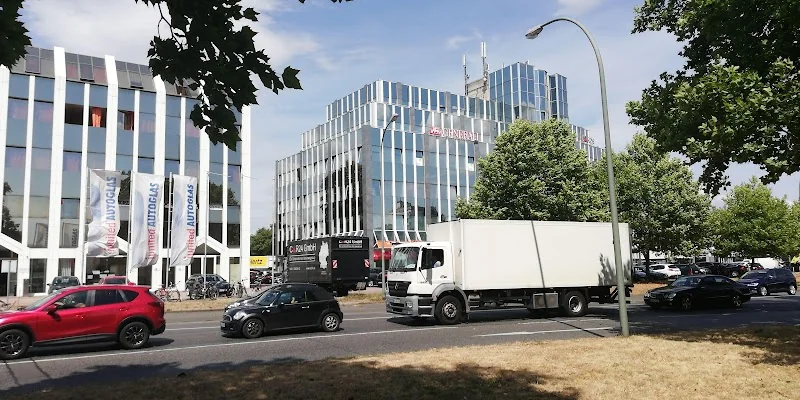
Kassel
34125 Kassel, Deutschland
Square of German Unity | Directions & Parking
The Square of German Unity in Kassel is not a classic gathering place with cafés, benches, and promenades, but a traffic hub with a strong recognition value. Those experiencing the place for the first time see primarily a large, multi-lane roundabout system that shapes the eastern part of the city and connects Unterneustadt with Bettenhausen. At the same time, the square is a piece of Kassel's city history, as it was early on understood as a symbol for the German division and later unity. This mixture of traffic, history, and urban significance makes the location so interesting for seekers: Many want to know where the square is located, how to get there, where to park, which lines stop there, and why it is named as such. The following sections categorize the place along the most important search intentions and connect practical information with historical backgrounds. The basis for this is official and editorial sources from Kassel that describe the square as a traffic roundabout at Leipziger Straße and B83, as a heavily loaded junction, and as a place for public transport, park-and-ride, and individual events. ([kassel.de](https://www.kassel.de/daten-und-karten/statistik/strassenverzeichnis-und-raeumliche-gliederung.php.media/152854/StrvzKS_A_Z.pdf))
History and Name of the Square of German Unity
The current significance of the square can only be understood by looking at its origins. The Kassel city chronicle notes that the large traffic roundabout on Leipziger Straße was opened in 1958 and named the Square of German Unity. The location was not chosen randomly, but deliberately charged with a political and social message. The naming occurred at a time when Germany was divided, and the idea of reunification remained a hope for many people. The HNA also describes the square as a project of post-war modernity: planned from 1955, built from 1957, and inaugurated in 1958 as the first roundabout in Hesse. The then mayor Lauritz Lauritzen wanted to remind people of the divided nation with the name and make the hope for a united Germany visible. This historical layer makes the square more than just a mere traffic structure to this day. When hearing the name, one thinks not only of roads and traffic lights but also of political memory and the urban planning ideas of the 1950s. ([kassel.de](https://www.kassel.de/buerger/stadtgeschichte/chronik/inhaltsseiten/chronik-der-jahre-1946-1999.php))
The symbolic power of the name became even clearer later when Kassel played a special role in the East-West traffic situation after the opening of the inner-German border. The Kassel chronicle notes that on the night of November 9, 1989, the first Trabant from the GDR reached the Square of German Unity. The location thus literally became a point of arrival for the newly opened paths between East and West. The historical development also shows that the square has repeatedly been linked to larger urban processes: new traffic routes, increasing traffic volumes, discussions about renovations, and the question of how to better balance safety, accessibility, and traffic flow. In this way, the Square of German Unity is a good example of how a seemingly sober traffic junction can become a place that embodies political memory, urban development, and everyday mobility at the same time. The name is therefore not just a label but part of a historical concept that remains readable to this day. ([kassel.de](https://www.kassel.de/buerger/stadtgeschichte/chronik/inhaltsseiten/chronik-der-jahre-1946-1999.php))
Driving Directions and Orientation at the Roundabout
For orientation, the location is particularly important: The Square of German Unity is located in eastern Kassel at the intersection of Leipziger Straße and B83. The official street directory of the city of Kassel explicitly lists it as a traffic roundabout at this point, and the HNA describes it as a junction connecting Unterneustadt and Bettenhausen. Practically, this means: Those coming from the city area usually reach the place via Leipziger Straße, Dresdner Straße, or the federal highway B83; from there, the connection to the A7 motorway or to the higher-level federal highways is particularly relevant. For this reason, the square is important not only in everyday city traffic but also for people who need to orient themselves briefly in eastern Kassel, for example, on their way to events, businesses, or park-and-ride areas. The city’s traffic planning has seen the junction as a central point with high traffic load for years. In a report by the city, it is described as one of the most heavily loaded junctions in Kassel, with an average of about 68,500 vehicles per day. This explains why the square has repeatedly become the subject of traffic planning considerations. ([kassel.de](https://www.kassel.de/daten-und-karten/statistik/strassenverzeichnis-und-raeumliche-gliederung.php.media/152854/StrvzKS_A_Z.pdf))
Those approaching the square by car should prepare for complex traffic flows. The city documents describe the junction not only as heavily loaded but also as needing renovation and as an accident hotspot. This leads to why the traffic flow here seems unfamiliar to many people and why the place is more of a transit location than a place to linger in everyday life. At the same time, this traffic density makes the square an important point of orientation in eastern Kassel: Those who know where the Square of German Unity is located can more easily place large parts of the surroundings because the axes towards the city center, Waldau, Bettenhausen, or Unterneustadt are clearly readable from here. For SEO searches regarding directions, address, and location, this clear geographical location is therefore particularly important: Leipziger Straße, B83, eastern Kassel, proximity to Unterneustadt and Bettenhausen. Those driving there should understand the intersection not as a classic square layout but as a highly frequented traffic junction, where navigation errors can quickly lead to detours. ([ratsinfo.kassel.de](https://ratsinfo.kassel.de/sdnet4/sdnetrim/UGhVM0hpd2NXNFdFcExjZXLje_RY7wQHOfbuFTcP3JA2rZmKmFvP_OWBL1Odiwwm/101.17.1745_Gutachten_zur_Umgestaltung_PDE.pdf))
Stop, Tram, and Bus at the Square of German Unity
Public transport plays a significant role at the Square of German Unity because the location functions as a stop and transfer point in eastern Kassel. The stop overview plan of the KVG lists lines N4, N10, N32, N37, and 38 among others. Additionally, a NVV information document records a bus connection of line 32, which connects the stop via the section from the main train station, Scheidemannplatz, Königsplatz/Mauerstraße, Am Stern, Altmarkt/Regierungspräsidium, and Unterneustädter Kirchplatz before reaching the Square of German Unity. This makes it clear that the square is not isolated but embedded in a dense network of inner-city and suburban connections. For many search queries regarding stops, buses, or trams, this fact is important: The square is not just a street name but a functional traffic point in public transport that can be reached by various lines and directions. ([kvg.de](https://www.kvg.de/fileadmin/kvg/Dokumente/Plaene/3D_Haltestellen/2024/Kassel_Platz_d_Dt_Einheit.pdf))
During events, the importance of public transport becomes even clearer. The official Kassel page for the Spring Festival 2026 mentions the tram stop Square of German Unity directly at the festival grounds and lists lines 4 and 8 as connections. This is a good example of how the square takes on different traffic roles depending on the occasion: as a junction in the line network in everyday life, as a direct arrival point for visitors during festivals. The existing stop infrastructure facilitates access for people traveling without a car and reduces search traffic in the vicinity. At the same time, the variety of lines shows that the location is not reliant on a single route but is integrated into various mobility patterns. So, those searching for the Square of German Unity stop, tram, or bus will find a junction that supports both everyday accessibility and event connections. Particularly interesting is the combination of day lines, night lines, and event traffic, as it confirms the significance of the place for very different user groups. ([visit.kassel.de](https://visit.kassel.de/event/fruehlingsfest-kassel))
Parking and Park-and-Ride at the Square of German Unity
The parking question is one of the most important search intentions at places like the Square of German Unity, and there is a clear recommendation for this in Kassel. The documenta-fifteen page mentions the P&R lot Leistersche Wiese for drivers with disabilities on the opposite side of the square. Access is via Dresdner Straße or B83. From there, one can reach the stop via two pedestrian crossings with lowered curbs. This is practical not only for people with mobility restrictions but for anyone looking for an orderly and planned access. At the same time, this solution makes it clear that the Square of German Unity relies more on directed parking and subsequent walking or continuing by public transport than on spontaneous wild parking. The combination of P&R and stop access fits well with a junction that is heavily influenced by traffic flow. So, those searching for parking at the Square of German Unity should primarily think of the park-and-ride logic and not of a classic parking garage directly at the square. ([documenta-fifteen.de](https://documenta-fifteen.de/bettenhausen-spaziergang/))
For large events, there are also specific parking and arrival logics. The Spring Festival Kassel mentions the Messeplatz-Schwanenwiese as a parking option and points out that the festival grounds are within walking distance in just a few minutes from there. The event also highlights that bicycle parking spaces are available at the entrance and that the area is designed to be barrier-free. In practice, this means: The location is organized differently depending on the event setting, but always with the aim of alleviating traffic peaks. This is particularly important for large visitor flows, as the square itself is already heavily loaded in everyday life. So, those planning a visit should check early whether a P&R solution, direct public transport arrival, or an event recommendation from the respective event is the best option. This creates a realistic picture of parking at the Square of German Unity: not as a search for an available parking space directly at the roundabout but as an interplay of P&R areas, footpaths, public transport, and event concepts. ([visit.kassel.de](https://visit.kassel.de/event/fruehlingsfest-kassel))
Underpass, Accessibility, and Safety
The underpass at the Square of German Unity is an important part of the location because it shows how strongly the traffic junction is designed for the separation of different traffic types. documenta fifteen used the southern pedestrian underpass as an exhibition space for a sound installation and describes the square itself as a huge, heavily trafficked roundabout that recalls Kassel's car-oriented past. For the underpass, the site mentions three ramps and an approximate incline of 12 percent; it is thus partially wheelchair accessible but not fully barrier-free in a practical sense. Assistance was also offered on site. These details are important because they highlight the difference between theoretical accessibility and actual usability. For visitors with limited mobility, the questions of ramps, incline, and assistance are crucial because the place does not function like an ordinary urban space but like a traffic-dominated transition. ([documenta-fifteen.de](https://documenta-fifteen.de/en/venues/platz-der-deutschen-einheit-underpass/))
The city of Kassel itself describes the square in a participatory process on the topic of open space as a place that, from the perspective of many participants, is not suitable for cyclists and pedestrians. This aligns with the traffic planning statements of the report that classifies the junction as heavily loaded, in need of renovation, and accident-prone, and explicitly seeks improvements in traffic safety and accessibility. This perspective helps to realistically answer search queries regarding accessibility, safety, or footpaths: The square is neither a pleasant gathering space nor a classic promenade but a functional traffic structure with crossings that, while present, are demanding. Therefore, those traveling on foot or by bike should plan crossings carefully, allow sufficient time, and pay attention to the designated paths over underpasses, crossings, and stop areas. Especially because the location is heavily designed for transit, the infrastructure for pedestrians and people with mobility restrictions is a central issue. ([kassel.de](https://www.kassel.de/buerger/umwelt_und_klima/luft-und-laerm/zeig-uns-deinen-freiraum.php))
Events and Experiences Around the Square
Even though the Square of German Unity is primarily perceived as a traffic junction, Kassel repeatedly uses the location as a stage for large public events. The best example is the Spring Festival Kassel, which is announced as a folk festival with rides, gastronomy, and supporting program at the Square of German Unity. The official Kassel page speaks of an opening fireworks display, family-friendly attractions, and a carousel around 80 meters high. For visitors, the direct connection between the festival and traffic is particularly exciting: The tram stop is located right at the grounds, and parking options as well as bicycle parking spaces are communicated. This transforms the area, which is otherwise heavily dominated by cars, into a place with public use and urban density for a time. For search queries about events at the Square of German Unity, this is particularly relevant because the square is not only used transitively but actually becomes a venue at certain moments. ([visit.kassel.de](https://visit.kassel.de/event/fruehlingsfest-kassel))
Another cultural reference arises through documenta fifteen, which included the underpass at the Square of German Unity as an exhibition space. The work shown there, The Walls Have Ears, connected the location with questions of migration, publicness, and sound in urban space. This shows how strongly Kassel can artistically charge even unusual places. Together with the Spring Festival, a second image of the square emerges: not just traffic and transit but also temporary publicness, encounters, and staging. The location between Bettenhausen and Unterneustadt, the connection to bus and tram, the event-related parking spaces, and the urban traffic debate make the square a place where many themes intersect. For this reason, it is worthwhile for visitors to take a closer look: Those who perceive the Square of German Unity only as a roundabout see only half the story. However, those who understand it as an urban junction recognize a place where Kassel's traffic, memory culture, and event logic come together in a confined space. ([documenta-fifteen.de](https://documenta-fifteen.de/en/venues/platz-der-deutschen-einheit-underpass/))
Sources:
Mehr anzeigenWeniger anzeigen
Square of German Unity | Directions & Parking
The Square of German Unity in Kassel is not a classic gathering place with cafés, benches, and promenades, but a traffic hub with a strong recognition value. Those experiencing the place for the first time see primarily a large, multi-lane roundabout system that shapes the eastern part of the city and connects Unterneustadt with Bettenhausen. At the same time, the square is a piece of Kassel's city history, as it was early on understood as a symbol for the German division and later unity. This mixture of traffic, history, and urban significance makes the location so interesting for seekers: Many want to know where the square is located, how to get there, where to park, which lines stop there, and why it is named as such. The following sections categorize the place along the most important search intentions and connect practical information with historical backgrounds. The basis for this is official and editorial sources from Kassel that describe the square as a traffic roundabout at Leipziger Straße and B83, as a heavily loaded junction, and as a place for public transport, park-and-ride, and individual events. ([kassel.de](https://www.kassel.de/daten-und-karten/statistik/strassenverzeichnis-und-raeumliche-gliederung.php.media/152854/StrvzKS_A_Z.pdf))
History and Name of the Square of German Unity
The current significance of the square can only be understood by looking at its origins. The Kassel city chronicle notes that the large traffic roundabout on Leipziger Straße was opened in 1958 and named the Square of German Unity. The location was not chosen randomly, but deliberately charged with a political and social message. The naming occurred at a time when Germany was divided, and the idea of reunification remained a hope for many people. The HNA also describes the square as a project of post-war modernity: planned from 1955, built from 1957, and inaugurated in 1958 as the first roundabout in Hesse. The then mayor Lauritz Lauritzen wanted to remind people of the divided nation with the name and make the hope for a united Germany visible. This historical layer makes the square more than just a mere traffic structure to this day. When hearing the name, one thinks not only of roads and traffic lights but also of political memory and the urban planning ideas of the 1950s. ([kassel.de](https://www.kassel.de/buerger/stadtgeschichte/chronik/inhaltsseiten/chronik-der-jahre-1946-1999.php))
The symbolic power of the name became even clearer later when Kassel played a special role in the East-West traffic situation after the opening of the inner-German border. The Kassel chronicle notes that on the night of November 9, 1989, the first Trabant from the GDR reached the Square of German Unity. The location thus literally became a point of arrival for the newly opened paths between East and West. The historical development also shows that the square has repeatedly been linked to larger urban processes: new traffic routes, increasing traffic volumes, discussions about renovations, and the question of how to better balance safety, accessibility, and traffic flow. In this way, the Square of German Unity is a good example of how a seemingly sober traffic junction can become a place that embodies political memory, urban development, and everyday mobility at the same time. The name is therefore not just a label but part of a historical concept that remains readable to this day. ([kassel.de](https://www.kassel.de/buerger/stadtgeschichte/chronik/inhaltsseiten/chronik-der-jahre-1946-1999.php))
Driving Directions and Orientation at the Roundabout
For orientation, the location is particularly important: The Square of German Unity is located in eastern Kassel at the intersection of Leipziger Straße and B83. The official street directory of the city of Kassel explicitly lists it as a traffic roundabout at this point, and the HNA describes it as a junction connecting Unterneustadt and Bettenhausen. Practically, this means: Those coming from the city area usually reach the place via Leipziger Straße, Dresdner Straße, or the federal highway B83; from there, the connection to the A7 motorway or to the higher-level federal highways is particularly relevant. For this reason, the square is important not only in everyday city traffic but also for people who need to orient themselves briefly in eastern Kassel, for example, on their way to events, businesses, or park-and-ride areas. The city’s traffic planning has seen the junction as a central point with high traffic load for years. In a report by the city, it is described as one of the most heavily loaded junctions in Kassel, with an average of about 68,500 vehicles per day. This explains why the square has repeatedly become the subject of traffic planning considerations. ([kassel.de](https://www.kassel.de/daten-und-karten/statistik/strassenverzeichnis-und-raeumliche-gliederung.php.media/152854/StrvzKS_A_Z.pdf))
Those approaching the square by car should prepare for complex traffic flows. The city documents describe the junction not only as heavily loaded but also as needing renovation and as an accident hotspot. This leads to why the traffic flow here seems unfamiliar to many people and why the place is more of a transit location than a place to linger in everyday life. At the same time, this traffic density makes the square an important point of orientation in eastern Kassel: Those who know where the Square of German Unity is located can more easily place large parts of the surroundings because the axes towards the city center, Waldau, Bettenhausen, or Unterneustadt are clearly readable from here. For SEO searches regarding directions, address, and location, this clear geographical location is therefore particularly important: Leipziger Straße, B83, eastern Kassel, proximity to Unterneustadt and Bettenhausen. Those driving there should understand the intersection not as a classic square layout but as a highly frequented traffic junction, where navigation errors can quickly lead to detours. ([ratsinfo.kassel.de](https://ratsinfo.kassel.de/sdnet4/sdnetrim/UGhVM0hpd2NXNFdFcExjZXLje_RY7wQHOfbuFTcP3JA2rZmKmFvP_OWBL1Odiwwm/101.17.1745_Gutachten_zur_Umgestaltung_PDE.pdf))
Stop, Tram, and Bus at the Square of German Unity
Public transport plays a significant role at the Square of German Unity because the location functions as a stop and transfer point in eastern Kassel. The stop overview plan of the KVG lists lines N4, N10, N32, N37, and 38 among others. Additionally, a NVV information document records a bus connection of line 32, which connects the stop via the section from the main train station, Scheidemannplatz, Königsplatz/Mauerstraße, Am Stern, Altmarkt/Regierungspräsidium, and Unterneustädter Kirchplatz before reaching the Square of German Unity. This makes it clear that the square is not isolated but embedded in a dense network of inner-city and suburban connections. For many search queries regarding stops, buses, or trams, this fact is important: The square is not just a street name but a functional traffic point in public transport that can be reached by various lines and directions. ([kvg.de](https://www.kvg.de/fileadmin/kvg/Dokumente/Plaene/3D_Haltestellen/2024/Kassel_Platz_d_Dt_Einheit.pdf))
During events, the importance of public transport becomes even clearer. The official Kassel page for the Spring Festival 2026 mentions the tram stop Square of German Unity directly at the festival grounds and lists lines 4 and 8 as connections. This is a good example of how the square takes on different traffic roles depending on the occasion: as a junction in the line network in everyday life, as a direct arrival point for visitors during festivals. The existing stop infrastructure facilitates access for people traveling without a car and reduces search traffic in the vicinity. At the same time, the variety of lines shows that the location is not reliant on a single route but is integrated into various mobility patterns. So, those searching for the Square of German Unity stop, tram, or bus will find a junction that supports both everyday accessibility and event connections. Particularly interesting is the combination of day lines, night lines, and event traffic, as it confirms the significance of the place for very different user groups. ([visit.kassel.de](https://visit.kassel.de/event/fruehlingsfest-kassel))
Parking and Park-and-Ride at the Square of German Unity
The parking question is one of the most important search intentions at places like the Square of German Unity, and there is a clear recommendation for this in Kassel. The documenta-fifteen page mentions the P&R lot Leistersche Wiese for drivers with disabilities on the opposite side of the square. Access is via Dresdner Straße or B83. From there, one can reach the stop via two pedestrian crossings with lowered curbs. This is practical not only for people with mobility restrictions but for anyone looking for an orderly and planned access. At the same time, this solution makes it clear that the Square of German Unity relies more on directed parking and subsequent walking or continuing by public transport than on spontaneous wild parking. The combination of P&R and stop access fits well with a junction that is heavily influenced by traffic flow. So, those searching for parking at the Square of German Unity should primarily think of the park-and-ride logic and not of a classic parking garage directly at the square. ([documenta-fifteen.de](https://documenta-fifteen.de/bettenhausen-spaziergang/))
For large events, there are also specific parking and arrival logics. The Spring Festival Kassel mentions the Messeplatz-Schwanenwiese as a parking option and points out that the festival grounds are within walking distance in just a few minutes from there. The event also highlights that bicycle parking spaces are available at the entrance and that the area is designed to be barrier-free. In practice, this means: The location is organized differently depending on the event setting, but always with the aim of alleviating traffic peaks. This is particularly important for large visitor flows, as the square itself is already heavily loaded in everyday life. So, those planning a visit should check early whether a P&R solution, direct public transport arrival, or an event recommendation from the respective event is the best option. This creates a realistic picture of parking at the Square of German Unity: not as a search for an available parking space directly at the roundabout but as an interplay of P&R areas, footpaths, public transport, and event concepts. ([visit.kassel.de](https://visit.kassel.de/event/fruehlingsfest-kassel))
Underpass, Accessibility, and Safety
The underpass at the Square of German Unity is an important part of the location because it shows how strongly the traffic junction is designed for the separation of different traffic types. documenta fifteen used the southern pedestrian underpass as an exhibition space for a sound installation and describes the square itself as a huge, heavily trafficked roundabout that recalls Kassel's car-oriented past. For the underpass, the site mentions three ramps and an approximate incline of 12 percent; it is thus partially wheelchair accessible but not fully barrier-free in a practical sense. Assistance was also offered on site. These details are important because they highlight the difference between theoretical accessibility and actual usability. For visitors with limited mobility, the questions of ramps, incline, and assistance are crucial because the place does not function like an ordinary urban space but like a traffic-dominated transition. ([documenta-fifteen.de](https://documenta-fifteen.de/en/venues/platz-der-deutschen-einheit-underpass/))
The city of Kassel itself describes the square in a participatory process on the topic of open space as a place that, from the perspective of many participants, is not suitable for cyclists and pedestrians. This aligns with the traffic planning statements of the report that classifies the junction as heavily loaded, in need of renovation, and accident-prone, and explicitly seeks improvements in traffic safety and accessibility. This perspective helps to realistically answer search queries regarding accessibility, safety, or footpaths: The square is neither a pleasant gathering space nor a classic promenade but a functional traffic structure with crossings that, while present, are demanding. Therefore, those traveling on foot or by bike should plan crossings carefully, allow sufficient time, and pay attention to the designated paths over underpasses, crossings, and stop areas. Especially because the location is heavily designed for transit, the infrastructure for pedestrians and people with mobility restrictions is a central issue. ([kassel.de](https://www.kassel.de/buerger/umwelt_und_klima/luft-und-laerm/zeig-uns-deinen-freiraum.php))
Events and Experiences Around the Square
Even though the Square of German Unity is primarily perceived as a traffic junction, Kassel repeatedly uses the location as a stage for large public events. The best example is the Spring Festival Kassel, which is announced as a folk festival with rides, gastronomy, and supporting program at the Square of German Unity. The official Kassel page speaks of an opening fireworks display, family-friendly attractions, and a carousel around 80 meters high. For visitors, the direct connection between the festival and traffic is particularly exciting: The tram stop is located right at the grounds, and parking options as well as bicycle parking spaces are communicated. This transforms the area, which is otherwise heavily dominated by cars, into a place with public use and urban density for a time. For search queries about events at the Square of German Unity, this is particularly relevant because the square is not only used transitively but actually becomes a venue at certain moments. ([visit.kassel.de](https://visit.kassel.de/event/fruehlingsfest-kassel))
Another cultural reference arises through documenta fifteen, which included the underpass at the Square of German Unity as an exhibition space. The work shown there, The Walls Have Ears, connected the location with questions of migration, publicness, and sound in urban space. This shows how strongly Kassel can artistically charge even unusual places. Together with the Spring Festival, a second image of the square emerges: not just traffic and transit but also temporary publicness, encounters, and staging. The location between Bettenhausen and Unterneustadt, the connection to bus and tram, the event-related parking spaces, and the urban traffic debate make the square a place where many themes intersect. For this reason, it is worthwhile for visitors to take a closer look: Those who perceive the Square of German Unity only as a roundabout see only half the story. However, those who understand it as an urban junction recognize a place where Kassel's traffic, memory culture, and event logic come together in a confined space. ([documenta-fifteen.de](https://documenta-fifteen.de/en/venues/platz-der-deutschen-einheit-underpass/))
Sources:
Square of German Unity | Directions & Parking
The Square of German Unity in Kassel is not a classic gathering place with cafés, benches, and promenades, but a traffic hub with a strong recognition value. Those experiencing the place for the first time see primarily a large, multi-lane roundabout system that shapes the eastern part of the city and connects Unterneustadt with Bettenhausen. At the same time, the square is a piece of Kassel's city history, as it was early on understood as a symbol for the German division and later unity. This mixture of traffic, history, and urban significance makes the location so interesting for seekers: Many want to know where the square is located, how to get there, where to park, which lines stop there, and why it is named as such. The following sections categorize the place along the most important search intentions and connect practical information with historical backgrounds. The basis for this is official and editorial sources from Kassel that describe the square as a traffic roundabout at Leipziger Straße and B83, as a heavily loaded junction, and as a place for public transport, park-and-ride, and individual events. ([kassel.de](https://www.kassel.de/daten-und-karten/statistik/strassenverzeichnis-und-raeumliche-gliederung.php.media/152854/StrvzKS_A_Z.pdf))
History and Name of the Square of German Unity
The current significance of the square can only be understood by looking at its origins. The Kassel city chronicle notes that the large traffic roundabout on Leipziger Straße was opened in 1958 and named the Square of German Unity. The location was not chosen randomly, but deliberately charged with a political and social message. The naming occurred at a time when Germany was divided, and the idea of reunification remained a hope for many people. The HNA also describes the square as a project of post-war modernity: planned from 1955, built from 1957, and inaugurated in 1958 as the first roundabout in Hesse. The then mayor Lauritz Lauritzen wanted to remind people of the divided nation with the name and make the hope for a united Germany visible. This historical layer makes the square more than just a mere traffic structure to this day. When hearing the name, one thinks not only of roads and traffic lights but also of political memory and the urban planning ideas of the 1950s. ([kassel.de](https://www.kassel.de/buerger/stadtgeschichte/chronik/inhaltsseiten/chronik-der-jahre-1946-1999.php))
The symbolic power of the name became even clearer later when Kassel played a special role in the East-West traffic situation after the opening of the inner-German border. The Kassel chronicle notes that on the night of November 9, 1989, the first Trabant from the GDR reached the Square of German Unity. The location thus literally became a point of arrival for the newly opened paths between East and West. The historical development also shows that the square has repeatedly been linked to larger urban processes: new traffic routes, increasing traffic volumes, discussions about renovations, and the question of how to better balance safety, accessibility, and traffic flow. In this way, the Square of German Unity is a good example of how a seemingly sober traffic junction can become a place that embodies political memory, urban development, and everyday mobility at the same time. The name is therefore not just a label but part of a historical concept that remains readable to this day. ([kassel.de](https://www.kassel.de/buerger/stadtgeschichte/chronik/inhaltsseiten/chronik-der-jahre-1946-1999.php))
Driving Directions and Orientation at the Roundabout
For orientation, the location is particularly important: The Square of German Unity is located in eastern Kassel at the intersection of Leipziger Straße and B83. The official street directory of the city of Kassel explicitly lists it as a traffic roundabout at this point, and the HNA describes it as a junction connecting Unterneustadt and Bettenhausen. Practically, this means: Those coming from the city area usually reach the place via Leipziger Straße, Dresdner Straße, or the federal highway B83; from there, the connection to the A7 motorway or to the higher-level federal highways is particularly relevant. For this reason, the square is important not only in everyday city traffic but also for people who need to orient themselves briefly in eastern Kassel, for example, on their way to events, businesses, or park-and-ride areas. The city’s traffic planning has seen the junction as a central point with high traffic load for years. In a report by the city, it is described as one of the most heavily loaded junctions in Kassel, with an average of about 68,500 vehicles per day. This explains why the square has repeatedly become the subject of traffic planning considerations. ([kassel.de](https://www.kassel.de/daten-und-karten/statistik/strassenverzeichnis-und-raeumliche-gliederung.php.media/152854/StrvzKS_A_Z.pdf))
Those approaching the square by car should prepare for complex traffic flows. The city documents describe the junction not only as heavily loaded but also as needing renovation and as an accident hotspot. This leads to why the traffic flow here seems unfamiliar to many people and why the place is more of a transit location than a place to linger in everyday life. At the same time, this traffic density makes the square an important point of orientation in eastern Kassel: Those who know where the Square of German Unity is located can more easily place large parts of the surroundings because the axes towards the city center, Waldau, Bettenhausen, or Unterneustadt are clearly readable from here. For SEO searches regarding directions, address, and location, this clear geographical location is therefore particularly important: Leipziger Straße, B83, eastern Kassel, proximity to Unterneustadt and Bettenhausen. Those driving there should understand the intersection not as a classic square layout but as a highly frequented traffic junction, where navigation errors can quickly lead to detours. ([ratsinfo.kassel.de](https://ratsinfo.kassel.de/sdnet4/sdnetrim/UGhVM0hpd2NXNFdFcExjZXLje_RY7wQHOfbuFTcP3JA2rZmKmFvP_OWBL1Odiwwm/101.17.1745_Gutachten_zur_Umgestaltung_PDE.pdf))
Stop, Tram, and Bus at the Square of German Unity
Public transport plays a significant role at the Square of German Unity because the location functions as a stop and transfer point in eastern Kassel. The stop overview plan of the KVG lists lines N4, N10, N32, N37, and 38 among others. Additionally, a NVV information document records a bus connection of line 32, which connects the stop via the section from the main train station, Scheidemannplatz, Königsplatz/Mauerstraße, Am Stern, Altmarkt/Regierungspräsidium, and Unterneustädter Kirchplatz before reaching the Square of German Unity. This makes it clear that the square is not isolated but embedded in a dense network of inner-city and suburban connections. For many search queries regarding stops, buses, or trams, this fact is important: The square is not just a street name but a functional traffic point in public transport that can be reached by various lines and directions. ([kvg.de](https://www.kvg.de/fileadmin/kvg/Dokumente/Plaene/3D_Haltestellen/2024/Kassel_Platz_d_Dt_Einheit.pdf))
During events, the importance of public transport becomes even clearer. The official Kassel page for the Spring Festival 2026 mentions the tram stop Square of German Unity directly at the festival grounds and lists lines 4 and 8 as connections. This is a good example of how the square takes on different traffic roles depending on the occasion: as a junction in the line network in everyday life, as a direct arrival point for visitors during festivals. The existing stop infrastructure facilitates access for people traveling without a car and reduces search traffic in the vicinity. At the same time, the variety of lines shows that the location is not reliant on a single route but is integrated into various mobility patterns. So, those searching for the Square of German Unity stop, tram, or bus will find a junction that supports both everyday accessibility and event connections. Particularly interesting is the combination of day lines, night lines, and event traffic, as it confirms the significance of the place for very different user groups. ([visit.kassel.de](https://visit.kassel.de/event/fruehlingsfest-kassel))
Parking and Park-and-Ride at the Square of German Unity
The parking question is one of the most important search intentions at places like the Square of German Unity, and there is a clear recommendation for this in Kassel. The documenta-fifteen page mentions the P&R lot Leistersche Wiese for drivers with disabilities on the opposite side of the square. Access is via Dresdner Straße or B83. From there, one can reach the stop via two pedestrian crossings with lowered curbs. This is practical not only for people with mobility restrictions but for anyone looking for an orderly and planned access. At the same time, this solution makes it clear that the Square of German Unity relies more on directed parking and subsequent walking or continuing by public transport than on spontaneous wild parking. The combination of P&R and stop access fits well with a junction that is heavily influenced by traffic flow. So, those searching for parking at the Square of German Unity should primarily think of the park-and-ride logic and not of a classic parking garage directly at the square. ([documenta-fifteen.de](https://documenta-fifteen.de/bettenhausen-spaziergang/))
For large events, there are also specific parking and arrival logics. The Spring Festival Kassel mentions the Messeplatz-Schwanenwiese as a parking option and points out that the festival grounds are within walking distance in just a few minutes from there. The event also highlights that bicycle parking spaces are available at the entrance and that the area is designed to be barrier-free. In practice, this means: The location is organized differently depending on the event setting, but always with the aim of alleviating traffic peaks. This is particularly important for large visitor flows, as the square itself is already heavily loaded in everyday life. So, those planning a visit should check early whether a P&R solution, direct public transport arrival, or an event recommendation from the respective event is the best option. This creates a realistic picture of parking at the Square of German Unity: not as a search for an available parking space directly at the roundabout but as an interplay of P&R areas, footpaths, public transport, and event concepts. ([visit.kassel.de](https://visit.kassel.de/event/fruehlingsfest-kassel))
Underpass, Accessibility, and Safety
The underpass at the Square of German Unity is an important part of the location because it shows how strongly the traffic junction is designed for the separation of different traffic types. documenta fifteen used the southern pedestrian underpass as an exhibition space for a sound installation and describes the square itself as a huge, heavily trafficked roundabout that recalls Kassel's car-oriented past. For the underpass, the site mentions three ramps and an approximate incline of 12 percent; it is thus partially wheelchair accessible but not fully barrier-free in a practical sense. Assistance was also offered on site. These details are important because they highlight the difference between theoretical accessibility and actual usability. For visitors with limited mobility, the questions of ramps, incline, and assistance are crucial because the place does not function like an ordinary urban space but like a traffic-dominated transition. ([documenta-fifteen.de](https://documenta-fifteen.de/en/venues/platz-der-deutschen-einheit-underpass/))
The city of Kassel itself describes the square in a participatory process on the topic of open space as a place that, from the perspective of many participants, is not suitable for cyclists and pedestrians. This aligns with the traffic planning statements of the report that classifies the junction as heavily loaded, in need of renovation, and accident-prone, and explicitly seeks improvements in traffic safety and accessibility. This perspective helps to realistically answer search queries regarding accessibility, safety, or footpaths: The square is neither a pleasant gathering space nor a classic promenade but a functional traffic structure with crossings that, while present, are demanding. Therefore, those traveling on foot or by bike should plan crossings carefully, allow sufficient time, and pay attention to the designated paths over underpasses, crossings, and stop areas. Especially because the location is heavily designed for transit, the infrastructure for pedestrians and people with mobility restrictions is a central issue. ([kassel.de](https://www.kassel.de/buerger/umwelt_und_klima/luft-und-laerm/zeig-uns-deinen-freiraum.php))
Events and Experiences Around the Square
Even though the Square of German Unity is primarily perceived as a traffic junction, Kassel repeatedly uses the location as a stage for large public events. The best example is the Spring Festival Kassel, which is announced as a folk festival with rides, gastronomy, and supporting program at the Square of German Unity. The official Kassel page speaks of an opening fireworks display, family-friendly attractions, and a carousel around 80 meters high. For visitors, the direct connection between the festival and traffic is particularly exciting: The tram stop is located right at the grounds, and parking options as well as bicycle parking spaces are communicated. This transforms the area, which is otherwise heavily dominated by cars, into a place with public use and urban density for a time. For search queries about events at the Square of German Unity, this is particularly relevant because the square is not only used transitively but actually becomes a venue at certain moments. ([visit.kassel.de](https://visit.kassel.de/event/fruehlingsfest-kassel))
Another cultural reference arises through documenta fifteen, which included the underpass at the Square of German Unity as an exhibition space. The work shown there, The Walls Have Ears, connected the location with questions of migration, publicness, and sound in urban space. This shows how strongly Kassel can artistically charge even unusual places. Together with the Spring Festival, a second image of the square emerges: not just traffic and transit but also temporary publicness, encounters, and staging. The location between Bettenhausen and Unterneustadt, the connection to bus and tram, the event-related parking spaces, and the urban traffic debate make the square a place where many themes intersect. For this reason, it is worthwhile for visitors to take a closer look: Those who perceive the Square of German Unity only as a roundabout see only half the story. However, those who understand it as an urban junction recognize a place where Kassel's traffic, memory culture, and event logic come together in a confined space. ([documenta-fifteen.de](https://documenta-fifteen.de/en/venues/platz-der-deutschen-einheit-underpass/))
Sources:
Upcoming Events
No events found
Frequently Asked Questions
Reviews
African People's Convention e.V President
24. October 2017
This is the biggest roundabout in Kassel, it has both tram and bus stops. This roundabout leads to all the major highways in Germany.
Ingo Römmelt
5. June 2023
Top
Dirk Piro (mailman71)
22. November 2025
I find the place or the roundabout and its surroundings rather ugly. Undeserving of this significant name.
Luc573
16. May 2025
Not a nice stop. Everything is dirty and polluted. The only good thing is the many connections.
Norbert Schmidt
28. October 2020
Cars rush around Kassel's largest roundabout. Surrounded by plain functional architecture from the 1950s to 2000s, and businesses that have seen better economic days, you get on and off. For that, three stars; Kassel could be called Broken Dream City anyway. Sorry, but the city is uniquely unappealing...