
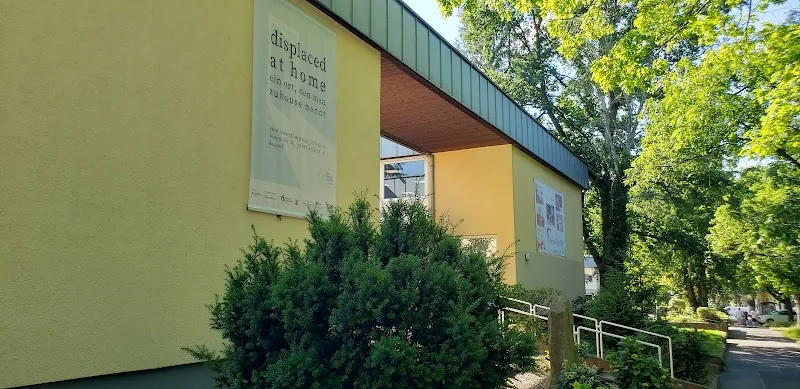
Kassel
Ljuba-Senderowna-Str. 127, 34121 Kassel, Deutschland
Sara Nussbaum Center | Exhibitions & Tours
The Sara Nussbaum Center for Jewish Life is a secular place for Jewish culture, history, and encounters in Kassel. According to the center, it serves as a second venue for Jewish life in the city alongside the Jewish Community of Kassel, opening its doors to all people interested in Jewish life. The institution connects memory, present, and future: it presents Jewish life as a historically grown reality, as a current perspective, and as part of an open urban society. Officially, the center is located at Ludwig-Mond-Straße 127 in 34121 Kassel and is operated by Jüdisches Leben Kassel gGmbH. The offerings range from exhibitions to tours, education, and events, with the place explicitly aiming not only to inform but also to enable dialogue and encounters. ([sara-nussbaum-zentrum.de](https://sara-nussbaum-zentrum.de/sara-nussbaum-zentrum/))
Contact, Opening Hours & Directions to the Sara Nussbaum Center
Those wishing to visit the Sara Nussbaum Center in Kassel should plan their visit in advance, as the official contact page does not list any free walk-in hours but rather visits by appointment only. The address is Ludwig-Mond-Straße 127, 34121 Kassel. The center can be reached by phone at 0561-93728281 or by email at info@sara-nussbaum-zentrum.de. For exhibitions, the hours are: Monday to Friday by appointment, closed on Saturday, and by appointment on Sunday. This arrangement makes it clear that the center organizes its work very consciously and accompanies visits content-wise. For all those coming with a group, early coordination is particularly advisable, as tours must be arranged in advance. This way, the team can better address questions, age groups, and content focuses and prepare the visit accordingly. The institution is thus not conceived as a classic museum with an open ticket office but as a place where exchange and mediation are at the forefront. ([sara-nussbaum-zentrum.de](https://sara-nussbaum-zentrum.de/kontakt/))
The directions are also clearly described: The official contact page mentions accessibility by public transport via bus lines 12 or 13 to the stop Sternbergstraße. For visitors from Kassel or outside, this is a practical orientation, as it allows for good planning of the visit with city traffic. Those arriving by car should also coordinate their appointment in advance with the center, as the official website does not present a large standard program for spontaneous visits, but rather focuses on arrangements. This fits the character of the institution: it is about a place where content is explained, contexts are contextualized, and conversations are made possible. Especially regarding Jewish history, memory culture, and political education, such preparation is often helpful. It creates calmness, reliability, and space for questions. So, for those seeking a conscious, non-hasty visit experience, they will find a place here that is more suitable for focused viewing, learning, and discussing than for a quick walkthrough. ([sara-nussbaum-zentrum.de](https://sara-nussbaum-zentrum.de/kontakt/))
Exhibitions, Tours, and Visits by Appointment
Content-wise, the Sara Nussbaum Center is particularly interesting as an exhibition and mediation venue. The current special exhibition 'displaced at home – a place you call home' explores the concept of home through the stories of Jewish people in Kassel before, during, and after the Holocaust. A particular focus is on the experiences of Jewish women and men in so-called displaced persons camps in Kassel. The permanent exhibition 'Jewish Life in Kassel' showcases a segment of the approximately 700-year history of the Jewish community in Kassel. In this way, the center connects biographical memory with urban history and shows that Jewish life in Kassel is not only a thing of the past but also influences contemporary living environments. The way the center connects historical depth with a concrete local perspective is particularly strong: the history is not told abstractly but through people, places, breaks, and new beginnings. This is where many visitors find the special appeal. The exhibitions are not merely information spaces but places where one understands the connections between family, city, persecution, survival, and new beginnings. ([sara-nussbaum-zentrum.de](https://sara-nussbaum-zentrum.de/ausstellungen/))
Those wishing to see the exhibitions should know that they can currently only be visited by prior arrangement as part of a guided tour. The website specifies groups of at least five people and an appointment between Monday and Friday. A small fee is charged for individual tours: 2 euros per person, 1 euro for children and young people. This is an important practical point for schools, clubs, group trips, or interested families, as it allows for good organization of the visit. At the same time, the tour offering shows that the center places value on mediation and not just on the silent viewing of exhibits. The tour is not an addition but a central part of the visit experience. The exhibition profile is complemented by previous presentations such as 'WHITE NOISE – Life Before October 7' and 'Network Against Hate'. This makes it clear that the center also addresses current political and social issues. The range thus extends from historical memory to contemporary debates about anti-Semitism, threats, and Jewish perspectives. ([sara-nussbaum-zentrum.de](https://sara-nussbaum-zentrum.de/ausstellungen/))
Jewish Life in Kassel: History, Present, and Sara Nussbaum
The name of the center directly refers to Sara Nussbaum, a woman whose life story is closely linked to Kassel. She is described on the website as Sara Rothschild, born in 1868 in Merzhausen. In 1891, she married the Kassel furniture dealer Rudolf Nussbaum, with whom she and her three children lived in the residential and commercial building on Schäfergasse. The couple was reportedly very engaged for the citizens of the city and the Jewish community. Sara Nussbaum also supported her husband in establishing the DRK medical unit 'Kolonne Nussbaum' and trained as a Red Cross nurse. Her biography stands for a sense of responsibility, social initiative, and urban engagement. The wording on the website emphasizes that she was not only a historical figure but a personality with conviction. In a city like Kassel, whose Jewish history has been deeply shaped by persecution and destruction, the choice of this namesake is a strong symbol. It connects memory with a role model for concrete civil courage. ([sara-nussbaum-zentrum.de](https://sara-nussbaum-zentrum.de/sara-nussbaum-zentrum/))
The mission statement of the center builds directly on this. It sees itself as a secular place that makes Jewish life visible, shows the many faces and stories of Judaism, explains the state of Israel, and aims to contribute to combating anti-Semitism and inhumanity. The center also points out that the Nazis nearly completely expelled the Jews from Kassel and murdered most of them. At the same time, the center addresses the present: due to the influx of Jews from the former Soviet Union, the Jewish community in Kassel grew significantly in the early 1990s. Therefore, the work of the center is dedicated to all three temporal aspects of local Jewish history: past, present, and future. This is crucial for the content orientation, as it is not only about remembering but also about explaining, contextualizing, and thinking further. Thus, those visiting the center encounter not a closed historical narrative but a lively engagement with Jewish diversity, urban memory, and contemporary Jewish life in Kassel. ([sara-nussbaum-zentrum.de](https://sara-nussbaum-zentrum.de/sara-nussbaum-zentrum/unser-leitbild/))
Events, Workshops, and Cultural Education at the Center
The Sara Nussbaum Center is much more than an exhibition venue. The official website explicitly mentions events such as lectures, concerts, workshops, and encounter formats. This makes it clear that the center functions as a place of cultural education and conversation. A good example is 'Selam & Shalom', an intercultural workshop conducted by Elena Padva and Attila Günaydin. According to the website, the project brings young people to reflect on identity and humanity through music; the workshop lasts about 90 minutes and takes place at the Sara Nussbaum Center or in the respective institution. The format has also been awarded as a 'Diversity Amplifier'. Such offerings demonstrate how the center places Jewish perspectives in a broader educational and social context. It is not just about imparting knowledge but about encounters, reflection, and the dismantling of prejudices. This is also interesting for schools, youth groups, or other educational contexts, as content is not conveyed dryly but made tangible through music, dialogue, and personal approaches. ([sara-nussbaum-zentrum.de](https://sara-nussbaum-zentrum.de/selam-und-shalom/?utm_source=openai))
Furthermore, the event program shows that the center addresses current topics, Jewish self-understandings, and socio-political questions. Examples include the Israel Day, book presentations, readings, memorial events, and museum dates. For the Israel Day in July 2025, the website mentions a garden party with a tour of the exhibition 'displaced at home' and a concert by the band LECHAIM; it also refers to the tenth anniversary of the center. This is a good example of how culture, celebration, memory, and public relations intertwine. The book presentation for the exhibition 'displaced at home' also illustrates this principle: the bilingual German-English volume deals with Jewish life in Kassel before, during, and after the Holocaust and links research with cultural work. Additionally, events are held at other locations in the city, such as in the city library or in the context of collaborations. This makes it clear that the Sara Nussbaum Center functions as a networking place that does not limit its themes to its own house but carries them into the urban society. ([sara-nussbaum-zentrum.de](https://sara-nussbaum-zentrum.de/event/israel-day-im-sara-nussbaum-zentrum/?utm_source=openai))
Why the Sara Nussbaum Center in Kassel is Special
The uniqueness of the Sara Nussbaum Center lies in its blend of openness, historical depth, and current stance. While the synagogue is described as a house of prayer and assembly for Jews, the center opens its doors as a secular place for all people. This is precisely its special contribution to Kassel: it complements the religious community with a learning and meeting space where Jewish life is explained, discussed, and conveyed into urban society. This role is not only culturally but also politically relevant, as the center explicitly works against anti-Semitism and inhumanity. The place is thus not neutral in the sense of arbitrary but is consciously positioned. It aims to make knowledge accessible, not to ignore conflicts, and yet to look hopefully at the present and future. For visitors, this creates a space where history does not feel closed but generates responsibility for today. This makes the center a place that is more than a museum and at the same time more than an event space. It is a place of conviction. ([sara-nussbaum-zentrum.de](https://sara-nussbaum-zentrum.de/sara-nussbaum-zentrum/unser-leitbild/))
The structure of the offerings also underscores this uniqueness. The center works with collaborations, is funded through the Hessian state program 'Hessen – active for democracy and against extremism', and explicitly invites volunteer work. This creates a vibrant environment that relies not only on individual projects but on lasting participation, education, and responsibility. The presence of topics such as Jewish history, Israel, memory culture, workshops, and interreligious encounters shows that the center connects many levels. For those searching for 'sara nussbaum zentrum kassel', 'opening hours', 'tours', or 'exhibitions', it is therefore both a practical point of contact and a content-rich cultural offering. Those who engage with the visit do not receive an isolated exhibition but an insight into local Jewish history, contemporary perspectives, and societal educational work. Thus, the Sara Nussbaum Center fulfills a task that reaches far beyond a single visit in a city like Kassel: it keeps memory alive, creates encounters, and opens perspectives. ([sara-nussbaum-zentrum.de](https://sara-nussbaum-zentrum.de/sara-nussbaum-zentrum/))
Sources:
Mehr anzeigenWeniger anzeigen
Sara Nussbaum Center | Exhibitions & Tours
The Sara Nussbaum Center for Jewish Life is a secular place for Jewish culture, history, and encounters in Kassel. According to the center, it serves as a second venue for Jewish life in the city alongside the Jewish Community of Kassel, opening its doors to all people interested in Jewish life. The institution connects memory, present, and future: it presents Jewish life as a historically grown reality, as a current perspective, and as part of an open urban society. Officially, the center is located at Ludwig-Mond-Straße 127 in 34121 Kassel and is operated by Jüdisches Leben Kassel gGmbH. The offerings range from exhibitions to tours, education, and events, with the place explicitly aiming not only to inform but also to enable dialogue and encounters. ([sara-nussbaum-zentrum.de](https://sara-nussbaum-zentrum.de/sara-nussbaum-zentrum/))
Contact, Opening Hours & Directions to the Sara Nussbaum Center
Those wishing to visit the Sara Nussbaum Center in Kassel should plan their visit in advance, as the official contact page does not list any free walk-in hours but rather visits by appointment only. The address is Ludwig-Mond-Straße 127, 34121 Kassel. The center can be reached by phone at 0561-93728281 or by email at info@sara-nussbaum-zentrum.de. For exhibitions, the hours are: Monday to Friday by appointment, closed on Saturday, and by appointment on Sunday. This arrangement makes it clear that the center organizes its work very consciously and accompanies visits content-wise. For all those coming with a group, early coordination is particularly advisable, as tours must be arranged in advance. This way, the team can better address questions, age groups, and content focuses and prepare the visit accordingly. The institution is thus not conceived as a classic museum with an open ticket office but as a place where exchange and mediation are at the forefront. ([sara-nussbaum-zentrum.de](https://sara-nussbaum-zentrum.de/kontakt/))
The directions are also clearly described: The official contact page mentions accessibility by public transport via bus lines 12 or 13 to the stop Sternbergstraße. For visitors from Kassel or outside, this is a practical orientation, as it allows for good planning of the visit with city traffic. Those arriving by car should also coordinate their appointment in advance with the center, as the official website does not present a large standard program for spontaneous visits, but rather focuses on arrangements. This fits the character of the institution: it is about a place where content is explained, contexts are contextualized, and conversations are made possible. Especially regarding Jewish history, memory culture, and political education, such preparation is often helpful. It creates calmness, reliability, and space for questions. So, for those seeking a conscious, non-hasty visit experience, they will find a place here that is more suitable for focused viewing, learning, and discussing than for a quick walkthrough. ([sara-nussbaum-zentrum.de](https://sara-nussbaum-zentrum.de/kontakt/))
Exhibitions, Tours, and Visits by Appointment
Content-wise, the Sara Nussbaum Center is particularly interesting as an exhibition and mediation venue. The current special exhibition 'displaced at home – a place you call home' explores the concept of home through the stories of Jewish people in Kassel before, during, and after the Holocaust. A particular focus is on the experiences of Jewish women and men in so-called displaced persons camps in Kassel. The permanent exhibition 'Jewish Life in Kassel' showcases a segment of the approximately 700-year history of the Jewish community in Kassel. In this way, the center connects biographical memory with urban history and shows that Jewish life in Kassel is not only a thing of the past but also influences contemporary living environments. The way the center connects historical depth with a concrete local perspective is particularly strong: the history is not told abstractly but through people, places, breaks, and new beginnings. This is where many visitors find the special appeal. The exhibitions are not merely information spaces but places where one understands the connections between family, city, persecution, survival, and new beginnings. ([sara-nussbaum-zentrum.de](https://sara-nussbaum-zentrum.de/ausstellungen/))
Those wishing to see the exhibitions should know that they can currently only be visited by prior arrangement as part of a guided tour. The website specifies groups of at least five people and an appointment between Monday and Friday. A small fee is charged for individual tours: 2 euros per person, 1 euro for children and young people. This is an important practical point for schools, clubs, group trips, or interested families, as it allows for good organization of the visit. At the same time, the tour offering shows that the center places value on mediation and not just on the silent viewing of exhibits. The tour is not an addition but a central part of the visit experience. The exhibition profile is complemented by previous presentations such as 'WHITE NOISE – Life Before October 7' and 'Network Against Hate'. This makes it clear that the center also addresses current political and social issues. The range thus extends from historical memory to contemporary debates about anti-Semitism, threats, and Jewish perspectives. ([sara-nussbaum-zentrum.de](https://sara-nussbaum-zentrum.de/ausstellungen/))
Jewish Life in Kassel: History, Present, and Sara Nussbaum
The name of the center directly refers to Sara Nussbaum, a woman whose life story is closely linked to Kassel. She is described on the website as Sara Rothschild, born in 1868 in Merzhausen. In 1891, she married the Kassel furniture dealer Rudolf Nussbaum, with whom she and her three children lived in the residential and commercial building on Schäfergasse. The couple was reportedly very engaged for the citizens of the city and the Jewish community. Sara Nussbaum also supported her husband in establishing the DRK medical unit 'Kolonne Nussbaum' and trained as a Red Cross nurse. Her biography stands for a sense of responsibility, social initiative, and urban engagement. The wording on the website emphasizes that she was not only a historical figure but a personality with conviction. In a city like Kassel, whose Jewish history has been deeply shaped by persecution and destruction, the choice of this namesake is a strong symbol. It connects memory with a role model for concrete civil courage. ([sara-nussbaum-zentrum.de](https://sara-nussbaum-zentrum.de/sara-nussbaum-zentrum/))
The mission statement of the center builds directly on this. It sees itself as a secular place that makes Jewish life visible, shows the many faces and stories of Judaism, explains the state of Israel, and aims to contribute to combating anti-Semitism and inhumanity. The center also points out that the Nazis nearly completely expelled the Jews from Kassel and murdered most of them. At the same time, the center addresses the present: due to the influx of Jews from the former Soviet Union, the Jewish community in Kassel grew significantly in the early 1990s. Therefore, the work of the center is dedicated to all three temporal aspects of local Jewish history: past, present, and future. This is crucial for the content orientation, as it is not only about remembering but also about explaining, contextualizing, and thinking further. Thus, those visiting the center encounter not a closed historical narrative but a lively engagement with Jewish diversity, urban memory, and contemporary Jewish life in Kassel. ([sara-nussbaum-zentrum.de](https://sara-nussbaum-zentrum.de/sara-nussbaum-zentrum/unser-leitbild/))
Events, Workshops, and Cultural Education at the Center
The Sara Nussbaum Center is much more than an exhibition venue. The official website explicitly mentions events such as lectures, concerts, workshops, and encounter formats. This makes it clear that the center functions as a place of cultural education and conversation. A good example is 'Selam & Shalom', an intercultural workshop conducted by Elena Padva and Attila Günaydin. According to the website, the project brings young people to reflect on identity and humanity through music; the workshop lasts about 90 minutes and takes place at the Sara Nussbaum Center or in the respective institution. The format has also been awarded as a 'Diversity Amplifier'. Such offerings demonstrate how the center places Jewish perspectives in a broader educational and social context. It is not just about imparting knowledge but about encounters, reflection, and the dismantling of prejudices. This is also interesting for schools, youth groups, or other educational contexts, as content is not conveyed dryly but made tangible through music, dialogue, and personal approaches. ([sara-nussbaum-zentrum.de](https://sara-nussbaum-zentrum.de/selam-und-shalom/?utm_source=openai))
Furthermore, the event program shows that the center addresses current topics, Jewish self-understandings, and socio-political questions. Examples include the Israel Day, book presentations, readings, memorial events, and museum dates. For the Israel Day in July 2025, the website mentions a garden party with a tour of the exhibition 'displaced at home' and a concert by the band LECHAIM; it also refers to the tenth anniversary of the center. This is a good example of how culture, celebration, memory, and public relations intertwine. The book presentation for the exhibition 'displaced at home' also illustrates this principle: the bilingual German-English volume deals with Jewish life in Kassel before, during, and after the Holocaust and links research with cultural work. Additionally, events are held at other locations in the city, such as in the city library or in the context of collaborations. This makes it clear that the Sara Nussbaum Center functions as a networking place that does not limit its themes to its own house but carries them into the urban society. ([sara-nussbaum-zentrum.de](https://sara-nussbaum-zentrum.de/event/israel-day-im-sara-nussbaum-zentrum/?utm_source=openai))
Why the Sara Nussbaum Center in Kassel is Special
The uniqueness of the Sara Nussbaum Center lies in its blend of openness, historical depth, and current stance. While the synagogue is described as a house of prayer and assembly for Jews, the center opens its doors as a secular place for all people. This is precisely its special contribution to Kassel: it complements the religious community with a learning and meeting space where Jewish life is explained, discussed, and conveyed into urban society. This role is not only culturally but also politically relevant, as the center explicitly works against anti-Semitism and inhumanity. The place is thus not neutral in the sense of arbitrary but is consciously positioned. It aims to make knowledge accessible, not to ignore conflicts, and yet to look hopefully at the present and future. For visitors, this creates a space where history does not feel closed but generates responsibility for today. This makes the center a place that is more than a museum and at the same time more than an event space. It is a place of conviction. ([sara-nussbaum-zentrum.de](https://sara-nussbaum-zentrum.de/sara-nussbaum-zentrum/unser-leitbild/))
The structure of the offerings also underscores this uniqueness. The center works with collaborations, is funded through the Hessian state program 'Hessen – active for democracy and against extremism', and explicitly invites volunteer work. This creates a vibrant environment that relies not only on individual projects but on lasting participation, education, and responsibility. The presence of topics such as Jewish history, Israel, memory culture, workshops, and interreligious encounters shows that the center connects many levels. For those searching for 'sara nussbaum zentrum kassel', 'opening hours', 'tours', or 'exhibitions', it is therefore both a practical point of contact and a content-rich cultural offering. Those who engage with the visit do not receive an isolated exhibition but an insight into local Jewish history, contemporary perspectives, and societal educational work. Thus, the Sara Nussbaum Center fulfills a task that reaches far beyond a single visit in a city like Kassel: it keeps memory alive, creates encounters, and opens perspectives. ([sara-nussbaum-zentrum.de](https://sara-nussbaum-zentrum.de/sara-nussbaum-zentrum/))
Sources:
Sara Nussbaum Center | Exhibitions & Tours
The Sara Nussbaum Center for Jewish Life is a secular place for Jewish culture, history, and encounters in Kassel. According to the center, it serves as a second venue for Jewish life in the city alongside the Jewish Community of Kassel, opening its doors to all people interested in Jewish life. The institution connects memory, present, and future: it presents Jewish life as a historically grown reality, as a current perspective, and as part of an open urban society. Officially, the center is located at Ludwig-Mond-Straße 127 in 34121 Kassel and is operated by Jüdisches Leben Kassel gGmbH. The offerings range from exhibitions to tours, education, and events, with the place explicitly aiming not only to inform but also to enable dialogue and encounters. ([sara-nussbaum-zentrum.de](https://sara-nussbaum-zentrum.de/sara-nussbaum-zentrum/))
Contact, Opening Hours & Directions to the Sara Nussbaum Center
Those wishing to visit the Sara Nussbaum Center in Kassel should plan their visit in advance, as the official contact page does not list any free walk-in hours but rather visits by appointment only. The address is Ludwig-Mond-Straße 127, 34121 Kassel. The center can be reached by phone at 0561-93728281 or by email at info@sara-nussbaum-zentrum.de. For exhibitions, the hours are: Monday to Friday by appointment, closed on Saturday, and by appointment on Sunday. This arrangement makes it clear that the center organizes its work very consciously and accompanies visits content-wise. For all those coming with a group, early coordination is particularly advisable, as tours must be arranged in advance. This way, the team can better address questions, age groups, and content focuses and prepare the visit accordingly. The institution is thus not conceived as a classic museum with an open ticket office but as a place where exchange and mediation are at the forefront. ([sara-nussbaum-zentrum.de](https://sara-nussbaum-zentrum.de/kontakt/))
The directions are also clearly described: The official contact page mentions accessibility by public transport via bus lines 12 or 13 to the stop Sternbergstraße. For visitors from Kassel or outside, this is a practical orientation, as it allows for good planning of the visit with city traffic. Those arriving by car should also coordinate their appointment in advance with the center, as the official website does not present a large standard program for spontaneous visits, but rather focuses on arrangements. This fits the character of the institution: it is about a place where content is explained, contexts are contextualized, and conversations are made possible. Especially regarding Jewish history, memory culture, and political education, such preparation is often helpful. It creates calmness, reliability, and space for questions. So, for those seeking a conscious, non-hasty visit experience, they will find a place here that is more suitable for focused viewing, learning, and discussing than for a quick walkthrough. ([sara-nussbaum-zentrum.de](https://sara-nussbaum-zentrum.de/kontakt/))
Exhibitions, Tours, and Visits by Appointment
Content-wise, the Sara Nussbaum Center is particularly interesting as an exhibition and mediation venue. The current special exhibition 'displaced at home – a place you call home' explores the concept of home through the stories of Jewish people in Kassel before, during, and after the Holocaust. A particular focus is on the experiences of Jewish women and men in so-called displaced persons camps in Kassel. The permanent exhibition 'Jewish Life in Kassel' showcases a segment of the approximately 700-year history of the Jewish community in Kassel. In this way, the center connects biographical memory with urban history and shows that Jewish life in Kassel is not only a thing of the past but also influences contemporary living environments. The way the center connects historical depth with a concrete local perspective is particularly strong: the history is not told abstractly but through people, places, breaks, and new beginnings. This is where many visitors find the special appeal. The exhibitions are not merely information spaces but places where one understands the connections between family, city, persecution, survival, and new beginnings. ([sara-nussbaum-zentrum.de](https://sara-nussbaum-zentrum.de/ausstellungen/))
Those wishing to see the exhibitions should know that they can currently only be visited by prior arrangement as part of a guided tour. The website specifies groups of at least five people and an appointment between Monday and Friday. A small fee is charged for individual tours: 2 euros per person, 1 euro for children and young people. This is an important practical point for schools, clubs, group trips, or interested families, as it allows for good organization of the visit. At the same time, the tour offering shows that the center places value on mediation and not just on the silent viewing of exhibits. The tour is not an addition but a central part of the visit experience. The exhibition profile is complemented by previous presentations such as 'WHITE NOISE – Life Before October 7' and 'Network Against Hate'. This makes it clear that the center also addresses current political and social issues. The range thus extends from historical memory to contemporary debates about anti-Semitism, threats, and Jewish perspectives. ([sara-nussbaum-zentrum.de](https://sara-nussbaum-zentrum.de/ausstellungen/))
Jewish Life in Kassel: History, Present, and Sara Nussbaum
The name of the center directly refers to Sara Nussbaum, a woman whose life story is closely linked to Kassel. She is described on the website as Sara Rothschild, born in 1868 in Merzhausen. In 1891, she married the Kassel furniture dealer Rudolf Nussbaum, with whom she and her three children lived in the residential and commercial building on Schäfergasse. The couple was reportedly very engaged for the citizens of the city and the Jewish community. Sara Nussbaum also supported her husband in establishing the DRK medical unit 'Kolonne Nussbaum' and trained as a Red Cross nurse. Her biography stands for a sense of responsibility, social initiative, and urban engagement. The wording on the website emphasizes that she was not only a historical figure but a personality with conviction. In a city like Kassel, whose Jewish history has been deeply shaped by persecution and destruction, the choice of this namesake is a strong symbol. It connects memory with a role model for concrete civil courage. ([sara-nussbaum-zentrum.de](https://sara-nussbaum-zentrum.de/sara-nussbaum-zentrum/))
The mission statement of the center builds directly on this. It sees itself as a secular place that makes Jewish life visible, shows the many faces and stories of Judaism, explains the state of Israel, and aims to contribute to combating anti-Semitism and inhumanity. The center also points out that the Nazis nearly completely expelled the Jews from Kassel and murdered most of them. At the same time, the center addresses the present: due to the influx of Jews from the former Soviet Union, the Jewish community in Kassel grew significantly in the early 1990s. Therefore, the work of the center is dedicated to all three temporal aspects of local Jewish history: past, present, and future. This is crucial for the content orientation, as it is not only about remembering but also about explaining, contextualizing, and thinking further. Thus, those visiting the center encounter not a closed historical narrative but a lively engagement with Jewish diversity, urban memory, and contemporary Jewish life in Kassel. ([sara-nussbaum-zentrum.de](https://sara-nussbaum-zentrum.de/sara-nussbaum-zentrum/unser-leitbild/))
Events, Workshops, and Cultural Education at the Center
The Sara Nussbaum Center is much more than an exhibition venue. The official website explicitly mentions events such as lectures, concerts, workshops, and encounter formats. This makes it clear that the center functions as a place of cultural education and conversation. A good example is 'Selam & Shalom', an intercultural workshop conducted by Elena Padva and Attila Günaydin. According to the website, the project brings young people to reflect on identity and humanity through music; the workshop lasts about 90 minutes and takes place at the Sara Nussbaum Center or in the respective institution. The format has also been awarded as a 'Diversity Amplifier'. Such offerings demonstrate how the center places Jewish perspectives in a broader educational and social context. It is not just about imparting knowledge but about encounters, reflection, and the dismantling of prejudices. This is also interesting for schools, youth groups, or other educational contexts, as content is not conveyed dryly but made tangible through music, dialogue, and personal approaches. ([sara-nussbaum-zentrum.de](https://sara-nussbaum-zentrum.de/selam-und-shalom/?utm_source=openai))
Furthermore, the event program shows that the center addresses current topics, Jewish self-understandings, and socio-political questions. Examples include the Israel Day, book presentations, readings, memorial events, and museum dates. For the Israel Day in July 2025, the website mentions a garden party with a tour of the exhibition 'displaced at home' and a concert by the band LECHAIM; it also refers to the tenth anniversary of the center. This is a good example of how culture, celebration, memory, and public relations intertwine. The book presentation for the exhibition 'displaced at home' also illustrates this principle: the bilingual German-English volume deals with Jewish life in Kassel before, during, and after the Holocaust and links research with cultural work. Additionally, events are held at other locations in the city, such as in the city library or in the context of collaborations. This makes it clear that the Sara Nussbaum Center functions as a networking place that does not limit its themes to its own house but carries them into the urban society. ([sara-nussbaum-zentrum.de](https://sara-nussbaum-zentrum.de/event/israel-day-im-sara-nussbaum-zentrum/?utm_source=openai))
Why the Sara Nussbaum Center in Kassel is Special
The uniqueness of the Sara Nussbaum Center lies in its blend of openness, historical depth, and current stance. While the synagogue is described as a house of prayer and assembly for Jews, the center opens its doors as a secular place for all people. This is precisely its special contribution to Kassel: it complements the religious community with a learning and meeting space where Jewish life is explained, discussed, and conveyed into urban society. This role is not only culturally but also politically relevant, as the center explicitly works against anti-Semitism and inhumanity. The place is thus not neutral in the sense of arbitrary but is consciously positioned. It aims to make knowledge accessible, not to ignore conflicts, and yet to look hopefully at the present and future. For visitors, this creates a space where history does not feel closed but generates responsibility for today. This makes the center a place that is more than a museum and at the same time more than an event space. It is a place of conviction. ([sara-nussbaum-zentrum.de](https://sara-nussbaum-zentrum.de/sara-nussbaum-zentrum/unser-leitbild/))
The structure of the offerings also underscores this uniqueness. The center works with collaborations, is funded through the Hessian state program 'Hessen – active for democracy and against extremism', and explicitly invites volunteer work. This creates a vibrant environment that relies not only on individual projects but on lasting participation, education, and responsibility. The presence of topics such as Jewish history, Israel, memory culture, workshops, and interreligious encounters shows that the center connects many levels. For those searching for 'sara nussbaum zentrum kassel', 'opening hours', 'tours', or 'exhibitions', it is therefore both a practical point of contact and a content-rich cultural offering. Those who engage with the visit do not receive an isolated exhibition but an insight into local Jewish history, contemporary perspectives, and societal educational work. Thus, the Sara Nussbaum Center fulfills a task that reaches far beyond a single visit in a city like Kassel: it keeps memory alive, creates encounters, and opens perspectives. ([sara-nussbaum-zentrum.de](https://sara-nussbaum-zentrum.de/sara-nussbaum-zentrum/))
Sources:
Upcoming Events
No events found
Frequently Asked Questions
Reviews
Michael Jacobson
23. June 2024
Important community center presenting exhibits about Jewish life in Kassel. Library and many contemporary events for all.
L Z
27. August 2023
Beautiful Jewish Museum. Great stuff. Loved the place.
Sheepsquad
3. June 2025
I was there recently with my class and I really enjoyed it. Ms. Padva and her colleague welcomed us very nicely and were able to tell us a lot of new and interesting things and were great at answering our questions. Unfortunately, we couldn't visit the permanent exhibition as it is currently being renovated, but the current exhibition you can check out is very good and informative. It was a bit short, but the personal stories of people directly from Kassel were very interesting and emotional. I can recommend it to everyone to check it out. I would love to come back for the permanent exhibition or other events there!
Orkan
19. July 2022
I was there as part of a class event from the Ev. Fröbelseminar and we got a great insight with mutual exchange. Elena, that was great! Thank you.
Viides Ratsastaja
17. December 2019
A moving insight into the Jewish history of Kassel, presented with heart and passion. The stories shared brought me to tears, while the many painted pictures by children and visitors were important moments of hope and reconciliation. I would love to come back. A beautiful place to remember the importance of peace and humanity in times when peace is once again threatened.