
Witzenhausen
An d. Fährgasse 1, 37213 Witzenhausen, Deutschland
Tropical Greenhouse Witzenhausen | Opening Hours & Directions
The Tropical Greenhouse in Witzenhausen is much more than a beautiful glass building with exotic plants. It is a historically grown learning place of the University of Kassel, where tropical and subtropical crops, sustainability, biological research, and public education come together. Those who come here experience not just a display facility, but a place where scientific work, illustrative communication, and the allure of unusual plant species are closely intertwined. This mixture has made the house a destination for families, school classes, students, plant enthusiasts, and people looking for a special outing in Northern Hesse for many years. The official website describes the greenhouse as unique in Germany; it also features a picture carousel and a 360° panoramic view that already provide a good impression of the atmosphere and layout. ([uni-kassel.de](https://www.uni-kassel.de/fb11agrar/gewaechshaus-fuer-tropische-nutzpflanzen/einblicke-1/tropengewaechshaus.html))
Particularly striking is the focus on crops. Not ornamental plants are in the spotlight, but species that play a role in people's everyday lives: food, spices, medicinal plants, fiber plants, aromatic plants, dye plants, and energy plants. This makes the Tropical Greenhouse a perfect match for inquiries about opening hours, events, directions, photos, and tours, as these practical topics are crucial for a visit. At the same time, it is about more than just information: The house shows how plants from tropical and subtropical regions are part of global food and economic systems and how a collection shaped by colonialism has become a modern place for teaching and research. Therefore, anyone wanting to understand the Tropical Greenhouse should not only look at the opening hours but also at the history, the collection, and the educational offerings. ([uni-kassel.de](https://www.uni-kassel.de/fb11agrar/gewaechshaus-fuer-tropische-nutzpflanzen/einblicke-1/tropengewaechshaus.html))
Opening Hours, Admission, and Public Tours
The visitor information is clear and pleasantly uncomplicated: The Tropical Greenhouse is open all year round on Wednesdays, Fridays, Saturdays, Sundays, and on public holidays from 2 PM to 4 PM. Admission is free, making spontaneous visits particularly attractive and also interesting for short trips or a detour during a city visit to Witzenhausen. Additionally, the University of Kassel offers a one-hour public tour every Saturday at 2 PM titled “Once to the Equator and back.” For this tour, a fee of €5.00 per person and €3.00 per child applies; no prior registration is necessary. This makes the greenhouse suitable for both spontaneous visits and guests who specifically want to come with a tour. ([uni-kassel.de](https://www.uni-kassel.de/fb11agrar/fachgebiete-einrichtungen/gewaechshaus-fuer-tropische-nutzpflanzen/startseite.html))
It is also very practical that there is a teaching and learning garden next to the Tropical Greenhouse. This is also open from May to September on Wednesdays, Fridays, Saturdays, Sundays, and on public holidays from 2 PM to 4 PM, also with free admission. Every Saturday at 3:30 PM, the public tour “Queerbeet through the vegetable rows” is offered there. According to the official recommendation, those wishing to visit both places should plan about 30 minutes of break between the tours. The same pricing rules apply for groups in the Tropical Greenhouse and the teaching and learning garden; timely registration and appointment coordination are required. This is particularly relevant for school classes, clubs, and family groups who wish to plan their visit and seek reliable framework conditions. ([uni-kassel.de](https://www.uni-kassel.de/fb11agrar/fachgebiete-einrichtungen/gewaechshaus-fuer-tropische-nutzpflanzen/startseite.html))
Directions, Train Station, and Parking
The official address is Steinstraße 19 in 37213 Witzenhausen. For travel by train, the University of Kassel names the train stations Kassel-Wilhelmshöhe or Göttingen as the nearest long-distance connections. From there, it continues with regional transport to Witzenhausen-Nord; from this station, the walk to Steinstraße takes about 20 minutes. Several bus connections are also mentioned, including the stops Brückenstraße, Markt, and Wickfeldtstraße, which are only a few minutes' walk away depending on the direction. This is a great advantage for visitors without a car, as the Tropical Greenhouse remains well accessible by public transport and can be integrated into a city walk. ([uni-kassel.de](https://www.uni-kassel.de/fb11agrar/fachgebiete-einrichtungen/gewaechshaus-fuer-tropische-nutzpflanzen/kontakt.html))
By car, the directions are also clearly described. From the north, you drive on the A7 to the Dreieck Drammetal, switch to the A38 there, take the Friedland exit, and then follow the B27 and B80 to Witzenhausen. From the south and west, the route leads over the A7 to the Hann. Münden - Werratal exit and then via the B80. It is important to note that the traffic routing has changed in 2024, and access is now via Südbahnhofstraße or Wickfeldtstraße. There are public parking spaces in the immediate vicinity, and a few parking spaces are located directly in front of the Tropical Greenhouse if you enter “An der Fährgasse” in the navigation device. This information is very helpful, especially for visitors with strollers, for group materials, or for spontaneous detours. ([uni-kassel.de](https://www.uni-kassel.de/fb11agrar/fachgebiete-einrichtungen/gewaechshaus-fuer-tropische-nutzpflanzen/kontakt.html))
Tours, Group Offers, and Events
The Tropical Greenhouse thrives not only on its plants but also on its educational program. The official website presents group tours, educational offerings for school classes and confirmation groups, as well as various thematic formats. Groups can visit the greenhouse daily as part of a tour if registered in advance. The same organizational rules apply for the teaching and learning garden. Additionally, the offerings directory shows numerous modules, for example, for kindergarten groups, teenagers aged 12 and older, or higher school grades. Topics such as cocoa, global trade, medicinal plants, nutrition, or plant diversity in everyday life make it clear that the Tropical Greenhouse is not only about botany but also about sustainability, fairness, global connections, and practical education. ([uni-kassel.de](https://www.uni-kassel.de/fb11agrar/fachgebiete-einrichtungen/gewaechshaus-fuer-tropische-nutzpflanzen/startseite.html))
The event calendar is also an important part of the profile. The official homepage refers to an annual program and names several dates, such as workshops, lectures, and training sessions. Additionally, current announcements from the University of Kassel regularly feature events at the location itself, such as the plant market around the Tropical Greenhouse, a storytelling café, or thematic tours related to food, spices, and cultural plants. This makes the location not only a destination for quiet visits to the greenhouse but also a lively meeting place for events with educational and recreational value. So, anyone searching for events, programs, or tours at the Tropical Greenhouse Witzenhausen will find a continuously maintained offering that positions the place as an active event venue beyond just a display facility. ([uni-kassel.de](https://www.uni-kassel.de/fb11agrar/fachgebiete-einrichtungen/gewaechshaus-fuer-tropische-nutzpflanzen/startseite.html))
History, Ownership, and Structural Development
The history of the Tropical Greenhouse is closely linked to the history of the former monastery complex on Steinstraße and agricultural education in Witzenhausen. At the end of the 19th century, the German Colonial School for Agriculture, Trade, and Industry was established there. The first greenhouse for tropical crops was built in 1902, just four years after the founding of the Colonial School. The origin of the house is thus deeply rooted in the educational history of the site. The plants were then established, among other things, through donations from botanical gardens and colonial contexts. At the same time, the current official historical presentation makes it very clear that this origin is critically reflected upon and is part of the self-understanding of the place. ([uni-kassel.de](https://www.uni-kassel.de/fb11agrar/fachgebiete-einrichtungen/gewaechshaus-fuer-tropische-nutzpflanzen/einblicke/das-haus/geschichte.html))
In 1937, a larger greenhouse with about 640 square meters of floor space was built on the same site. World War II left significant marks: In 1945, glass panes were destroyed by shells, and in the winter of 1945/46, a large part of the plants froze. In 1957, the Teaching Institute for Tropical and Subtropical Agriculture was founded under the auspices of the German Institute for Tropical and Subtropical Agriculture, and in 1964, the decision was made for a new six-semester engineering degree program. For this, a new greenhouse was built on the opposite side of the site on Fährgasse; the current facility was built in 1965 and rented for teaching purposes in 1966. Since 1971, the University of Kassel has been the tenant of the house, which is assigned to the Department of Ecological Plant Production and Agricultural Ecosystem Research in the Tropics and Subtropics. The construction and usage history thus shows an unusual path from the colonial collection to a scientifically shaped educational institution. ([uni-kassel.de](https://www.uni-kassel.de/fb11agrar/fachgebiete-einrichtungen/gewaechshaus-fuer-tropische-nutzpflanzen/einblicke/das-haus/geschichte.html))
Plant Collection, Research, and Sustainable Learning
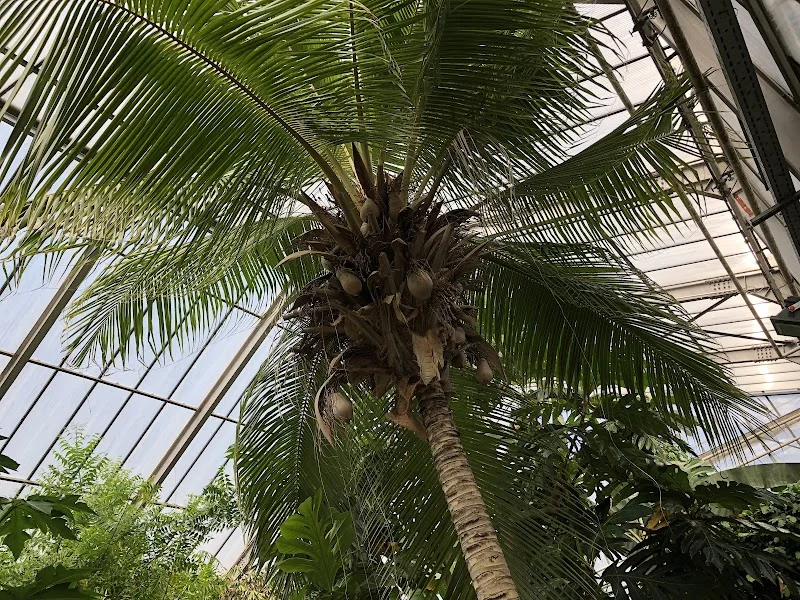
Content-wise, the Tropical Greenhouse thrives on its extraordinary plant collection. On 1,200 square meters, around 480 plant species grow, organized by usage groups: food and enjoyment plants, spice, medicinal, dye, energy, aromatic, and fiber plants. The house is divided into several climatic zones, including an orangery, field crops, coffee house, palm house, and cocoa house. This classification makes the visit illustrative, as different climate and usage conditions become directly experienceable. The university emphasizes that the selection and cultivation of plants are carried out according to the principles of agricultural and horticultural practice in warm climates. Thus, the greenhouse becomes a living classroom for tropical agriculture, biodiversity, and the interconnections between plants, climate, and usage. ([uni-kassel.de](https://www.uni-kassel.de/fb11agrar/index.php?eID=dumpFile&f=1395&t=f&token=a9d52dac98e56a11930f7625563401fab6ef10f7))
The role of research and sustainable management is also well documented. Since 1990, biological plant protection has been used, which underscores the house's focus on ecological agriculture. The official site also describes that the plant collection not only attracts visitors but also supports students in their learning and serves as an interface between science and the public. Annually, around 12,000 to 15,000 people visit the house, and regular thematic tours, special exhibitions, and plant markets are offered. The greenhouse is thus not a static museum object but an active learning and meeting space where education, research, and public communication intertwine. ([uni-kassel.de](https://www.uni-kassel.de/fb11agrar/gewaechshaus-fuer-tropische-nutzpflanzen/einblicke-1/tropengewaechshaus.html))
Anyone wanting to get an impression before the visit will find not only image material on the website but also a 360° panoramic view. This is particularly helpful for the search intent for photos, impressions, and atmosphere, as the Tropical Greenhouse becomes experienceable in advance. At the same time, the website refers to media, teaching materials, and various participation offers. These include internships, a voluntary ecological year, and the opportunity to obtain a specialized tour guide certificate. This mixture of visitor experience, educational place, and training practice explains why the Tropical Greenhouse in Witzenhausen is so well received by both families and professionals and why it has a fixed place among the special excursion destinations in Northern Hesse. ([uni-kassel.de](https://www.uni-kassel.de/fb11agrar/gewaechshaus-fuer-tropische-nutzpflanzen/einblicke-1/tropengewaechshaus.html))
Sources:
Show moreShow less
Tropical Greenhouse Witzenhausen | Opening Hours & Directions
The Tropical Greenhouse in Witzenhausen is much more than a beautiful glass building with exotic plants. It is a historically grown learning place of the University of Kassel, where tropical and subtropical crops, sustainability, biological research, and public education come together. Those who come here experience not just a display facility, but a place where scientific work, illustrative communication, and the allure of unusual plant species are closely intertwined. This mixture has made the house a destination for families, school classes, students, plant enthusiasts, and people looking for a special outing in Northern Hesse for many years. The official website describes the greenhouse as unique in Germany; it also features a picture carousel and a 360° panoramic view that already provide a good impression of the atmosphere and layout. ([uni-kassel.de](https://www.uni-kassel.de/fb11agrar/gewaechshaus-fuer-tropische-nutzpflanzen/einblicke-1/tropengewaechshaus.html))
Particularly striking is the focus on crops. Not ornamental plants are in the spotlight, but species that play a role in people's everyday lives: food, spices, medicinal plants, fiber plants, aromatic plants, dye plants, and energy plants. This makes the Tropical Greenhouse a perfect match for inquiries about opening hours, events, directions, photos, and tours, as these practical topics are crucial for a visit. At the same time, it is about more than just information: The house shows how plants from tropical and subtropical regions are part of global food and economic systems and how a collection shaped by colonialism has become a modern place for teaching and research. Therefore, anyone wanting to understand the Tropical Greenhouse should not only look at the opening hours but also at the history, the collection, and the educational offerings. ([uni-kassel.de](https://www.uni-kassel.de/fb11agrar/gewaechshaus-fuer-tropische-nutzpflanzen/einblicke-1/tropengewaechshaus.html))
Opening Hours, Admission, and Public Tours
The visitor information is clear and pleasantly uncomplicated: The Tropical Greenhouse is open all year round on Wednesdays, Fridays, Saturdays, Sundays, and on public holidays from 2 PM to 4 PM. Admission is free, making spontaneous visits particularly attractive and also interesting for short trips or a detour during a city visit to Witzenhausen. Additionally, the University of Kassel offers a one-hour public tour every Saturday at 2 PM titled “Once to the Equator and back.” For this tour, a fee of €5.00 per person and €3.00 per child applies; no prior registration is necessary. This makes the greenhouse suitable for both spontaneous visits and guests who specifically want to come with a tour. ([uni-kassel.de](https://www.uni-kassel.de/fb11agrar/fachgebiete-einrichtungen/gewaechshaus-fuer-tropische-nutzpflanzen/startseite.html))
It is also very practical that there is a teaching and learning garden next to the Tropical Greenhouse. This is also open from May to September on Wednesdays, Fridays, Saturdays, Sundays, and on public holidays from 2 PM to 4 PM, also with free admission. Every Saturday at 3:30 PM, the public tour “Queerbeet through the vegetable rows” is offered there. According to the official recommendation, those wishing to visit both places should plan about 30 minutes of break between the tours. The same pricing rules apply for groups in the Tropical Greenhouse and the teaching and learning garden; timely registration and appointment coordination are required. This is particularly relevant for school classes, clubs, and family groups who wish to plan their visit and seek reliable framework conditions. ([uni-kassel.de](https://www.uni-kassel.de/fb11agrar/fachgebiete-einrichtungen/gewaechshaus-fuer-tropische-nutzpflanzen/startseite.html))
Directions, Train Station, and Parking
The official address is Steinstraße 19 in 37213 Witzenhausen. For travel by train, the University of Kassel names the train stations Kassel-Wilhelmshöhe or Göttingen as the nearest long-distance connections. From there, it continues with regional transport to Witzenhausen-Nord; from this station, the walk to Steinstraße takes about 20 minutes. Several bus connections are also mentioned, including the stops Brückenstraße, Markt, and Wickfeldtstraße, which are only a few minutes' walk away depending on the direction. This is a great advantage for visitors without a car, as the Tropical Greenhouse remains well accessible by public transport and can be integrated into a city walk. ([uni-kassel.de](https://www.uni-kassel.de/fb11agrar/fachgebiete-einrichtungen/gewaechshaus-fuer-tropische-nutzpflanzen/kontakt.html))
By car, the directions are also clearly described. From the north, you drive on the A7 to the Dreieck Drammetal, switch to the A38 there, take the Friedland exit, and then follow the B27 and B80 to Witzenhausen. From the south and west, the route leads over the A7 to the Hann. Münden - Werratal exit and then via the B80. It is important to note that the traffic routing has changed in 2024, and access is now via Südbahnhofstraße or Wickfeldtstraße. There are public parking spaces in the immediate vicinity, and a few parking spaces are located directly in front of the Tropical Greenhouse if you enter “An der Fährgasse” in the navigation device. This information is very helpful, especially for visitors with strollers, for group materials, or for spontaneous detours. ([uni-kassel.de](https://www.uni-kassel.de/fb11agrar/fachgebiete-einrichtungen/gewaechshaus-fuer-tropische-nutzpflanzen/kontakt.html))
Tours, Group Offers, and Events
The Tropical Greenhouse thrives not only on its plants but also on its educational program. The official website presents group tours, educational offerings for school classes and confirmation groups, as well as various thematic formats. Groups can visit the greenhouse daily as part of a tour if registered in advance. The same organizational rules apply for the teaching and learning garden. Additionally, the offerings directory shows numerous modules, for example, for kindergarten groups, teenagers aged 12 and older, or higher school grades. Topics such as cocoa, global trade, medicinal plants, nutrition, or plant diversity in everyday life make it clear that the Tropical Greenhouse is not only about botany but also about sustainability, fairness, global connections, and practical education. ([uni-kassel.de](https://www.uni-kassel.de/fb11agrar/fachgebiete-einrichtungen/gewaechshaus-fuer-tropische-nutzpflanzen/startseite.html))
The event calendar is also an important part of the profile. The official homepage refers to an annual program and names several dates, such as workshops, lectures, and training sessions. Additionally, current announcements from the University of Kassel regularly feature events at the location itself, such as the plant market around the Tropical Greenhouse, a storytelling café, or thematic tours related to food, spices, and cultural plants. This makes the location not only a destination for quiet visits to the greenhouse but also a lively meeting place for events with educational and recreational value. So, anyone searching for events, programs, or tours at the Tropical Greenhouse Witzenhausen will find a continuously maintained offering that positions the place as an active event venue beyond just a display facility. ([uni-kassel.de](https://www.uni-kassel.de/fb11agrar/fachgebiete-einrichtungen/gewaechshaus-fuer-tropische-nutzpflanzen/startseite.html))
History, Ownership, and Structural Development
The history of the Tropical Greenhouse is closely linked to the history of the former monastery complex on Steinstraße and agricultural education in Witzenhausen. At the end of the 19th century, the German Colonial School for Agriculture, Trade, and Industry was established there. The first greenhouse for tropical crops was built in 1902, just four years after the founding of the Colonial School. The origin of the house is thus deeply rooted in the educational history of the site. The plants were then established, among other things, through donations from botanical gardens and colonial contexts. At the same time, the current official historical presentation makes it very clear that this origin is critically reflected upon and is part of the self-understanding of the place. ([uni-kassel.de](https://www.uni-kassel.de/fb11agrar/fachgebiete-einrichtungen/gewaechshaus-fuer-tropische-nutzpflanzen/einblicke/das-haus/geschichte.html))
In 1937, a larger greenhouse with about 640 square meters of floor space was built on the same site. World War II left significant marks: In 1945, glass panes were destroyed by shells, and in the winter of 1945/46, a large part of the plants froze. In 1957, the Teaching Institute for Tropical and Subtropical Agriculture was founded under the auspices of the German Institute for Tropical and Subtropical Agriculture, and in 1964, the decision was made for a new six-semester engineering degree program. For this, a new greenhouse was built on the opposite side of the site on Fährgasse; the current facility was built in 1965 and rented for teaching purposes in 1966. Since 1971, the University of Kassel has been the tenant of the house, which is assigned to the Department of Ecological Plant Production and Agricultural Ecosystem Research in the Tropics and Subtropics. The construction and usage history thus shows an unusual path from the colonial collection to a scientifically shaped educational institution. ([uni-kassel.de](https://www.uni-kassel.de/fb11agrar/fachgebiete-einrichtungen/gewaechshaus-fuer-tropische-nutzpflanzen/einblicke/das-haus/geschichte.html))
Plant Collection, Research, and Sustainable Learning
Content-wise, the Tropical Greenhouse thrives on its extraordinary plant collection. On 1,200 square meters, around 480 plant species grow, organized by usage groups: food and enjoyment plants, spice, medicinal, dye, energy, aromatic, and fiber plants. The house is divided into several climatic zones, including an orangery, field crops, coffee house, palm house, and cocoa house. This classification makes the visit illustrative, as different climate and usage conditions become directly experienceable. The university emphasizes that the selection and cultivation of plants are carried out according to the principles of agricultural and horticultural practice in warm climates. Thus, the greenhouse becomes a living classroom for tropical agriculture, biodiversity, and the interconnections between plants, climate, and usage. ([uni-kassel.de](https://www.uni-kassel.de/fb11agrar/index.php?eID=dumpFile&f=1395&t=f&token=a9d52dac98e56a11930f7625563401fab6ef10f7))
The role of research and sustainable management is also well documented. Since 1990, biological plant protection has been used, which underscores the house's focus on ecological agriculture. The official site also describes that the plant collection not only attracts visitors but also supports students in their learning and serves as an interface between science and the public. Annually, around 12,000 to 15,000 people visit the house, and regular thematic tours, special exhibitions, and plant markets are offered. The greenhouse is thus not a static museum object but an active learning and meeting space where education, research, and public communication intertwine. ([uni-kassel.de](https://www.uni-kassel.de/fb11agrar/gewaechshaus-fuer-tropische-nutzpflanzen/einblicke-1/tropengewaechshaus.html))
Anyone wanting to get an impression before the visit will find not only image material on the website but also a 360° panoramic view. This is particularly helpful for the search intent for photos, impressions, and atmosphere, as the Tropical Greenhouse becomes experienceable in advance. At the same time, the website refers to media, teaching materials, and various participation offers. These include internships, a voluntary ecological year, and the opportunity to obtain a specialized tour guide certificate. This mixture of visitor experience, educational place, and training practice explains why the Tropical Greenhouse in Witzenhausen is so well received by both families and professionals and why it has a fixed place among the special excursion destinations in Northern Hesse. ([uni-kassel.de](https://www.uni-kassel.de/fb11agrar/gewaechshaus-fuer-tropische-nutzpflanzen/einblicke-1/tropengewaechshaus.html))
Sources:
Tropical Greenhouse Witzenhausen | Opening Hours & Directions
The Tropical Greenhouse in Witzenhausen is much more than a beautiful glass building with exotic plants. It is a historically grown learning place of the University of Kassel, where tropical and subtropical crops, sustainability, biological research, and public education come together. Those who come here experience not just a display facility, but a place where scientific work, illustrative communication, and the allure of unusual plant species are closely intertwined. This mixture has made the house a destination for families, school classes, students, plant enthusiasts, and people looking for a special outing in Northern Hesse for many years. The official website describes the greenhouse as unique in Germany; it also features a picture carousel and a 360° panoramic view that already provide a good impression of the atmosphere and layout. ([uni-kassel.de](https://www.uni-kassel.de/fb11agrar/gewaechshaus-fuer-tropische-nutzpflanzen/einblicke-1/tropengewaechshaus.html))
Particularly striking is the focus on crops. Not ornamental plants are in the spotlight, but species that play a role in people's everyday lives: food, spices, medicinal plants, fiber plants, aromatic plants, dye plants, and energy plants. This makes the Tropical Greenhouse a perfect match for inquiries about opening hours, events, directions, photos, and tours, as these practical topics are crucial for a visit. At the same time, it is about more than just information: The house shows how plants from tropical and subtropical regions are part of global food and economic systems and how a collection shaped by colonialism has become a modern place for teaching and research. Therefore, anyone wanting to understand the Tropical Greenhouse should not only look at the opening hours but also at the history, the collection, and the educational offerings. ([uni-kassel.de](https://www.uni-kassel.de/fb11agrar/gewaechshaus-fuer-tropische-nutzpflanzen/einblicke-1/tropengewaechshaus.html))
Opening Hours, Admission, and Public Tours
The visitor information is clear and pleasantly uncomplicated: The Tropical Greenhouse is open all year round on Wednesdays, Fridays, Saturdays, Sundays, and on public holidays from 2 PM to 4 PM. Admission is free, making spontaneous visits particularly attractive and also interesting for short trips or a detour during a city visit to Witzenhausen. Additionally, the University of Kassel offers a one-hour public tour every Saturday at 2 PM titled “Once to the Equator and back.” For this tour, a fee of €5.00 per person and €3.00 per child applies; no prior registration is necessary. This makes the greenhouse suitable for both spontaneous visits and guests who specifically want to come with a tour. ([uni-kassel.de](https://www.uni-kassel.de/fb11agrar/fachgebiete-einrichtungen/gewaechshaus-fuer-tropische-nutzpflanzen/startseite.html))
It is also very practical that there is a teaching and learning garden next to the Tropical Greenhouse. This is also open from May to September on Wednesdays, Fridays, Saturdays, Sundays, and on public holidays from 2 PM to 4 PM, also with free admission. Every Saturday at 3:30 PM, the public tour “Queerbeet through the vegetable rows” is offered there. According to the official recommendation, those wishing to visit both places should plan about 30 minutes of break between the tours. The same pricing rules apply for groups in the Tropical Greenhouse and the teaching and learning garden; timely registration and appointment coordination are required. This is particularly relevant for school classes, clubs, and family groups who wish to plan their visit and seek reliable framework conditions. ([uni-kassel.de](https://www.uni-kassel.de/fb11agrar/fachgebiete-einrichtungen/gewaechshaus-fuer-tropische-nutzpflanzen/startseite.html))
Directions, Train Station, and Parking
The official address is Steinstraße 19 in 37213 Witzenhausen. For travel by train, the University of Kassel names the train stations Kassel-Wilhelmshöhe or Göttingen as the nearest long-distance connections. From there, it continues with regional transport to Witzenhausen-Nord; from this station, the walk to Steinstraße takes about 20 minutes. Several bus connections are also mentioned, including the stops Brückenstraße, Markt, and Wickfeldtstraße, which are only a few minutes' walk away depending on the direction. This is a great advantage for visitors without a car, as the Tropical Greenhouse remains well accessible by public transport and can be integrated into a city walk. ([uni-kassel.de](https://www.uni-kassel.de/fb11agrar/fachgebiete-einrichtungen/gewaechshaus-fuer-tropische-nutzpflanzen/kontakt.html))
By car, the directions are also clearly described. From the north, you drive on the A7 to the Dreieck Drammetal, switch to the A38 there, take the Friedland exit, and then follow the B27 and B80 to Witzenhausen. From the south and west, the route leads over the A7 to the Hann. Münden - Werratal exit and then via the B80. It is important to note that the traffic routing has changed in 2024, and access is now via Südbahnhofstraße or Wickfeldtstraße. There are public parking spaces in the immediate vicinity, and a few parking spaces are located directly in front of the Tropical Greenhouse if you enter “An der Fährgasse” in the navigation device. This information is very helpful, especially for visitors with strollers, for group materials, or for spontaneous detours. ([uni-kassel.de](https://www.uni-kassel.de/fb11agrar/fachgebiete-einrichtungen/gewaechshaus-fuer-tropische-nutzpflanzen/kontakt.html))
Tours, Group Offers, and Events
The Tropical Greenhouse thrives not only on its plants but also on its educational program. The official website presents group tours, educational offerings for school classes and confirmation groups, as well as various thematic formats. Groups can visit the greenhouse daily as part of a tour if registered in advance. The same organizational rules apply for the teaching and learning garden. Additionally, the offerings directory shows numerous modules, for example, for kindergarten groups, teenagers aged 12 and older, or higher school grades. Topics such as cocoa, global trade, medicinal plants, nutrition, or plant diversity in everyday life make it clear that the Tropical Greenhouse is not only about botany but also about sustainability, fairness, global connections, and practical education. ([uni-kassel.de](https://www.uni-kassel.de/fb11agrar/fachgebiete-einrichtungen/gewaechshaus-fuer-tropische-nutzpflanzen/startseite.html))
The event calendar is also an important part of the profile. The official homepage refers to an annual program and names several dates, such as workshops, lectures, and training sessions. Additionally, current announcements from the University of Kassel regularly feature events at the location itself, such as the plant market around the Tropical Greenhouse, a storytelling café, or thematic tours related to food, spices, and cultural plants. This makes the location not only a destination for quiet visits to the greenhouse but also a lively meeting place for events with educational and recreational value. So, anyone searching for events, programs, or tours at the Tropical Greenhouse Witzenhausen will find a continuously maintained offering that positions the place as an active event venue beyond just a display facility. ([uni-kassel.de](https://www.uni-kassel.de/fb11agrar/fachgebiete-einrichtungen/gewaechshaus-fuer-tropische-nutzpflanzen/startseite.html))
History, Ownership, and Structural Development
The history of the Tropical Greenhouse is closely linked to the history of the former monastery complex on Steinstraße and agricultural education in Witzenhausen. At the end of the 19th century, the German Colonial School for Agriculture, Trade, and Industry was established there. The first greenhouse for tropical crops was built in 1902, just four years after the founding of the Colonial School. The origin of the house is thus deeply rooted in the educational history of the site. The plants were then established, among other things, through donations from botanical gardens and colonial contexts. At the same time, the current official historical presentation makes it very clear that this origin is critically reflected upon and is part of the self-understanding of the place. ([uni-kassel.de](https://www.uni-kassel.de/fb11agrar/fachgebiete-einrichtungen/gewaechshaus-fuer-tropische-nutzpflanzen/einblicke/das-haus/geschichte.html))
In 1937, a larger greenhouse with about 640 square meters of floor space was built on the same site. World War II left significant marks: In 1945, glass panes were destroyed by shells, and in the winter of 1945/46, a large part of the plants froze. In 1957, the Teaching Institute for Tropical and Subtropical Agriculture was founded under the auspices of the German Institute for Tropical and Subtropical Agriculture, and in 1964, the decision was made for a new six-semester engineering degree program. For this, a new greenhouse was built on the opposite side of the site on Fährgasse; the current facility was built in 1965 and rented for teaching purposes in 1966. Since 1971, the University of Kassel has been the tenant of the house, which is assigned to the Department of Ecological Plant Production and Agricultural Ecosystem Research in the Tropics and Subtropics. The construction and usage history thus shows an unusual path from the colonial collection to a scientifically shaped educational institution. ([uni-kassel.de](https://www.uni-kassel.de/fb11agrar/fachgebiete-einrichtungen/gewaechshaus-fuer-tropische-nutzpflanzen/einblicke/das-haus/geschichte.html))
Plant Collection, Research, and Sustainable Learning
Content-wise, the Tropical Greenhouse thrives on its extraordinary plant collection. On 1,200 square meters, around 480 plant species grow, organized by usage groups: food and enjoyment plants, spice, medicinal, dye, energy, aromatic, and fiber plants. The house is divided into several climatic zones, including an orangery, field crops, coffee house, palm house, and cocoa house. This classification makes the visit illustrative, as different climate and usage conditions become directly experienceable. The university emphasizes that the selection and cultivation of plants are carried out according to the principles of agricultural and horticultural practice in warm climates. Thus, the greenhouse becomes a living classroom for tropical agriculture, biodiversity, and the interconnections between plants, climate, and usage. ([uni-kassel.de](https://www.uni-kassel.de/fb11agrar/index.php?eID=dumpFile&f=1395&t=f&token=a9d52dac98e56a11930f7625563401fab6ef10f7))
The role of research and sustainable management is also well documented. Since 1990, biological plant protection has been used, which underscores the house's focus on ecological agriculture. The official site also describes that the plant collection not only attracts visitors but also supports students in their learning and serves as an interface between science and the public. Annually, around 12,000 to 15,000 people visit the house, and regular thematic tours, special exhibitions, and plant markets are offered. The greenhouse is thus not a static museum object but an active learning and meeting space where education, research, and public communication intertwine. ([uni-kassel.de](https://www.uni-kassel.de/fb11agrar/gewaechshaus-fuer-tropische-nutzpflanzen/einblicke-1/tropengewaechshaus.html))
Anyone wanting to get an impression before the visit will find not only image material on the website but also a 360° panoramic view. This is particularly helpful for the search intent for photos, impressions, and atmosphere, as the Tropical Greenhouse becomes experienceable in advance. At the same time, the website refers to media, teaching materials, and various participation offers. These include internships, a voluntary ecological year, and the opportunity to obtain a specialized tour guide certificate. This mixture of visitor experience, educational place, and training practice explains why the Tropical Greenhouse in Witzenhausen is so well received by both families and professionals and why it has a fixed place among the special excursion destinations in Northern Hesse. ([uni-kassel.de](https://www.uni-kassel.de/fb11agrar/gewaechshaus-fuer-tropische-nutzpflanzen/einblicke-1/tropengewaechshaus.html))
Sources:
Upcoming Events
No events found
Frequently Asked Questions
Reviews
Phuong Emily
27. October 2019
There are many different plants from around the world gathering in there. You will be amazed when seeing kind of trees from hot Africa being planted there 😊 You may consume coffee every day but will be the first time seeing how a coffee tree seeded and planted until it comes to a cup of coffee. Wanna hear about biodiversity? Come and talk with the people there. They are so helpful with many informative facts and stories to share.
Elke Tan
14. May 2019
A great place to learn about plants all over the world
Jote Mimo
20. November 2016
Great amount of tropical and subtropical plants
Tobias blog
24. June 2019
Cool
Dirk Mundt
1. May 2019
Top