
Kassel
Harleshausen, 34128 Kassel, Deutschland
Wanderparkplatz Nekropole | Directions & Artist Necropolis
The Wanderparkplatz Nekropole in Kassel-Harleshausen is much more than a practical parking spot at the edge of the forest. It is the entrance to an unusual place where nature, art, and memory are closely intertwined. Those who stop here stand at the edge of the Habichtswald, in an area shaped by former mining activities, where the paths are generally easy to walk according to tourist information. From here, the view leads towards the Artist Necropolis and Blue Lake, a place that has been one of the quieter yet culturally significant destinations in Kassel for years. The combination of a short journey, free access, and a clear hiking structure makes this point particularly interesting for visitors. The necropolis is not a classic event venue but an open art and nature experience that is explored on foot and remains memorable precisely because of its tranquility. ([visit.kassel.de](https://visit.kassel.de/poi/wanderparkplatz-nekropole-ehem-bergfreiheit))
Directions and Parking at Wanderparkplatz Nekropole
For driving directions, the city of Kassel suggests two simple options: from the city center, take Ahnatalstraße and Rasenallee to the parking lot, and from Kassel-Wilhelmshöhe, also via Rasenallee and Ahnatalstraße towards Wilhelmsthal. The official tourism entry lists the location as Wanderparkplatz Nekropole, formerly Bergfreiheit, with the address Ahnatalstraße, 34128 Kassel. This is helpful for anyone wanting to enter the starting point directly into their navigation system. Those visiting the site for the first time will quickly notice that the location is very deliberately chosen: the parking lot is situated exactly where the transition from the urban edge to the forest begins. This makes it a natural starting point for short walks as well as access to the actual art area. The free access fits the character of this place as an open, low-threshold entry into the landscape. ([kassel.de](https://www.kassel.de/buerger/kunst_und_kultur/parks_und_gaerten/wilhelmshoehe/sehenswertes/Kuenstler-Nekropole-Hauptartikel.php))
Even without a car, the Wanderparkplatz Nekropole is easily accessible. The city of Kassel recommends taking bus lines 10 or 24 from Königsplatz towards Kassel-Harleshausen to the Sonnenhang stop. From there, it is about 500 meters on foot along Ahnatalstraße to the parking lot. This short remaining distance is pleasant as it slowly prepares the transition from urban everyday life to the quieter forest zone. Therefore, those arriving by public transport can easily start their tour. This is particularly important for day visitors, as the necropolis does not rely on an elaborate arrival ritual but on a clear and quick access. The Wanderparkplatz thus fulfills exactly the function that its name promises: it is the practical, easily understandable starting point for a walk into the art landscape at Blue Lake. ([kassel.de](https://www.kassel.de/buerger/kunst_und_kultur/parks_und_gaerten/wilhelmshoehe/sehenswertes/Kuenstler-Nekropole-Hauptartikel.php))
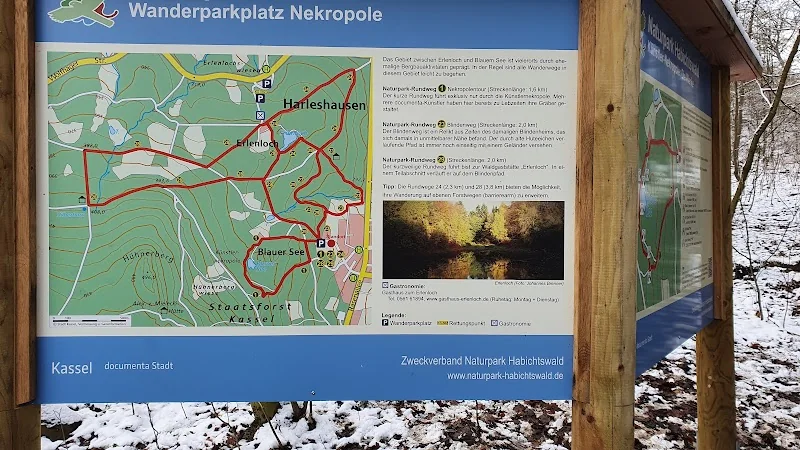
Additionally, the location is advantageous because it not only provides direct access to the Artist Necropolis but is also connected to other circular paths. The official tourism site explicitly mentions paths 23, 24, 28, and 29, as well as the Nature Park Circular Path 1, which runs through the necropolis. Thus, the parking lot is not just a destination for a single photo stop but a real hub in the hiking trail network. Those wishing to extend their route a bit can combine their visit with nearby forest sections and additional loops. This makes the place particularly attractive for guests who want to see not just a single monument in Kassel but are looking for a small tour with multiple perspectives. The location is therefore ideal for anyone who prefers a quiet, well-planned, yet content-rich tour. ([visit.kassel.de](https://visit.kassel.de/poi/wanderparkplatz-nekropole-ehem-bergfreiheit))
Artist Necropolis at Blue Lake: Location, Circular Path, and Access
The Artist Necropolis is located in the Habichtswald on the outskirts of Kassel, near the Bergpark Wilhelmshöhe. It was initiated by Harry Kramer, who taught as a professor at the Art Academy in Kassel and participated in documenta III. Around Blue Lake, a disused quarry, tombstones of artists of documenta rank have been created and continue to be created. The facility is therefore neither an ordinary cemetery nor a classic sculpture park but a place where burial, art, and landscape intertwine. The fact that the circular path is directly accessible from the parking lot shows the particular clarity of the concept: one does not drive to a closed museum but to an open path through a forest area where art remains part of the environment. This connection of geography and idea makes the necropolis in Kassel so unique. ([kassel.de](https://www.kassel.de/buerger/kunst_und_kultur/parks_und_gaerten/wilhelmshoehe/sehenswertes/Kuenstler-Nekropole-Hauptartikel.php))
The official path through the necropolis is about 1.5 kilometers long and bears the path sign 22. The city of Kassel describes it as a circular walk around Blue Lake; the EKKW publication also emphasizes the one-and-a-half-kilometer circular hiking trail with a total of nine tombs. Along the way, visitors encounter not a single sight but a succession of works and perspectives. This is important for visitors who often search for a seating plan, a route description, or images after the keyword Wanderparkplatz Nekropole Kassel: on-site orientation is easy because the route is clearly structured. At the same time, there is enough space to let the individual artistic works have an effect in peace. The path is not over-staged but understated, which fits very well with the atmosphere of the place. ([kassel.de](https://www.kassel.de/buerger/kunst_und_kultur/parks_und_gaerten/wilhelmshoehe/sehenswertes/Kuenstler-Nekropole-Hauptartikel.php))
It is particularly interesting that the entire area between Erlenloch and Blue Lake is, according to Visit Kassel, largely shaped by former mining activities. The paths are generally considered easy to walk, and the hiking area towards Erlenloch is connected by circular paths. This allows the Artist Necropolis to be well combined with a small nature walk. Those starting from the Wanderparkplatz not only encounter art but also landscape history: forest, former raw material use, and today's recreational function are closely intertwined here. This is one of the reasons why the necropolis is perceived as a special place. It does not function through size or noise but through the quiet tension between past and present. ([visit.kassel.de](https://visit.kassel.de/poi/wanderparkplatz-nekropole-ehem-bergfreiheit))
Harry Kramer, documenta, and the History of the Artist Necropolis
The history of the necropolis begins with Harry Kramer. The city of Kassel describes him as an artist, professor at the Art Academy in Kassel, and participant in documenta III. The initiative for the facility came from him, and he explicitly understood the project as a new form of art in public space. Thus, the necropolis did not arise by chance at this location but is the result of a clear idea: art should not only be exhibited but embedded in a long-term living and memory space. In 1992, Kramer founded the Artist Necropolis Foundation. The EKKW publication and the city site emphasize that the foundation originates from his private assets and is now supported by the city of Kassel. This institutional anchoring explains why the project has endured and continues to be developed to this day. ([kassel.de](https://www.kassel.de/buerger/kunst_und_kultur/parks_und_gaerten/wilhelmshoehe/sehenswertes/Kuenstler-Nekropole-Hauptartikel.php))
Remarkable is the claim that Harry Kramer associated with the project. The city of Kassel writes that around Blue Lake, artists of documenta rank erect their own tombs during their lifetimes and later have themselves buried there. A total of 40 tombs are planned. At the same time, the condition is that the forest of the nature reserve is not disturbed and the tombs remain self-contained. This results in a very special character: the necropolis should not appear elitist but open, contemplative, and consistently artistic. This attitude continues to shape the appearance to this day. The place does not invite quick representation but a quiet engagement with art, finitude, and landscape. ([kassel.de](https://www.kassel.de/buerger/kunst_und_kultur/parks_und_gaerten/wilhelmshoehe/sehenswertes/Kuenstler-Nekropole-Hauptartikel.php))
Harry Kramer's own role is also part of the story. The city of Kassel notes that he himself opted out of a tomb in the necropolis and was buried there anonymously in 1997. This gives the place a special credibility because the initiator did not put himself in the foreground. Rather, the idea remains the focus. Therefore, those using the Wanderparkplatz Nekropole as a starting point are not just following a hiking trail but a biographically and art-historically charged thought. The necropolis is thus also an example of how strongly documenta in Kassel continues to resonate not only as an exhibition but as an urban space. Visitors to the site encounter an idea that has been consistently anchored in the landscape since the 1990s. ([kassel.de](https://www.kassel.de/buerger/kunst_und_kultur/parks_und_gaerten/wilhelmshoehe/sehenswertes/Kuenstler-Nekropole-Hauptartikel.php))
Circular Path, Audio Tour, and Other Paths in the Habichtswald Nature Park
A major advantage of the Wanderparkplatz is its integration into the regional trail network. Visit Kassel mentions the Nature Park Circular Path 1, which runs directly through the facility. For this path, there is also an audio tour with further information about the artworks. This transforms the walk into an informed tour, where visitors can not only see but also understand what they have in front of them. Especially in a place like the necropolis, where many works operate in a highly symbolic and conceptual manner, this is a real added value. The combination of path, audio guide, and landscape ensures that the visit works well even without a guided tour. Those searching for audio tour artist necropolis or nature park circular path 1 will find not a theoretical but a very practical access. ([visit.kassel.de](https://visit.kassel.de/poi/wanderparkplatz-nekropole-ehem-bergfreiheit))
In addition to this main circular path, Visit Kassel points out paths 23, 24, 28, and 29. This shows that the necropolis is not isolated but embedded in a network of circular paths. For hikers, this is particularly pleasant because a short visit can easily turn into a longer walk. The area between Erlenloch and Blue Lake is, according to the official description, largely shaped by former mining activities, and the paths are generally easy to walk. This makes the area suitable for both quiet individual guests and small groups looking for a relaxed outing. The topographical and historical embedding gives the place additional depth without complicating it. ([visit.kassel.de](https://visit.kassel.de/poi/wanderparkplatz-nekropole-ehem-bergfreiheit))
The EKKW publication also emphasizes the circular path character of the visit. It mentions a one-and-a-half-kilometer circular hiking trail that passes by a total of nine tombs. This is a good orientation for anyone wanting to know how much time to plan. One can thus experience the necropolis as a short, concentrated cultural walk without much preparation. At the same time, the path is long enough to allow for multiple perspectives on the artworks and the forest. In combination with the free audio tour, this creates a visit format that is very contemporary: freely accessible, clearly marked, and yet rich in content. This is exactly why the Wanderparkplatz Nekropole is so sensible as a starting point. It makes the entry easy while still providing enough depth to stay longer. ([ekkw.de](https://www.ekkw.de/fileadmin/suchrelevant/service/bereiche/blick/spirituelle_orte_2024.pdf))
Images, Atmosphere, and the Most Important Artworks on Site
Those searching for images of the Wanderparkplatz Nekropole will find several views of the site on the official Visit Kassel page, including photos of the parking lot, the hiking signs, and a traffic sign. This is helpful because the entrance to the site may seem unremarkable at first glance, but in reality, it is very clearly readable. This mixture creates the atmosphere: no grand entrance, no spectacular stage, but a quiet transition into the forest. The images therefore primarily assist with orientation and simultaneously set the tone for the character of the place. One immediately recognizes that this is about a nature-oriented access, not a commercial excursion destination. For the search intent images of wanderparkplatz nekropole, this is particularly relevant, as the official page shows the place in its actual use and not just in an idealized external representation. ([visit.kassel.de](https://visit.kassel.de/poi/wanderparkplatz-nekropole-ehem-bergfreiheit))
The atmosphere on site is characterized by tranquility and concentration. The EKKW describes the Artist Necropolis as a city of the dead in the middle of the forest, inviting visitors to encounters with traces of artists. Particularly vivid is the description of the bench above Blue Lake: those who sit there look directly at the tomb of the artist Karl Oskar Blase, whose towering sculpture is titled Momentum. This shows how strongly the place works with sightlines. One does not simply stand in front of a work of art but in a situation where landscape, text, sculpture, and memory intertwine. This gives the walk a quiet, almost meditative quality. It is a place where one looks more slowly and lingers longer than at many other sights in Kassel. ([ekkw.de](https://www.ekkw.de/fileadmin/suchrelevant/service/bereiche/blick/spirituelle_orte_2024.pdf))
Among the most well-known realized grave and art works are the pieces by E.R. Nele, Gernot Minke, Rune Mields, Timm Ulrichs, and Fritz Schwegler. E.R. Nele's The Gang from 2022 consists of two stainless steel houses leaning towards each other on either side of the path to Blue Lake, connected by a long pipe on which a figure walks with a balancing pole. Gernot Minke's clay dome from 2021 is a walk-in sculpture with special acoustics. Rune Mields makes the prime numbers between 1 and 100 visible in La vita corre come rivo fluente. Timm Ulrichs has embedded his Upside Down Hollow Body Monument II upside down into the forest floor. Fritz Schwegler, in turn, placed a sarcophagus with its own language in the facility with EN 6355. This diversity makes it clear that the necropolis cannot be reduced to a single stylistic ideal but thrives on the variety of its positions. ([kassel.de](https://www.kassel.de/buerger/kunst_und_kultur/parks_und_gaerten/wilhelmshoehe/sehenswertes/Kuenstler-Nekropole-Hauptartikel.php))
Practical Tips for Visiting the Wanderparkplatz Nekropole
The most practical tip is simply: plan enough time for the short path. The official circular path is manageable at about 1.5 kilometers, but the effect of the place arises precisely because one does not rush through it. The path is easy to follow, access is free, and the starting point is clearly marked. Those traveling from Kassel can easily combine their visit with a walk without having to wade through complicated information in advance. The official signage, the provided address, and the indications for the circular path make orientation simple. This is why the necropolis is also suitable for spontaneous outings. For users who have little time, the Wanderparkplatz is an ideal starting point for a compact yet content-rich visit. ([visit.kassel.de](https://visit.kassel.de/poi/wanderparkplatz-nekropole-ehem-bergfreiheit))
Another advantage is the absence of fees. Visit Kassel explicitly points out that admission is free. This distinguishes the place from many cultural offerings that are tied to fixed opening hours, ticket bookings, or capacities. The necropolis is designed as an open landscape and art site and can be visited year-round. The EKKW publication confirms the year-round accessibility around Blue Lake. So, for those looking for a quiet alternative to the large Kassel attractions, this is a place that does not require reservations but only needs to be reached. This openness is also part of the artistic idea: the site should not be an exclusive cemetery but a place of reflection and free access. ([visit.kassel.de](https://visit.kassel.de/poi/wanderparkplatz-nekropole-ehem-bergfreiheit))
In practice, this means: the Wanderparkplatz Nekropole is best suited for those who appreciate a short nature and art walk, prefer to be quiet, and are interested in Kassel's documenta history. The place is not loud, not overcrowded, and not designed for an event character. This restraint is its greatest charm. Those who have searched for images, directions, parking, or the circular path will find a very clear structure and yet a lot of atmosphere on site. With the parking lot as a starting point, the circular path as a common thread, and the audio guide as additional information, the visit can be planned very straightforwardly. Thus, a simple forest parking lot becomes an entry point into one of the most exciting art locations in the city of Kassel. ([visit.kassel.de](https://visit.kassel.de/poi/wanderparkplatz-nekropole-ehem-bergfreiheit))
Sources:
Show moreShow less
Wanderparkplatz Nekropole | Directions & Artist Necropolis
The Wanderparkplatz Nekropole in Kassel-Harleshausen is much more than a practical parking spot at the edge of the forest. It is the entrance to an unusual place where nature, art, and memory are closely intertwined. Those who stop here stand at the edge of the Habichtswald, in an area shaped by former mining activities, where the paths are generally easy to walk according to tourist information. From here, the view leads towards the Artist Necropolis and Blue Lake, a place that has been one of the quieter yet culturally significant destinations in Kassel for years. The combination of a short journey, free access, and a clear hiking structure makes this point particularly interesting for visitors. The necropolis is not a classic event venue but an open art and nature experience that is explored on foot and remains memorable precisely because of its tranquility. ([visit.kassel.de](https://visit.kassel.de/poi/wanderparkplatz-nekropole-ehem-bergfreiheit))
Directions and Parking at Wanderparkplatz Nekropole
For driving directions, the city of Kassel suggests two simple options: from the city center, take Ahnatalstraße and Rasenallee to the parking lot, and from Kassel-Wilhelmshöhe, also via Rasenallee and Ahnatalstraße towards Wilhelmsthal. The official tourism entry lists the location as Wanderparkplatz Nekropole, formerly Bergfreiheit, with the address Ahnatalstraße, 34128 Kassel. This is helpful for anyone wanting to enter the starting point directly into their navigation system. Those visiting the site for the first time will quickly notice that the location is very deliberately chosen: the parking lot is situated exactly where the transition from the urban edge to the forest begins. This makes it a natural starting point for short walks as well as access to the actual art area. The free access fits the character of this place as an open, low-threshold entry into the landscape. ([kassel.de](https://www.kassel.de/buerger/kunst_und_kultur/parks_und_gaerten/wilhelmshoehe/sehenswertes/Kuenstler-Nekropole-Hauptartikel.php))
Even without a car, the Wanderparkplatz Nekropole is easily accessible. The city of Kassel recommends taking bus lines 10 or 24 from Königsplatz towards Kassel-Harleshausen to the Sonnenhang stop. From there, it is about 500 meters on foot along Ahnatalstraße to the parking lot. This short remaining distance is pleasant as it slowly prepares the transition from urban everyday life to the quieter forest zone. Therefore, those arriving by public transport can easily start their tour. This is particularly important for day visitors, as the necropolis does not rely on an elaborate arrival ritual but on a clear and quick access. The Wanderparkplatz thus fulfills exactly the function that its name promises: it is the practical, easily understandable starting point for a walk into the art landscape at Blue Lake. ([kassel.de](https://www.kassel.de/buerger/kunst_und_kultur/parks_und_gaerten/wilhelmshoehe/sehenswertes/Kuenstler-Nekropole-Hauptartikel.php))
Additionally, the location is advantageous because it not only provides direct access to the Artist Necropolis but is also connected to other circular paths. The official tourism site explicitly mentions paths 23, 24, 28, and 29, as well as the Nature Park Circular Path 1, which runs through the necropolis. Thus, the parking lot is not just a destination for a single photo stop but a real hub in the hiking trail network. Those wishing to extend their route a bit can combine their visit with nearby forest sections and additional loops. This makes the place particularly attractive for guests who want to see not just a single monument in Kassel but are looking for a small tour with multiple perspectives. The location is therefore ideal for anyone who prefers a quiet, well-planned, yet content-rich tour. ([visit.kassel.de](https://visit.kassel.de/poi/wanderparkplatz-nekropole-ehem-bergfreiheit))
Artist Necropolis at Blue Lake: Location, Circular Path, and Access
The Artist Necropolis is located in the Habichtswald on the outskirts of Kassel, near the Bergpark Wilhelmshöhe. It was initiated by Harry Kramer, who taught as a professor at the Art Academy in Kassel and participated in documenta III. Around Blue Lake, a disused quarry, tombstones of artists of documenta rank have been created and continue to be created. The facility is therefore neither an ordinary cemetery nor a classic sculpture park but a place where burial, art, and landscape intertwine. The fact that the circular path is directly accessible from the parking lot shows the particular clarity of the concept: one does not drive to a closed museum but to an open path through a forest area where art remains part of the environment. This connection of geography and idea makes the necropolis in Kassel so unique. ([kassel.de](https://www.kassel.de/buerger/kunst_und_kultur/parks_und_gaerten/wilhelmshoehe/sehenswertes/Kuenstler-Nekropole-Hauptartikel.php))
The official path through the necropolis is about 1.5 kilometers long and bears the path sign 22. The city of Kassel describes it as a circular walk around Blue Lake; the EKKW publication also emphasizes the one-and-a-half-kilometer circular hiking trail with a total of nine tombs. Along the way, visitors encounter not a single sight but a succession of works and perspectives. This is important for visitors who often search for a seating plan, a route description, or images after the keyword Wanderparkplatz Nekropole Kassel: on-site orientation is easy because the route is clearly structured. At the same time, there is enough space to let the individual artistic works have an effect in peace. The path is not over-staged but understated, which fits very well with the atmosphere of the place. ([kassel.de](https://www.kassel.de/buerger/kunst_und_kultur/parks_und_gaerten/wilhelmshoehe/sehenswertes/Kuenstler-Nekropole-Hauptartikel.php))
It is particularly interesting that the entire area between Erlenloch and Blue Lake is, according to Visit Kassel, largely shaped by former mining activities. The paths are generally considered easy to walk, and the hiking area towards Erlenloch is connected by circular paths. This allows the Artist Necropolis to be well combined with a small nature walk. Those starting from the Wanderparkplatz not only encounter art but also landscape history: forest, former raw material use, and today's recreational function are closely intertwined here. This is one of the reasons why the necropolis is perceived as a special place. It does not function through size or noise but through the quiet tension between past and present. ([visit.kassel.de](https://visit.kassel.de/poi/wanderparkplatz-nekropole-ehem-bergfreiheit))
Harry Kramer, documenta, and the History of the Artist Necropolis
The history of the necropolis begins with Harry Kramer. The city of Kassel describes him as an artist, professor at the Art Academy in Kassel, and participant in documenta III. The initiative for the facility came from him, and he explicitly understood the project as a new form of art in public space. Thus, the necropolis did not arise by chance at this location but is the result of a clear idea: art should not only be exhibited but embedded in a long-term living and memory space. In 1992, Kramer founded the Artist Necropolis Foundation. The EKKW publication and the city site emphasize that the foundation originates from his private assets and is now supported by the city of Kassel. This institutional anchoring explains why the project has endured and continues to be developed to this day. ([kassel.de](https://www.kassel.de/buerger/kunst_und_kultur/parks_und_gaerten/wilhelmshoehe/sehenswertes/Kuenstler-Nekropole-Hauptartikel.php))
Remarkable is the claim that Harry Kramer associated with the project. The city of Kassel writes that around Blue Lake, artists of documenta rank erect their own tombs during their lifetimes and later have themselves buried there. A total of 40 tombs are planned. At the same time, the condition is that the forest of the nature reserve is not disturbed and the tombs remain self-contained. This results in a very special character: the necropolis should not appear elitist but open, contemplative, and consistently artistic. This attitude continues to shape the appearance to this day. The place does not invite quick representation but a quiet engagement with art, finitude, and landscape. ([kassel.de](https://www.kassel.de/buerger/kunst_und_kultur/parks_und_gaerten/wilhelmshoehe/sehenswertes/Kuenstler-Nekropole-Hauptartikel.php))
Harry Kramer's own role is also part of the story. The city of Kassel notes that he himself opted out of a tomb in the necropolis and was buried there anonymously in 1997. This gives the place a special credibility because the initiator did not put himself in the foreground. Rather, the idea remains the focus. Therefore, those using the Wanderparkplatz Nekropole as a starting point are not just following a hiking trail but a biographically and art-historically charged thought. The necropolis is thus also an example of how strongly documenta in Kassel continues to resonate not only as an exhibition but as an urban space. Visitors to the site encounter an idea that has been consistently anchored in the landscape since the 1990s. ([kassel.de](https://www.kassel.de/buerger/kunst_und_kultur/parks_und_gaerten/wilhelmshoehe/sehenswertes/Kuenstler-Nekropole-Hauptartikel.php))
Circular Path, Audio Tour, and Other Paths in the Habichtswald Nature Park
A major advantage of the Wanderparkplatz is its integration into the regional trail network. Visit Kassel mentions the Nature Park Circular Path 1, which runs directly through the facility. For this path, there is also an audio tour with further information about the artworks. This transforms the walk into an informed tour, where visitors can not only see but also understand what they have in front of them. Especially in a place like the necropolis, where many works operate in a highly symbolic and conceptual manner, this is a real added value. The combination of path, audio guide, and landscape ensures that the visit works well even without a guided tour. Those searching for audio tour artist necropolis or nature park circular path 1 will find not a theoretical but a very practical access. ([visit.kassel.de](https://visit.kassel.de/poi/wanderparkplatz-nekropole-ehem-bergfreiheit))
In addition to this main circular path, Visit Kassel points out paths 23, 24, 28, and 29. This shows that the necropolis is not isolated but embedded in a network of circular paths. For hikers, this is particularly pleasant because a short visit can easily turn into a longer walk. The area between Erlenloch and Blue Lake is, according to the official description, largely shaped by former mining activities, and the paths are generally easy to walk. This makes the area suitable for both quiet individual guests and small groups looking for a relaxed outing. The topographical and historical embedding gives the place additional depth without complicating it. ([visit.kassel.de](https://visit.kassel.de/poi/wanderparkplatz-nekropole-ehem-bergfreiheit))
The EKKW publication also emphasizes the circular path character of the visit. It mentions a one-and-a-half-kilometer circular hiking trail that passes by a total of nine tombs. This is a good orientation for anyone wanting to know how much time to plan. One can thus experience the necropolis as a short, concentrated cultural walk without much preparation. At the same time, the path is long enough to allow for multiple perspectives on the artworks and the forest. In combination with the free audio tour, this creates a visit format that is very contemporary: freely accessible, clearly marked, and yet rich in content. This is exactly why the Wanderparkplatz Nekropole is so sensible as a starting point. It makes the entry easy while still providing enough depth to stay longer. ([ekkw.de](https://www.ekkw.de/fileadmin/suchrelevant/service/bereiche/blick/spirituelle_orte_2024.pdf))
Images, Atmosphere, and the Most Important Artworks on Site
Those searching for images of the Wanderparkplatz Nekropole will find several views of the site on the official Visit Kassel page, including photos of the parking lot, the hiking signs, and a traffic sign. This is helpful because the entrance to the site may seem unremarkable at first glance, but in reality, it is very clearly readable. This mixture creates the atmosphere: no grand entrance, no spectacular stage, but a quiet transition into the forest. The images therefore primarily assist with orientation and simultaneously set the tone for the character of the place. One immediately recognizes that this is about a nature-oriented access, not a commercial excursion destination. For the search intent images of wanderparkplatz nekropole, this is particularly relevant, as the official page shows the place in its actual use and not just in an idealized external representation. ([visit.kassel.de](https://visit.kassel.de/poi/wanderparkplatz-nekropole-ehem-bergfreiheit))
The atmosphere on site is characterized by tranquility and concentration. The EKKW describes the Artist Necropolis as a city of the dead in the middle of the forest, inviting visitors to encounters with traces of artists. Particularly vivid is the description of the bench above Blue Lake: those who sit there look directly at the tomb of the artist Karl Oskar Blase, whose towering sculpture is titled Momentum. This shows how strongly the place works with sightlines. One does not simply stand in front of a work of art but in a situation where landscape, text, sculpture, and memory intertwine. This gives the walk a quiet, almost meditative quality. It is a place where one looks more slowly and lingers longer than at many other sights in Kassel. ([ekkw.de](https://www.ekkw.de/fileadmin/suchrelevant/service/bereiche/blick/spirituelle_orte_2024.pdf))
Among the most well-known realized grave and art works are the pieces by E.R. Nele, Gernot Minke, Rune Mields, Timm Ulrichs, and Fritz Schwegler. E.R. Nele's The Gang from 2022 consists of two stainless steel houses leaning towards each other on either side of the path to Blue Lake, connected by a long pipe on which a figure walks with a balancing pole. Gernot Minke's clay dome from 2021 is a walk-in sculpture with special acoustics. Rune Mields makes the prime numbers between 1 and 100 visible in La vita corre come rivo fluente. Timm Ulrichs has embedded his Upside Down Hollow Body Monument II upside down into the forest floor. Fritz Schwegler, in turn, placed a sarcophagus with its own language in the facility with EN 6355. This diversity makes it clear that the necropolis cannot be reduced to a single stylistic ideal but thrives on the variety of its positions. ([kassel.de](https://www.kassel.de/buerger/kunst_und_kultur/parks_und_gaerten/wilhelmshoehe/sehenswertes/Kuenstler-Nekropole-Hauptartikel.php))
Practical Tips for Visiting the Wanderparkplatz Nekropole
The most practical tip is simply: plan enough time for the short path. The official circular path is manageable at about 1.5 kilometers, but the effect of the place arises precisely because one does not rush through it. The path is easy to follow, access is free, and the starting point is clearly marked. Those traveling from Kassel can easily combine their visit with a walk without having to wade through complicated information in advance. The official signage, the provided address, and the indications for the circular path make orientation simple. This is why the necropolis is also suitable for spontaneous outings. For users who have little time, the Wanderparkplatz is an ideal starting point for a compact yet content-rich visit. ([visit.kassel.de](https://visit.kassel.de/poi/wanderparkplatz-nekropole-ehem-bergfreiheit))
Another advantage is the absence of fees. Visit Kassel explicitly points out that admission is free. This distinguishes the place from many cultural offerings that are tied to fixed opening hours, ticket bookings, or capacities. The necropolis is designed as an open landscape and art site and can be visited year-round. The EKKW publication confirms the year-round accessibility around Blue Lake. So, for those looking for a quiet alternative to the large Kassel attractions, this is a place that does not require reservations but only needs to be reached. This openness is also part of the artistic idea: the site should not be an exclusive cemetery but a place of reflection and free access. ([visit.kassel.de](https://visit.kassel.de/poi/wanderparkplatz-nekropole-ehem-bergfreiheit))
In practice, this means: the Wanderparkplatz Nekropole is best suited for those who appreciate a short nature and art walk, prefer to be quiet, and are interested in Kassel's documenta history. The place is not loud, not overcrowded, and not designed for an event character. This restraint is its greatest charm. Those who have searched for images, directions, parking, or the circular path will find a very clear structure and yet a lot of atmosphere on site. With the parking lot as a starting point, the circular path as a common thread, and the audio guide as additional information, the visit can be planned very straightforwardly. Thus, a simple forest parking lot becomes an entry point into one of the most exciting art locations in the city of Kassel. ([visit.kassel.de](https://visit.kassel.de/poi/wanderparkplatz-nekropole-ehem-bergfreiheit))
Sources:
Wanderparkplatz Nekropole | Directions & Artist Necropolis
The Wanderparkplatz Nekropole in Kassel-Harleshausen is much more than a practical parking spot at the edge of the forest. It is the entrance to an unusual place where nature, art, and memory are closely intertwined. Those who stop here stand at the edge of the Habichtswald, in an area shaped by former mining activities, where the paths are generally easy to walk according to tourist information. From here, the view leads towards the Artist Necropolis and Blue Lake, a place that has been one of the quieter yet culturally significant destinations in Kassel for years. The combination of a short journey, free access, and a clear hiking structure makes this point particularly interesting for visitors. The necropolis is not a classic event venue but an open art and nature experience that is explored on foot and remains memorable precisely because of its tranquility. ([visit.kassel.de](https://visit.kassel.de/poi/wanderparkplatz-nekropole-ehem-bergfreiheit))
Directions and Parking at Wanderparkplatz Nekropole
For driving directions, the city of Kassel suggests two simple options: from the city center, take Ahnatalstraße and Rasenallee to the parking lot, and from Kassel-Wilhelmshöhe, also via Rasenallee and Ahnatalstraße towards Wilhelmsthal. The official tourism entry lists the location as Wanderparkplatz Nekropole, formerly Bergfreiheit, with the address Ahnatalstraße, 34128 Kassel. This is helpful for anyone wanting to enter the starting point directly into their navigation system. Those visiting the site for the first time will quickly notice that the location is very deliberately chosen: the parking lot is situated exactly where the transition from the urban edge to the forest begins. This makes it a natural starting point for short walks as well as access to the actual art area. The free access fits the character of this place as an open, low-threshold entry into the landscape. ([kassel.de](https://www.kassel.de/buerger/kunst_und_kultur/parks_und_gaerten/wilhelmshoehe/sehenswertes/Kuenstler-Nekropole-Hauptartikel.php))
Even without a car, the Wanderparkplatz Nekropole is easily accessible. The city of Kassel recommends taking bus lines 10 or 24 from Königsplatz towards Kassel-Harleshausen to the Sonnenhang stop. From there, it is about 500 meters on foot along Ahnatalstraße to the parking lot. This short remaining distance is pleasant as it slowly prepares the transition from urban everyday life to the quieter forest zone. Therefore, those arriving by public transport can easily start their tour. This is particularly important for day visitors, as the necropolis does not rely on an elaborate arrival ritual but on a clear and quick access. The Wanderparkplatz thus fulfills exactly the function that its name promises: it is the practical, easily understandable starting point for a walk into the art landscape at Blue Lake. ([kassel.de](https://www.kassel.de/buerger/kunst_und_kultur/parks_und_gaerten/wilhelmshoehe/sehenswertes/Kuenstler-Nekropole-Hauptartikel.php))
Additionally, the location is advantageous because it not only provides direct access to the Artist Necropolis but is also connected to other circular paths. The official tourism site explicitly mentions paths 23, 24, 28, and 29, as well as the Nature Park Circular Path 1, which runs through the necropolis. Thus, the parking lot is not just a destination for a single photo stop but a real hub in the hiking trail network. Those wishing to extend their route a bit can combine their visit with nearby forest sections and additional loops. This makes the place particularly attractive for guests who want to see not just a single monument in Kassel but are looking for a small tour with multiple perspectives. The location is therefore ideal for anyone who prefers a quiet, well-planned, yet content-rich tour. ([visit.kassel.de](https://visit.kassel.de/poi/wanderparkplatz-nekropole-ehem-bergfreiheit))
Artist Necropolis at Blue Lake: Location, Circular Path, and Access
The Artist Necropolis is located in the Habichtswald on the outskirts of Kassel, near the Bergpark Wilhelmshöhe. It was initiated by Harry Kramer, who taught as a professor at the Art Academy in Kassel and participated in documenta III. Around Blue Lake, a disused quarry, tombstones of artists of documenta rank have been created and continue to be created. The facility is therefore neither an ordinary cemetery nor a classic sculpture park but a place where burial, art, and landscape intertwine. The fact that the circular path is directly accessible from the parking lot shows the particular clarity of the concept: one does not drive to a closed museum but to an open path through a forest area where art remains part of the environment. This connection of geography and idea makes the necropolis in Kassel so unique. ([kassel.de](https://www.kassel.de/buerger/kunst_und_kultur/parks_und_gaerten/wilhelmshoehe/sehenswertes/Kuenstler-Nekropole-Hauptartikel.php))
The official path through the necropolis is about 1.5 kilometers long and bears the path sign 22. The city of Kassel describes it as a circular walk around Blue Lake; the EKKW publication also emphasizes the one-and-a-half-kilometer circular hiking trail with a total of nine tombs. Along the way, visitors encounter not a single sight but a succession of works and perspectives. This is important for visitors who often search for a seating plan, a route description, or images after the keyword Wanderparkplatz Nekropole Kassel: on-site orientation is easy because the route is clearly structured. At the same time, there is enough space to let the individual artistic works have an effect in peace. The path is not over-staged but understated, which fits very well with the atmosphere of the place. ([kassel.de](https://www.kassel.de/buerger/kunst_und_kultur/parks_und_gaerten/wilhelmshoehe/sehenswertes/Kuenstler-Nekropole-Hauptartikel.php))
It is particularly interesting that the entire area between Erlenloch and Blue Lake is, according to Visit Kassel, largely shaped by former mining activities. The paths are generally considered easy to walk, and the hiking area towards Erlenloch is connected by circular paths. This allows the Artist Necropolis to be well combined with a small nature walk. Those starting from the Wanderparkplatz not only encounter art but also landscape history: forest, former raw material use, and today's recreational function are closely intertwined here. This is one of the reasons why the necropolis is perceived as a special place. It does not function through size or noise but through the quiet tension between past and present. ([visit.kassel.de](https://visit.kassel.de/poi/wanderparkplatz-nekropole-ehem-bergfreiheit))
Harry Kramer, documenta, and the History of the Artist Necropolis
The history of the necropolis begins with Harry Kramer. The city of Kassel describes him as an artist, professor at the Art Academy in Kassel, and participant in documenta III. The initiative for the facility came from him, and he explicitly understood the project as a new form of art in public space. Thus, the necropolis did not arise by chance at this location but is the result of a clear idea: art should not only be exhibited but embedded in a long-term living and memory space. In 1992, Kramer founded the Artist Necropolis Foundation. The EKKW publication and the city site emphasize that the foundation originates from his private assets and is now supported by the city of Kassel. This institutional anchoring explains why the project has endured and continues to be developed to this day. ([kassel.de](https://www.kassel.de/buerger/kunst_und_kultur/parks_und_gaerten/wilhelmshoehe/sehenswertes/Kuenstler-Nekropole-Hauptartikel.php))
Remarkable is the claim that Harry Kramer associated with the project. The city of Kassel writes that around Blue Lake, artists of documenta rank erect their own tombs during their lifetimes and later have themselves buried there. A total of 40 tombs are planned. At the same time, the condition is that the forest of the nature reserve is not disturbed and the tombs remain self-contained. This results in a very special character: the necropolis should not appear elitist but open, contemplative, and consistently artistic. This attitude continues to shape the appearance to this day. The place does not invite quick representation but a quiet engagement with art, finitude, and landscape. ([kassel.de](https://www.kassel.de/buerger/kunst_und_kultur/parks_und_gaerten/wilhelmshoehe/sehenswertes/Kuenstler-Nekropole-Hauptartikel.php))
Harry Kramer's own role is also part of the story. The city of Kassel notes that he himself opted out of a tomb in the necropolis and was buried there anonymously in 1997. This gives the place a special credibility because the initiator did not put himself in the foreground. Rather, the idea remains the focus. Therefore, those using the Wanderparkplatz Nekropole as a starting point are not just following a hiking trail but a biographically and art-historically charged thought. The necropolis is thus also an example of how strongly documenta in Kassel continues to resonate not only as an exhibition but as an urban space. Visitors to the site encounter an idea that has been consistently anchored in the landscape since the 1990s. ([kassel.de](https://www.kassel.de/buerger/kunst_und_kultur/parks_und_gaerten/wilhelmshoehe/sehenswertes/Kuenstler-Nekropole-Hauptartikel.php))
Circular Path, Audio Tour, and Other Paths in the Habichtswald Nature Park
A major advantage of the Wanderparkplatz is its integration into the regional trail network. Visit Kassel mentions the Nature Park Circular Path 1, which runs directly through the facility. For this path, there is also an audio tour with further information about the artworks. This transforms the walk into an informed tour, where visitors can not only see but also understand what they have in front of them. Especially in a place like the necropolis, where many works operate in a highly symbolic and conceptual manner, this is a real added value. The combination of path, audio guide, and landscape ensures that the visit works well even without a guided tour. Those searching for audio tour artist necropolis or nature park circular path 1 will find not a theoretical but a very practical access. ([visit.kassel.de](https://visit.kassel.de/poi/wanderparkplatz-nekropole-ehem-bergfreiheit))
In addition to this main circular path, Visit Kassel points out paths 23, 24, 28, and 29. This shows that the necropolis is not isolated but embedded in a network of circular paths. For hikers, this is particularly pleasant because a short visit can easily turn into a longer walk. The area between Erlenloch and Blue Lake is, according to the official description, largely shaped by former mining activities, and the paths are generally easy to walk. This makes the area suitable for both quiet individual guests and small groups looking for a relaxed outing. The topographical and historical embedding gives the place additional depth without complicating it. ([visit.kassel.de](https://visit.kassel.de/poi/wanderparkplatz-nekropole-ehem-bergfreiheit))
The EKKW publication also emphasizes the circular path character of the visit. It mentions a one-and-a-half-kilometer circular hiking trail that passes by a total of nine tombs. This is a good orientation for anyone wanting to know how much time to plan. One can thus experience the necropolis as a short, concentrated cultural walk without much preparation. At the same time, the path is long enough to allow for multiple perspectives on the artworks and the forest. In combination with the free audio tour, this creates a visit format that is very contemporary: freely accessible, clearly marked, and yet rich in content. This is exactly why the Wanderparkplatz Nekropole is so sensible as a starting point. It makes the entry easy while still providing enough depth to stay longer. ([ekkw.de](https://www.ekkw.de/fileadmin/suchrelevant/service/bereiche/blick/spirituelle_orte_2024.pdf))
Images, Atmosphere, and the Most Important Artworks on Site
Those searching for images of the Wanderparkplatz Nekropole will find several views of the site on the official Visit Kassel page, including photos of the parking lot, the hiking signs, and a traffic sign. This is helpful because the entrance to the site may seem unremarkable at first glance, but in reality, it is very clearly readable. This mixture creates the atmosphere: no grand entrance, no spectacular stage, but a quiet transition into the forest. The images therefore primarily assist with orientation and simultaneously set the tone for the character of the place. One immediately recognizes that this is about a nature-oriented access, not a commercial excursion destination. For the search intent images of wanderparkplatz nekropole, this is particularly relevant, as the official page shows the place in its actual use and not just in an idealized external representation. ([visit.kassel.de](https://visit.kassel.de/poi/wanderparkplatz-nekropole-ehem-bergfreiheit))
The atmosphere on site is characterized by tranquility and concentration. The EKKW describes the Artist Necropolis as a city of the dead in the middle of the forest, inviting visitors to encounters with traces of artists. Particularly vivid is the description of the bench above Blue Lake: those who sit there look directly at the tomb of the artist Karl Oskar Blase, whose towering sculpture is titled Momentum. This shows how strongly the place works with sightlines. One does not simply stand in front of a work of art but in a situation where landscape, text, sculpture, and memory intertwine. This gives the walk a quiet, almost meditative quality. It is a place where one looks more slowly and lingers longer than at many other sights in Kassel. ([ekkw.de](https://www.ekkw.de/fileadmin/suchrelevant/service/bereiche/blick/spirituelle_orte_2024.pdf))
Among the most well-known realized grave and art works are the pieces by E.R. Nele, Gernot Minke, Rune Mields, Timm Ulrichs, and Fritz Schwegler. E.R. Nele's The Gang from 2022 consists of two stainless steel houses leaning towards each other on either side of the path to Blue Lake, connected by a long pipe on which a figure walks with a balancing pole. Gernot Minke's clay dome from 2021 is a walk-in sculpture with special acoustics. Rune Mields makes the prime numbers between 1 and 100 visible in La vita corre come rivo fluente. Timm Ulrichs has embedded his Upside Down Hollow Body Monument II upside down into the forest floor. Fritz Schwegler, in turn, placed a sarcophagus with its own language in the facility with EN 6355. This diversity makes it clear that the necropolis cannot be reduced to a single stylistic ideal but thrives on the variety of its positions. ([kassel.de](https://www.kassel.de/buerger/kunst_und_kultur/parks_und_gaerten/wilhelmshoehe/sehenswertes/Kuenstler-Nekropole-Hauptartikel.php))
Practical Tips for Visiting the Wanderparkplatz Nekropole
The most practical tip is simply: plan enough time for the short path. The official circular path is manageable at about 1.5 kilometers, but the effect of the place arises precisely because one does not rush through it. The path is easy to follow, access is free, and the starting point is clearly marked. Those traveling from Kassel can easily combine their visit with a walk without having to wade through complicated information in advance. The official signage, the provided address, and the indications for the circular path make orientation simple. This is why the necropolis is also suitable for spontaneous outings. For users who have little time, the Wanderparkplatz is an ideal starting point for a compact yet content-rich visit. ([visit.kassel.de](https://visit.kassel.de/poi/wanderparkplatz-nekropole-ehem-bergfreiheit))
Another advantage is the absence of fees. Visit Kassel explicitly points out that admission is free. This distinguishes the place from many cultural offerings that are tied to fixed opening hours, ticket bookings, or capacities. The necropolis is designed as an open landscape and art site and can be visited year-round. The EKKW publication confirms the year-round accessibility around Blue Lake. So, for those looking for a quiet alternative to the large Kassel attractions, this is a place that does not require reservations but only needs to be reached. This openness is also part of the artistic idea: the site should not be an exclusive cemetery but a place of reflection and free access. ([visit.kassel.de](https://visit.kassel.de/poi/wanderparkplatz-nekropole-ehem-bergfreiheit))
In practice, this means: the Wanderparkplatz Nekropole is best suited for those who appreciate a short nature and art walk, prefer to be quiet, and are interested in Kassel's documenta history. The place is not loud, not overcrowded, and not designed for an event character. This restraint is its greatest charm. Those who have searched for images, directions, parking, or the circular path will find a very clear structure and yet a lot of atmosphere on site. With the parking lot as a starting point, the circular path as a common thread, and the audio guide as additional information, the visit can be planned very straightforwardly. Thus, a simple forest parking lot becomes an entry point into one of the most exciting art locations in the city of Kassel. ([visit.kassel.de](https://visit.kassel.de/poi/wanderparkplatz-nekropole-ehem-bergfreiheit))
Sources:
Upcoming Events
No events found
Frequently Asked Questions
Reviews
Pamela “Pam” S
9. August 2023
If you like walking through lush green forest with a bit of art to see then this is the place for you.
wossi gouldhamsda
18. February 2026
Nice simple parking lot to check out the necropolis artworks, the Blue Lake, or just take one of the other hiking trails.
Franz Koshorst
9. June 2020
One of the many hiking parking lots in Habichtswald from which you can embark on beautiful hikes with varying demands! A special highlight is a circular hike that includes a visit to the necropolis! A place in the forest where Documenta artists can present their ideas about their resting place and later be buried!
Sebastian E
27. July 2025
Parking lot is big. One to two hours to the Blue Lake and around. Extension to Erlenloch or even further is possible. The Habichtswald is open to you :)
Conny Maus
2. August 2018
Nice parking lot with plenty of shaded spots, starting point for the circular hiking trails 1, 22.