
Sergei Sergejewitsch Prokofjew
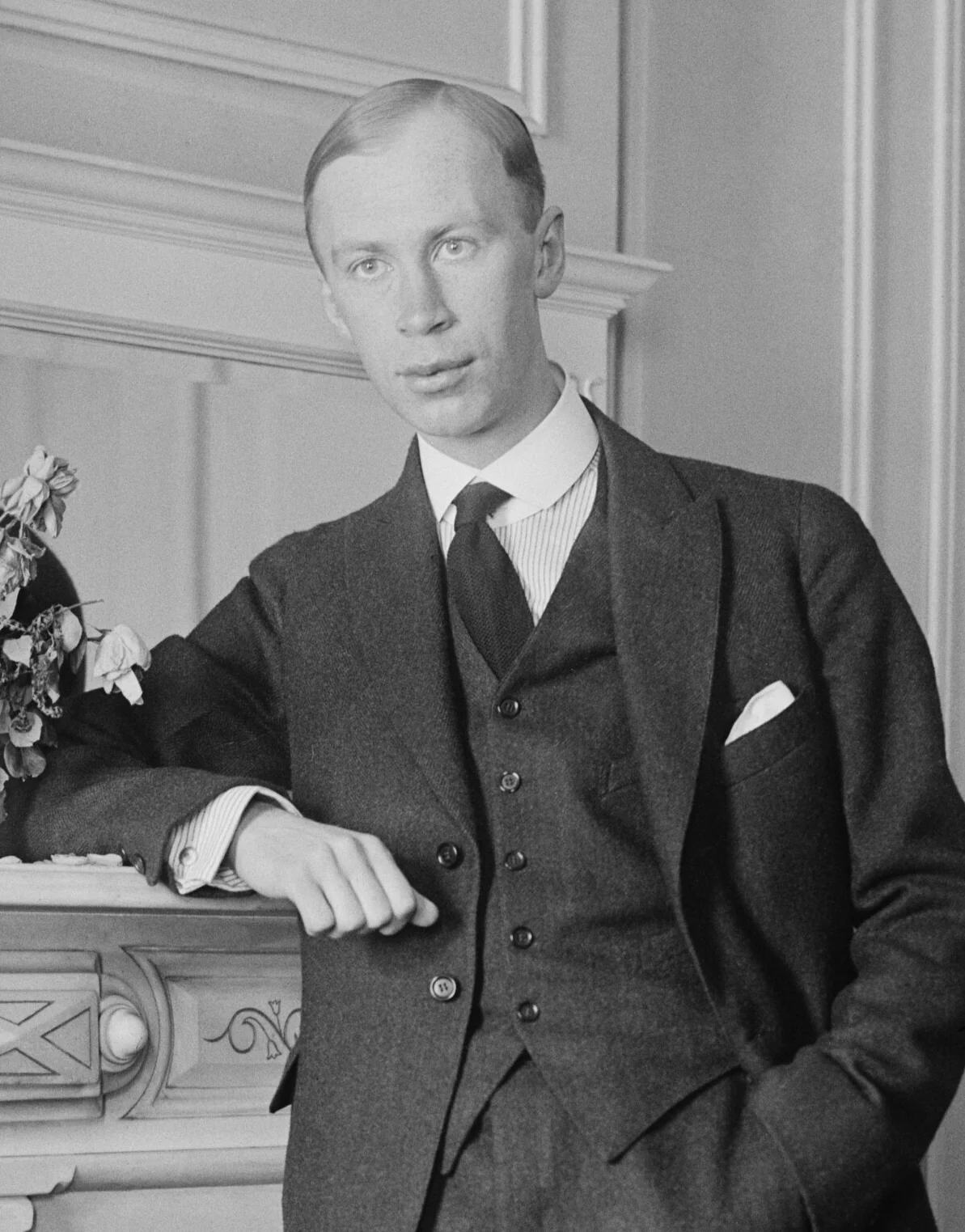
Image from Wikipedia
Image from Wikipedia
Sergei Sergeyevich Prokofiev – The Sound Revolutionary Between Modernity, Melody, and Power
A Master of Contrasts: Sergei Prokofiev and the Grand Narrative of Classical Modernity
Sergei Sergeyevich Prokofiev is considered one of the most influential composers of the 20th century. As a pianist, composer, and a key figure in Soviet music, he combined technical brilliance with bold inventiveness, creating works that continue to play a central role on concert stages, in opera houses, and within the ballet canon. His name is associated with sharp rhythms, catchy melodies, sardonic wit, and a distinctive musical language that straddles the line between avant-garde and classical form.
Born on April 23, 1891, in Sonziwka in what was then the Russian Empire, Prokofiev grew up in an environment that quickly recognized his musical talent. He began piano lessons as a child and started composing at a very young age. The child prodigy evolved into an artist of international stature, shaping the music world with a creative development that took him from the stages of Petersburg to Paris and New York, and back to Moscow.
Early Years and Education: Talent, Discipline, and the Drive for Innovation
Prokofiev’s musical career began unusually early and with remarkable determination. His first teachers quickly realized that he was not merely a virtuoso in the making but an independent musical spirit. His time at the St. Petersburg Conservatory was particularly significant in showcasing how he consistently combined academic foundations with a desire for artistic renewal. The years there, from 1904 to 1914, became a phase of rapid creative maturity.
By 1908, Prokofiev was performing publicly as a pianist, soon presenting his own works as well. Early on, he displayed a blend of formal control and provocative energy that would make him famous. His teachers and contemporaries noted that he did not just imitate modern music but developed his own sound language with increasing confidence. He was influenced not only by musical but also by literary, theatrical, and artistic currents of his time.
The Breakthrough: Virtuosity, Provocation, and Conquering the Concert Halls
Prokofiev first made a name for himself as an eccentric composer-pianist. His early public successes were closely linked to the piano, an instrument he mastered with almost athletic precision. The early piano concertos and solo works impressed with jagged harmonies, striking motoric rhythms, and a fearless virtuosity that both fascinated and polarized audiences. He was not an artist of smooth effects; he was a creator of dramatic tensions.
The combination of composition and performance was crucial to his breakthrough. Prokofiev wrote music that he himself performed with utmost conviction. This gave his art an immediate physical presence that still stands out in music history. Particularly, the first two piano concertos became signature works where technical brilliance, rhythmic sharpness, and musical independence condensed into a new pianistic language.
From Exile to a Global Career: Between America, Europe, and Return to Russia
After the revolutionary upheavals, Prokofiev left Russia and lived first in Japan, then in the USA and Europe starting in 1918. These years greatly expanded his horizons and brought him into contact with international concert and opera companies. During this phase, he created works that visibly showcased his stylistic openness and solidified his position as a modern, internationally-minded composer. Exile became not a mere footnote but a productive workshop for him.
In 1927, he made a brief return to the Soviet Union, followed by a permanent homecoming in 1933. This return marked a turning point in his biography and in the broader sense of his oeuvre: it was during this time that the compositions emerged that made Prokofiev popular worldwide. At the same time, he increasingly had to grapple with the political and aesthetic expectations of the Soviet system, which recurrently strained his artistic freedom.
Opera, Ballet, Symphony: The Great Work Between Drama and Precision
Prokofiev’s oeuvre includes operas, ballets, symphonies, concertos, piano sonatas, and film music of extraordinary variety. Early on, he proved that he worked as confidently in large forms as he did in miniature gestures. Among his most important operas are The Gambler, The Love for Three Oranges, and War and Peace, while his ballet music ranks among the most frequently performed works in the repertoire. Particularly, Romeo and Juliet has become an epitome of dramatic ballet art.
Peter and the Wolf, composed in 1936, has also attained a special status. The work combines educational ideas with orchestral color and narrative clarity in a form that has reached generations of listeners. In the symphonic realm, Prokofiev displayed a unique ability for balance: he combined classical architecture with cutting energy, allowing even in large forms a clear thematic contour to emerge. His music remains immediately accessible while simultaneously being analytically fascinating.
Style and Signature: Rhythm, Irony, Lyricism, and Sonic Boldness
Prokofiev’s musical development cannot be understood without his rhythmic inventiveness. His works are alive with precise accents, motoric impulses, and often surprising harmonies. At the same time, he possessed a striking gift for lyrical melodies that shine amidst hard contours and lend emotional depth to his pieces. It is precisely this tension between hardness and lyricism that makes his compositions unmistakable.
The ironic gesture is also central to his oeuvre. Prokofiev loved musical masks, pointed twists, and an expressiveness that generates both distance and passion. In works like The Gambler and The Love for Three Oranges, a handwriting emerges that does not shy away from the grotesque yet never tips into the arbitrary. His music remains constructed, controlled, and dramaturgically precise—even when it appears wild and eruptive.
Political Tensions and Artistic Pressure in the Soviet Union
Returning to the Soviet Union brought Prokofiev recognition but also growing pressure. In the 1930s and 1940s, he had to contend with cultural-political directives, accusations of formalism, and expectations of ideological clarity. In 1948, he was attacked by the Central Committee of the Communist Party of the Soviet Union as a "westward-infected formalist." Such conflicts overshadowed his later years and significantly shaped the perception of his work.
Nevertheless, Prokofiev remained productive until the end. He worked on War and Peace until his death on March 5, 1953, in Moscow. The fact that this monumental work was premiered only in 1957 shows how much political circumstances shaped his late phase. It is in this very ambivalence that a significant part of his historical importance lies: Prokofiev stands for artistic independence under adverse conditions.
Discography, Repertoire, and Critical Reception: A Permanent Fixture of Classical Music
Although Prokofiev did not leave a discography in the pop sense, his works are extraordinarily rich within the classical repertoire. Among the most performed and frequently recorded pieces are Peter and the Wolf, Romeo and Juliet, the Lieutenant Kijé Suite, the first two piano concertos, and the symphonies, particularly the Fifth. These works form the foundation of his international posthumous reputation and ensure a significant presence in concert halls and recording catalogs today.
Critical reception particularly emphasizes his stylistic originality. Music press, musicology, and performance practice repeatedly highlight the combination of formal rigor, expressive power, and melodic clarity. Prokofiev is regarded as a composer who has simultaneously renewed symphonic, concert, and theatrical writing. His music has influenced generations of performers and continues to shape aesthetic debates about modernity, comprehensibility, and musical radicalism.
Cultural Influence: Why Prokofiev Remains Alive Today
Prokofiev's cultural influence extends far beyond classical music. Themes from Peter and the Wolf, Romeo and Juliet, or Lieutenant Kijé have long become part of the collective sonic memory. His compositions appear in films, concert programs, ballet productions, and educational formats, thereby firmly establishing themselves in the global music landscape. It is precisely the mix of recognizability and refinement that makes his work timeless.
Even in 2026, his significance remains visible: A concert featuring Prokofiev's works such as the Second Piano Concerto, the Lieutenant Kijé Suite, and the Romeo and Juliet Suite has been announced in Moscow to celebrate his 135th birthday. Such programs demonstrate that Prokofiev is not only revered in a museum context but actively performed and newly heard. His music keeps the concert world in motion because it ideally balances virtuosity, drama, and narrative power.
Conclusion: A Composer of Global Standing Whose Energy Has Never Faded
Sergei Sergeyevich Prokofiev remains intriguing because he did not dissolve contrasts but rendered them productive. He was classical yet modern, ironic yet lyrical, hard in rhythm yet grand in song, politically challenged yet artistically unyielding. Listening to his music provides an unmistakable connection between intellectual precision and immediate impact.
It is precisely in this lasting fascination that Prokofiev composes works that electrify the concert hall, set the ballet stage in motion, and immediately reach generations of listeners. His art demands attention and rewards it with dramatic energy, sonic imagination, and historical depth. An artist like Prokofiev is experienced not just in archives—he is experienced most powerfully live.
Official Channels of Sergei Sergeyevich Prokofiev:
- Instagram: no official profile found
- Facebook: no official profile found
- YouTube: no official profile found
- Spotify: no official profile found
- TikTok: no official profile found
Sources:
- LeMO – Sergey Prokofiev, Biography
- Britannica – Sergey Prokofiev
- Wikipedia – Sergei Sergeyevich Prokofiev
- National Philharmonic Orchestra of Russia – Concert to the 135th Anniversary of Sergei Prokofiev
- Oleg Prokofiev Trust – Organization Related to Promoting Sergei Prokofiev's Work
- Klassika – Sergei Sergeyevich Prokofiev
- Klassika – Catalogue of Works by Sergei Sergeyevich Prokofiev
- Kulturgemeinschaft – Annual Program 2024/25 Featuring Prokofiev Performances
- Wikipedia: Image and Text Source